- 300 pages
- English
- ePUB (mobile friendly)
- Available on iOS & Android
eBook - ePub
About this book
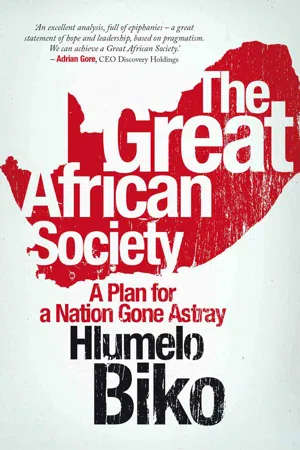
Only a dramatic, imaginatively crafted intervention - a massive redistribution programme managed by the private sector, far-reaching policy changes in schooling, housing and health, and better, disciplined governance - will deliver the genuine liberation South Africa's still-poor millions expected from the 1994 settlement. Without it, without the real promise of a free, meritocratic society, South Africa will flounder and fail as corruption, crime, social decay, hopelessness and anger engulf society. This is the compelling thesis of Hlumelo Biko's hard-hitting, thoughtful analysis of South Africa's past, present and future, a sobering assessment of where we stand today, and where we need to go. At once unnervingly candid and inspiring, The Great African Society demolishes the complacent optimism that underpins much soft thinking about South Africa's future and places at the service of public debate practical, achievable objectives for business, government and civil society. South Africa's challenge, the book argues, is to act now to avoid the mounting threat of revolt and decline that would devalue every political and economic achievement of the past decade-and-a-half and leave Nelson Mandela's feted rainbow nation staring decrepitude in the face. No debate from here on about the South African future can be taken seriously without weighing Biko's insights and his warnings. The Great African Society is vividly moral in its intentions, but sober and unsentimental in examining political and economic imperatives. It is guaranteed to make the reader sit up and take stock afresh.
Information
1. The Elusive Rainbow Nation
1
The Elusive Rainbow Nation
The rainbow nation built under the leadership of the great President Nelson Mandela is facing grave threats. Though South Africa has much to be proud of and many massive achievements to celebrate, it has failed to honestly face its socio-economic legacy, leading to a social fabric that is very thinly knit.
Yet, as most critics are told by supporters of the governing party, the ANC has successfully doubled the middle class, drastically reduced illiteracy, built over 2 million new low-income houses, created a social grant system that supports 16 million people and electrified most of the country while successfully providing fresh running water to tens of millions of South Africans. As amazing and indeed monumental as these achievements are, they don’t begin to describe the hard work that has gone into rebuilding a state bureaucracy that previously catered for less than 15 per cent of the country to one that can be responsive to the needs of close to 50 million people. Rome was certainly not built in a day – so why should South Africans not be more patient with the status quo? The answer to that question is probably better initiated by another: Why is it that after 18 years of being liberated more than half of South Africans are living in poverty?
There are no easy answers. First, there is a crucial distinction to make between a society that is unequal, and a society displaying signs of inequity. An unequal society is one in which, comparatively speaking, everyone is at varying levels of economic progression, with significant gaps between rich and poor. Inequity, however, includes the prospect that not all members of society are treated equally in their efforts to move from their current economic state towards prosperity. This nuanced difference points to the perpetuation of an injustice that holds certain citizens back while supporting the progress of others. To evolve from a society characterised by the framework of inequity towards a functional, equitable meritocracy, South Africa needs to be able to analyse its history honestly and apply the principles of restorative justice in the construction of policy for its future.
Equity for the minority: the apartheid legacy
Apartheid was a tool used by white governments to divide scarce resources amongst South Africa’s white people at the expense of the indigenous majority. This process was facilitated by a legislated ‘othering’ of blacks that sought to strip them of any rights they had to the country’s resources. The resources themselves were used to finance the incredible infrastructure citizens still enjoy, subsidising the country’s development for the benefit of a minority.
In 1994 South Africans acknowledged the fundamental flaw of this development model, and agreed that it had to be changed radically. The country went about setting the foundations of change to its socio-political structure – from an economically isolated inward-looking authoritarian state, to a globally integrated outward-looking centralised bureaucracy. Institutions were set up to help deal with the past and ensure a fairer future for all. Of all these none is more important than the national constitution.
What was neglected was a proper diagnosis of the structural problems resulting from the development model of the last 60 years, to identify what specifically about that development framework was broken and more importantly, how to fix it. In 1994 the focus of analysis was on apartheid as a perverted system of government that was put in place by Afrikaner fundamentalists blinded to reality by racism. In this narrative British imperialism’s role as an uneasy facilitator was regarded as an unfortunate confluence of agendas.
In reality, however, apartheid had been a rational mobilisation tool for white Afrikaner supremacists in order to win political power and to deliver patronage to a growing number of poor and unskilled Afrikaners struggling to attain employment. These Afrikaners saw black population growth in urban South Africa as a major hindrance to their economic advancement – swart gevaar (black danger) became the rallying cry that resonated with their constituency. They also saw a possible future marginalisation of the volk if indigenous African interests could one day be aligned with British imperial interests.
Over the course of the preceding century or so, the patient British colonial government had allowed the Afrikaner Voortrekkers to act as trailblazers in the harsh interior, while exercising their ‘right’ to annex any valuable land that might be deemed strategic because of its mineral content or geographical proximity to trading routes. This gave the British Empire a method of expanding the imperial economy without having to use significant British resources. Black people were merely pawns in a game of resource accumulation between imperialist and settler demands. Like any other game, imperialism/apartheid took on a dynamic of its own, with the players of the game moving the hapless pieces in a contest for unequally distributed opportunities and resources.
During the twentieth century, South Africa was incorporated as a country, divided amongst its new shareholders and opened for business with the rest of the world through global economic integration. Its rich resources, including former shareholders who now served as cheap labour, made it a very globally competitive economy. Its customers turned a blind eye to how it operated so long as it remained a reliable supplier and a safe investment destination. It was only in the 1970s that the ‘global shareholders’ of these international customers started making uncomfortable noises about their trading partner. The tens of thousands who died under apartheid over the years served to turn global sentiment against the government while weakening the resolve of the Afrikaner electorate.
To be sure, the work of the liberation movement gradually made apartheid as a policy impossible to implement. The growing support for a sanctions campaign and more tellingly the increasing reluctance of the international banking community to roll over the South African sovereign debt were testimony to the relentless work of the African National Congress (ANC) and internal activists in highlighting the plight of black South Africans. Global discomfort with the apartheid government’s modus operandi ultimately contributed significantly to the undoing of the apartheid regime.
To assign such a passive role to black people in this story will anger many of South Africa’s struggle veterans, who would have an amplified view of their role as political agents for change. There is no doubt that were it not for their role, South Africa would not yet be a free society. But I firmly believe that viewing history through the lens of rational resource accumulation, with its skewed allocation to white people as a motive and apartheid as a modus operandi, offers a more useful perspective.
The perspective of resource accumulation enables an analysis of South Africa’s historical socio-economic development process and the structural impacts that have proven difficult to tackle in the post-apartheid era. To date the focus has been on a diagnosis of the racial symptoms of apartheid, resulting in a weak prescription of a Truth and Reconciliation Commission with a narrow mandate focused on racist-motivated crimes against humanity, and prescribing a cocktail of Black Economic Empowerment and affirmative procurement as a remedy for South Africa’s economic ills. If the desired outcome behind BEE as a policy was broad-based economic empowerment of previously disadvantaged South Africans, then so far it has failed. To reverse the de-industrialisation currently taking place in South Africa while attempting to address the many sources of inequity within the society requires a powerful social re-engineering mechanism.
Social re-engineering for the future
The key difficulty South Africans face with addressing inequality arises from a lack of shared understanding of what liberation from apartheid was supposed to achieve. The middle and upper classes (black and white) view liberty as a combination of freedom of expression, freedom of movement, universal suffrage and the constitutional protection of their property rights. Under this definition, liberty has been achieved; they are part of a small cohort of liberated South Africans. For the centrists in the ANC, liberation meant the end of white minority political rule in South Africa. They subscribed to Kwame Nkrumah’s maxim that liberation movements should ‘seek first the political kingdom and the rest will follow’. They too view South Africans as a liberated people. The left wing of the ANC – namely the Alliance partners of Cosatu and the SACP – share Chris Hani’s view that ‘liberation should free the poor from hunger and landlessness’.1 By this definition 1994 represented a first step in a long process of liberating South Africa.
Apartheid was a massive social engineering project that lasted (in its official form) nearly 60 years. What we need now is a similarly ambitious social re-engineering project, if pitfalls of the current path are to be corrected and new ones avoided. The reality is that the country has massive assets – a combination of public infrastructure, mineral wealth, agricultural heritage, natural beauty and human capital – which were sold off to the private sector after being unlawfully accumulated at close to no cost by the state (most South African land was taken from blacks using the ‘terra nullius’ principle, meaning that the territory had never been subject to the sovereignty of any state). What is now South Africa Inc, with its trillions of rands in wealth, needs to proceed with a massive redistribution programme, or else risk a rapid and unprecedented devaluation of its assets.
The process of devaluation has already begun, driven by a new value system that has captured South Africans as a result of a growing realisation that the post-apartheid system is not fair. This value system has supplanted 1994’s idealism, manifesting itself in new police officers who view their badge and gun as apparatus with which to extort favours from the very people they are supposed to serve, in the new ‘business mechanic’ who bribes officials to win a tender, and in the teacher who makes his students perform sexual favours in exchange for good grades. Equally disturbing is the increase in institutionalised corruption of state-owned enterprises as ANC party ‘deployees’ adjust to a free-for-all environment.
The only way to stop this runaway force is to convince everyone that the system can be made fair and that the rule of law (which must be focused on the egalitarian socio-economic undertakings encapsulated in the Bill of Rights) can offer them legal opportunities for self-improvement – in other words, that they too will be given an opportunity to join the ranks of truly liberated South Africans. Such an environment would allow them the means through which to acquire skills to pursue careers in their chosen trades and be fairly compensated for an honest day’s work while living dignified lives.
The test of whether a society is successful has to be when ordinary citizens are capable of success through hard work alone and not through extraordinary gifts. So far post-liberation South Africa has consistently failed this test. It has tended complacently to measure its success on the basis of the achievements of exceptional black people. This illusion of fairness flies in the face of evidence that South Africa is one of the world’s least fair and most unequal societies. People who know that apartheid has robbed them of an opportunity to excel in life cannot be expected to wait another 50 years for the governing party to build a better life for all. They have lost patience. The increasingly common xenophobia attacks, the almost monthly service delivery strikes, the growing numbers of so-called wildcat strikes in the mining industry, the millions of instances of crime committed against all citizens, and the rampant corruption which prevents many government departments from successfully executing their mandates are leading indicators of societal decay.
The failure of Black Economic Empowerment to be a significant catalyst for broad-based poverty eradication calls for a moment of pause and reflection about South Africa’s societal outlook on redistributive economics. What is it that led most citizens to think that selling shares in white-owned companies at small discounts to well-connected black businessmen (and I use this term in its loosest sense) would translate to sustainable wealth creation amongst a broad class of black people? Whether one believes it was the influence on policy makers of the discredited theory of trickle-down economics, a corrupt need driven by the new black elite with the support of big business to create a patronage network, or the result of a severe disconnect with poor South Africans, the damage is done.
According to South Africa’s most popular BEE ratings agency, Empowerdex, black South Africans own 1.6 per cent (R81 billion) of the JSE’s value, which stands at R5.2 trillion. This amount is the unencumbered portion of the shares. When you add the portion still encumbered the percentage rises to a total of 5.75 per cent. All the different BEE codes are aimed at a percentage of between 10 and 25 per cent, depending on the industry. The fundamental flaw in the empowerment legislation is that the so-called transfer of wealth comes with a transfer of liabilities to people with underlying assets (the shares that they are sold as part of the BEE deal) that they don’t control and with dividend streams that are earmarked for debt repayment usually structured over five to ten years. There are few multiplier effects that come from such a policy. The ‘empowered companies’ often don’t change their corporate behaviour. These new shareholders are usually preoccupied with the reality of having to find cash for working capital and therefore as BEE ‘investors’ are often unable to add any real value to their investee companies. There is little indication that BEE has any job-creating effects. What South Africa needs to do is to press the reset button on redistribution and find alternative channels to achieve more sustainable results that have greater multiplier effects.
The country needs to give all firms that have already agreed (through industry empowerment charters) to participate in the current BEE policy an alternative avenue for redressing the wrongs of the past. This alternative set of channels needs to be underpinned by a desire to create a society that is genuinely owned by its citizens. Such a society needs to provide a trampoline for the majority of its citizens to jump on so that they can get to level ground before putting in place a social safety net. To successfully achieve this some home truths need to be accepted by the key players.
Central to a national turnaround strategy:
• South Africa’s corporate sector needs to realise that what Archbishop Desmond Tutu refers to as the ‘powder keg of South African poverty’ threatens to blow up in their faces and drastically devalue their aggregate assets. They need to fast-track the money spent on redistribution, incorporating this type of corporate spending into the long-term incentive structure, so that executives’ performance on empowerment can be incorporated as part of the creation of shareholder value. Without this, the mining industry will be the first of many to experience the erosion of long-term shareholder value as a result of a failure to correctly share the economic upside with the broader communities within which firms operate.
• Unions need to recognise that they have performed dismally by the index of job creation. They have to take responsibility for their role in creating the jobless growth model that the country current...
Table of contents
- Cover
- Description
- Title Page
- Dedication
- Preface
- 1. The Elusive Rainbow Nation
- 2. The Making of South Africa
- 3. A Pre-owned Society
- 4. The Great Fraud
- 5. After 1994 – Unintended Consequences of the Settlement
- 6. An Imperfect Democracy
- 7. Are We Capitalists or Communists?
- 8. Economic Freedom and the Comrades Marathon
- 9. The Original Sin
- 10. Societies in Peril
- 11. A More Civil Society
- 12. Towards a Great Society
- Copyright Page
Trusted by 375,005 students
Access to over 1.5 million titles for a fair monthly price.
Study more efficiently using our study tools.
Frequently asked questions
Yes, you can cancel anytime from the Subscription tab in your account settings on the Perlego website. Your subscription will stay active until the end of your current billing period. Learn how to cancel your subscription
No, books cannot be downloaded as external files, such as PDFs, for use outside of Perlego. However, you can download books within the Perlego app for offline reading on mobile or tablet. Learn how to download books offline
Perlego offers two plans: Essential and Complete
- Essential is ideal for learners and professionals who enjoy exploring a wide range of subjects. Access the Essential Library with 800,000+ trusted titles and best-sellers across business, personal growth, and the humanities. Includes unlimited reading time and Standard Read Aloud voice.
- Complete: Perfect for advanced learners and researchers needing full, unrestricted access. Unlock 1.5M+ books across hundreds of subjects, including academic and specialized titles. The Complete Plan also includes advanced features like Premium Read Aloud and Research Assistant.
We are an online textbook subscription service, where you can get access to an entire online library for less than the price of a single book per month. With over 1.5 million books across 990+ topics, we’ve got you covered! Learn about our mission
Look out for the read-aloud symbol on your next book to see if you can listen to it. The read-aloud tool reads text aloud for you, highlighting the text as it is being read. You can pause it, speed it up and slow it down. Learn more about Read Aloud
Yes! You can use the Perlego app on both iOS and Android devices to read anytime, anywhere — even offline. Perfect for commutes or when you’re on the go.
Please note we cannot support devices running on iOS 13 and Android 7 or earlier. Learn more about using the app
Please note we cannot support devices running on iOS 13 and Android 7 or earlier. Learn more about using the app
Yes, you can access The Great African Society by Hlumelo Biko,Hlumelo Biko in PDF and/or ePUB format, as well as other popular books in Politics & International Relations & Politics. We have over 1.5 million books available in our catalogue for you to explore.