- 272 pages
- English
- ePUB (mobile friendly)
- Available on iOS & Android
eBook - ePub
About this book
Are you bored and baffled by spin doctors telling you how to succeed, how to make $1 000 000 or how to build the best business in just 30 days? Everyone claims to have the next best short cut or hack to help you along the path of entrepreneurship. It's all bullshit.
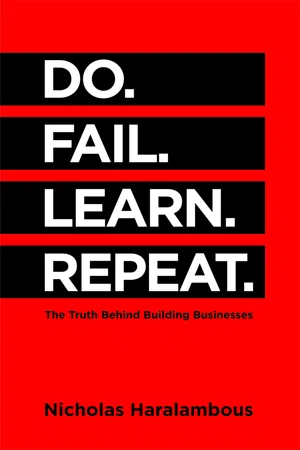
In his business autobiography Do. Fail. Learn. Repeat. Nicholas Haralambous discusses the truth about the last 15 years of his entrepreneurial journey.
ANYONE CAN START SOMETHING.
Nic openly discusses his failures and sacrifices over the past decade and a half spent building businesses. There is advice all over the place about the rules to follow if you want to succeed, the do's and don'ts of running a company, the how-to of how-to do this, that or the next thing. There are also many personalities out there telling young entrepreneurs to hustle non-stop, risk everything and never sleep if they want success.
YOUR CHANCE OF FAILURE IS ALMOST GUARANTEED.
No one talks about how hard it is, how lonely it is and how difficult it is to build a business. No one is willing to forgo their ego and be honest. If nothing else, Nic Haralambous is honest about his journey.
MOST PEOPLE WON'T LEARN.
Nic has lived the hustle; he has pushed through physical pain, mental suffering, business failures, personal torment and relationship strife all in the name of building businesses.
ALMOST NO ONE DOES IT AGAIN.
Nic decided to write a big book of his failures so that entrepreneurs around the world can begin to understand that it is not always glamorous, easy or fun to build a business.
If entrepreneurship is calling you then you absolutely cannot miss out on the truth, behind the business, written by Nic Haralambous.
Information
SECTION 1
GROWING UP
1
WHERE YOU COME FROM
WHERE YOU'RE GOING
I was one of those kids who thought that he knew better than his parents. I never took their lessons seriously, I never acknowledged that their experience was not only valid but valuable. It’s important to distinguish between a valid and a valuable experience. Everyone has an experience of the world that is valid. It is theirs and they experience the world in that way. That makes it valid to them. It may not be valuable to me because I experience the world in a different way, but I can’t deny that my father experienced his life in a way that was unique to him. Not everyone’s valid experiences are valuable to me.
My family had many valuable experiences that I chose to ignore and believe were not like my experience of the world. I wish I had paid closer attention to them and their lessons. I wish I had been more engaged in conversations with my grandparents when they were alive. I wish that I had been more curious when I was younger. But I think this is part of the curse of being young and invincible; I believed that no one understood my experience of the world or could help me become better. Least of all my parents.
Having said that, over time you notice that the things your parents once told you actually start to make sense and the lessons they provided become more relevant and useful. I learned from my grandfather, uncle, mother and father that you need to be resilient to survive. You will absolutely fail. There is no question that if you take the leap to start something, you will fail at some point. If you choose to start over or continue, then you’re resilient and you’ll probably be OK.
I was born into a family of South African Greeks who collectively had very little formal or traditional education past high school. My mom and dad both finished high school and are both extremely intelligent and resourceful people, but they are not academic. They are hustlers and I suppose that’s where I get it from.
My grandfather moved from Cyprus to South Africa fleeing an invasion by the Turks. He gave up his British passport for a South African one and arrived with his young wife. They were betrothed so she had no real choice in the matter. When they landed in South Africa, they did not follow the trend and head into a city centre or to the coast, they went to Welkom. Yup, they moved to a place called Welkom, in the Free State. There are many jokes about Greeks but the most common and accurate one is actually true. What does the Greek football team do when they get a corner in a game? They open up a café. We like to open up corner cafés. That’s our jam. That’s our default. That’s what we revert to in times of trouble and uncertainty. When my grandfather arrived in South Africa, that’s what he did. He opened a café that supplied the town with things like bread, milk, cheese and any other basics people required. My grandfather used to say: ‘You can buy bread, you can buy cheese, but you cannot buy experience.’ He should know; he sold bread and cheese and I’ll bet back then if he figured out how to sell experience he would have.
This is also what my father and uncle have done when they met with hard times. Open a corner café. My father tells me that he and my uncle had a company that was thriving in the late 1980s and early 90s called Quorum. It was a listed entity and did exceedingly well. I remember driving in my uncle’s Ferrari when I was a kid. That’s all I remember of that period in my life: money. We had lots of it, and then we had little. And then we had a lot again, and then we had a little. It was confusing. My dad went from driving fancy cars and splurging on nice things to being a depressed and deflated man sitting on the couch with no prospects and what appeared to be a broken heart. I didn’t understand at the time that he was going through a real loss. I also didn’t realise that I would go through a few of these real and heartbreaking business losses in the years to come. If only I had paid more attention.
No matter what my parents went through, they always made sure that I had enough. They always found a way to make it work. They always gave me a birthday present, always paid my school fees and they always managed to feed me and put clothes on my back. They were and are successful people by any definition of the word. But neither of my parents found a vocation. Neither of them had the luxury to take the time to discover their true calling, that thing that makes them content and gets them up in the morning. It didn’t seem to hold them back though. They owned restaurants, my father was once a fantastic chef who trained in top hotels in Johannesburg; he has worked in finance; owned the obligatory corner café, a paint shop and a car radio installation centre, amongst many other ventures. My mother has worked at car companies, finance businesses, selling property all over the world and even sold luxury socks when she worked for me at one of my businesses.
They both taught me one of the most important entrepreneurial lessons of my life: resilience.
As hard as my parents tried, they were unable to dissuade me from the life of an entrepreneur. My dad in particular tried extremely hard to get me to become a professional with a stable career. He wanted me to do anything other than own a business. Over the years I’ve looked back and have held a lot of frustration towards my dad for not embracing the entrepreneurial path as a more viable one for his son but he was doing the best he could. The grass is always greener and my dad wanted me to have the most lush lawn in the world.
I could have been a doctor, lawyer, accountant, any of these, and he would have been content. Unfortunately for my dad, I believe that I was born to be an entrepreneur. I don’t believe that everyone has it in them to be an entrepreneur. I believe that entrepreneurs exist in the same way that gifted athletes exist. They have a sense that there is an innate gift that they have and they set out to nurture it throughout their lives. Entrepreneurs build, fail, learn and do. Yeah, sure, there are lots of people who own businesses and people who buy and sell things who probably don’t care too much about their business or lives as entrepreneurs. But I think that true entrepreneurship is something you simply can’t live without. It’s an addiction, a desire, a drug that you get into and it consumes all of you.
In my experience, entrepreneurs are all kinds of broken. If you understand this as a fundamental then you will have a much better chance of understanding anyone building a business. We are broken. I don’t think there are any exceptions. In one way or another there is something we are trying to fix, fill, understand, come to terms with or battle.
Once I understood that I was broken and that I came from a long line of broken people, my journey became a lot more enjoyable. The pain doesn’t go away, the turmoil never leaves and it definitely doesn’t get easier the more you do it. The problems become more complex and the goals become more ambitious so it rarely gets easier.
I wouldn’t want it any other way. This shit is hard and it’s meant to be.
I am often asked what I believe it truly takes to be an entrepreneur. Is there a single trait that defines the best from everyone else?
It’s not a simple answer but if I had to pick one thing, I believe that resilience is the single trait that has separated me from my peers or my competition. The best entrepreneurs I know didn’t have the best ideas, the best teams or the most money. They persisted and survived for longer with less than anyone else. They were alive for long enough to succeed.
Paul Graham is a programmer, investor and writer. In 2005 he and Jessica Livingston, Robert Morris, and Trevor Blackwell started Y Combinator, the first of a new type of startup incubator. Since 2005 Y Combinator has funded over a thousand startups, including Dropbox, Airbnb, Stripe, and Reddit. Paul wrote a fantastic essay that I read regularly called ‘How Not to Die’. Here’s an excerpt:
If you can just avoid dying, you get rich. That sounds like a joke, but it’s actually a pretty good description of what happens in a typical startup. It certainly describes what happened in Viaweb. We avoided dying till we got rich.
It was really close, too. When we were visiting Yahoo to talk about being acquired, we had to interrupt everything and borrow one of their conference rooms to talk down an investor who was about to back out of a new funding round we needed to stay alive. So even in the middle of getting rich we were fighting off the grim reaper.
Just avoid dying. Repeat that with me: Just. Avoid. Dying.
It’s incredible how often I talk with other entrepreneurs who are not willing to do what it takes to make their businesses survive. Some claim that they will do whatever it takes, I had a business partner who believed that dearly until crunch time came, but I’ll get to that later.
For now, if you want to know what it takes to make it then look no further than resilience.
There are very, very few businesses that are literal overnight successes.
Here are a few businesses that I admire and their ages (in 2018):
- Hermès – 180 years old
- Ford Motor Company – 114 years old
- Ferrari – 71 years old
- Starbucks – 46 years old
- Versace – 39 years old
- Amazon – 23 years old
- Facebook – 13 years old
Even the sprightly Facebook is more than a decade old.
Take a moment now to think about the business you currently own, your side hustle or the project you are working on at your job. How long have you been working on it? More than a year? Less than ten? I have been building my business NicHarry.com for five years and I believe we’re just a little baby that hasn’t yet figured out how to talk properly or run.
It may be popular today to brag about how quickly a person created their wealth but I am less interested in the creation of someone’s wealth than I am in their story and the knowledge they have gained. Yes, you can make a quick buck building a YouTube channel with every trick and hack in the book and build it to a point where some brand is paying you a chunk of money to review their products, but will you be able to pivot that into a business? A media company? A series of YouTube channels? Or are you just a personality getting paid per video?
Or are you a freelancer? I hate to be the one to break it to you, but if you are a freelancer and you have a steady pay cheque coming in working in someone else’s business then you probably aren’t an entrepreneur, you’re a freelancer. And that’s absolutely great. You can be the best freelancer out there, you just aren’t an entrepreneur in my definition of the experience.
But that doesn’t really matter because if you truly believe you’re an entrepreneur, then who am I to argue?
What I do know is that there are thousands of entrepreneurs who are sitting at corporate jobs bored out of their minds. If that’s you and you’re reading this book then prepare yourself for the brutal truth on the difficulties you are going to face if you go it alone. If you are not interested in starting your own venture, that’s cool too. You can still engage in your work with the verve of an entrepreneur but I urge you to sit up and take your career seriously, don’t coast by because then you are wasting your talents and ambitions. It’s not binary out there, there are billions of ways to do the things you want to do.
2
MY DAD’S BUSINESSES
The first recollection that I have of feeling businesslike is visiting my dad’s businesses through the years. He is quite an accomplished entrepreneur. That’s not to say that he’s a rich retiree. He’s accomplished in that he has built many businesses that set up a good life for himself, his wife and his kids. My dad knows how to hustle and how to grind.
Like many kids around the world, I liked visiting my dad’s work. He was the boss and I always f...
Table of contents
- Prologue
- THE THING ABOUT FAILURE
- SECTION 1 GROWING UP
- SECTION 2 RULES? PFFFT, WHAT RULES?
- SECTION 3 THE ‘REAL’ WORLD
- SECTION 4 BUILD IT! GROW IT! BIGGER! BIGGER!
- SECTION 5 STARTING ALL OVER AGAIN. AGAIN.
- SECTION 6 IF YOU’RE ABOUT TO START SOMETHING ...
Trusted by 375,005 students
Access to over 1.5 million titles for a fair monthly price.
Study more efficiently using our study tools.
Frequently asked questions
Yes, you can cancel anytime from the Subscription tab in your account settings on the Perlego website. Your subscription will stay active until the end of your current billing period. Learn how to cancel your subscription
No, books cannot be downloaded as external files, such as PDFs, for use outside of Perlego. However, you can download books within the Perlego app for offline reading on mobile or tablet. Learn how to download books offline
Perlego offers two plans: Essential and Complete
- Essential is ideal for learners and professionals who enjoy exploring a wide range of subjects. Access the Essential Library with 800,000+ trusted titles and best-sellers across business, personal growth, and the humanities. Includes unlimited reading time and Standard Read Aloud voice.
- Complete: Perfect for advanced learners and researchers needing full, unrestricted access. Unlock 1.5M+ books across hundreds of subjects, including academic and specialized titles. The Complete Plan also includes advanced features like Premium Read Aloud and Research Assistant.
We are an online textbook subscription service, where you can get access to an entire online library for less than the price of a single book per month. With over 1.5 million books across 990+ topics, we’ve got you covered! Learn about our mission
Look out for the read-aloud symbol on your next book to see if you can listen to it. The read-aloud tool reads text aloud for you, highlighting the text as it is being read. You can pause it, speed it up and slow it down. Learn more about Read Aloud
Yes! You can use the Perlego app on both iOS and Android devices to read anytime, anywhere — even offline. Perfect for commutes or when you’re on the go.
Please note we cannot support devices running on iOS 13 and Android 7 or earlier. Learn more about using the app
Please note we cannot support devices running on iOS 13 and Android 7 or earlier. Learn more about using the app
Yes, you can access Do. Fail. Learn. Repeat. by Nicholas Haralambous in PDF and/or ePUB format, as well as other popular books in Business & Business Biographies. We have over 1.5 million books available in our catalogue for you to explore.