- 264 pages
- English
- ePUB (mobile friendly)
- Available on iOS & Android
eBook - ePub
About this book
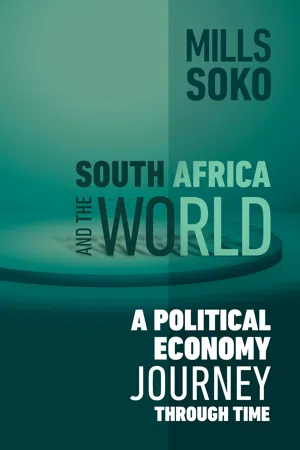
Over the past 20 years the global political economy has experienced its most profound shifts since the onset of the industrial revolution. In South Africa and the World, Mills Soko reflects on some of the salient issues that have pervaded public discourse during this time, analysing them within the context of the contemporary South African political economy and of the country's position in the world.
Arranged thematically, the essays were all written during a defining period in recent history, a period that has witnessed, among others, the accession of China to the WTO, the 9/11 terrorist attacks on the US, the invention of the iPad, the birth of Facebook, the 2008/9 global financial crisis, Brexit and the global coronavirus pandemic which began at the end of 2019.
The turbulent multipolar world demands visionary political and economic leadership, supported by institutions well attuned to contemporary conditions. Such leadership is in short supply. Nor is the existing institutional architecture sufficiently equipped to deal with a complex array of economic, social, environmental, technological and demographic challenges.
Mills Soko highlights what has not worked in terms of politics, leadership, foreign policy, the economy, the African development trajectory, corporate ethics, international trade, global governance, and the thread which underlies all these issues – the importance of strong, decisive and accountable leadership. He counters his criticism with what has worked and offers views on how some of the problems that have constrained progress in South Africa and the world can be solved.
A central message emerges from his writings: leadership and governance matter, whether in the national or international context. It is a message that permeates all the chapters in the book. And it goes to the heart of what South Africa has gone through over the past two decades and where it is today.
Information
Subtopic
WirtschaftssethikSOUTH AFRICA
AND THE
WORLD
A POLITICAL ECONOMY
JOURNEY
THROUGH TIME

Praise for
South Africa and the World
‘An essential guide to understanding the intricacies of South Africa’s political economy and the country’s place in the world in the first two decades after independence.’
Wandile Sihlobo, Chief Economist, Agricultural Business Chamber of South Africa (Agbiz)
‘… a really good body of work written in accessible language. Readers will find it highly informative, rich in analysis, and broad in thematic areas.’
Professor Mzukisi Qobo, Head: Wits School of Governance, University of the Witwatersrand, Johannesburg
‘Mills Soko has been relentlessly critical and vocal over the challenges that are seemingly making it impossible for African countries to extricate themselves from economic impoverishment, despite huge resource endowments … This book is a candid interrogation of why leadership is failing African countries. It takes head-on the challenging subject of how to nurture African countries to steer their own democratic and economic advancement. It examines how misgovernance can be resolved and leadership accountability secured. In his own narrative style, Mills elucidates how irresponsible and unaccountable leadership has perpetuated misgovernance and regressed growth and prosperity … His fire and craving for democratic and economic prosperity are still alight. The book is a battle cry – a luta continua.’
Professor Florens Luoga, Governor, Central Bank of Tanzania, and former Deputy Vice-Chancellor Academic Affairs at the University of Dar es Salaam, Tanzania
‘Covering a period of 20 years, the book captures Soko’s pointed and nuanced thoughts and observations on South Africa’s place in the global political economy. His articles on leadership are excellent in demonstrating the need to have a strong and visionary leadership which is often lacking in African countries. The most important … is his nuanced observation concerning the lack of a coherent, clear and predictable succession plan in the ANC after the current President Cyril Ramaphosa. Soko is sceptical and probably scathing in his assessment of the paucity of leadership within the ANC. He is not persuaded that the calibre of leaders has the capacity to manage a modern post-industrial state. This leads to uncertainty, which can be dangerous going forward … an excellent, well-written and eloquent book …’
Dr Alex T Magaisa, University of Kent Law School, UK, and former Chief of Staff in the Office of Prime Minister Morgan Tsvangirai, Zimbabwe (2012-13)
First published by Tracey McDonald Publishers, 2021
Suite No. 53, Private Bag X903, Bryanston, South Africa, 2021
www.traceymcdonaldpublishers.com
Copyright © Milford Soko, 2021
All rights reserved.
No part of this book may be reproduced, stored in a retrieval system, or transmitted in any form or by any means, electronic, mechanical, photocopying, recording, or otherwise, without the prior written permission from the publisher.
ISBN 978-1-920707-27-9
e-ISBN 978-1-920707-28-6
Text design and typesetting by Patricia Crain, Empressa
Cover design by Tomangopawpadilla
Digital conversion by Wouter Reinders
For Lwazi and Naledi
CONTENTS
Title page
Praise for South Africa and the World
Imprint page
Dedication
PREFACE
Chapter 1: Politics and Governance
1 Why Nene should have resigned before he was axed
2 Zuma is sowing the seeds of his demise
3 Is it time for electoral reform?
4 What South Africa can learn from Japan, Singapore and China
5 The June 16 legacy – a catalogue of failure
6 South Africa on road to collapse unless ANC takes corrective action
Chapter 2: Leadership
1 Hu’s next: what China could teach ANC about succession
2 China’s coronavirus combat shows decisive leadership important
3 What coronavirus has taught us about South Africa’s leadership
Chapter 3: Foreign Policy and Geopolitics
1 Creating more walls than BRICS
2 South Africa too timid in handling Nigeria
3 South Africa has a duty to step up as Harare nears the end of an era
4 The price of China’s economic support
5 Zuma’s muddled foreign policy
6 BRICS needs to mature before it can challenge current world order
7 Can South Africa and Nigeria reset the button?
8 How Russia’s pursuit of African allies will test the continent
9 Much ado about Cuban doctors – so what’s behind their recruitment?
10 South Africa must rethink its policy towards Zimbabwe
Chapter 4: Business Ethics
1 #Guptaleaks expose lack of business ethics South Africa can’t afford
2 Book on Steinhoff’s demise shows danger of ‘big men’ business leaders
Chapter 5: South African and International Trade
1 West must pull down farm fences
2 In search of South sufficiency
3 Doha needs a grand bargain
4 Information age changes approach to trade
5 Report urges fresh thinking on world trade
6 Our trade problems are at home, not the WTO
7 Regional wrangling mustn’t hamper South Africa’s growth
8 A rising tide lifts all boats
9 South Africa must get ready for an inevitable loosening of trade ties with the US
10 Here’s why South Africa and its neighbours are anxious about EU and UK post-Brexit trade talks
Chapter 6: South African Economy
1 South Africa can cut lessons from Chinese cloth
2 Singapore has a lot to teach South Africa about SOE governance
3 No pressure, Pravin, but you need to pull us out of the fire
4 How to fix South Africa’s labour market
5 ANC transformation plan vague on strategies to boost economy
6 Making the (down)grade: Can South Africa innovation weather the storm?
7 South Africa’s cancellation of bilateral investment treaties - strategic or hostile?
8 Covid-19 crisis is an opportunity to drive change
9 Business and government must work together to rebuild South Africa after Covid-19
Chapter 7: African Development
1 Africa needs to resolve where it stands in global war on terror
2 Bush has chance to prove US commitment to Africa
3 Help migrants wire home hope
4 How Africa’s past will shape its future
5 Development in Africa is on a firm footing – here’s how to take it to the next level
6 No short cuts to development
7 Identifying key drivers to help transform African agriculture
Chapter 8: Global Governance
1 Searching for a new role model
2 Lack of global leadership is destabilising economies of the world
3 The World Bank needs deep reforms to reflect a changing world order
4 The G7 is antiquated, and should be disbanded
5 A bold response, but coordination is the missing element
Conclusion
Acknowledgements
List of Acronyms
ENDNOTES
PREFACE
My political economy journey started at the University of Cape Town (UCT), where I was a student and activist from the late 1980s until the early 1990s. I arrived at the university in 1989 to pursue a social science degree. From the outset, I took a keen interest in campus politics. The 1980s were a period of great political upheaval in South Africa and UCT was the hotbed of student activism.
The university had for decades been mockingly labelled ‘Moscow on the Hill’ by its detractors.1 It was a cauldron of sharp ideological arguments, setting student organisations affiliated to the African National Congress (ANC) against those aligned to other liberation movements and formations, such as the Pan-Africanist Congress of Azania and the Azanian People’s Organisation. There were also other vociferous political voices such as the New Unity Movement, as well as those representing a mixture of Trotskyist ideological orientations.
One of the first things I set out to do was to join a student organisation. At high school, I was a member of the Congress of South African Students (COSAS). When I came to UCT, I looked for an organisation that mirrored COSAS’s political traditions. Ultimately, that was the key factor in my decision to join the Black Students Society (BSS).
Set up to address the interests of black students, the BSS was a significant and influential voice on campus. Amid the mounting influx of working-class black students, UCT was frequently rocked by protests against academic and financial exclusions, accommodation shortages and institutional cultural problems. During these volatile times, the BSS stepped in to allay the fears of the students and address their concerns. The BSS later morphed into South African National Students Congress (SANSCO). I participated enthusiastically in the activities of the BSS and SANSCO, rising to various leadership positions within their structures. Subsequently, SANSCO merged with the predominantly white National Union of South African Students to form the South African Students Congress, the first ever non-racial national student body in South Africa.
My time at UCT was a period of i...
Table of contents
- 9781920707286
Trusted by 375,005 students
Access to over 1.5 million titles for a fair monthly price.
Study more efficiently using our study tools.
Frequently asked questions
Yes, you can cancel anytime from the Subscription tab in your account settings on the Perlego website. Your subscription will stay active until the end of your current billing period. Learn how to cancel your subscription
No, books cannot be downloaded as external files, such as PDFs, for use outside of Perlego. However, you can download books within the Perlego app for offline reading on mobile or tablet. Learn how to download books offline
Perlego offers two plans: Essential and Complete
- Essential is ideal for learners and professionals who enjoy exploring a wide range of subjects. Access the Essential Library with 800,000+ trusted titles and best-sellers across business, personal growth, and the humanities. Includes unlimited reading time and Standard Read Aloud voice.
- Complete: Perfect for advanced learners and researchers needing full, unrestricted access. Unlock 1.5M+ books across hundreds of subjects, including academic and specialized titles. The Complete Plan also includes advanced features like Premium Read Aloud and Research Assistant.
We are an online textbook subscription service, where you can get access to an entire online library for less than the price of a single book per month. With over 1.5 million books across 990+ topics, we’ve got you covered! Learn about our mission
Look out for the read-aloud symbol on your next book to see if you can listen to it. The read-aloud tool reads text aloud for you, highlighting the text as it is being read. You can pause it, speed it up and slow it down. Learn more about Read Aloud
Yes! You can use the Perlego app on both iOS and Android devices to read anytime, anywhere — even offline. Perfect for commutes or when you’re on the go.
Please note we cannot support devices running on iOS 13 and Android 7 or earlier. Learn more about using the app
Please note we cannot support devices running on iOS 13 and Android 7 or earlier. Learn more about using the app
Yes, you can access South Africa and the World by Mills Soko in PDF and/or ePUB format, as well as other popular books in Volkswirtschaftslehre & Wirtschaftssethik. We have over 1.5 million books available in our catalogue for you to explore.