- 300 pages
- English
- ePUB (mobile friendly)
- Available on iOS & Android
eBook - ePub
About this book
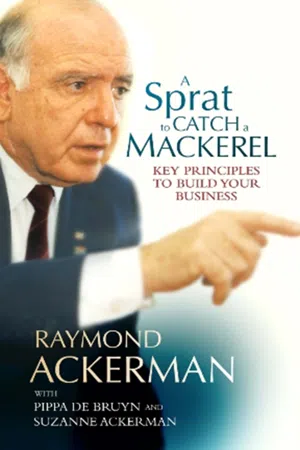
When Raymond Ackerman was fired from his job in 1966, he persuaded a group of friends to loan him the money to buy three small Pick 'n Pay stores, which at the time employed a total of 175 people. On his retirement, 44 years later, he had changed the face of southern African retailing, growing his company to encompass 792 stores in eight countries, employing more than 60 000 people, and generating an annual turnover of around R60 billion. In A Sprat to Catch a Mackerel: Key principles to build your business, Raymond Ackerman shares the basic tenets behind his business philosophy - timeless principles that have guided him through some of South Africa's most turbulent times. Whatever your business background or interest, the practical, accessible advice in this book will help you define and build your vision, and help you reach success and self-actualised growth - not by chasing profit, but by giving expression to a driving passion. Rated by the Financial Times as among the World's Top 100 Most Respected Businessmen, Raymond Ackerman is also the first South African ever to receive the International Woodrow Wilson Award for Corporate Citizenship. In 2009, his company was voted the World's Best Retailer by the National Retail Federation (NRF). Raymond Ackerman is also the author of the best-selling memoir Hearing Grasshoppers Jump, and The Four Legs of the Table, in which he recounts how he built Pick 'n Pay into one of the most respected brands in the world today.
Information
CHAPTER 1
Passion – The Most Vital Ingredient of All
Deciding What to Do
PRINCIPLE #1
‘Find meaning in life by doing the work you want to do, and do it to distraction.’ – Dr Viktor Frankl
Choosing a business is a little like choosing a life partner. It doesn’t matter whether you’re a young student trying to carve out a future, a seasoned businessman unhappy with his lot, or recently fired from a job you may even have cared a great deal about: Starting your own business is not something you rush into, or take lightly. It has to be more than just vaguely suitable, or the first thing that comes up. Owning a business is relentless. No matter how successful you become, as the owner you can’t ever rest up and say, ‘I’ve made it’. So, in the end, the essential difference between the success and failure of an enterprise is the level of passion you bring to it. If you’re not sure what kind of enterprise – or whether in fact any – could ignite this in you, it’s worth sitting down and first doing a little mental research. Not only will it save you a great deal of money, but you won’t waste your most precious commodity: time.
Your interests and knowledge are both terribly important. If you’re fascinated by something, you will know a great deal about it. So hobbies – the things you do for pleasure in downtime – could be an important source. Alternatively, and usually more pertinent, is what you’ve been doing for a living.
Most successful entrepreneurs are people who launch businesses in the field they were employed in. I fully subscribe to Malcolm Gladwell’s ‘10 000-hour rule’, which essentially states that the key to real success in any field is a matter of practising a specific task for a total of around 10 000 hours! You can’t put a price on the hours spent immersed in a particular environment, learning how a business works, the pitfalls and how and where it could be improved upon. Having worked in a certain industry, you will naturally also know your way around the feeder industries that surround it. Most importantly, the mistakes you make will be at someone else’s expense. This is not a dishonest strategy. You are not using the company you are working for any more than they are using you and your skills to advance their profit. You get to hone your talents, while – all things being equal – your employer harnesses them to make more money: a fair trade in anyone’s language. That’s not to say it is not possible to strike out in an entirely fresh direction from your current career path and achieve long-term success, but your passion will need to be all the stronger to overcome the mistakes you will inevitably make in a brand-new industry.
‘Starting your own business is not something you rush into, or take lightly. It has to be more than just vaguely suitable, or the first thing that comes up.’
At this stage, it may still not be clear to you exactly which route to take; not only whether to start your own business or not, but which industry to sink your savings and energy into. You may be toying with a variety of options, none of which jump out as ‘the one’. The following method should help you achieve clarity. You may find it rather simplistic, but it worked for me after I found myself jobless with a pregnant wife and three children to support, and it has worked for countless others who have asked me to help them find their feet in the four decades since I found mine. All you need are a few pieces of paper, a pen and the brutal honesty to explore every option.
The first step is to ask yourself, very clearly: Do I really want to change my life?
If the answer is a resounding yes, the next question is: What exactly is the problem?
Often, people strike out in a new direction, eager to escape what they perceive to be a trapped existence, but do not deal with the actual root of the problem. They then find themselves in a new environment but feel the same desperation. So it’s vitally important to clarify and distil what the real problem is.
Don’t confuse the problem with the cause. This is a common mistake, given that the cause is usually the thing more keenly felt. So ‘I hate my job’ could either be a problem, or it could be a cause, with the real problem lying deeper – for instance, ‘I don’t like the way my boss treats me’ or ‘I hate the fact that it keeps me from my family’ or ‘I’m not paid enough’.
Ask yourself: Is it the broader career choice I have made, or the particular job I am currently in? Is it really the job, or is it the people I am working with, or for? Is it perhaps my lifestyle? Is it affecting my health? Or does the real problem lie with my relationships at home? Try to cover all bases.
‘Do not allow your inner critic to interfere while compiling a list of all the things you want to do before you die. This is not the time to self-edit.’
Having determined the root of the problem, you can now list the causes. There may be one, but more often than not there are four or five. Write them all down. If there is more than one problem, do a separate ‘cause’ analysis for each.
Having determined which aspect of your life you find most problematic, and clarified the causes, set these aside. It’s time to move closer to the solution.
Take a fresh sheet of paper and write a list of all the things you have ever wanted to do before you die. Do not allow your ‘inner critic’ to interfere while compiling this list; this is not the time to self-edit. List even the crazy things, like jumping off a mountain strapped to a glider, or the idealistic dreams, like campaigning for environmental issues. Ask yourself: What is it I want to achieve with my life? What do I want to spend all those working hours on? What will I regret not doing if I don’t? What would be meaningful to me? What do I want to be remembered for? Call it your ‘Before I Kick the Bucket’ list, and make it as long as you want.
When you’re satisfied that you’ve listed all the things you would really like to do, give each listed item a score out of 10, with 1 showing the lowest-level interest, and 10 being a sky-high-absolutely-must-do rating. Having given yourself free reign in the original listing, you may now allow realism to temper the actual scores.
Consider all factors. It’s all very well wanting to make a living as an artist, for instance, but if you’ve never picked up a paintbrush you’re unlikely to earn much, at least for a while. In my case, I always dreamed of being a doctor, but with a wife and children to support I did not have the luxury of time to pursue an eight-year degree, so, despite it being a long-held dream, I scored this a relatively low 3.
Now look at the list. How did you score ‘Start my own business’?
Back in 1966 I gave this an 8. All the rest – emigrate, study further, join another company, and so on – scored 5 and under. As I looked at that piece of paper, I knew what my objective was. It was not only realistic and achievable, but also exhilarating. (As for jumping off a mountain, I finally got round to doing that aged 77, and it’s something of a relief not to have to do it ever again!)
CHAPTER 2
Analysis – The First Part of Every Plan
How to Create a Business Plan
PRINCIPLE #2
‘When in doubt, rely on the “7 Tried & True” – what, where, why, when, which, how and who.’
Entrepreneurs are neither born nor made. You may have certain innate instincts that will incline you towards entrepreneurial enterprise, but, frankly, a lot depends on outside influences, and how you choose to respond to them. Certainly, if you are the kind of person who constantly challenges the status quo in your working environment, and constantly looks for better, more efficient ways of doing things – be it working conditions, service delivery or manufacturing processes – then you have what is probably the key characteristic of a good entrepreneur. This is the ‘vision’ that people always refer to when talking about entrepreneurs: not just the ability to save or make more money, but to keep looking at new ways of doing things and finding alternate ways to give people what they need.
As a boy, I was shy and retiring, and was constantly warned by my father – a man of Victorian principles – that I was too kind, too nice, too worried about others to ever make a success of it. My small achievements at school – doing well academically, being chosen as a prefect, playing first team rugby – went largely ignored. It hurt me deeply that he refused to come and watch me play rugby. ‘I’ll come when you play for the Springboks,’ he would say. But as a result of his impossibly high standards, I kept raising my own. I am by nature a team player, but in order to impress my father I was driven to achieve pole position in everything I tackled, and this internal pressure became a bit of a habit.
Still, it never occurred to me that I might be an entrepreneur. The general thinking – then as now – was that it was ‘too late’, that it had been somehow ‘easier’ during some earlier Arcadian era.
Soon after graduating, I joined Greatermans in Johannesburg on the advice of my father, whose aversion to debt had forced him to sell his own company, Ackermans, to the very consciously named Greatermans, where he now worked in what he himself regarded as the ‘third team’. I remained a loyal employee at Greatermans for twelve years. My father passed away; I slowly climbed the ranks, reasonably content with earning my monthly stipend. I would probably never have started my own business if Greatermans had not taken the first step for me, and fired me.
‘Entrepreneurs are neither born nor made.’
Dealing with these two difficulties – trying to impress my authoritarian, difficult-to-please father, then the visionless, impossible-to-please company elders – was what ‘nurtured’ my entrepreneurial career. Both were problems I overcame by refusing to accept their version of me, and by analysing every situation in a kind of mental hopscotch that went ‘Problem–Cause–Solution’.
In Chapter 1, I dealt with the importance of clarity, self-awareness and honesty when asking yourself, ‘What exactly is the problem?’, and, having identified the real root, listing its causes. But Problem–Cause–Solution analysis is just the initial step. Having identified the problem and its causes, and rated the possible solutions, the next step is to use the ‘7 Tried & True’, asking yourself: what, where, why, when, which, how and who.
I used the ‘7 Tried & True’ analysis to provide me with the logical, systematic steps I needed to realise the goal of starting my own business; indeed, it became the basis of my mission statement and my business plan. It focused me on where to shop for my business, what kind of business I was looking for, how I was going to achieve it, and so on. Over the years, I have encouraged many budding entrepreneurs to use the same simple tool as a basis for their own business plan. As in Chapter 1, all you need is a few sheets of paper, a pen and a few uninterrupted hours to work through the answers to the following questions:
1. What type of enterprise would I be good at/would make me happy? What do I want to achieve in the short term/long term? What are the possible pitfalls/opportunities/etc? This should have been somewhat clarified by the exercise in Chapter 1. This is also the place to visualise the worst things that could go wrong: What would happen if I lost my health/there was a terrorist attack/a competitor opened next door … This is not meant to deter you but to prepare you mentally for every eventuality.
2. Where would I like to open my business/is there a need for my service or product/am I prepared to travel to/is the ideal place to bring up a family?
3. Why am/should I be doing this/is this a product or service that someone will be interested in purchasing or hiring/is there a gap? List all the reasons here; again, this should have been clarified by the Chapter 1 exercise. If it evokes more than one answer, list them all and then score them out of 10 to ascertain the primary reason you want to launch this enterprise, and use this as the basis for your mission statement, after reading Chapter 3.
4. When should I start? Think about any specific event that will benefit you or your launch, or events in your personal calendar that may hinder or benefit you.
5. Which format/kind of business/model fits best with my long-term plans? Should I buy an existing business or start from scratch? Form a partnership or find shareholders?
6. How do I research existing services or products for purposes of comparison/will my proposed enterprise operate logistically/will I finance my plan/will I promote my service or product/will I plan should things go wrong?
7. Who will be my customers/my employees/my accountant/my lawyer/my banker?
PRINCIPLE #3
‘If there’s no solution, there’s no problem.’
Aside from using the ‘7 Tried & True’ analysis to help launch my business, I must briefly add here that it has been an immensely useful problem-solving process over the years. I extrapolate a little in Chapter 19 on what some like to call ‘scenario planning’. I never had a name for it, but the desire to work through problems by looking at every possible angle has always been there, guided by the twin combination of curiosity and fear.
I have to admit to an almost pathological fear of failure. Regardless of how successful my business became, and how many good people I had in place looking after it, I found it almost impossible not to worry about it, like a slightly anxious parent, always keeping a watchful eye on their child, regardless of its age.
‘I never ignored or dismissed my concerns as being over-anxious. I saw it as an ability to identify problems before they happen.’
I never ignored or dismissed my concerns as being neurotic or over-anxious. I saw it as an ability to identify problems almost before they happen – not because I was some kind of visionary, but because I had the self-awareness to listen to the inner voice we all have which tells us when we are stepping close to danger. It’s a voice that may wake you at night, or whisper to you while you shave, take the dog for a walk or play a round of golf. Ignore it at your peril.
Take out your pen, get a large piece of paper, and do the Problem–Cause–Solution mental hopscotch, then rate the solutions out of 10 as discussed in Chapter 1. Follow this initial analysis with the more in-depth ‘7 Tried & True’ analysis. Not only will it help you navigate your way through any problem, but the very process will help set your mind at rest, allowing you to f...
Table of contents
- Title page
- Dedication
- Prologue
- 1. Passion – The Most Vital Ingredient of All
- 2. Analysis – The First Part of Every Plan
- 3. The Real Reason You’re in Business
- 4. Building Four Balanced Legs for Your Table
- 5. The Courage of Conviction – A Capital Plan
- 6. Research – Finding the Right Business in the Ideal Premises
- 7. Negotiating – The Art of Persuasion
- 8. Empathy & Empowerment – The Guardians of Your Greatest Asset
- 9. Pricing – A Tricky Business
- 10. Self-discipline – Managing Cash Flow
- 11. Serving Your Customer – Three Cast-iron Rules
- 12. Competition – Within and Without
- 13. Building a Great Management Team
- 14. Humility – Never Know Enough
- 15. Generosity – Ethics as Enlightened Self-interest
- 16. Marketing From the Heart
- 17. Hope – The Importance of Optimism
- 18. Stand Still and You’re Dead
- 19. Make Mistakes, Not Regrets
- 20. Time Out – Prioritising
- Appendix: Nuts & Bolts
- Copyright
Trusted by 375,005 students
Access to over 1.5 million titles for a fair monthly price.
Study more efficiently using our study tools.
Frequently asked questions
Yes, you can cancel anytime from the Subscription tab in your account settings on the Perlego website. Your subscription will stay active until the end of your current billing period. Learn how to cancel your subscription
No, books cannot be downloaded as external files, such as PDFs, for use outside of Perlego. However, you can download books within the Perlego app for offline reading on mobile or tablet. Learn how to download books offline
Perlego offers two plans: Essential and Complete
- Essential is ideal for learners and professionals who enjoy exploring a wide range of subjects. Access the Essential Library with 800,000+ trusted titles and best-sellers across business, personal growth, and the humanities. Includes unlimited reading time and Standard Read Aloud voice.
- Complete: Perfect for advanced learners and researchers needing full, unrestricted access. Unlock 1.5M+ books across hundreds of subjects, including academic and specialized titles. The Complete Plan also includes advanced features like Premium Read Aloud and Research Assistant.
We are an online textbook subscription service, where you can get access to an entire online library for less than the price of a single book per month. With over 1.5 million books across 990+ topics, we’ve got you covered! Learn about our mission
Look out for the read-aloud symbol on your next book to see if you can listen to it. The read-aloud tool reads text aloud for you, highlighting the text as it is being read. You can pause it, speed it up and slow it down. Learn more about Read Aloud
Yes! You can use the Perlego app on both iOS and Android devices to read anytime, anywhere — even offline. Perfect for commutes or when you’re on the go.
Please note we cannot support devices running on iOS 13 and Android 7 or earlier. Learn more about using the app
Please note we cannot support devices running on iOS 13 and Android 7 or earlier. Learn more about using the app
Yes, you can access A Sprat To Catch A Mackerel by Raymond Ackerman in PDF and/or ePUB format, as well as other popular books in Business & Entrepreneurship. We have over 1.5 million books available in our catalogue for you to explore.