- 300 pages
- English
- ePUB (mobile friendly)
- Available on iOS & Android
eBook - ePub
About this book
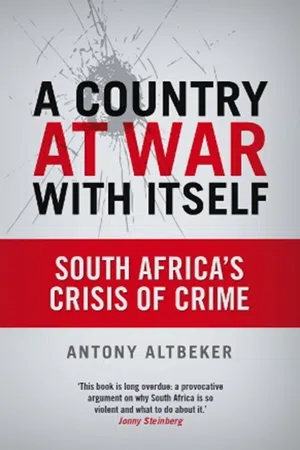
Crime is tearing South Africa apart. Whether it is hijacking or rape, a home robbery or a husband's explosion of rage, violence is so common that few lives have been left untouched by it. The result is a society deformed by its fears. Closeted behind locked doors and high walls, panic buttons at the ready, members of the middle class live lives haunted by fear. The poor, who are both more likely to be victimised and less able to secure themselves, are just as traumatised. A Country at War with Itself is a penetrating exploration of South Africa's crime problem. Getting behind the statistics to offer a sober and sobering account of the scale of the problem and its evolution, it describes how government has sometimes sought to deal with the crisis and sometimes sought to deny its existence. The book ends with some suggestions of what needs to be done to deal with this scourge.
Information
Chapter one
‘Stuff happens’ or how we used to think about crime
There can be few South Africans who have yet to become a crime statistic. In our divided land, it is the one experience we have all shared. Whether it’s a mugging or a hijacking, the burglary of one’s home or a rape, a moment of high drama in a shopping centre or the banality of a stolen car, we all have a story to tell. Mine is of a restaurant robbery in 1997.
*
On a winter’s evening in the middle of 1997, I was eating steak rolls with slap chips in one of Johannesburg’s franchised fast-food emporia with a friend. I had my back to the room, and my companion, Angela, a fey, hippy-ish blonde who also happens to have a fine head for figures, was sitting in the corner. About halfway through the meal a figure appeared at the side of our table. Dressed in jeans and a rugby shirt, he was short and young – no more than 16 or 17, possibly younger. With a hesitation that verged on timidity, he showed us the top of the barrel of a handgun and told us to get down.
Now, it is no embarrassment to me to admit that I have no gun sense. I don’t know a .22 from a .45, a pistol from a revolver; I don’t know a cheap Chinese import from a Cold War-era Makarov. Something about this would-be robber’s tone of voice, his body language and the cautious way he showed only the top of the gun, however, made me suspicious. He reminded me of a classmate at school who, with exaggerated, implausible stealth, pulled me aside one afternoon and, seeking to profit from my pharmacological naiveté, offered me a bottle of Vitamin E pills, claiming they were LSD tabs. I had the same thought now as I had then: ‘This is not real.’ In the restaurant this thought was followed by another: ‘This prick is threatening me with a toy!’
‘Fuck off,’ I said, allowing the tartrazine in the mustard to get the better of me. ‘Go away.’
‘Get down,’ the boy-man repeated. There was astonishment in his voice, and he began to raise the weapon towards my face.
‘It’s a fucking toy,’ I said to Angela, getting up, rage boiling in my breast and reducing my vocabulary to four-letter words. ‘I’m going to fuck this little shit up.’ Turning on him, I struck his wrist with my left hand, knocking the gun away from me. Then I hit him in the neck, just above the breastbone.
I am not a big man, though I am tall. Skinny to the point of frailty, my legs, for instance, cast a shadow only when I wear dark trousers. Still, I played schoolboy rugby until I was about 14 largely because, beanpole though I was, I could tackle. So, visions of Henry Honiball dancing in my head, I pursued the little man I had just punched as he staggered backwards into the restaurant. I was going to donner him into the ground.
As I was about to pounce, his friend put a gun in my face.
No doubt others have had this experience, and perhaps they can relate to the sensation of time slowing down precipitously, its flow congealing like day-old toffee. I was in hot pursuit, about to leap on fleeing prey, about to turn a would-be robber into the next victim of vigilantism, when the universal clock simply stopped. It gave me what seemed to be a surprising length of time in which to contemplate my immediate future. I can’t have had more than half a second to think these thoughts, but this is what went through my head:
‘Item: the boy-man’s gun didn’t go off. Even though I’ve hit his arm. Even though I’ve hit him in the neck. Even though I’m still threatening him.
‘Conclusion: his gun must be a toy.
‘Item: this new fellow knows that I am being aggressive. He knows that he needs to gain control over me. He knows that I am idiot enough to resist him. Nevertheless, he is choosing to threaten me with his gun.
‘Conclusion: his gun must be real.’
I stopped and put both hands in the air.
‘Back to the table.’ He gestured with his weapon rather than spoke, but I did as I was told.
The second man, the man with the real gun, was also small, but he was older than the first. Despite the cold, his shirt had no sleeves and his muscles looked as hard and raw as tendons. He wore a skullcap made of thinly-striped blue cloth that framed a narrow, strangely reddish face with high cheekbones and that came to the sharpest, pointiest chin I have ever seen. I remember all of this because, while the teenager who’d first threatened me looted the cash register and demanded wallets from the restaurant’s staff and its other patrons, Pointy Face and I had a long conversation. The gist of our deliberations was that I was mad and should be dead. I could, in truth, appreciate the point. I was conscious of trying not to be too conciliatory or to seem to be telling him how to do his job, but I was also trying to assure him that I had learned my lesson. ‘Take what you want,’ I kept saying. ‘No-one has to get hurt.’ I was hyper-aware of two things. The first was that my actions had made it more likely that someone in the room would get hurt; Angela, who was directly behind me and in the path of any bullets that might pass through my skinny torso, was especially at risk. The second was a flash of insight: if I could get this bastard to see me as a human being rather than a mere wallet-carrier, he would be less likely to shoot. If he were to see me as anything less than a human, though, I’d be dead. Both thoughts led to one conclusion: I had to engage him. I knew with unnatural clarity that I had to maintain eye contact. I had to speak to him.
In defiance of the objective facts, that insight made me feel in full control.
Pointy Face wanted my jacket; I gave it to him. He wanted my cellphone; I gave that to him, too, vaguely conscious that it was the property of the Ministry for Safety and Security. Then he wanted my wallet.
I was buggered if he was going to get my credit cards and my name. Instead, I took the wallet out of my pocket, emptied the cash, handed him the notes, and put it back in my pocket. I worried while I did this, fearing that I may be offending his sense of dignity and position. He felt this too, I think, and for a moment I imagined he was considering demanding the rest of the wallet’s contents. But perhaps I was wrong. Perhaps Pointy Face was too self-conscious to ask for more. Perhaps he felt his authority wane as mine increased. In any event, he didn’t ask for anything that had my name on it.
My interaction with Pointy Face must have lasted five minutes, the most dangerous moment coming towards the end of that period when a woman, another would-be burger-eater like myself, another wallet-carrier, entered the restaurant and walked straight into him. Panicking as she realised what was happening, she tried to retreat out of the door. Pointy Face was quicker. Grabbing her by the arm, he pulled her into the room, the momentum carrying her off her feet. The distraction upset the flow between Pointy Face and me and, when he looked up, he announced matter-of-factly that he was going to kill me. His voice was cool, with a hint of something like resentment that I had brought matters to this. Nevertheless, it was, he felt, imperative that he shoot me.
As he spoke, he moved to cock the gun.
This is a matter I have since discussed with a number of police officers of my acquaintance and each has been clear on this point: if someone cocks his gun, he is planning to shoot. Up until that moment, a robbery victim’s best bet, they insist, is to cooperate fully. But everything changes when a bullet has been chambered and the gun has been cocked. When that happens, whatever the circumstances, however great your disadvantage, you have to act. ‘You’ve got to attack,’ one policewoman told me. ‘If you don’t, you’re going home in the mortuary van.’
This is something I now know because cops have told me. But, even at the time, I remember contemplating the option of launching myself at this man who’d walked out of the night, stolen my jacket and money and phone, and who was now threatening to end my life. The trouble was that there was a table between us; there was just no way to get at him.
For a moment, I knew I was going to die.
This was a hard, physical piece of wisdom, one that left imprinted on my mind a picture, almost a sensation, of the blunt, shattering violence that would be delivered by a bullet to so brittle a structure as a human skull.
My skull.
Even now it makes my stomach turn.
As if I had not already had my share of good fortune that evening, what happened next suggested that I should have gone straight to a casino: the gun’s mechanism jammed; it couldn’t be cocked.
Pointy Face tried only once, but somehow I knew he didn’t have it in him to risk failing again. I had the impression of a workman embarrassed by the failure of his tools.
As quickly as the knowledge that I was going to die passed through my body, so it was replaced by the elation that I would live. For that moment, I loved Pointy Face, and I contemplated a joke. ‘I know,’ I was going to say with faked solicitousness, ‘that you’re just doing your job.’ Then I thought again. This guy’s not on my Christmas card list; I don’t have to be his friend. Barely had these two thoughts flashed through my head than he used the same words to me: ‘I’m just doing my job,’ he said, as if hoping for greater understanding of, and sympathy for, his position.
‘Bingo,’ I thought. ‘We’ve bonded; I’ve become a human being.’
And then, just as suddenly as it had begun, it was over: my new best friend was gone and the aftermath began. Someone cried. Someone started mixing sugar water for the shock. A third person called the cops. Angela, I discovered later, was deciding never to speak to me again. I smoked a cigarette and talked to a man who turned out to be a champion boxer. Even he thought I was an idiot.
Dazedly we sat in a room, violated and relieved, a stunned rabble in a room of overturned chairs.
Never let it be said, though, that Johannesburg’s finest weren’t there when we needed them. It couldn’t have been ten minutes later when two cops arrived, automatic weapons draped over their shoulders. Boldly, confident in their authority, they walked in and looked at us.
Silently, we returned their gaze.
They looked at the menu.
‘Are you here for the robbery?’ I asked, puzzled.
‘What robbery?’ the sergeant replied.
They’d come in for supper. Fifteen minutes earlier and we’d have been players in a hostage drama.
*
The night I spent with Pointy Face took place in mid-1997, a time when I was working for the Minister for Safety and Security. In a job like that you are accorded some advantages that others are denied. One was that I could spend the next day berating the Minister, demanding from him some explanation of what exactly it was he thought he and his department were doing to solve the crime problem. I think I suggested that he get out of his office more.
He humoured me politely.
Another privilege I had was that, when I expressed my disbelief to the investigating officer that the first appointment I could make with the only remaining police identikit artist was a week after the robbery, I was quickly offered an earlier slot. I refused it, but was troubled by the thought that in the two years I’d worked for the Minister reviewing police expenditure trends and budget submissions, perhaps we had not taken seriously enough the operational impact of the loss of skills the organisation was suffering. Having inherited something like 145 000 cops in 1994 – the number is imprecise because of the many ghost employees on Bantustan payrolls – by the time I met Pointy Face in mid-1997, the Police Service employed fewer than 130 000.
The loss of personnel, damaging enough, coincided with a massively destabilising programme of organisational transformation and reform as well as an explosion of crime. All this had devastated police morale. White cops, especially in middle and senior ranks, having accumulated the lion’s share of skills under apartheid, were now taking advantage of government’s generous severance packages, clearing their desks and finding other things to do with the rest of their lives. I knew that this was the organisational context, but the idea that it would be a week before I could sit with a police artist was worrying: criminological studies everywhere show that witnesses’ ability to describe a suspect, weak at the best of times, decays rapidly as their memories falter. What else, I wondered, didn’t I know about how transformation was affecting police operations?
I was not alone in my obliviousness about the operational consequences of the loss of personnel. If I’d asked them at the time, my colleagues in the Ministry would have offered our boilerplate response that these were the inevitable short-term costs of a transformation process that would improve policing in the medium and long term. ‘Besides,’ my hypothetical interlocutor would have said, ‘the skills of those who are leaving are not relevant to a police service operating in a democracy and guided by the philosophy of community policing. Especially in a country as diverse as ours.’
Our eye, we said (and sincerely believed), was on the long term.
Senior leadership in police headquarters was not necessarily any better at looking after the health of the organisation than were we, the left-wing civilians sitting in the Minister’s boardroom. Mole-blind, at the nominal helm of an institution that is too unwieldy to control from the centre, they were just as badly out of touch.
They also had a lot on their plate.
Apart from the wave of panic about crime that was beginning to sweep through post-liberation South Africa, apart from their having to preside over one of the most dramatic processes of police reform ever contemplated, apart from the loss of skills and the decline in morale, apart from all this, they were also having to figure out how to secure their own futures in a new, unfamiliar government whose politics and policies might as well have originated on Jupiter. No wonder they were out of touch. No wonder none but the boldest would offer anything more than token protest, offered sometimes for form’s sake alone, when they believed any new policies were impacting negatively on police effectiveness. Besides, most had been head-office desk-jockeys for so long, they had almost no sense of what policing South Africa’s streets was like. Or how quickly it was changing.
*
From early colonial times, policing in South Africa had been dominated by a conviction that the whole social order rested on the vigorous application of force against anyone deemed a threat. Political resistance was one kind of threat, but so too was criminality, much of which was inseparable from the underlying ethos of resistance. In the 19th century, for instance, local magistrates would lead posses of burghers out beyond the boundaries of the colony to hunt down cattle thieves, operations that were integral to the conflicts between settler and indigene that marked the growth of the colony. The first detective units worked the diamond fields of Kimberley, emerging at the same time and for the same reason as the building of the first mine hostels: the reduction of illegal diamond dealing. Later, in the 20th century, policing was more concerned with reinforcing the racial social structure than with preventing crime. Indeed, for most cops, the two objectives would have been indistinguishable since they routinely served in the townships combating mass resistance to apartheid, fought in Namibia to prevent its independence, and even waged counter-insurgency warfare in what was then Rhodesia. Who can blame the young men involved for thinking that policing and maintaining the political order were one in the same thing? For all practical purposes, they were.
Given this history, it was hardly surprising that much of the transformational effort immediately after 1994 was directed at reining in police abuses, a process that was sometimes understood to mean the reining in of policing more generally. Anti-torture policies were adopted and human-rights training was initiated. Police watchdogs – the Independent Complaints Directorate and the Secretariats for Safety and Security – were established. Kicking and screaming, cops were dragged to the Truth Commission. An aggressive programme of demilitarisation sought to change police culture, structures and symbols. At the same time, new rules governing the right to bail made it significantly easier for arrestees to obtain their release, others narrowed sharply the circumstances under which officers could legally fire their weapons. The unrelated decision of the Constitutional Court that the death penalty offended against the right to life, handed down around that time, implied to cops – pro-death penalty to a man – that government envisaged a softer approach to the enforcement of the law.
Along with all these changes, a new model of policing was being aggressively pursued. Based on faddish notions of community policing and crime prevention drawn from the pages of international criminology journals, it was premised on a conviction that traditional police methods for tackling crime were ineffective. It was argued that the existing approach – contemptuously called the ‘professional model of policing’ – resulted in policing that was too remote, too isolated from the community to deal with the social problems that gave rise to crime. Instead, the police were to embed themselves in communities and become the fulcrum about which social transformation would turn.
You might think that when a new model of policing – of police officer – is needed, a police service would go out to recruit people to fill the new job descriptions. You might think that but, at least in our case, you’d be wrong. In fact, in the midst of all of this destabilising change, in the midst of the fastest rising crime wave since at least the Anglo-Boer War, a moratorium was imposed on police recruitment. It was the result of budget constraints attendant on rising police salaries rather than a deliberate policy choice to shrink police numbers, but it also went unregretted and unprotested by people in key policy positions.
The effort to introduce a new model of policing while watching police personnel numbers shrink was, I now believe, a symptom of one of the most striking aspects of the manner in which reform was being managed: the process was almost entirely driven by the abstractions of policy rather than the operational questions of what it would take to provide decent policing. Papers were passed from one office at police headquarters to the next. They were read, parsed and criticised. Then they were sent back. It was like an enormous game of pass-the-parcel, and it only very occasionally involved anyone working outside the bureaucratic towers in the middle of Pretoria. What was going on in the street – that was for others to worry about.
For the ‘blokes on ground level’, as one senior cop took to calling them, the lunatics were running the asylum; everything that came out of the policy process smacked of an unarticulated contempt for law enforcement and, by extension, for law enforcers. (Nor were they necessarily wrong. I remember a conversation with some of the Minister’s advisors in 1995 when a call had gone out to institute a state of emergency in the battlefields of KwaZulu-Natal. When I asked why everyone was opposed to it, I was told that sending thousands of ‘useless policemen’ ...
Table of contents
- Title page
- Dedication
- Acknowledgements
- Epigraph
- Preface
- 1. ‘Stuff happens’ or how we used to think about crime
- 2. The crime capital of the world?
- 3. Is it getting worse? The facts (and politics) of fear
- 4. Why a plague of robbery is so difficult to cure
- 5. Kilroy was here: vroumoer in South Africa
- 6. A country unhinged
- 7. A sunny spot for shady characters or the foreign element in our crime
- 8. From ‘fighting crime’ to ‘fighting criminals’
- 9. It’s about values, stupid!
- 10. Hope or despair?
- Notes
- Copyright
Trusted by 375,005 students
Access to over 1.5 million titles for a fair monthly price.
Study more efficiently using our study tools.
Frequently asked questions
Yes, you can cancel anytime from the Subscription tab in your account settings on the Perlego website. Your subscription will stay active until the end of your current billing period. Learn how to cancel your subscription
No, books cannot be downloaded as external files, such as PDFs, for use outside of Perlego. However, you can download books within the Perlego app for offline reading on mobile or tablet. Learn how to download books offline
Perlego offers two plans: Essential and Complete
- Essential is ideal for learners and professionals who enjoy exploring a wide range of subjects. Access the Essential Library with 800,000+ trusted titles and best-sellers across business, personal growth, and the humanities. Includes unlimited reading time and Standard Read Aloud voice.
- Complete: Perfect for advanced learners and researchers needing full, unrestricted access. Unlock 1.5M+ books across hundreds of subjects, including academic and specialized titles. The Complete Plan also includes advanced features like Premium Read Aloud and Research Assistant.
We are an online textbook subscription service, where you can get access to an entire online library for less than the price of a single book per month. With over 1.5 million books across 990+ topics, we’ve got you covered! Learn about our mission
Look out for the read-aloud symbol on your next book to see if you can listen to it. The read-aloud tool reads text aloud for you, highlighting the text as it is being read. You can pause it, speed it up and slow it down. Learn more about Read Aloud
Yes! You can use the Perlego app on both iOS and Android devices to read anytime, anywhere — even offline. Perfect for commutes or when you’re on the go.
Please note we cannot support devices running on iOS 13 and Android 7 or earlier. Learn more about using the app
Please note we cannot support devices running on iOS 13 and Android 7 or earlier. Learn more about using the app
Yes, you can access A Country At War With Itself by Antony Altbeker in PDF and/or ePUB format, as well as other popular books in Politics & International Relations & Politics. We have over 1.5 million books available in our catalogue for you to explore.