- 300 pages
- English
- ePUB (mobile friendly)
- Available on iOS & Android
eBook - ePub
About this book
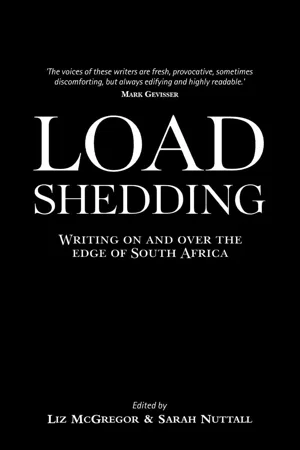
South Africa is not an easy place in which to live. Soaring crime levels, xenophobia, rampant corruption and the rise to power of the controversial Jacob Zuma all signal the end of the dream years. A new personal resilience is needed to cope with a new political uncertainty. Load Shedding is a collection of non-fiction stories by some of South Africa's pre-eminent authors, journalists and commentators, including Imraan Coovadia, Achille Mbembe, Deborah Posel and Karina Magdalena Szczurek, that reveal how we live under pressure. Written during the nation's period of electricity blackouts, these personal accounts shine new light on our contemporary South African world.
Information
1. If Only There Was a God
If Only There Was a God
Liz McGregor
I don’t know if this is common practice but in the ICU at the Rustenburg hospital where my mother died, the patients were kept naked under their sheets. Something about bedsores, I think one of the Tswana sisters said when I asked her. But communication was never good. We, a verbal, English-speaking family, used to asking questions and getting answers, found ourselves trapped in this moment of extreme stress between two stoic and silent cultures. The Afrikaans physician responsible for my mother’s care would stride in each morning at around 8 am, wave us away from her bedside, confer briefly with the sisters and then pronounce. When pneumonia invaded my mother’s lungs a few days after the operation on her broken hip, he said to my trembling, tearful father: ‘Shall I intubate her or let her die?’
He didn’t deign to explain how low her chances of survival were anyway and that, once they had inserted the tube into her lungs, they couldn’t remove it without a court order. When they stuck the tube down her throat, she gave one small heartbreaking cry and then they pumped her full of morphine and she drifted into a deep unconsciousness.
And so we sat there over her comatose body for five fraught days and nights while her organs failed, one after the other. When the kidneys went, her body began to swell with accumulated fluid. Slim and lithe in life, in her dying she acquired a grotesque pulpiness. The physician, in his fleeting morning visits, began making predictions: ‘She will be gone by evening.’ He was always wrong.
Guy, my older brother, and Liza, his wife, wanted to call in a priest to give her the last rites. My father refused. He had become increasingly averse to religion. In the early years of their marriage he had been tolerant of my mother’s Catholicism but by the time the last of us had left home, she too had turned her back on it. Only Guy and Liza still kept the faith. They draped a rosary across her chest and prayed over her. My sister, Cathy, read poetry to her. I sought solace in activity.
Arrangements needed to be made for when she did die. My father was in no state to deal with this and we had no friends in this benighted place to help. I found the hospital manager and asked for advice. She said she would investigate what the local funeral parlours offered and come back to us.
A couple of hours later, she came into my mother’s cubicle where Cathy and I sat hunched. There were two funeral parlours in Rustenburg, she said. We would need to select one and they would fetch the body from the hospital mortuary. Her English was halting. If we wanted my mother, ‘What is the word, incriminated?’ We stared at her, dumb with horror that she would discuss this in front of my mother. ‘Yes, incriminated,’ she said, taking our silence as acquiescence. ‘If you want her incriminated, these are the prices.’
When she had gone, I stroked my mother’s hair. ‘Don’t worry, Mom. We won’t let anyone incriminate you.’
On the fourth morning, the doctor said: ‘She definitely won’t last the night.’ By then we were all beyond exhaustion. The farm where my parents lived was 40 kilometres out of town, too far to go for regular breaks. As a result we barely left the hospital. My father was swallowing handfuls of tranquillisers and had stopped eating.
As evening fell, Guy and Liza went back to the farm for a rest. Cathy and I drove across Rustenburg to the Waterfall Mall, a fanciful name for such a drought-prone town. The parking lot was full of SUVs and double-cab bakkies. Big cars for big people: black and white alike. This is a town for the sturdy, a frontier town, fed by platinum mines and hunting farms, where physical strength is required to make a living. We ended up at the News Café, which was full of people eating, drinking, talking, flirting. We were the only white people but what set us apart in this room bursting with life was our preoccupation with impending death.
Back at the hospital, my father was still sitting in the chair at my mother’s bedside where we had left him. We took rugs from the car and lay down on the hard benches outside the ICU, pulling the wool up over our eyes to shield them from the neon light. On another bench, two black women sat upright side by side, a white blanket with pink roses pulled up over their faces like a shroud.
In the morning, my mother’s hands and feet were blue. Her failing heart couldn’t pump blood far enough. But still her chest rose and fell, courtesy of the respirator. My father, who had sat beside her all night, was white-faced and weeping. I didn’t think he could take much more.
‘How much longer?’ I demanded from the physician when he finally arrived.
‘I can’t say,’ he said huffily. ‘I’m not God.’ Finally, an admission. But he did ask the sister to increase the morphine being dripped into her arm.
Dad went back to the farm to rest. Guy and Liza returned. Cathy and I went down to the café below for tea and toast. We returned to find Liza sobbing over my mother. ‘She feels she’s let mom down because she wasn’t able to get her the last rites,’ said Guy.
Meanwhile, the additional morphine was having an effect. The zigzag line of her heartbeat on the monitor above her bed was slowly flattening. I called my dad but got his voicemail. Hours went by. The sister appeared at the doorway, a phone to her ear. She looked at the monitor and spoke into the phone. Then she came and adjusted the drip. ‘The doctor says to increase the morphine.’
Almost immediately the line began to flatten. I called my dad again. This time, he answered. ‘I took a sleeping pill,’ he said groggily.
‘I think you should start thinking about coming back,’ I said, trying not to sound too urgent. He’d always been a recklessly fast driver. I didn’t want him killing himself on the way in.
The line was almost horizontal. Her heart rate, which had been steady for days, plummeted. I thought: typical of these bloody people. They didn’t even bother to explain to us how quickly it would work. Now Dad won’t be here when she goes.
Then alarms went off and nurses rushed into the room. It was over. My only thought was: Dad is going to be so upset he wasn’t here.
*
In truth, my mother had been a long time dying. It was in early 2001 that her mind began to go. Alzheimer’s is a hideous disease: death by inches. A slow bereavement for us, her family. She looked like our mother but everything that made her our mother slowly disappeared until there was just the shell left; the ever deteriorating body. My father was inconsolable. She had been his mate for over 50 years and, for most of that, I think, it was a passionate marriage.
In his rage and grief, he retreated into survivalist mode: he bought this farm out in the arse-end of nowhere surrounded by neo-Nazi white farmers and drunken, hopeless black workers. Down the road was Skierlik where the young white boy reared on racial hatred had gone on a killing spree in a black informal settlement.
We, his five children, watched with awe (and some exasperation! Why couldn’t he take the easy route? Buy himself into a retirement village, with a frail care centre for my mother? But he had always danced to his own tune) as, at the age of 70-plus, he once again re-invented himself.
It was back to basics: he and his ailing mate against the world. He had guns, which he periodically fired off into the night – to let everyone around him know he was armed, he explained. He swapped his beloved Mercedes for a 4x4. With the help of an elderly and irascible but talented builder I found through my friends, Coco and Georgie, he built a rather beautiful house for himself and my mother. He did much of it himself: the design; the electrics, the plumbing. He sunk a septic tank for sewage and put a tank up on the hill above the house for water. He erected a mast on a nearby hill, powered by solar energy, to give him cell coverage and Internet access. My brother Andrew made sure he retained enough of a connection to Who Owns Whom, the company they had started together, to fund this financially voracious adventure. In some ways he did create a little paradise. Vervet monkeys clattered over the roof and baboons barked from a nearby ridge. He bought zebra, kudu and waterbuck, and every evening, he would take my mother on a game drive. When we visited, we always had to have sundowners in the hide he had built overlooking a dam where the buck came to drink.
Yet he found no peace. My mother, now almost entirely silent, followed him wherever he went, her eyes fixed on his face. He changed her nappies, fed her, bathed her and medicated her, mostly for her incessant anxiety. She must, at some level, have realised what was happening to her and it terrified her.
He hired a succession of carers but they invariably turned out to be dishonest or inept. No one of quality would stay for any length of time in such a remote place. Either that or he or my mother didn’t take to them, which happened quite a lot. I think neither of them really wanted a third party in the house. The most consistent help he had was from Julia, the tiny local woman who came in to clean. Julia slowly drank her way through all the alcohol in the house. She had four children by four different men and lived with HIV, which meant my father had the added burden of taking her into town for regular trips to doctors and clinics. But she was a gentle person and my mother would allow her to bathe and feed her, which gave Dad a break.
I’ve always been close to my father: I was born on his birthday, his first daughter. We are similar in temperament. I have always relied on his clear, razor-sharp mind to help me think through any issue that was troubling me. The pride and delight he took in me – for him, almost anything I did was quite startling in its brilliance – has warmed and bolstered me throughout my life. Which is not to say that it wasn’t a complex relationship, with its fair share of monumental rows over the years. But he was part of me and I was part of him.
During those last years of my mother’s life, I felt I lost him as a father. Every time I saw his name flash up on my cellphone, I braced myself for an onslaught of anger and neediness. He had deliberately isolated himself yet he craved our company. Cathy, Liza and I took it in turns to spend weeks at the farm helping him with my mother. It was never enough: he was still alone with her most of the time and every few months there was some new crisis. So it was no surprise to get an email from him one morning in late July to say my mother had fallen in the night and broken her hip. By the time he got back to his computer to write to us, she had already been operated on, apparently successfully.
It was our joint birthdays a couple of days later – 2 August – so, with Mom safely recuperating in hospital, Dad came into Joburg, and Andrew and his wife, Karen, took us to dinner at Dad’s favourite restaurant, The Grillhouse in Rosebank Mall. I told Dad I would come back to the farm with him and help him settle my mother back in once she had been discharged. But, as it turned out, she never left the hospital. Exactly a week after that dinner, on 9 August, she died.
*
We had my mother’s memorial service on 17 August 2007, in McGregor, the whimsical Boland village where they had lived for much of the eighties. Dad, still in uncharacteristically passive mode, let us make the decisions ‘as long as there is no bloody religion involved’. McGregor’s Temenos Retreat, with its low-key, haphazard spirituality – buddhas and ganeshas and madonnas scattered in an indigenous garden – seemed a good compromise. There was an agenda behind the choice of McGregor: we hoped he would sell up at the farm and return to live there. He still had friends there and, with its many free-spirited residents of a certain age, there was an informal supportive network that he could rely on without sacrificing his independence.
*
Back at the farm he fell apart. A psychiatrist he consulted for his overwhelming grief put him on antidepressants so strong that he slept most of the time. He told us later that, in the few hours he was conscious, he would walk around the house howling out loud. We offered to come and stay but he insisted on being alone.
He sent us all an email: ‘In retrospect it was a big mistake to have had Mom intubated. I could have saved all of us that last dreadful week. Please note that if I am ever in the same position, I DO NOT want to be intubated. Love, Dad.’
We sent back jokey emails: ‘Me too!’, ‘Me too!’ Partly in an attempt to distract him, partly because even the prospect of another parental death at that point w...
Table of contents
- Cover
- Description
- Title Page
- Acknowledgements
- Foreword
- 1. If Only There Was a God
- 2. My Defence Force
- 3. Midnight
- 4. Serene in My Skin
- 5. Excerpts from My Diary February – December 2008
- 6. Risky Returns
- 7. War Envy
- 8. Marginal Gains
- 9. Given Half a Chance
- 10. The Bequest
- 11. Absences
- 12. Shedding Light
- 13. An Unsuitable Girl
- 14. Beauty
- 15. I Love You, I Hate You – August–September 2008
- Copyright Page
Trusted by 375,005 students
Access to over 1.5 million titles for a fair monthly price.
Study more efficiently using our study tools.
Frequently asked questions
Yes, you can cancel anytime from the Subscription tab in your account settings on the Perlego website. Your subscription will stay active until the end of your current billing period. Learn how to cancel your subscription
No, books cannot be downloaded as external files, such as PDFs, for use outside of Perlego. However, you can download books within the Perlego app for offline reading on mobile or tablet. Learn how to download books offline
We are an online textbook subscription service, where you can get access to an entire online library for less than the price of a single book per month. With over 1.5 million books across 990+ topics, we’ve got you covered! Learn about our mission
Look out for the read-aloud symbol on your next book to see if you can listen to it. The read-aloud tool reads text aloud for you, highlighting the text as it is being read. You can pause it, speed it up and slow it down. Learn more about Read Aloud
Yes! You can use the Perlego app on both iOS and Android devices to read anytime, anywhere — even offline. Perfect for commutes or when you’re on the go.
Please note we cannot support devices running on iOS 13 and Android 7 or earlier. Learn more about using the app
Please note we cannot support devices running on iOS 13 and Android 7 or earlier. Learn more about using the app
Yes, you can access Load Shedding by Liz McGregor in PDF and/or ePUB format, as well as other popular books in Social Sciences & Sociology. We have over 1.5 million books available in our catalogue for you to explore.