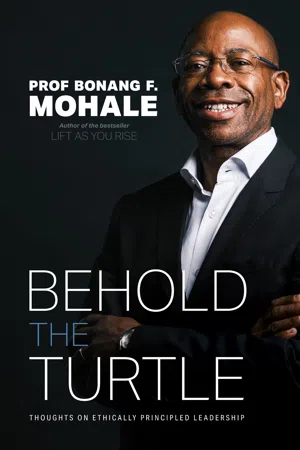
- 304 pages
- English
- ePUB (mobile friendly)
- Available on iOS & Android
eBook - ePub
About this book
Behold the turtle, he only makes progress when his neck is stuck out.
This proverb, included in Bonang Mohale's best-selling first book, Lift As You Rise, sets the tone for his second book, which includes fresh insights and wisdom from one of South Africa's best-loved leaders. As a change agent, defender of democracy and a social justice activist, Bonang continues to stick his own neck out, addressing issues of key societal importance. Following on from the success of his first book, his new book, Behold the Turtle – Thoughts on Ethically Principled Leadership, expands on issues of leadership, resilience, ethics and social justice – sounding a call for change.
Never one to avoid tough issues, Bonang tackles the role that business, institutions of higher learning and other organisations need to play in creating South Africa's future, as well as the risk and responsibility required of each of us as individuals.
The book incorporates insights from Bonang's respected colleagues, such as Mteto Nyati, Adrian Gore, Andile Nomlala, Vukani Mngxati, and Nicola Kleyn, who add personal lessons and anecdotes, creating a pool of wisdom from which readers can drink deeply.
Citing Alexander the Great, Bonang says, 'I am not afraid of an army of lions led by a sheep, I am afraid of an army of sheep led by a lion.' This book focuses on ethical leadership and embracing our own agency.
A MUST-READ!
Professor Bonang F. Mohale is the Chancellor of the University of the Free State, Professor of Practice at the Johannesburg Business School (JBS) College of Business and Economics, Chairman of both Bidvest Group Limited and SBV Services, President of Business Unity South Africa, former CEO of Business Leadership South Africa and past president of the Black Management Forum.
Information
BEHOLD
THE
TURTLE
Thoughts on Ethically Principled Leadership
First published by Tracey McDonald Publishers, 2021
Suite No. 53, Private Bag X903, Bryanston, South Africa, 2021
www.traceymcdonaldpublishers.com
Copyright © Bonang Mohale, 2021
All rights reserved.
No part of this book may be reproduced, stored in a retrieval system, or transmitted in any form or by any means, electronic, mechanical, photocopying, recording, or otherwise, without the prior written permission from the publisher.
ISBN 978-1-920707-31-6
e-ISBN (ePUB) 978-1-920707-32-3
Text design and typesetting by Patricia Crain, Empressa
Narrative compilation by Tamara Oberholster, Word Chef
Cover design by Tomangopawpadilla
Cover photograph by Devin Lester Photography
Digital conversion by Wouter Reinder
CONTENTS
FOREWORD
PREFACE
PART 1 BRIDGING TWO PANDEMICS
PART 2 COVID-19: A TEST WE ARE BOTH PASSING AND FAILING
PART 3 EDUCATION
PART 4 LEADERSHIP
PART 5 COLLABORATION AND COMMITMENT
PART 6 GOVERNMENT AND GOVERNANCE
PART 7 ETHICS
PART 8 SUSTAINABILITY
PART 9 EQUALITY AND INCLUSIVITY
PART 10 TRIBUTES
FINAL WORDS
EPILOGUE
BRIEF BIOGRAPHY
ENDNOTES
FOREWORD
Following on his first book, Lift As You Rise, the unstoppable Bonang Mohale now offers us Behold the Turtle.
This book is a compilation of previous articles and speeches, letters, tributes, thoughts on leadership in all its aspects, and more. An affidavit is thrown in for good measure. And then there are the unusual, or is it unique, testimonial contributions penned by 10 leading South Africans from academia and the corporate world. This testimonial treatment easily translates into a biography and attests to Bonang’s character.
But ultimately this book is a treatise on leadership. The tone throughout the book is simultaneously motivational and challenging. A positive energy emanates from each page. And so does a sense of urgency, so characteristic of Bonang.
His diagnostic approach to our country’s ills is clinical, clearly contextualised through a historical prism, of present-day South Africa. Whilst decidedly opinionated, he backs his arguments with facts. As Wiseman Nkuhlu opines in the book, Bonang has ‘a keen interest in facts’. And data. Numbers come easily for Bonang through his facile use of statistics.
State capture is seen as a pandemic, a precursor to the ‘corona-coaster’, living with the ups and downs during the current pandemic, and our mixed response to it. A change in human behaviour is called for, spurred by the lives versus livelihood conundrum. In an almost evangelical tone he asserts that COVID-19 provides for not just a new normal, but a ‘better’ normal, one that delivers prosperity to the people of South Africa.
Bonang writes about how B-BBEE, whilst not a permanent feature, can and must be used to erase economic inequality. Gender equality is another subject matter. And then there are proposals on how we can fix our state-owned enterprises. Business is reminded of its role as a catalyst for social change. Business must do good and be values driven.
Education is seen as a bridge for class distinction, for independent thinking and a sine qua non for civilisation and poverty eradication. He writes about transformation not just from a racial or gender perspective, but how education can serve to internalise better human behaviour. And this is done through use of Afrocentric language and idioms.
Bonang reflects on a new agenda for leadership. A leadership that encompasses transparency and accountability, is ethical and visionary. For him ‘The Two Weeks in July’, when broad and general mayhem visited Gauteng and KwaZulu-Natal, was the coagulation of ethno-tribalism, criminality and economic desperation. The failure to contain the looting and destruction is placed squarely on the ruling party.
Bonang also examines in detail leadership aspects such as succession planning; servant leadership, the dearth of continental leadership, ethical leadership, etc.
Various policy documents are examined and how these can lead to national cohesion. He argues for the democratisation of capitalism through ensuring that capitalism lives side by side with human rights. The book also delves into the great global issue of the day, namely equality and inclusivity.
Personal and heartfelt tributes are paid at the end of the book to recently departed South African leaders.
Read this book and be inspired!
B. PETER VUNDLA
PREFACE
How the world has changed, dear reader, since my first book, Lift As You Rise, was published in 2018.
The launch of that book will forever remain one of the highlights of my life. I was completely unprepared for the level of support it would receive – that I would receive. I was touched and humbled by all those who came to the launch at the Exclusive Books store in Sandton City, forming a queue down the corridors of the shopping centre, and by all those who purchased copies for themselves or their teams. I was thrilled to see the book sitting on the local best-sellers list alongside such international works as Michelle Obama’s Becoming.
At the time, I imagined that my next book would be more autobiographical and be written from a small farm that I would retire to, spending my days reflecting and living off the land, as I had long planned.
Little did any of us know what lay ahead for South Africa and for the world! That is probably a good thing too, or we may not have had the courage to face what was coming.
In 2018, South Africa had emerged from nine years of the Zuma presidency, battered by state capture – a national crisis that to this day casts a long shadow over us all. At the time, I was CEO of Business Leadership South Africa (BLSA) and we flagged the two leadership challenges that we believed lay ahead of us: the need for state building to address the decimated public administration, and to retain and even strengthen our active citizenry.
At BLSA we embarked on a campaign called #BusinessBelieves, which launched on 23 August 2017. BLSA had entered into a contract with South Africa, committing to playing its part in creating a South Africa of increasing prosperity for all by harnessing the resources and capabilities of business in partnership with government and civil society to deliver economic growth, transformation and inclusion.
We were in a good (or at least better) place as a country, following the recall of Jacob Zuma and the victory of Cyril Ramaphosa at the 54th ANC Policy and Elective Conference and his subsequent unopposed election to President of South Africa by the National Assembly on 15 February 2018.
Although I cautioned that we should remain vigilant and avoid sliding back into complacency, I was optimistic about what the next period held in store. Confident that I had played my part at BLSA, I felt ready for the next chapter in my life. In June 2019 I ended my term at the organisation, choosing to hand over the reins to the eminently competent and energetic ‘Me Busisiwe Mavuso, who was my own choice as my successor and with whom I had been working side-by-side for 20 months in preparation for this moment.
However, those who know me will know that I am not very good at sitting still! I was invited to join the board of Bidvest Group Limited as an independent non-executive director. I felt it was a nice piece of biltong I could sink my teeth into and was humbled by the offer, which I accepted. Within a year, I was honoured to be elected as Chairman of Bidvest.
I was then offered a full professorship at the Johannesburg Business School (JBS) College of Business and Economics. As Professor of Practice, I now teach global MBA students, although I maintain that I learn as much from them as they do from me. So you see, I came to teaching by accident.
Then, just under a year after my so-called retirement, I was offered the position as Chancellor of the University of the Free State. I was appointed on 4 June 2020, in the midst of the COVID-19 pandemic.
I remain involved with three other boards – I am an independent non-executive director for Swiss Re Africa Limited and Rand Merchant Bank Limited (RMB), and I chair the board of SBV.
These things have kept me active, alive and busy, for which I am grateful.
At the time of writing this, South Africa has been in one or another level of COVID-19 lockdown for more than 500 days and the world has changed beyond what any of us could have imagined in 2018. We are still grappling with the long tail of state capture, and the Zondo Commission1 has dragged on. I include my own submission to the Commission on the following pages.
On top of this, South Africa continues to suffer from structural inequalities, laid even barer by the unrest of July 2021, which saw rioting and looting sweeping across areas of Gauteng and KwaZulu-Natal, as well as the taxi strikes in the Western Cape.
And so, instead of a book of quiet reflections on life’s lessons and farm living from a retiree, this book is another call for leadership. In these deadly times, one thing that’s been dem...
Table of contents
- 9781920707323
Trusted by 375,005 students
Access to over 1.5 million titles for a fair monthly price.
Study more efficiently using our study tools.
Frequently asked questions
Yes, you can cancel anytime from the Subscription tab in your account settings on the Perlego website. Your subscription will stay active until the end of your current billing period. Learn how to cancel your subscription
No, books cannot be downloaded as external files, such as PDFs, for use outside of Perlego. However, you can download books within the Perlego app for offline reading on mobile or tablet. Learn how to download books offline
Perlego offers two plans: Essential and Complete
- Essential is ideal for learners and professionals who enjoy exploring a wide range of subjects. Access the Essential Library with 800,000+ trusted titles and best-sellers across business, personal growth, and the humanities. Includes unlimited reading time and Standard Read Aloud voice.
- Complete: Perfect for advanced learners and researchers needing full, unrestricted access. Unlock 1.5M+ books across hundreds of subjects, including academic and specialized titles. The Complete Plan also includes advanced features like Premium Read Aloud and Research Assistant.
We are an online textbook subscription service, where you can get access to an entire online library for less than the price of a single book per month. With over 1.5 million books across 990+ topics, we’ve got you covered! Learn about our mission
Look out for the read-aloud symbol on your next book to see if you can listen to it. The read-aloud tool reads text aloud for you, highlighting the text as it is being read. You can pause it, speed it up and slow it down. Learn more about Read Aloud
Yes! You can use the Perlego app on both iOS and Android devices to read anytime, anywhere — even offline. Perfect for commutes or when you’re on the go.
Please note we cannot support devices running on iOS 13 and Android 7 or earlier. Learn more about using the app
Please note we cannot support devices running on iOS 13 and Android 7 or earlier. Learn more about using the app
Yes, you can access Behold the Turtle by Bonang Mohale in PDF and/or ePUB format, as well as other popular books in Business & Business Ethics. We have over 1.5 million books available in our catalogue for you to explore.