- 300 pages
- English
- ePUB (mobile friendly)
- Available on iOS & Android
eBook - ePub
About this book
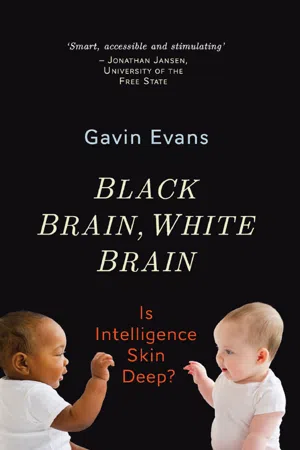
By far the most important book yet written to systematically debunk society's lingering attachments to race science and its pet topics of intelligence, genetics and civilization.' - Jonathan Jansen, University of Free State Racist thinking - that intelligence is influenced by racial origin - was part of mainstream science a century ago and, surprisingly, is still endorsed by maverick scientists at some of the world's most respectable institutions. The myths being perpetuated on genetics, race, IQ and general intelligence are what Black Brain, White Brain challenges - precisely, systematically and in painstaking detail. In this immensely readable book Gavin Evans tackles highly complex subjects, from the origin of humans and the genesis of intelligence to athletic performance and genes, IQ and cleverness, in a fluent and engaging style that makes science accessible and the facts absorbing. Carefully balancing claims, testing dodgy propositions and presenting fairly the theories of modern scientists and evolutionary psychologists, Evans shows just how uniform we are, genetically, as a species and that it's mainly the environment we grow up and live in that's the determining factor.
Information
Subtopic
Human GeographyIndex
Social Sciences1
AN INTRODUCTION IN BLACK AND WHITE
Here are a few things you may have read over the last decade or so about race and intelligence: that Europeans and Asians evolved to be more intelligent than Africans because of their exposure to ice age conditions 45 000 years ago; that there is a gene variant that makes sub-Saharan Africans less intelligent than everyone else; that the smartest people on earth today are Ashkenazi Jews, followed by East Asians and white Europeans and Americans; that the dumbest people on earth are Bushmen and Congo Pygmies, followed by Australian Aboriginals and Ethiopians; that poor people are poor because they are stupid, which is why there are so many underclass black people; that the prime cause of poor health all over the world is low IQ, which is why Africa suffers; and that infectious diseases have affected the genomes of Africans, making them less intelligent. And even more recently, you might have heard that Jews evolved to be well suited to capitalism, the English evolved to work hard, the Chinese to be authoritarian, Finns to become violent when drunk and the Africans, well, simply to be tribal.
You may think such claims are confined to the anonymous midnight trolls who furiously patrol racist websites, or the backwoodsmen of Confederate America or, indeed, of apartheid South Africa where I grew up. Certainly, the idea of a link between race and intelligence has a long pedigree – at least as ancient as slavery and colonialism. But now, after a post-Holocaust lull, scientific racism has returned. Claims like these are being trumpeted by a renegade band of scientists, anthropologists, IQ proselytisers, pop-science authors and evolutionary psychologists who have managed to grab disproportionate mainstream media attention. These ideas have also spread far and wide on the Web, sometimes coming out of the mouths or computers of surprising sources.
To take perhaps the best-known of many examples, one of America’s greatest living scientists, James Watson, Nobel laureate and codiscoverer of the structure of DNA, attracted headlines for trumpeting his belief that black people were inherently less intelligent than whites. Having previously advocated eugenic solutions to weed out less intelligent people, he started speaking out on race in 2000 when he announced there was a link between darker skin and higher libidos. Seven years later he went significantly further, saying that the idea that blacks and whites shared ‘equal powers of reason’ was a delusion and that ‘people who have to deal with black employees find this is not true’.1 Subsequently, in the midst of an outcry over these views, he apologised, but then made it clear in a newspaper comment feature that he had not changed his mind, noting that the desire of society ‘to assume that equal powers of reason are a universal heritage of humanity’ was ‘not science’, and that it was not racist to question this assumption.2
Watson’s outburst was in the same tradition as that of another Nobel Prize science laureate, William Shockley, who believed that higher rates of reproduction among innately unintelligent black people were prompting a decline in civilisation, and that nature had ‘colour-coded’ population groups so that people could make ‘reliable predictions of their adaptability to intellectually rewarding and effective lives’.3
I spent most of my childhood in South Africa, where this brand of race consciousness, partly premised on scientific racism and partly on simple prejudice (they often go together), was deeply embedded in the cultural pores of the white population. The notion of apartheid was founded on the view that each race had its own mentality, attributes and potential, and each its own ‘stage of development’. In reality, within the 87% of the country designated as white, there were three classes of citizen: whites at the top, Indians and mixed-race people in the middle and Africans at the bottom.4
This Nazi-influenced racial science had its heyday in the 1930s and 1940s before morphing into policies that prompted the forced removal of 3.5 million black people from their homes, meaning that the only contact most whites had with black people was as servants or workers. Growing up as a member of the ‘European’ population meant that all this land and all the privileges accompanying it were taken for granted. It was the norm. And with it came a casual racism that could easily turn virulent. I recall hitchhiking around the country in my teens and being told by a very pleasant-seeming English-speaking driver that ‘the problem with the black mind is that it can only learn things one way, and when things don’t work that way it gets confused. You can teach him that the wheel goes clockwise when it goes forward, but if one day the wheel goes anticlockwise, he won’t understand. It’s a known fact, and that’s why he won’t ever invent anything, and he’ll always rely on us.’
This kind of talk reflected the conception that Africans did not have the intelligence to govern themselves and needed white overlords to hold the ring. All race groups were said to have in-built characteristics – blacks were incapable of abstract intellectual thought but were volatile and highly sexed, Jews and Indians were innately calculating and money-grabbing, Coloureds had a genetic propensity towards alcoholism, and so on. For me, these ideas were challenged through reading beyond the school curriculum, through having relatively liberal parents and, later, through involvement in anti-apartheid campaigns and organisations, which meant I was working on a day-to-day basis with people who weren’t white. The anti-apartheid cause eventually won the day, but even now, more than two decades on, with the country having overcome the most overt dimensions of this heritage, the people, both black and white, struggle to conceive of the world without a race-tinted lens. A person is not simply a person but a black person, a white person, a Coloured person or an Indian person.
I also came across residues of these notions when living in Texas in the late 1970s. One rancher I knew took me aside and, nodding his head sagely, said that while he had nothing against individual black people of his acquaintance, if anyone had asked him to contribute to a fund to assassinate Martin Luther King, he would have been only too delighted to pay up, and that he still felt exactly the same way about ‘uppity niggers’. When I moved to England in the early 1990s I anticipated this kind of thinking would be restricted to a tiny rump – and, for the most part, my hopes were realised. Now and then, however, it would pop up, sometimes in salubrious surroundings. One of the earliest stories I wrote after returning to London was on the Monday Club of the Conservative Party. One of its senior members, a lord in tweeds, took me into his confidence and told me how cold European weather created conditions for the evolution of the human brain, leaving the Africans behind. It did not occur to him to ask why the earliest expressions of civilisation emerged in hot countries.
What surprised me even more was finding such ideas edging their way into the media mainstream, and gaining extensive and surprisingly uncritical reception. Their increasing prevalence, particularly on the Web, was worrying enough to prompt me to revisit debates I thought I’d left behind in apartheid South Africa. And so I began reading again on issues relating to race and racism – getting to grips with the new variants of scientific racism that seemed to be resurfacing all over the place.
My academic background was in economic history and law, and my PhD was in politics, and for a quarter of a century I had worked as a journalist and lectured on the media. All of this helped, but my reading took me to places I’d barely ventured before: evolutionary biology, palaeontology, biological anthropology, archaeology, neuroscience, and educational and evolutionary psychology, because it soon became clear that the contemporary variants of race science came from several overlapping zones – in particular, theories of human origin, theories of intelligence and of IQ, and theories of evolution. More specifically, the scientific racism underpinning views like James Watson’s was based on three contentions.
First, that our brains, like our bodies, have continued to evolve in response to different environmental conditions, leading some races or population groups to develop superior intelligence to others. Specifically, it is argued by the punters of racial science, the extreme challenges created by periodic ice ages in Europe encouraged the further evolution of the brain after groups of humans left Africa 50 000 years ago and made their way through Asia to Europe, prompting what Eurocentric anthropologists called a ‘human revolution’.
Second, evidence for this conceptual leap includes the flowering of cave art and other creative innovations in parts of Europe, some of it carbon dated at over 35 000 years old. Since then, it is argued, relatively isolated groups (such as Ashkenazi Jews) faced conditions encouraging further evolution of their intelligence, while others (such as Bushmen and Pygmies) have been left far behind.
This was the perspective of the race scientists of apartheid, but over the last two decades variants of these ideas have been echoed by several prominent American and European-based scientists and psychologists. For example, the University of Chicago-based Chinese geneticist Bruce Lahn made big waves in the mainstream media, which rippled around racist websites, by claiming that two relatively recent gene variants were implicated in intelligence and brain size, and were less prevalent in sub-Saharan Africa than elsewhere.
Third, they claim, the decisive proof of hard-wired racial differences in intelligence comes from IQ tests, which are capable of measuring innate ‘general’ intelligence. They argue that the reliability of these tests as an accurate measure of intelligence is proved by studies of twins, which show that IQ is highly heritable.
Again, this was a staple of educational psychology in apartheid South Africa, where there was a devotion to IQ testing (I’d already been tested twice in my state school by the age of 12) and a belief that they provided proof of innate intelligence. IQ testing was also used to bolster the belief that white people were inherently smarter than black people.
Such thinking has also found fertile ground in American psychology, with its devotion to IQ testing. There is considerable variation in IQ scores when assessed on a population basis, with, for example, Asian Americans having higher average scores than white Americans, who have higher average scores than African Americans. These psychologists have argued that this racial variation in IQ proves their point that brains of different race groups have evolved differently. They frequently add that those who ignore this evidence are simply being ‘politically correct’ by obdurately refusing to go where the scientific evidence leads.
Before getting to grips with the detail of the specific claims made by the racial scientists, it is worth taking a quick look at these underlying premises.
One area of confusion relates to the fact that in certain limited ways human bodies continued to evolve within and beyond Africa, illustrated through diseases that proliferate more in some ethnic groups than others. But none of this has any bearing on the evolution of human intelligence, which is far more complex, partly because it is an abstract notion that is hard to define (intelligence comes in a variety of guises). But even if we restrict our notion of intelligence to the IQ variant, it involves numerous gene combinations and different parts of the brain. More than 10 000 genes are implicated in the development and functioning of the brain, and neuroscientists believe that a network of thousands of these (which would have evolved for a variety for reasons – most not related to natural selection) are implicated in intelligence. Specifically, no single gene has been found for IQ (Lahn, for one, produced no evidence that the gene variants he isolated had any bearing on intelligence).
The American palaeoanthropologist Ian Tattersall, widely acknowledged as one of the world’s leading experts on the Cro-Magnons (the European-based cave-dwelling humans), says that long before humans left Africa for Europe they reached the end of the line as far as significant evolution of their brains. ‘We don’t have the right conditions for any meaningful biological evolution of the species,’ he said. ‘In order to get the fixation of evolutionary novelties … you need to have small isolated populations. Large, interbreeding populations are just not the right place for innovations to become fixed.’5
One of the remarkable dimensions of the human genome is how little genetic variation there is between us compared to other mammals – largely because of our relatively recent evolution, probably from a single African ‘Eve’. As the British ethologist Richard Dawkins puts it: ‘We are indeed a very uniform species if you count the totality of genes, or you take a truly random sample of genes.’6
Contrary views, such as James Watson’s, claiming there are racial or geographical genetic differences regarding intelligence, are not taken seriously among biologists focusing on human evolution. For example, Craig Venter, the American scientist who led the private effort to decode the human genome, noted in response to Watson’s outburst that ‘skin colour as a surrogate for race is a social concept, not a scientific one’. And he added: ‘There is no basis in scientific fact or in the human genetic code for the notion that skin colour will be predictive of intelligence.’7
Certainly, there is no evidence for the view that the cold weather of Europe prompted further evolution of the brain. One could just as well claim that hot climates had the same effect – by pointing to the early emergence of agriculture and writing and city states in the heat of Mesopotamia, China, Egypt, Nubia, Anatolia and India. And the focus on European cave art as proof of superior intelligence is also highly selective. For one thing, cave art emerged in Australia in roughly the same period as in Europe, but artistic expression starts far earlier – in Africa. In caves in the Western Cape province in South Africa there is evidence of geometric art carbon dated at 75 000 years, and of the use of blended paint and sophisticated tool-hardening techniques carbon dated at 100 000 years. In other words, it seems clear that the humans who left Africa nearly 70 000 years ago and eventually ended up in Australia, or who left for Asia and Europe 20 000 years later, had brains capable of symbolic, artistic behaviour and of scientific experimentation – in all probability, people with brains very much like ours.
The idea that the proof of racial differences in intelligence can be drawn from IQ tests is also spurious. What IQ tests measure is the capacity to cope with a certain kind of abstract logic. They do not, and cannot, measure ‘general’ intelligence. Over the last three decades, those involved with IQ testing have been aware of what is now called the ‘Flynn effect’8 – the discovery that over each generation IQ tests need to get progressi...
Table of contents
- Cover
- About the Book
- Title Page
- Contents
- 1: AN INTRODUCTION IN BLACK AND WHITE
- PART 1: OUR AFRICAN HERITAGE
- 2: 200 000 YEARS OF MODERN HUMANITY
- 3: THE MYTHS OF CIVILISATION
- PART 2: RACE, RACISM AND BIOLOGY
- 4: ORIGINS OF RACE, ORIGINS OF RACISM
- 5: RACE AND THE QUEST FOR AN INTELLIGENCE GENE
- 6: BLACK MEN CAN SWIM, WHITE MEN CAN RUN
- PART 3: RACISM AND IQ
- 7: A SHORT HISTORY OF RACE AND IQ
- 8: THE TWO JIMS: WHAT TWIN STUDIES TELL US ABOUT IQ (AND WHAT THEY DON’T)
- 9: THE FLYNN EFFECT: HOW THE ENVIRONMENT SHAPES IQ
- 10: THE BELL CURVE AND THE REVIVAL OF RACE SCIENCE
- 11: RICHARD LYNN AND THE IQ OF NATIONS
- 12: THE JEWISH INTELLIGENCE DEBATE
- 13: THE FUTURE OF RACE SCIENCE
- 14: POSTSCRIPT: RACE, INTELLIGENCE AND IQ
- NOTES
- GLOSSARY
- BIBLIOGRAPHY
- INDEX
- Copyright Page
Trusted by 375,005 students
Access to over 1.5 million titles for a fair monthly price.
Study more efficiently using our study tools.
Frequently asked questions
Yes, you can cancel anytime from the Subscription tab in your account settings on the Perlego website. Your subscription will stay active until the end of your current billing period. Learn how to cancel your subscription
No, books cannot be downloaded as external files, such as PDFs, for use outside of Perlego. However, you can download books within the Perlego app for offline reading on mobile or tablet. Learn how to download books offline
Perlego offers two plans: Essential and Complete
- Essential is ideal for learners and professionals who enjoy exploring a wide range of subjects. Access the Essential Library with 800,000+ trusted titles and best-sellers across business, personal growth, and the humanities. Includes unlimited reading time and Standard Read Aloud voice.
- Complete: Perfect for advanced learners and researchers needing full, unrestricted access. Unlock 1.5M+ books across hundreds of subjects, including academic and specialized titles. The Complete Plan also includes advanced features like Premium Read Aloud and Research Assistant.
We are an online textbook subscription service, where you can get access to an entire online library for less than the price of a single book per month. With over 1.5 million books across 990+ topics, we’ve got you covered! Learn about our mission
Look out for the read-aloud symbol on your next book to see if you can listen to it. The read-aloud tool reads text aloud for you, highlighting the text as it is being read. You can pause it, speed it up and slow it down. Learn more about Read Aloud
Yes! You can use the Perlego app on both iOS and Android devices to read anytime, anywhere — even offline. Perfect for commutes or when you’re on the go.
Please note we cannot support devices running on iOS 13 and Android 7 or earlier. Learn more about using the app
Please note we cannot support devices running on iOS 13 and Android 7 or earlier. Learn more about using the app
Yes, you can access Black Brain, White Brain by Gavin Evans in PDF and/or ePUB format, as well as other popular books in Social Sciences & Human Geography. We have over 1.5 million books available in our catalogue for you to explore.