- 300 pages
- English
- ePUB (mobile friendly)
- Available on iOS & Android
eBook - ePub
About this book
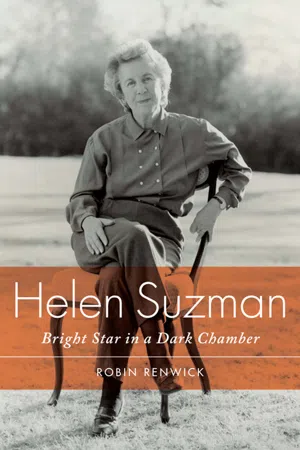
When Robin Renwick was appointed British ambassador to South Africa in 1987, he formed a deep friendship with Helen Suzman. Now, drawing on her personal papers, Renwick sets out to capture the qualities of the woman who, in the face of the hostility of the apartheid regime, carved out a unique role for herself as an intrepid fighter for human rights, simple justice and the rights of prisoners and the disenfranchised majority. Her steely determination in pursuit of these principles earned her the admiration of millions of South Africans, black and white. As she memorably said: 'Like everybody else I long to be loved but I am not prepared to make any concessions whatsoever.' In Bright Star in a Dark Chamber, Renwick recalls her biting wit, fierce intelligence and close friendship with Nelson Mandela, formed when he was still behind prison bars.
Information
Chapter I
And when he was dead, did you still think he was shamming?
On 25 September 1977 a large, angry and hostile crowd of black South Africans gathered on the outskirts of King William’s Town in the east of the Cape Province for the funeral of Steve Biko.
Biko had been an organiser for the all-black South African Students’ Organisation (SASO). He became the leading spokesman of the Black Consciousness Movement (BCM), according to which black people had first to get rid of the mental servitude that had developed among them. They must look to themselves for their own salvation. This was a more radical doctrine than that of the ANC, and, with the charismatic young Steve Biko at its head, the movement rapidly developed a large following among the region’s desperately poor townships.
Biko’s close friend Donald Woods, the leading newspaper editor in the region, had contacted Helen Suzman to arrange for Steve Biko to meet her during a visit he was planning to make to Cape Town. En route to Cape Town by car, Biko and a coloured friend, Peter Jones, were stopped and detained by the police. On 6 September he was taken by the security police to Port Elizabeth, where he was interrogated for 48 hours. He then was transferred to Pretoria Central prison, over 1 100km away, in the back of a Land Rover. He died in the prison hospital on 12 September, aged 30. Dr Jonathan Gluckman, called in by Biko’s family to conduct a postmortem, telephoned Helen Suzman. ‘Helen, they murdered him,’ he said.
At the subsequent inquest, much of which she attended, the great advocate Sydney Kentridge cross-examined one of the security policemen who had been a member of the interrogation team. Kentridge asked whether he had thought Biko was shamming injuries during his brutal interrogation. ‘Yes, your worship,’ was the reply. Kentridge asked the security policeman whether he thought Biko still was shamming when he found him sitting fully clothed in a bathtub full of water. ‘Yes,’ he replied. When Kentridge asked, once Biko was dead, did he still think he was shamming, ‘Yes, your worship,’ was the reply.
The inquest came after the funeral. But none of the tens of thousands of mainly young, male, black South Africans attending that event had any doubt what had happened to Steve Biko. Helen Suzman attended the funeral with two of her Progressive Party colleagues, Alex Boraine and Zach de Beer. The field was sodden. As they tried to make their way toward the podium through the huge crowd, their passage was barred by a group of young men, one of whom told them in a very hostile manner: ‘We don’t want you whites here.’ Helen said that they had come to pay their respects to Steve Biko, but was told that she should go and talk to Vorster and Jimmy Kruger (the Minister of Justice, who infamously stated that Biko’s death ‘left him cold’).
As the crowd hemmed them in, she became angry. ‘I’m Helen Suzman,’ she said, ‘and I’ve come to pay my respects to Steve Biko.’
‘Who did you say you are?’ was the response.
‘I’m Helen Suzman.’
‘You prove that.’
With difficulty, she managed to open her handbag and extract a credit card. At this she was told, ‘Mrs Suzman, I beg your pardon. You may certainly go through.’ The crowd parted, causing Zach de Beer to say: ‘Now I have seen everything!’
They reached the podium, which promptly collapsed. But they then witnessed an immensely impressive ceremony, with 20 000 black South Africans ‘singing their heads off’ in a spectacular display of sorrow and resistance.1
* * *
To Helen Suzman’s fury, the magistrate presiding at the inquest, MJ Prins, refused to attribute any blame to the security police for Biko’s death, though the evidence clearly showed that he had been struck on the head, causing extensive brain damage. In parliament she laid the responsibility squarely at the feet of Minister Kruger, saying of Steve Biko that he had been kept without clothing for days on end, in handcuffs and leg irons and, when already gravely ill, was transported unconscious in the back of a Land Rover for over 1 000 kilometres to Pretoria. The officer in charge, Colonel Piet Goosen, had told the inquest that the security police did not operate under any statutes. They were a law unto themselves.
As for Kruger, he first stated that Biko had died of a hunger strike and that it was a man’s democratic right to starve himself to death. He then had changed his story to say that ‘heads may roll’, but none did. He was told by Mrs Suzman in full parliament that he would carry to his grave the infamy of his statement that Biko’s death ‘leaves me cold’.
Donald Woods was subjected to a banning order, rendering it impossible for him to publish his impassioned articles about the circumstances of his friend’s death. He and his family left South Africa in a dramatic escape, later chronicled, with the story of Steve Biko, in Richard Attenborough’s 1987 film, Cry Freedom.
Characteristically, Helen Suzman did not forget about Peter Jones, who had been arrested with Biko. In a bravura performance in parliament, she ended her speech about Steve Biko to dramatic effect by asking what had happened to Peter Jones. Where is Peter Jones? Why is he not being charged? And how is Peter Jones?2 Her efforts succeeded, as Peter Jones was released, whereupon she helped to find him a job.
She considered that the two doctors who had visited Steve Biko in detention and failed to help him deserved ‘especially dishonourable mention’, supporting friends in the medical profession who succeeded, through a court case, in getting one of them, Dr Benjamin Tucker, struck off the medical register for six years.3
She also had befriended and exerted herself to help protect Biko’s partner and mother of his child, Dr Mamphela Ramphele, at the time one of the few black woman doctors in South Africa. Dr Ramphele subsequently was banned and restricted to Tzaneen in the far north of the country, as far away as possible from King William’s Town. Fifteen years later, after visiting the desperately impoverished township of Lenyenye near Tzaneen, Helen Suzman wrote in the Johannesburg Sunday Times that the only bright spot there was Dr Ramphele, who was running a medical and community service for the district on a shoestring. Despite the circumstances, Suzman found her radiating energy and good humour.4
Mamphela Ramphele was to serve with distinction in the new South Africa as vice-chancellor of the University of Cape Town and with the World Bank, before giving up her position as chairperson of Gold Fields to become a forceful critic of the ruling ANC, founding her own opposition party, Agang SA.
Chapter II
He regarded her as a troublemaker
Helen Suzman was born in the mining town of Germiston just outside Johannesburg on 7 November 1917, the day of the Bolshevik Revolution in Russia. In later life it was to be a source of great satisfaction to her that she managed to outlive the three ideologies she abhorred as having inflicted untold misery on tens of millions of human beings in the succeeding decades – Nazism, communism and apartheid.
She was born into a family of recent immigrants from Lithuania. In 1905, in the village of Klykoliai in Lithuania, then part of the Russian empire, the tsarist authorities had sought to levy a fine on the Gavronsky family because her father, Samuel, had failed to report for military service. Jewish families like the Gavronskys suffered various forms of discrimination, including a prohibition on joining any of the professions, and also were subject to periodic attacks or pogroms. Samuel Gavronsky followed his brother Oscar on the long sea voyage to South Africa and found in Johannesburg, centre of the gold mining industry, a town full of migrants looking to make their fortunes.
The Gavronskys were to form part of the extraordinary story of the Johannesburg Jewish community, never much more than 100 000 strong, yet which played an immensely influential role in the South African economy. The Oppenheimers, Hersovs and Menells came to dominate much of the mining industry. A high proportion of the Jewish immigrants came from Lithuania. The tsarist authorities, through their discriminatory policies, did much to accelerate the development of the South African economy.
The Gavronsky brothers knew nothing about mining and concentrated on supplying the miners, dealing in cattle, leather, clothing and real estate. The brothers married two sisters, also from Lithuania, Frieda and Hansa David.
When Helen Gavronsky was just two weeks old, her mother, Frieda, died, aged 28. Helen, her father and elder sister moved in with Oscar Gavronsky and his wife. Helen experienced no deprivation, but the loss of her mother before she had even known her probably did contribute to her fierce spirit of independence.
Her father, who had arrived in South Africa penniless at the age of 17, had little formal education, and there was scarcely a book in the house. He was too busy trying to make a living to have much time for anything else. He never spoke to her about her mother, she presumed because it was too painful a subject for him. She never saw a photograph of her mother until she was 55 years old.
When she was nine, her father got remarried, to an English-born divorcée named Debbie. Helen Suzman got on well with her stepmother, whom she described as a thoroughly nice woman, generous, hospitable and sociable. The upwardly mobile Gavronskys moved to a house built by Sir Herbert Baker in the expensive suburb of Parktown.
For her education, Helen was sent to the best school available, which was the Roman Catholic Parktown Convent. Many of the other private schools at the time did not take Jewish children. There she discovered a well-stocked library and developed a passionate appetite for reading. She was, she said, taught to learn by rote, which helped to give her an excellent memory. She also developed a love of sports. On the hockey pitch, the nuns taught her to be a bad loser, which, she contended, was good preparation for a career in politics. She grew up in an English-speaking Jewish Johannesburg environment in which Afrikaners figured very little, and with no contact with black South Africans other than the domestic staff at home and at the convent.
Having matriculated at 16, she started studying for a Bachelor of Commerce degree at the University of the Witwatersrand, but spent much of her time playing tennis and golf, swimming and dancing, which, together with the fact that she detested the accountancy course, led to failure in her third-year exams. She went, she claimed, to every single university dance. Her father had paid for her to make two trips to Europe on the Union-Castle shipping line. She wanted to stay in London and take her degree there at the London School of Economics, but Samuel insisted that she return to South Africa.
Helen did not feel that her education by the nuns had any particular influence on her views on race relations, and her self-made father, with whom she got on well, despite having little in common with him, was no liberal at all. They had, she said, many an argument about politics and race relations. He could never really understand why she bothered about the conditions of the black population. He did not try to dissuade her from entering parliament, but, once she had done so, in the course of an overseas trip, she learned that he had donated £500 to Dr Verwoerd’s scholarship fund. She was met at the airport by her stepmother. ‘Where is the old boy?’ she inquired. ‘Too scared to come,’ was the reply. Congratulating her father on his generosity to her arch-enemy the prime minister, she suggested that he should donate the same amount to the Progressive Party, which he meekly agreed to do. She acknowledged inheriting from her father his stamina, love of animals and enjoyment of a glass of Scotch and soda in the evening.
In 1937, at the age of 19, she married Moses (Mosie) Suzman. Nearly 14 years her senior, he already was an eminent physician. They enjoyed dancing and horse riding. Their elder daughter, Frances, was born on 30 September 1939, shortly after the start of the Second World War. Helen then attempted to join the Women’s Auxiliary Force, but was annoyed to be told instead to go home and look after her child. She returned to Wits University and within a year graduated with first-class honours. She got a humdrum job at the War Supplies Board, attempting to track down war profiteers.
Mosie Suzman joined the South African Medical Corps. Their second child, Patricia, was born after he had left to become second-in-command of the South African army hospital in Egypt. At the end of the war, the Suzmans built a large and rambling house, which they called Blue Haze, on a beautiful plot on what was then the northern edge of Johannesburg. There was as yet no reason to believe that thi...
Table of contents
- Description
- About the author
- Title page
- Introduction – Like everybody else, I long to be loved. But I am not prepared to make any concessions whatsoever
- Chapter I – And when he was dead, did you still think he was shamming?
- Chapter II – He regarded her as a troublemaker
- Chapter III – Bright star in a dark chamber
- Chapter IV – He should go into the townships, heavily disguised as a human being
- Chapter V – Our Lady of the Prisoners
- Chapter VI – Mrs Rosenkowitz and her sextuplets
- Chapter VII – She had fought the government tooth and nail
- Chapter VIII – Quite inevitably, time is on our side
- Chapter IX – The struggle continues
- Chapter X – If she could speak truth to power then, when it was so dangerous, we must do so now
- Picture section
- Appendix
- Notes
- Acknowledgements
- Copyright
Trusted by 375,005 students
Access to over 1.5 million titles for a fair monthly price.
Study more efficiently using our study tools.
Frequently asked questions
Yes, you can cancel anytime from the Subscription tab in your account settings on the Perlego website. Your subscription will stay active until the end of your current billing period. Learn how to cancel your subscription
No, books cannot be downloaded as external files, such as PDFs, for use outside of Perlego. However, you can download books within the Perlego app for offline reading on mobile or tablet. Learn how to download books offline
Perlego offers two plans: Essential and Complete
- Essential is ideal for learners and professionals who enjoy exploring a wide range of subjects. Access the Essential Library with 800,000+ trusted titles and best-sellers across business, personal growth, and the humanities. Includes unlimited reading time and Standard Read Aloud voice.
- Complete: Perfect for advanced learners and researchers needing full, unrestricted access. Unlock 1.5M+ books across hundreds of subjects, including academic and specialized titles. The Complete Plan also includes advanced features like Premium Read Aloud and Research Assistant.
We are an online textbook subscription service, where you can get access to an entire online library for less than the price of a single book per month. With over 1.5 million books across 990+ topics, we’ve got you covered! Learn about our mission
Look out for the read-aloud symbol on your next book to see if you can listen to it. The read-aloud tool reads text aloud for you, highlighting the text as it is being read. You can pause it, speed it up and slow it down. Learn more about Read Aloud
Yes! You can use the Perlego app on both iOS and Android devices to read anytime, anywhere — even offline. Perfect for commutes or when you’re on the go.
Please note we cannot support devices running on iOS 13 and Android 7 or earlier. Learn more about using the app
Please note we cannot support devices running on iOS 13 and Android 7 or earlier. Learn more about using the app
Yes, you can access Helen Suzman by Robin Renwick in PDF and/or ePUB format, as well as other popular books in Politics & International Relations & Political Biographies. We have over 1.5 million books available in our catalogue for you to explore.