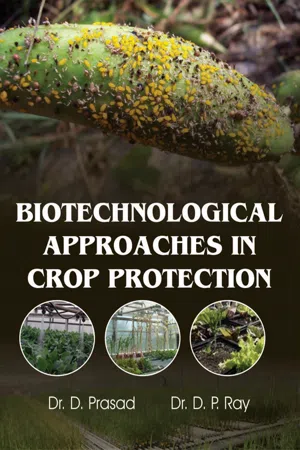
The Science of Biotechnology is taking rapid strides. At this juncture, it is very important for all stakeholders including farmers to understand and accordingly take informed decision for adopting various products of biotechnology. A historic milestone was reached in 2005 when 21 countries grew biotech crops, including 11 developing and 10 industrial countries that had tremendous impact on the production and productivity of the agricultural crops. So as the developing resistant varieties against biotic stresses such as insect pests, diseases, nematodes and weeds. Bt genes is an efficient in controlling the larvae of Helicoverpa armigera under field conditions. This particular gene was further exploited for developing resistant of the crops like, rice, corn, eggplant or okra. However, the Bt is effective only during first and second stages of insect attack. Once the attack becomes very severe, it may not be effective. The Book 'Biotechnological Approaches in Crop Protection' is an efforts to bring out the scattered materials, publications together in a book form. This book is very useful for the plant protectionists working on various disciplines. The Editors have compiled 42 chapters on Biotechnology, Plant Protection in general, Nanotechnology and Eco-friendly options written by experts of their fields of specialization. The book is very useful for the students, workers, scientists, policy makers and administrators.
- 935 pages
- English
- PDF
- Available on iOS & Android
eBook - PDF
About this book
Information
Subtopic
AgricultureTable of contents
- Cover
- Preface
- 1. Biotechnology Tools for Plant Protection
- 2. Biotechnology: The Green Tool for Insect Pest Control
- 3. Biotechnology: A Promising Tool in Plant Protection
- 4. Biotechnology: Potential, Constraints and Future Perspective in Integrated Pest Management
- 5. Eco-friendly and Biotechnological Approaches of Insect Pest Management
- 6. Prospects of RNA Interference in Insect Pest Management
- 7. Modern Biotechnology in Integrated Pest Management
- 8. Biotechnology in Plant Disease Management: Dawn of a New Era
- 9. Biotechnological Strategies to Incorporate Resistance in Crop Plants against Fungal Pathogens
- 10. Role of Biotechnology in Management of Plant Viral Diseases
- 11. Current Trends of Biotechnology in Tissue Culture in Apple and Management of Apple Maggot and Woolly Apple Aphid
- 12. Fungal Mediated Nano-Particles and their Role in Plant Protection
- 13. Soil Solarization: A Sustainable Approach Towards Crop Health Management
- 14. Application of Biotechnology for Integrated Pest Management
- 15. Horizontal Gene Transfer in Evolution of Nematode Parasitism
- 16. Information and Biotechnology in Integrated Pest Management
- 17. Commercial Neem-based Pesticides and Standardization: An Overview
- 18. Bacillus thuringiensis (Bt): Present Status, Future Perspective and Environmental Concern
- 19. Role of Natural Enemies of Cabbage Aphid, Brevicoryne brassicae (L.) and their Possible Use in IPM Strategy
- 20. Phytopathogenomics in Plant Disease Management: A Paradigm Shift
- 21. Fungicide Resistance and their Management
- 22. Mechanism, Quality Control and Commercialization of Microbial Biopesticides
- 23. Biodiversity of Aphidophagous Coccinellids of North-East India
- 24. Neem under the Ambit of Integrated Pest Management
- 25. Secondary Metabolites in Plant Defence Mechanisms Against Insect Pests and Pathogens–Part I: Phenolics, Alkaloids, Terpenes, Proteins and Enzymes
- 26. Secondary Metabolites in Plant Defence Mechanisms Against Insect Pests and Pathogens–Part II: Cyanogenic Glycosides, Glucosinolates, Non-protein Amino Acids and Saponins
- 27. Some Important Insect Pests of Citrus and their Management
- 28. Damage Potential and Management of Thrips (Insecta: Thysanoptera) Infesting Crops
- 29. Spider Fauna (Arachnida: Araneae) of Temperate Vegetable Ecosystem of Kashmir
- 30. Sex Pheromone: A Tool for Managing Insect Pest of Crops
- 31. Impact of Climate Change in Agriculture and its Effects on Pests
- 32. Biology and Life-Cycle of Economically Important Plant Parasitic Nematodes
- 33. Bacterial Detoxification of Pesticides
- 34. Aflatoxins: Threat for Agricultural Trade and Food Safety
- 35. Lac Cultivation: A New Livelihood Option for the Bundelkhand Region
- 36. Contribution of Microarthropods to Enhancement the Soil Fertility in Two Different Forest Types of Manipur
- 37. Biotechnological Approaches for Crop Protection and Improvement
- 38. Prediction of Co-regulated Genes in Mycobacterium tuberculosis using Microarray Expression Profile
- 39. Polymerase Chain Reaction based Diagnosis and Quantification of Seed Borne Fungi and Bacteria
- 40. Herbicide Resistance in Crop Plants
- 41. Ecofriendly and Biotech Management of Phytonematodes in Vegetables
- 42. Current Status of Sesamum and their Disease Management
- Index
Trusted by 375,005 students
Access to over 1.5 million titles for a fair monthly price.
Study more efficiently using our study tools.
Frequently asked questions
Yes, you can cancel anytime from the Subscription tab in your account settings on the Perlego website. Your subscription will stay active until the end of your current billing period. Learn how to cancel your subscription
No, books cannot be downloaded as external files, such as PDFs, for use outside of Perlego. However, you can download books within the Perlego app for offline reading on mobile or tablet. Learn how to download books offline
Perlego offers two plans: Essential and Complete
- Essential is ideal for learners and professionals who enjoy exploring a wide range of subjects. Access the Essential Library with 800,000+ trusted titles and best-sellers across business, personal growth, and the humanities. Includes unlimited reading time and Standard Read Aloud voice.
- Complete: Perfect for advanced learners and researchers needing full, unrestricted access. Unlock 1.5M+ books across hundreds of subjects, including academic and specialized titles. The Complete Plan also includes advanced features like Premium Read Aloud and Research Assistant.
We are an online textbook subscription service, where you can get access to an entire online library for less than the price of a single book per month. With over 1.5 million books across 990+ topics, we’ve got you covered! Learn about our mission
Look out for the read-aloud symbol on your next book to see if you can listen to it. The read-aloud tool reads text aloud for you, highlighting the text as it is being read. You can pause it, speed it up and slow it down. Learn more about Read Aloud
Yes! You can use the Perlego app on both iOS and Android devices to read anytime, anywhere — even offline. Perfect for commutes or when you’re on the go.
Please note we cannot support devices running on iOS 13 and Android 7 or earlier. Learn more about using the app
Please note we cannot support devices running on iOS 13 and Android 7 or earlier. Learn more about using the app
Yes, you can access Biotechnological Approaches in Crop Protection by Prasad, D in PDF and/or ePUB format, as well as other popular books in Technology & Engineering & Agriculture. We have over 1.5 million books available in our catalogue for you to explore.