"Mushrooms have been described as " Food for God" in classic writing of "Vedas". The earliest word in Sanskrit appeared to be ksumpa, in Hindi as Kumbhi in Gujarati it is known as Biladino Top. Chinese people were the first to do the artificial cultivation of the mushroom about thousand yars ago systematic study of mushroom fungi is only 250 years old real commercial cultivation of button mushroom started by Europeans during 16th & 17th Century. Mushroom cultivation in India began in the year 1962 in Himachal Pradesh at Solan. This first improvised small mushroom farm was established by the Government of India at Solan in 1965. Since then mushroom production in India has increased from 7000 tons in the years 1983 to 70, 000 tons in the years 2004. This production is quite low as compared to other mushroom growing countries of the world. Mushrooms are not group of edible fungi they belong to the plant nor to the animal do they belong to separate group of organism cell gungi (Mycota). They lack chlorophyll So cannot prepare their own food depend on the outside source for their nutritional requirement. Mushrooms are macro fruiting bodies or reproductive structures emanating from the mycelium with a distinctive fruiting body which can be either epigeous or hypogeous and large enough to be seen by naked eye and to be picked by hand. Not all mushrooms are edible, but some are highly poisonous, while edible fleshy fungi are called mushrooms, poisonous ones are termed 'toadstools'. It has been estimated that out of 10, 000 species of fleshy fungi about half of them are edible and as many as 100 species are highly poisonous. "
- 114 pages
- English
- PDF
- Available on iOS & Android
eBook - PDF
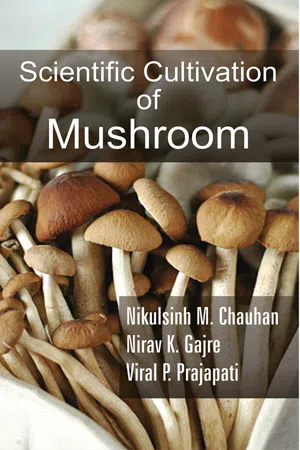
Scientific Cultivation of Mushroom
About this book
Information
Subtopic
AgricultureTable of contents
- Cover
- Preface
- 1. Introduction
- 2. Biology of Mushrooms
- 3. The Potential of the Mushroom Industry in India
- 4. Benefits of Mushroom Growing
- 5. Mushroom Recipes
- 6. Types of Mushroom
- 7. Mushroom Production Technology
- 8. Insect Pests of Mushroom
- 9. Fungal Diseases of Mushrooms
- 10. Bacterial Diseases
- 11. General Guidelines
- 12. Constrains in Mushroom Cultivation
- 13. Future Prospects
- 14. For Better Mushroom Industry in India
- Bibliography
- Index
Trusted by 375,005 students
Access to over 1.5 million titles for a fair monthly price.
Study more efficiently using our study tools.
Frequently asked questions
Yes, you can cancel anytime from the Subscription tab in your account settings on the Perlego website. Your subscription will stay active until the end of your current billing period. Learn how to cancel your subscription
No, books cannot be downloaded as external files, such as PDFs, for use outside of Perlego. However, you can download books within the Perlego app for offline reading on mobile or tablet. Learn how to download books offline
Perlego offers two plans: Essential and Complete
- Essential is ideal for learners and professionals who enjoy exploring a wide range of subjects. Access the Essential Library with 800,000+ trusted titles and best-sellers across business, personal growth, and the humanities. Includes unlimited reading time and Standard Read Aloud voice.
- Complete: Perfect for advanced learners and researchers needing full, unrestricted access. Unlock 1.5M+ books across hundreds of subjects, including academic and specialized titles. The Complete Plan also includes advanced features like Premium Read Aloud and Research Assistant.
We are an online textbook subscription service, where you can get access to an entire online library for less than the price of a single book per month. With over 1.5 million books across 990+ topics, we’ve got you covered! Learn about our mission
Look out for the read-aloud symbol on your next book to see if you can listen to it. The read-aloud tool reads text aloud for you, highlighting the text as it is being read. You can pause it, speed it up and slow it down. Learn more about Read Aloud
Yes! You can use the Perlego app on both iOS and Android devices to read anytime, anywhere — even offline. Perfect for commutes or when you’re on the go.
Please note we cannot support devices running on iOS 13 and Android 7 or earlier. Learn more about using the app
Please note we cannot support devices running on iOS 13 and Android 7 or earlier. Learn more about using the app
Yes, you can access Scientific Cultivation of Mushroom by Chauhan, Nikulsinh M in PDF and/or ePUB format, as well as other popular books in Technology & Engineering & Agriculture. We have over 1.5 million books available in our catalogue for you to explore.