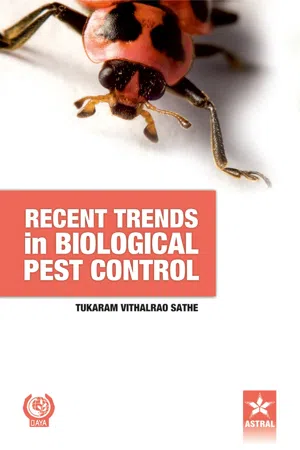
Pesticides lead serious problems like pollutions, health hazards, pest resistance, secondary pest outbreak, etc. Therefore, biological control is widely accepted at global scenario as an effective alternative for pesticidal use and as eco-friendly pest control method. Therefore, newer and recent trends of biological insect pest control are given in this book. The book contains 16 chapters under which biocontrol agents like braconids, Ichneumonids, tachinids, chalcids, ladybird beetles, carabids, lace wings, grasshoppers, hemipterans, weevils and vertebrates such as picies, amphibians and birds are discussed with respect to their diversity and their role in pest management. Emphasis is given on biological control of mosquitoes, mulberry and sugarcane pests and some commonly occurring insect pests. Thus, the book is extremely useful for farmers, students, teachers, scientists and industrialists.
- 285 pages
- English
- PDF
- Available on iOS & Android
eBook - PDF
About this book
Information
Subtopic
AgricultureTable of contents
- Cover
- Preface
- 1. Biological Control of Insect Pests
- 2. Biological Control of Mosquitoes
- 3. Biological Control of Sugarcane Pests
- 4. Biological Control of Insect Pests in Mulberry Ecosystem
- 5. Carabids (Coleoptera : Carabidae) for Biological Control of Insect Pests
- 6. Role of Chalcids in control of insect pests
- 7. Role of Hemipterous Predators in Insect Pest Management
- 8. Grasshoppers in Pest Management: Biocontrol Potential of Grasshopper Hieroglypus banian from Paddy Ecosystems of Kolhapur Region
- 9. Lacewings for Biological Pest Control: (A) Biodiversity of Lacewings (Order : Neuroptera) from Kolhapur Agroecosystems
- 10. Lacewings for Biological Pest Control: (B) Predatory Capacityof Chrysoperla carnea (Stephens) (Neuroptera : Chrysopidae) on Rhopalosiphum maidis Fitch. Under Laboratory Conditions
- 11. Ichneumonids in Pest Management: (A) Biology of Diadegma trochanterata (Morley) (Hymenoptera : Ichneumonidae): An Inter al Larval Parasitoid of the Castor Capsule Borer Dichocrocis punctiferalis Guene (Lepidoptera : Pyralididae)
- 12. Ichneumonids in Pest Management: (B) Effect of Dichocrocis punctiferalis Guenee (Lepidoptera : Pyralididae) Density on P ogeny Production of Diadegma trochanterata (Hymenoptera : Ichneumonidae)
- 13. Ichneumonids in Pest Management: (C) Host Specificity in Pristomerus testaceus Morley (Ichneumonidae : Hymenoptera)
- 14. Ichneumonids in Pest Management: (D) Life Cycle of Netelia ephippiata Smith (Ichneumonidae: Hymenoptera) on Castor Semilooper Achea janata (Linnaeus)
- 15. Ichneumonids in Pest Management: (E) Life Cycle of Xanthopimpla pedator (Hymenoptera : Ichneumonidae): A Parasitoid of Tasar Silkworm Antheraea mylitta (Lepidoptera : Saturnidae)
- 16. Braconids in Pest Management: (A) Life Cycle ofApanteles euproctisiphagus Muzaffar (Hymenoptera : Braconidae): A Parasitoid of Castor Hairy Caterpillar Euproctis lunata (Walker)
- 17. Braconids in Pest Management: (B) Life Cycle of Apanteles sudanus Wilkinson (Hymenoptera : Braconidae): An Internal Larval Parasitoid of Castor Semilooper Achea janata Linnaeus (Lepidoptera : Noctuidae)
- 18. Tachinids in Pest Management: (A) Diversity of Tachinids from Agroecosystems of Kolhapur District
- 19. Tachinids in Pest Management: (B) Biology of Eucelatoria bryani Sabrosky (Diptera : Tachinidae): A Larval Parasitoid of Helicoverpa armigera (Hubn.)(Lepidoptera: Noctuidae) 132
- 20. Weevils in Biological Control of Weeds
- 21. Pisces for Mosquito Control
- 22. Amphibians for Insect Pest Management
- 23. Birds in Insect Pest Management
- Index
Trusted by 375,005 students
Access to over 1.5 million titles for a fair monthly price.
Study more efficiently using our study tools.
Frequently asked questions
Yes, you can cancel anytime from the Subscription tab in your account settings on the Perlego website. Your subscription will stay active until the end of your current billing period. Learn how to cancel your subscription
No, books cannot be downloaded as external files, such as PDFs, for use outside of Perlego. However, you can download books within the Perlego app for offline reading on mobile or tablet. Learn how to download books offline
Perlego offers two plans: Essential and Complete
- Essential is ideal for learners and professionals who enjoy exploring a wide range of subjects. Access the Essential Library with 800,000+ trusted titles and best-sellers across business, personal growth, and the humanities. Includes unlimited reading time and Standard Read Aloud voice.
- Complete: Perfect for advanced learners and researchers needing full, unrestricted access. Unlock 1.5M+ books across hundreds of subjects, including academic and specialized titles. The Complete Plan also includes advanced features like Premium Read Aloud and Research Assistant.
We are an online textbook subscription service, where you can get access to an entire online library for less than the price of a single book per month. With over 1.5 million books across 990+ topics, we’ve got you covered! Learn about our mission
Look out for the read-aloud symbol on your next book to see if you can listen to it. The read-aloud tool reads text aloud for you, highlighting the text as it is being read. You can pause it, speed it up and slow it down. Learn more about Read Aloud
Yes! You can use the Perlego app on both iOS and Android devices to read anytime, anywhere — even offline. Perfect for commutes or when you’re on the go.
Please note we cannot support devices running on iOS 13 and Android 7 or earlier. Learn more about using the app
Please note we cannot support devices running on iOS 13 and Android 7 or earlier. Learn more about using the app
Yes, you can access Recent Trends in Biological Pest Control by Sathe, T V in PDF and/or ePUB format, as well as other popular books in Technology & Engineering & Agriculture. We have over 1.5 million books available in our catalogue for you to explore.