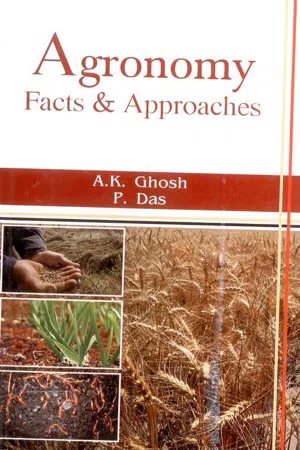
Agronomy is a compulsory subject for the undergraduate and post-graduate students of Agriculture in Colleges and Universities of India and abroad. The crop production and post harvest technology have gradually being changed due to coming up of some inputs of Agriculture such as high yielding varieties of different crops, pesticides, fertilizers etc. to fulfil our goal of crop production, it is essential to have some sound knowledge on different aspects of Agronomy. Keeping this fact in view in the present book, attempts has been made to provide readily available informations on various aspects of Agronomy. The remarkable contents of the book are climatology, growth and development of crops, soil, cultivation, manures and fertilizers, water management of crops, weed and weed control, agroforestry. We do hope that this book serves as an advanced text and reference book for students, research scholars, teachers and those who are actively engaged in different fields of Agriculture. This book contains 9 chapters, a positive approach to mobilize the farmers in right direction.
eBook - PDF
About this book
Information
Subtopic
LandwirtschaftTable of contents
- Acknowledgements
- Preface
- List of Figures
- List of Tables
- 1. INTRODUCTION
- 1.1 Basic Principles of Agronomy
- 1.2 Twenty Points working schedule in Cultivation
- 1.3 Relation of Agricultural Science with other basic sciences
- 2. CLIMATOLOGY
- 2.1 Introduction
- 2.2 Elements of Climate
- 2.3 Meterological Instruments
- 2.4 Weather hazard and their mitigation
- 2.5 Weather and Crops
- 2.6 Crops, Season and Classification of Crops.
- 2.7 Classification of Crops
- References
- 3. GROWTH AND DEVELOPMENT OF CROPS
- 3.1 Growth of the crop
- 3.2 Photosynthesis
- 3.3 Development of crop
- 3.4 Plant growth substances
- References
- 4. SOIL
- 4.1 Introduction
- 4.2 Definition of soil
- 4.3 Composition of soil
- 4.4 Formation of soil
- 4.5 Factors affecting soil character
- 4.6 Types of soil
- 4.7 Physical properties of soil
- 4.8 Plant nutrients
- 4.8.1 Function of essential nutrients
- 4.8.2 Nutrient deficiency symptoms in plants
- 4.8.3 Usefulness of some of non-essential elements
- 4.8.4 Sources of plant nutrients
- 4.8.5 Integrated nutrient management (INM)
- 4.9 Soil fertility
- 4.9.1 Soil fertility evaluation method
- 4.10 Soil moisture
- 4.11 Reclamation of soil
- References
- 5. CULTIVATION
- 5.1 Introduction
- 5.2 Land selection
- 5.3 Tillage
- 5.3.1 Objectives of tillage
- 5.3.2 Types of tillage
- 5.3.3 Factors influencing preparatory tillage
- 5.3.4 Modern concept of tillage
- 5.4 Sowing of Seed
- 5.4.1 Types of Seed
- 5.4.2 Dormancy of Seed
- 5.4.3 Seed Treatment
- 5.4.4 Method sowing
- 5.5 Raising of Seedling
- 5.6 Transplanting
- 5.7 Manuring
- 5.8 Intercultural operations
- 5.9 Harvesting
- 5.10 Threshing
- 5.11 Storage
- 5.12 Common Farm implements and their uses
- 5.12.1 Different Kinds of Farm implements and their uses
- 5.12.1.1 Implements used for tillage operation
- 5.12.1.2 Implements Used for Sowing Seed
- 5.12.1.4 Implements used for harvesting and threshing
- 5.12.1.5 Pesticides application equipment
- References
- 6. MANURES AND FERTILIZERS
- 6.1 INTRODUCTION
- 6.2 Classification of manures and fertilizers
- 6.3 Manures
- 6.4 Fertilizers
- 6.5 Methods of fertilizer application
- 6.6 Tips to get best efficiency of applied fertilizers
- References
- 7. WATER MANAGEMENT OF CROPS
- 7.1 Introduction
- 7.2 Role of water for growth and development of plants
- 7.4 Soil Moisture Constents
- 7.5 Irrigation
- 7.5.1 Objectives of irrigation
- 7.5.2 Necessity of irrigation
- 7.5.3 Sources of irrigation
- 7.5.4 Method of scheduling irrigation to Crops
- 7.5.5 Water requirement of crops
- 7.5.6 Proper utilization of irrigation water
- 7.5.7 Quantity of irrigation water
- 7.5.8 Depth of irrigation
- 7.5.9 Losses of irrigation water
- 7.5.10 Irrigation water efficiency
- 7.5.11 Demerits of irrigation
- 7.5.12 System and method of irrigation
- 7.5.13 Irrigation practices for major crops
- 7.5.14 Water lifting devices used for irrigation
- 7.6 Drainage
- References
- 8. WEED AND WEED CONTROL
- 8.1 Introduction
- 8.2 Definition of weed
- 8.3 Classification of weeds
- 8.4 Characteristics of weeds
- 8.5 Dispersal of weeds
- 8.6 Crop-weed association
- 8.7 Crop-weed competition
- 8.8 Ecology of weeds
- 8.9 Harmful effect of weeds
- 8.10 Mechanism of surbival of weed
- 8.11 Beneficial effects of weeds
- 8.12 Methods of weed control
- 8.12.4 Chemical method
- 8.12.4.1 Classification of herbicides
- 8.12.4.2 Formulation of herbicides
- 8.14 Aquatic Weeds
- 8.15 Weed control in forest
- 8.16 Weed control in non-cropped areas
- 1. Mechanical Method
- 8.17 Particulars about application of herbicide
- References
- 9. AGROFORESTRY
- 9.1 Introduction
- 9.2 Definition of Agroforestry
- 9.3 Components of Agroforestry
- 9.4 Classification of Agroforestry systems
- 9.5 Advantages of Agroforestry
- 9.6 Limitation of Agroforestry
- 9.7 Characteristic features of trees for Agroforestry
- 9.8 Materials available through Agroforestry
- 9.9 Suitable Plants for Agroforestry
- References
- 10. GLOSSARY
- 11. APPENDIX
- Land and its measurement
- Weight : Its unit and conversion
- Lengh : Its unit and conversion
- Liquid : Its unit and conversion
- Weight : Per acre into kilogram per hectare
- Fertilizers and its relation with Plant nutrient
- Area coverage by some Agricultural implement
- Soil pH and its range for some crops
- Crops and its usable product (Ratio)
- Different oil seed crops and their oil content (Percentage)
- Use of land in India
- List of ICAR Research Institute dealing with crops and related activities
- List of Agricultural Universities in India
- List of Publications by Author (Dr. A.K. Ghosh) in East and West
- INDEX
- Subject Index
- Plant Index
- Animal Index
Trusted by 375,005 students
Access to over 1.5 million titles for a fair monthly price.
Study more efficiently using our study tools.
Frequently asked questions
Yes, you can cancel anytime from the Subscription tab in your account settings on the Perlego website. Your subscription will stay active until the end of your current billing period. Learn how to cancel your subscription
No, books cannot be downloaded as external files, such as PDFs, for use outside of Perlego. However, you can download books within the Perlego app for offline reading on mobile or tablet. Learn how to download books offline
Perlego offers two plans: Essential and Complete
- Essential is ideal for learners and professionals who enjoy exploring a wide range of subjects. Access the Essential Library with 800,000+ trusted titles and best-sellers across business, personal growth, and the humanities. Includes unlimited reading time and Standard Read Aloud voice.
- Complete: Perfect for advanced learners and researchers needing full, unrestricted access. Unlock 1.5M+ books across hundreds of subjects, including academic and specialized titles. The Complete Plan also includes advanced features like Premium Read Aloud and Research Assistant.
We are an online textbook subscription service, where you can get access to an entire online library for less than the price of a single book per month. With over 1.5 million books across 990+ topics, we’ve got you covered! Learn about our mission
Look out for the read-aloud symbol on your next book to see if you can listen to it. The read-aloud tool reads text aloud for you, highlighting the text as it is being read. You can pause it, speed it up and slow it down. Learn more about Read Aloud
Yes! You can use the Perlego app on both iOS and Android devices to read anytime, anywhere — even offline. Perfect for commutes or when you’re on the go.
Please note we cannot support devices running on iOS 13 and Android 7 or earlier. Learn more about using the app
Please note we cannot support devices running on iOS 13 and Android 7 or earlier. Learn more about using the app
Yes, you can access Agronomy: Facts and Approaches by Das, P. in PDF and/or ePUB format, as well as other popular books in Technik & Maschinenbau & Landwirtschaft. We have over 1.5 million books available in our catalogue for you to explore.