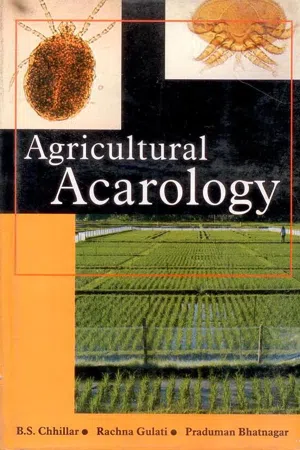
Acarines are prominent pests of field crops, granaries, warehouse and animals (arthropods, birds) causing heavy financial losses. House dust acarines are notorious agents of allergic reactions in human beings and other mammals. Acarines because of their small size and cryptic habitat are difficult to detect and hence most of the time infestations are overlooked. Once established in a new area, certain biological characteristics like high fecundity, various modes of reproduction, short life cycles, a myriad of dispersal techniques and adaptability to diverse ecological conditions allow rapid escalation to pest status. On the other hand, acarines are among the major resources for biological control of various classes of pests including insects, nematodes and weeds. These widely distributed microscopic animal ranging from free living to parasitic forms and terrestrial to aquatic forms require specialized techniques for handling. The literature regarding their biodiversity, collection, rearing, biology etc. are scattered and most of the time unavailable to scientists interested to work on them. Hence, a comprehensive book on agricultural acarology is prepared which covers all aspects of acarine biodiversity, acarological techinques and their role as bio-control agent in an abridged form. The book is divided into three sections-'Acarine biodiversity', Acarological techniques' and 'Acarines as biocontrol agents'. Acarine biodiversity contains six chapters, one each on plant, stored, soil, house dust, parasitic and water mites. In second section, details on techniques of collection and extraction, preparation and mounting, labelling and housing the collection, culturing, counting and bioassay are given in individual chapters. Information related to predatory potential of acarines against insects, nematodes and weeds is included in third section in three chapters. The book has been liberally furnished with illustrations for better understanding. An extensive list of references and glossary are also provided at the ende of the book.
eBook - PDF
About this book
Information
Subtopic
ZoologyIndex
Biological SciencesTable of contents
- 1. Introduction
- Part I: Acarine Biodiversity
- 2. Plant Mites
- 3. Stored Product Mites
- 4. Soil Mites
- 5. Housedust Mites
- 6. Parasitic Mites
- 7. Water Mites
- Part II: Acarological Techniques
- 8. Collection and Extraction of Acarines
- 9. Preparations and Mounting
- 10. Labeling and Housing the Collection
- 11. Culturing Techniques
- 12. Counting
- 13. Bioassay
- Part III: Acarine as Biocontrol Agents
- 14. Acarines for Insect Control
- 15. Acarines for Nematode Control
- 16. Acarines for Weed Control
- Glossary
- References
- Index
Trusted by 375,005 students
Access to over 1.5 million titles for a fair monthly price.
Study more efficiently using our study tools.
Frequently asked questions
Yes, you can cancel anytime from the Subscription tab in your account settings on the Perlego website. Your subscription will stay active until the end of your current billing period. Learn how to cancel your subscription
No, books cannot be downloaded as external files, such as PDFs, for use outside of Perlego. However, you can download books within the Perlego app for offline reading on mobile or tablet. Learn how to download books offline
Perlego offers two plans: Essential and Complete
- Essential is ideal for learners and professionals who enjoy exploring a wide range of subjects. Access the Essential Library with 800,000+ trusted titles and best-sellers across business, personal growth, and the humanities. Includes unlimited reading time and Standard Read Aloud voice.
- Complete: Perfect for advanced learners and researchers needing full, unrestricted access. Unlock 1.5M+ books across hundreds of subjects, including academic and specialized titles. The Complete Plan also includes advanced features like Premium Read Aloud and Research Assistant.
We are an online textbook subscription service, where you can get access to an entire online library for less than the price of a single book per month. With over 1.5 million books across 990+ topics, we’ve got you covered! Learn about our mission
Look out for the read-aloud symbol on your next book to see if you can listen to it. The read-aloud tool reads text aloud for you, highlighting the text as it is being read. You can pause it, speed it up and slow it down. Learn more about Read Aloud
Yes! You can use the Perlego app on both iOS and Android devices to read anytime, anywhere — even offline. Perfect for commutes or when you’re on the go.
Please note we cannot support devices running on iOS 13 and Android 7 or earlier. Learn more about using the app
Please note we cannot support devices running on iOS 13 and Android 7 or earlier. Learn more about using the app
Yes, you can access Agricultural Acarology by Chhillar, B S in PDF and/or ePUB format, as well as other popular books in Biological Sciences & Zoology. We have over 1.5 million books available in our catalogue for you to explore.