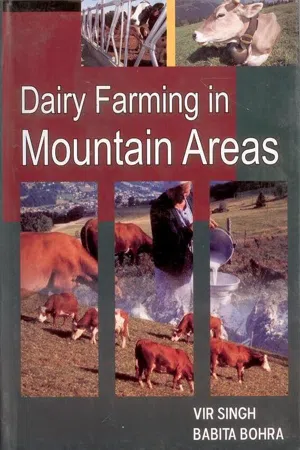
Dairy Farming is one of the key economic activities livestock-dependent farming communities in the mountain areas depend upon. Dairy farming involves natural resource base-forests/rangelands, croplands, livestock breeding-feeding, breeding, health management, marketing and consumption of the products. This book presents wonderful synthesis of the smallholders resource management in the mountains. Smallholders constitute the majority of the mountain communities. Their strategies of resource management this book portrays provide the interesting matter the institutions might like to know about before they being with the interventions into dairy farming. Mountain areas are altogether distinguishable from those of the mainstream plain areas. And so are their production systems. Peri-urban areas in the region constitute the high-pressure areas. Dairy farming in these areas is essentially market-oriented. The book especially characterizes the smallholder dairy farms in the vicinity of urban milk consuming centres. These scenarios are different from those in the remote areas. Smallholder dairy farming has enormous potential. It can contribute to family income, generate gainful employment especially for women, elevate living standards of the producers, fight malnutrition especially amongst children and enhance processes of sustainable agriculture. Crop-livestock-forest/rangeland integrity is a key factor to the sustainability of mountain livelihoods. Augmentation of dairy farming systems leads to the enhanced performance of the overall production system. The book finally discusses perspective based approaches to operationalise sustainability in the mountains. The book, in essence, is a landmark publication in the area of sustainable mountain development. India is the leading milk producer in the world today, which is largely thanks to the smallholders' contributions. Dairy development could be one of the key areas to help the country to occupy centre stage in the on-going rapid globalisation processes. This book is an humble attempt to further advance towards this direction.
eBook - PDF
About this book
Information
Subtopic
AgricultureTable of contents
- Acknowledgements
- Preface
- Abbreviations and Acronyms
- 1. Introduction
- 2. Dairy Development in the Plans: A Review
- Livestock in the Mixed Farming Systems
- Development Interventions through Plans
- Some Case Studies
- Summary.
- 3. Dairy Development Indicators
- Mountain Specificities
- Dairy Indicators
- Types of Dairy Farms
- Management
- Dairy Species
- Dairy Breeds
- Marketable Products
- Use of Inputs
- Scale of Production
- Location/Site
- Production Traits/Individual Performance Indicators
- Summary.
- 4. Livestock Population, Composition and Dynamics
- Population
- Livestock in Diverse Agro-ecological Zones
- Livestock in a Village
- Livestock Holding
- Summary.
- 5. Feeds and Feeding Management
- Why Uncultivated Fodder?
- Response to Fragility
- Biodiversity
- Ecological Niche
- Higher Productivity
- Comparative Nutritive Value
- Year-round Fodder Supplies
- Resilience
- Compatibility
- Topographic Suitability
- Energy Efficiency
- Multiple Benefits
- Man-Animal Symbiosis
- Environmental safety
- Phenology of Fodder Plants
- Contributions of Different Resources
- Nutritive Value
- Feeding Management
- Summary.
- 6. Dairy Breeds and Breeding Management
- Breeds in Indian Central Himalayas
- Ponwar
- Jwalapuri
- Crossbreds
- Hill Breeds
- Buffalo Breeds
- The Conventional Breeding Management
- Lessons Learned
- Some Arguments For and Against
- Alternate Husbandry Practices
- Summary.
- 7. Health Management
- Main Diseases
- Effect of Diseases
- Health Services and Policies
- The Ethno-vet System
- Summary.
- 8. Milk Production, Marketing and Consumption Pattern
- Trends in Milk Production
- Seasonal Variation
- Milk Marketing System
- State Dairy Cooperative Federations
- Milk Marketing Channels
- Producer-Consumer Channel
- Producer-Trader-Consumer Channel
- Producer-Cooperative Consumer Channel
- Milk Marketing Scenarios
- Consumption Pattern of Dairy Products
- Consumption Pattern in Urban areas
- Consumption Pattern in Rural Areas
- Summary.
- 9. Constraints to Dairy Farming in the HKH Region
- Physical Constraints
- Biological Constraints
- Management-related Constraints
- Socioeconomic and Institutional Constraints
- Summary.
- 10. Livestock in High Pressure Peri-urban Areas: A Case of the Central Himalayas
- The Setting and the Methodology
- Marketing of Milk
- Marketed Surplus of Milk
- Sample Analysis
- Results and Discussion
- Demographic Features
- Landholding Size; Livestock Population and Composition
- Livestock Holding
- Livestock Breeds
- Milk Production at Peri-urban Dairy farms; Per Capita Milk Availability; Marketing of Milk; Marketable Surplus of Milk
- Determinants of Marketable Surplus of Milk
- Flow of Milk through Different Marketing Channels
- Consumption Pattern of Dairy Products
- Fodder Calendar
- Feeds and their Quality
- Gender Contribution to Dairy Production
- Summary.
- 11. Potentials of Smallholder Dairy Farming and Approaches to Sustainability
- Livestock and Natural Resource Base: Existing Potentialities
- Natural Resource Management
- Afforestation
- Protection
- Increasing Biodiversity
- Deferred-cum-Rotational Grazing
- Practising Stall-feeding
- Alternate Energy Sources
- Efficient Resource Utilisation
- Improved Composting Techniques
- Livestock Resource Base
- Technological Options
- Institutional Intervention
- Summary.
- Annexure
- Bibliography
- Index
Trusted by 375,005 students
Access to over 1.5 million titles for a fair monthly price.
Study more efficiently using our study tools.
Frequently asked questions
Yes, you can cancel anytime from the Subscription tab in your account settings on the Perlego website. Your subscription will stay active until the end of your current billing period. Learn how to cancel your subscription
No, books cannot be downloaded as external files, such as PDFs, for use outside of Perlego. However, you can download books within the Perlego app for offline reading on mobile or tablet. Learn how to download books offline
Perlego offers two plans: Essential and Complete
- Essential is ideal for learners and professionals who enjoy exploring a wide range of subjects. Access the Essential Library with 800,000+ trusted titles and best-sellers across business, personal growth, and the humanities. Includes unlimited reading time and Standard Read Aloud voice.
- Complete: Perfect for advanced learners and researchers needing full, unrestricted access. Unlock 1.5M+ books across hundreds of subjects, including academic and specialized titles. The Complete Plan also includes advanced features like Premium Read Aloud and Research Assistant.
We are an online textbook subscription service, where you can get access to an entire online library for less than the price of a single book per month. With over 1.5 million books across 990+ topics, we’ve got you covered! Learn about our mission
Look out for the read-aloud symbol on your next book to see if you can listen to it. The read-aloud tool reads text aloud for you, highlighting the text as it is being read. You can pause it, speed it up and slow it down. Learn more about Read Aloud
Yes! You can use the Perlego app on both iOS and Android devices to read anytime, anywhere — even offline. Perfect for commutes or when you’re on the go.
Please note we cannot support devices running on iOS 13 and Android 7 or earlier. Learn more about using the app
Please note we cannot support devices running on iOS 13 and Android 7 or earlier. Learn more about using the app
Yes, you can access Dairy Farming in Mountain Areas by Singh, Vir in PDF and/or ePUB format, as well as other popular books in Technology & Engineering & Agriculture. We have over 1.5 million books available in our catalogue for you to explore.