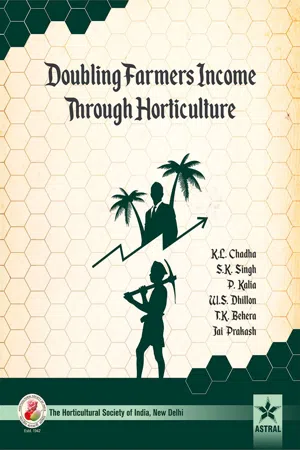
This book is a compendium of 108 lead papers presented by R&D workers from various national and international institutions including industry during the four day 7th Indian Horticulture Congress-2016 held from November 15-18, 2016 by the Horticultural Society of India, New Delhi to commemorate its Diamond Jubilee. The book analyses the contribution which various strategies can make to doubling of farmers income by 2022 as envisioned by the Prime Minister of India. Contribution cover role of improved varieties, technologies, input management, disease and pest management, mechanization, quality improvement, post-harvest management, value-addition, marketing and trade, skill development and policy interventions and frontier technologies in different horticultural crops. It is hoped that the book will be of interest to all interested in technology-led Horticulture development and benefit the researchers, students, teachers, development workers, policy makers, and all amateurs and professional.
- 1,825 pages
- English
- PDF
- Available on iOS & Android
eBook - PDF
About this book
Information
Subtopic
HorticultureIndex
Biological SciencesTable of contents
- Cover
- Half Title
- The Editors
- Title
- Copyright
- Preface
- Contents
- List of Contributors
- — Improving Availability and Quality of Planting Materials and Seeds —
- 1. Production of Quality Planting Material in Fruit Crops: A Pre-Requisite for High Productivity
- 2. An Integrated Citrus Propagation Programme for Improving Production and ProfitabilityÁ
- 3. Improving Availability and Quality of Vegetable Seeds for Higher ProfitabilityÁ
- 4. Plug Plant Production of Horticultural Crops through Hi-Tech Nursery RaisingÁ
- 5. Grafting for High Productivity and Profitability in Vegetable CropsÁ
- 6. Micropropagation for Mass Production of Horticultural CropsÁ
- 7. Diagnostics for Management of Viral Diseases in Horticultural CropsÁ
- — Biotechnological Interventions —
- 8. Role of Biotechnology for the Improvement of Production, Productivity and ResistanceÁin Vegetable Crops
- 9. Role and Status of Genome Sequencing and Post-genomic Research in Improving Productivity
- 10. Vegetable Breeding through New Techniques for Higher ProductivityÁ
- 11. Molecular Breeding for Hastening Varietal Development in Horticultural CropsÁ
- 12. Biotechnological Interventions in Canopy Architecture of Tree FruitsÁ
- 13. Silencing the Pathogen in a Non-transgenic Scion through SiRNAÁ
- — Technology Innovations —
- 14. Technology Driven Horticulture Development: Suggested Model for Small andÁMarginal Farmers
- 15. Crop Regulation in Fruit Crops for Improving Quality and Income of FarmersÁ
- 16. Innovative Technologies for Improving P-roduction and Economic Security of Banana Farmers ÁS. Uma
- 17. Technological Innovations for Bridging the Yield Gap in Spices
- 18. Technology Options for Doubling Farmers’ Income in Cashew CultivationÁ
- 19. Development of Technologies for Increasing Productivity and Availability of OnionÁ
- 20. Development of Orchid Biodiversity-based Microenterprises for ConservationÁ and Income Generation
- — HDP and Canopy Management —
- 21. Canopy Architecture and HDP in Temperate Fruits: An Innovative Approach forÁDoubling Farmers’ Income
- 22. Canopy Architecture Management for Doubling India‘s Fruit ProductionÁ
- 23. Canopy Management, High Density Planting and Advanced Production Systems in CitrusÁ
- 24. Role of Pollinizers and Pollinators in Enhancing Horticulture Crop ProductivityÁ
- 25. Rejuvenation of Fruit Plants as a Means of Improving Productivity and ProfitabilityÁ
- 26. Effect of Cycocel on Suppression of Post-monsoon Vegetative Growth of Mango cv. Alphonso
- — Crop Management —
- 27. Increasing Farmers Income from Mango and Guava in Sub-tropicsÁ
- 28. Improving Profitability through Enhanced Nutrient Use Efficiency in Horticultural CropsÁ
- 29. Harnessing Heterosis in Vegetable Crops: A Means for Achieving High ProductivityÁ and Profitability
- 30. Utilizing Indigenous Flowers for Livelihood Security of FarmersÁ
- 31. Cultural Practices and Disease Management in Mushroom for Improving Proftability
- 32. Production of Seed Spices through Hi-Tech Interventions for Enhancing Farmers IncomeÁ
- — Nutrient and Water Management —
- 33. Soil Health Management for Raising Profitable Horticultural CropsÁ
- 34. Soil Fertility Management for Better Productivity of Fruit CropsÁ
- 35. Microbial Consortia in Bio-capsule for Enhancing the Farmers’ Income in SpicesÁ
- 36. Improving Productivity and Income of Horticultural Crops from Degraded LandsÁ
- 37. Improving Productivity and Profitability of Horticultural Crops throughÁ Micro-Irrigation Technologies
- 38. Deficiencies and Management of Micronutrients in Horticultural CropsÁA.N. Ganeshamurthy, T.R. Rupa, H.B. Raghupathi, G.C. Satisha and Mahendra Kumar
- 39. Fertigation and Innovative Approach for Fertilizer Use Efficiency in Horticultural CropsÁ
- 40. Micro-Irrigation Systems for Enhancing Input Use Efficiency in Horticultural CropsÁ
- — Managing Emerging Insect Pests —
- 41. Biological Control of Pests in Horticultural Crops to Improve Profitability and QualityÁ
- 42. Role of IPM Protocols in Horticultural Crops for Improving ProfitabilityÁ
- 43. Integrated Management of Fruit Flies in Horticultural CropsÁ
- 44. Strategies for Managing Sap Sucking Pests in Horticultural CropsÁ
- 45. Nematode Management in Horticultural Crops for Improving ProductivityÁ
- — Managing Emerging Diseases and Disorders —
- 46. Online Advisory for Disease Management in Horticultural Crops
- 47. Minimizing Pesticide Residues in Horticulture Produce for Ensuring Higher ReturnsÁ in Exports
- 48. Management of Guava Wilt for Improving ProductivityÁ
- 49. Major Physiological Disorders in Horticulture Crops Focus Spongy Tissue inÁ Mango
- 50. Slow Release Nano-formulations of Bio-active Molecules from Horticultural CropsÁN.A. Shakil
- — Ensuring Higher Price of Farm Produce and Products —
- 51. Role of Credit and Price Policy in Development of HorticultureÁ
- 52. National Agriculture Market: Status and Future ProspectsÁ
- 53. Re-Orienting Horticultural Extension Services for Doubling Farmers IncomeÁ
- 54. Innovations in Horticulture Markets and Value Chains DevelopmentÁ
- — Technology-led Organic Horticulture and Safe Food —
- 55. Food Safety begets Food SecurityÁ
- 56. Income-Assisted Safe Food Production for Remunerative Organic HorticultureÁ
- 57. Organic Cultivation of Medicinal and Aromatic PlantsÁ
- 58. Role of Weather Factors in the Progression of Leaf Blight in MangoÁ
- 59. Green Technologies for Production of Clean and Safe Food SpicesÁ
- — Promoting Innovative Production Systems —
- 60. Innovative Protected Horticulture and its Potential for Doubling Farmers’ Income
- 61. Technologies for Hybrid Seed Production of Vegetable Crops under Protected ConditionsÁ for Improving Farmer’s Income
- 62. Role of Urban and Peri-urban Horticulture (UPH) for Meeting Aesthetics, NutritionalÁand Livelihood Security
- 63. Agroforestry Interventions in Fruit Orchards for Improving Productivity,ÁProfitability and Sustainability
- 64. Horticulture Based Integrated Farming Systems: A Way Forward in Doubling Farm IncomeÁ
- 65. Aeroponics: A Soilless Method of Potato MinitubersÁ
- 66. IPM and GAP in Protected CultivationÁ
- — Reducing Post-Harvest Losses —
- 67. Infrastructure Requirements in Post-harvest Management for Horticultural CropsÁ
- 68. Post-harvest Losses and their Mitigation to Improve Farmers’ IncomeÁ
- 69. Harnessing Profit through New Innovations in Storage of Horticultural ProduceÁ
- 70. Ethylene Management for Effective Post-harvest Handling of Horticultural ProduceÁ
- 71. Nanotechnology Interventions in Post-harvest Management of Horticultural CropsÁ
- — Adding Value to Produce-I —
- 72. Value-addition in Floriculture for Nutraceuticals
- 73. Tuber Crop Based Novel Products and Functional Foods for Improving ProfitabilityÁ
- 74. Waste Utilisation in Horticultural Crops for Supplementing Farmers Income
- 75. Value-addition in Vegetables for Increasing Farmers’ IncomeÁ
- 76. Utilisation of Winery By-products: Initiatives and Future StrategiesÁ
- 77. Probiotic Micro-organisms: Avenue for Processing and Value-addition inÁ Horticultural Produce
- — Adding Value to Produce-II —
- 78. Exploitation of Natural Colours and Dyes from Horticultural CropsÁ
- 79. Phytomedicines from Horticultural Crops for Human Health and ProsperityÁ
- 80. Intrinsic Quality and Phytochemical Profiling of Major Horticultural CropsÁ
- — Reducing Drudgery through Mechanization —
- 81. Initiatives on Reduction of Drudgery through Mechanisation in HorticultureÁ
- 82. Reducing Drudgery through User Friendly Equipment in HorticultureÁ
- 83. Precision Agriculture Applications in HorticultureÁ
- 84. Role of Primary Processing in Improving Income from Horticulture Crop ProductionÁ
- 85. Machine Vision and Sensor-based Applications for Pre- and Post-HarvestÁ Operations in Horticulture
- — Managing Climate Risks —
- 86. Climate Resilience in Horticulture: A Way Forward in Improving Farmers IncomeÁ
- 87. Development of Abiotic Stress Tolerant Climate Smart Varieties of Horticultural CropsÁ
- 88. Mango Production in the Emerging Climate Change for Ensuring SustainabilityÁ
- 89. Climate Change: Management Strategies in Potato ProductionÁ
- 90. Carbon Sequestration Potential in Perennial Horticultural Trees for ManagingÁ Global Warming Issues
- 91. Impact of Climate Change on Apple Production and Strategies to Mitigate its EffectsÁJ.I. Mir, D.B. Singh, N. Ahmed, O.C. Sharma, A. Sharma, S. Lal, W. H. Raja and Aarifa Jan
- — Creating Employment Opportunities for Youth —
- 92. Horticulture Information System Network (HORTNET) 2.0 for Increasing Farmers’ÁIncomes through Digital India Programme
- 93. Fruit Nursery Production: An Attractive Entrepreneurship Venture for YouthÁ
- 94. Vegetable Seed Production: A Remunerative Entrepreneurial VentureÁ
- 95. Mushroom Production: A Viable and Profitable Avocation for Educated YouthÁ
- 96. Beekeeping as an Attractive Agro-based Enterprise for Youths, Especially in Rural Areas:Á Perspectives and Opportunities
- 97. Custom Hiring of Farm Machinery/Equipment/Implements: A Way for Increasing FarmÁEfficiency and Enhancing Profitability
- 98. Horti-Tourism: A Venture in India for Creating Employment Opportunities for YouthÁ
- 99. Quality Seed Production and Profitability of Horticultural Crops in Northern KarnatakaÁ
- 100. Production of Bioagents: A Potential Enterprise for Youth
- 101. Value-addition in Horticultural Crops as an Entrepreneurial Option for Creating Employment Opportunities for Youth
- — Developing Horticulture in North East India —
- 102. Horticulture in North Eastern Region of India
- 103. Horticulture Based Farming Systems: The Engine for Prosperity in Northeast India
- 104. Floriculture in North Eastern States of India: Prospects and Challenges
- 105. Marketing and Market Infrastructure Development for Improving Farmer’s Income
- 106. Nutritional Security of Tribals of NEH Region of India through Underutilized Vegetables
- 107. Kiwi: A Potential Fruit Crop, in North East India
- 108. Revisiting Citrus Genetic Resources of Northeast India
Trusted by 375,005 students
Access to over 1.5 million titles for a fair monthly price.
Study more efficiently using our study tools.
Frequently asked questions
Yes, you can cancel anytime from the Subscription tab in your account settings on the Perlego website. Your subscription will stay active until the end of your current billing period. Learn how to cancel your subscription
No, books cannot be downloaded as external files, such as PDFs, for use outside of Perlego. However, you can download books within the Perlego app for offline reading on mobile or tablet. Learn how to download books offline
Perlego offers two plans: Essential and Complete
- Essential is ideal for learners and professionals who enjoy exploring a wide range of subjects. Access the Essential Library with 800,000+ trusted titles and best-sellers across business, personal growth, and the humanities. Includes unlimited reading time and Standard Read Aloud voice.
- Complete: Perfect for advanced learners and researchers needing full, unrestricted access. Unlock 1.5M+ books across hundreds of subjects, including academic and specialized titles. The Complete Plan also includes advanced features like Premium Read Aloud and Research Assistant.
We are an online textbook subscription service, where you can get access to an entire online library for less than the price of a single book per month. With over 1.5 million books across 990+ topics, we’ve got you covered! Learn about our mission
Look out for the read-aloud symbol on your next book to see if you can listen to it. The read-aloud tool reads text aloud for you, highlighting the text as it is being read. You can pause it, speed it up and slow it down. Learn more about Read Aloud
Yes! You can use the Perlego app on both iOS and Android devices to read anytime, anywhere — even offline. Perfect for commutes or when you’re on the go.
Please note we cannot support devices running on iOS 13 and Android 7 or earlier. Learn more about using the app
Please note we cannot support devices running on iOS 13 and Android 7 or earlier. Learn more about using the app
Yes, you can access Doubling Farmers Income Through Horticulture by Chadha, K L in PDF and/or ePUB format, as well as other popular books in Biological Sciences & Horticulture. We have over 1.5 million books available in our catalogue for you to explore.