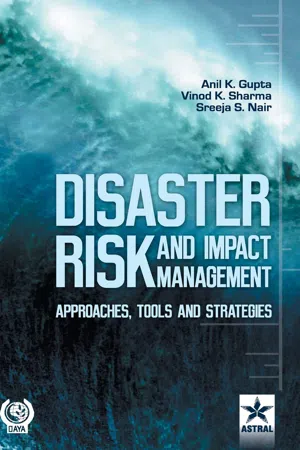
Disaster is any occurrence that causes damage, ecological disruption, loss of human life and deterioration of health and health services on a scale sufficient to warrant an extraordinary response from outside the affected community. A disaster as an occurrence such as hurricane, tornado, storm, flood, high water, wind driven water, tidal wave, earthquake, drought, blizzard, pestilence, famine, fire, explosion, volcanic eruption, building collapse, transportation wreck, or other situation that causes human suffering or creates human needs that the victims cannot alleviate without assistance.The present book "Disaster Risk and Impact Management: Approaches, Tools and Strategies" comprises of three sections: Disaster Risks: Overview, Case Studies and Strategic Approaches. Experts in the relevant fields have given critical appraisal of the various aspects of disasters risk and its management. The scientists, teachers, scholars, administrators and policy makers dealing with disaster risk and impact management find this book very useful and informative.Dr. Anil Kumar Gupta, Head – Division of Policy Planning, National Institute of Disaster Management, New Delhi, India (Former Reader & Head, Director, Institute of Environment & Development Studies, Bundelkhand University, Uttar Pradesh, India).Dr. Vinod K. Sharma is Senior Professor, Disaster Management at Indian Institute of Public Administration, New Delhi and Executive Vice Chairman, Sikkim State Disaster Management Authority and Vice Chancellor of Devi Ahilya University Indore.Sreeja S. Nair, Consortium Coordinator, Myanmar Consortium for Disaster Risk Reduction Capacity Building, Yangon, Myanmar (Assistant Professor, National Institute of Disaster Management, New Delhi).
- 352 pages
- English
- PDF
- Available on iOS & Android
eBook - PDF
About this book
Information
Subtopic
EcologyIndex
Biological SciencesTable of contents
- Cover
- Halftitle
- Editors
- Title
- Copyright
- Acknowledgements
- Foreword
- Introduction
- Contents
- List of Contributors
- (Disaster Risks: Overview)
- 1. Disaster Risk Management for Sustainability
- 2. Climatic Effects of Increasing Concentrations of Atmospheric Methane
- 3. Coastal and Sea Erosion: Risk Profile dand Mitigation Strategies
- 4. Bioterrorism: A Technological Hazard for Ecology and Mankind
- (Case Studies)
- 5. Space Application in Disaster Assessment and Mitigation: Case of Haryana State
- 6. Drought Occurrences and Management in Kenya
- 7. Approach to Landslides Risk Management: Case from Earthquake
- 8. Empowerment Planning as a Strategy in Drought Management
- 9. Application of Mulches in Conservation Dry Areas
- 10. Utilization of Rainfed areas through Agroforestry
- 11. Choice Experiment Method to Inform Flood Risk Reduction Policies
- 12. Watershed Management: An Integrated Mission
- 13. Hazardous Waste: Treatment and Disposal Technique
- (Strategic Approaches)
- 14. Community Based Risk and Vulnerability Assessment
- 15. Toxicological Approach to Environmental Risk Management
- 16. Health Impacts of Natural Disasters: Environmental and Emergency Response
- 17. Role of Stakeholders in Disaster Responses
Trusted by 375,005 students
Access to over 1.5 million titles for a fair monthly price.
Study more efficiently using our study tools.
Frequently asked questions
Yes, you can cancel anytime from the Subscription tab in your account settings on the Perlego website. Your subscription will stay active until the end of your current billing period. Learn how to cancel your subscription
No, books cannot be downloaded as external files, such as PDFs, for use outside of Perlego. However, you can download books within the Perlego app for offline reading on mobile or tablet. Learn how to download books offline
Perlego offers two plans: Essential and Complete
- Essential is ideal for learners and professionals who enjoy exploring a wide range of subjects. Access the Essential Library with 800,000+ trusted titles and best-sellers across business, personal growth, and the humanities. Includes unlimited reading time and Standard Read Aloud voice.
- Complete: Perfect for advanced learners and researchers needing full, unrestricted access. Unlock 1.5M+ books across hundreds of subjects, including academic and specialized titles. The Complete Plan also includes advanced features like Premium Read Aloud and Research Assistant.
We are an online textbook subscription service, where you can get access to an entire online library for less than the price of a single book per month. With over 1.5 million books across 990+ topics, we’ve got you covered! Learn about our mission
Look out for the read-aloud symbol on your next book to see if you can listen to it. The read-aloud tool reads text aloud for you, highlighting the text as it is being read. You can pause it, speed it up and slow it down. Learn more about Read Aloud
Yes! You can use the Perlego app on both iOS and Android devices to read anytime, anywhere — even offline. Perfect for commutes or when you’re on the go.
Please note we cannot support devices running on iOS 13 and Android 7 or earlier. Learn more about using the app
Please note we cannot support devices running on iOS 13 and Android 7 or earlier. Learn more about using the app
Yes, you can access Disaster Risk and Impact Management: Approaches, Tools and Strategies by Gupta, Anil K. in PDF and/or ePUB format, as well as other popular books in Biological Sciences & Ecology. We have over 1.5 million books available in our catalogue for you to explore.