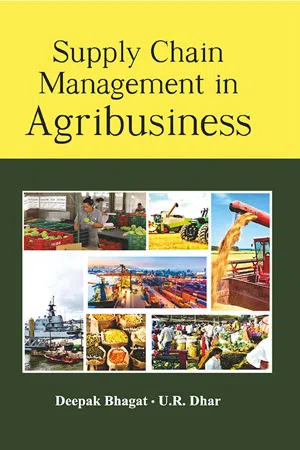
Supply chain management in agribusiness has the potential to strengthen the traditional agricultural marketing channels of developing countries to come at par with modern sophisticated chains of developed counries. This will facilitate farmers of developing countries to compete in modern consumer driven market and have maximum share of the growing food markets not only in their own country but of the entire world. All these might lead to quality improvement in the life of farmers. At the same time urban residents can also get timely and quality food supply and all at low price. However, there are not enough literatures that can be drawn on the subject matter. In the absence of a clear unanimous perception on the status of agribusiness in terms of both backward and forward linkage etc., the formulation of policy, strategies, programmes and schemes relating to agribusiness becomes difficult.The present book is humble attempt to analyze both economic and social aspects of the agricultural supply chains including the information aspect. The study presented in this book initially tries to find out and map the supply chain networks of selected high-value agricultural commodities. After that, it attempts to study and analyze the supply chains over three critical dimensions- product flow dimension, relationship dimension and information flow dimension. The book has been arranged in twelve chapters.Since the concept of agribusiness supply chain management is still in nascent stage, this book hoped to supplement the economic aspect of the agriculture supply chains with social aspect and information aspect and thus provide more insight enabling better understanding of the agriculture supply chains and thus, add to the developing theory of agribusiness supply chain management. This book shall be useful for the academicians, researchers and students of economics, management, agricultural marketing etc. This book shall also be useful to the policy makers, planners, practitioners and all those who are interested in welfare of the farmers as well as consumers and strengthening of the overall agricultural marketing and agribusiness supply chain system.
- 253 pages
- English
- PDF
- Available on iOS & Android
eBook - PDF
About this book
Information
Subtopic
AgricolturaTable of contents
- Foreword
- Preface
- List of Figures
- List of Tables
- 1. Introduction
- 1.1. Background
- 1.2. Research Problem
- 1.3. Framework of Analysis
- 1.4. Objectives of the Study
- 1.5. Justification of the Study
- 1.6. Outline of the Study
- References
- 2. Conceptual Framework
- 2.1. Background
- 2.2. Theoretical constructs
- 2.3. Conclusion
- References
- 3. Review of Literature
- 3.1. The Concept of High Value Agricultural Products (HVAPs)
- 3.2. The Evolution of Supply Chain Management
- 3.3. The Supply Chain Concept
- 3.4. Agricultural Supply Chains
- 3.5. Factors Affecting Supply Chain Performance
- 3.6. Analysis of Agricultural Supply Chains
- 3.6.1. Economics of HVAPs Marketing
- 3.6.2. Relationships in Supply Chains
- 3.6.3. Information Flow in Supply Chains
- 3.7. Conclusion
- References
- 4. Methodology
- 4.1. Research Design
- 4.1.1. Data Collection
- 4.1.2. Subject Selection
- 4.1.3. Sampling Procedure
- 4.2. Analytical Tools and Procedures
- 4.2.1. Growth and Instability
- 4.2.2. Supply Chain Analysis
- References
- 5. High Value Agricultural Commodity Scenario in Garo Hills
- 5.1. Zonal Distribution of Horticultural Crops in Meghalaya
- 5.2. High Value Agricultural Commodities Scenario in Meghalaya
- 5.3. High Value Agricultural Commodities Scenario in Garo Hills
- 5.4. Agribusiness Opportunities in Garo Hills
- References
- 6. Profile of the Study Area
- 6.1. A Brief Profile of Meghalaya
- 6.2. Land Use Pattern in Meghalaya
- 6.3. Land Holding Pattern in Meghalaya
- 6.4. Garo Hills of Meghalaya
- 6.5. Brief Description of the Study Area
- 6.6. Profile of the Respondents
- 7. Supply Chain Networks of High Value Agricultural Commodities
- 7.1. Supply Chain Network of Pineapple
- 7.2. Supply Chain Network of Areca Nut
- 7.3. Supply Chain Network of Cashew Nut
- 8. Economics of Agribusiness Supply Chains
- 8.1. Pineapple Supply Chain
- 8.1.1. Marketing Cost, Margin and Price Spread in Pineapple Supply Chain
- 8.2. Areca Nut Supply Chain
- 8.2.1. Marketing Cost, Margin and Price Spread in Areca Nut Supply Chain
- 8.3. Cashew Nut Supply Chain
- 8.3.1. Marketing Cost, Margin and Price Spread in Cashew Nut Supply Chain
- 8.4. Comparative Analysis of the Supply Chains of the Selected High Value Agricultural Commodities
- References
- 9. Relationship Relationship Dimension in Agribusiness Supply Chains
- 9.1. Relationship Analysis in Pineapple Supply Chain
- 9.1.1. Identification of Principal Relationship Factors in Pineapple Supply Chain
- 9.1.2. Identification of Significant Factors Affecting Relationship Satisfaction of Pineapple Small Holders
- 9.2. Relationship Analysis in Areca Nut Supply Chain
- 9.2.1. Identification of Principal Relational Factors in Areca Nut Supply Chain
- 9.2.2. Identification of Significant Factors Affecting Relationship Satisfaction of Areca Nut Small Holders
- 9.3. Relationship Analysis in Cashew Nut Supply Chain
- 9.3.1. Identification of Principal Relationship Factors in Cashew Nut Supply Chain
- 9.3.2. Identification of Significant Factors Affecting Relationship Satisfaction of Cashew Nut Small Holders
- 9.4. Conclusion
- References
- 10. Information Flow in Agribusiness Supply Chains
- 10.1. Information Flow in Pineapple Supply Chain
- 10.2. Information Flow in Areca Nut Supply Chain
- 10.3. Information Flow in Cashew Nut Supply Chain
- 10.4. Conclusion References
- 11. Analysis of Supply Chain Constraints
- 11.1. Agribusiness Development Constraints in Garo Hills of Meghalaya
- 11.2. Supply Chain Constraints of High Value Agricultural Commodities
- 12. Summary and Conclusion
- 12.1. Introduction
- 12.2. Methodology
- 12.3. Summary of Findings
- 12.3.1.High Value Agricultural Commodity Scenario and Agribusiness Opportunities in Garo Hills
- 12.3.2.Supply Chain Networks of Selected High Value Agricultural Commodities in Garo Hills
- 12.3.3.Economics of High Value Agricultural Commodity Marketing in Garo Hills
- 12.3.4.Relationships in High Value Agricultural Commodity Supply Chains
- 12.3.5.Information Flow in High Value Agricultural Commodity Supply Chains
- 12.3.6.Analysis of Supply Chain Constraints
- 12.4. Conclusion
- 12.5. Implications
- 12.5.1. Theoretical Implications
- 12.5.2. Managerial Implications
- 12.5.3. Policy Implications
- 12.6. Research Limitations and Suggestions for Future Research
- 12.6.1. Limitations
- 12.6.2. Future Research
- Appendices
- Bibliography
Trusted by 375,005 students
Access to over 1.5 million titles for a fair monthly price.
Study more efficiently using our study tools.
Frequently asked questions
Yes, you can cancel anytime from the Subscription tab in your account settings on the Perlego website. Your subscription will stay active until the end of your current billing period. Learn how to cancel your subscription
No, books cannot be downloaded as external files, such as PDFs, for use outside of Perlego. However, you can download books within the Perlego app for offline reading on mobile or tablet. Learn how to download books offline
Perlego offers two plans: Essential and Complete
- Essential is ideal for learners and professionals who enjoy exploring a wide range of subjects. Access the Essential Library with 800,000+ trusted titles and best-sellers across business, personal growth, and the humanities. Includes unlimited reading time and Standard Read Aloud voice.
- Complete: Perfect for advanced learners and researchers needing full, unrestricted access. Unlock 1.5M+ books across hundreds of subjects, including academic and specialized titles. The Complete Plan also includes advanced features like Premium Read Aloud and Research Assistant.
We are an online textbook subscription service, where you can get access to an entire online library for less than the price of a single book per month. With over 1.5 million books across 990+ topics, we’ve got you covered! Learn about our mission
Look out for the read-aloud symbol on your next book to see if you can listen to it. The read-aloud tool reads text aloud for you, highlighting the text as it is being read. You can pause it, speed it up and slow it down. Learn more about Read Aloud
Yes! You can use the Perlego app on both iOS and Android devices to read anytime, anywhere — even offline. Perfect for commutes or when you’re on the go.
Please note we cannot support devices running on iOS 13 and Android 7 or earlier. Learn more about using the app
Please note we cannot support devices running on iOS 13 and Android 7 or earlier. Learn more about using the app
Yes, you can access Supply Chain Management in Agribusiness by Bhagat, Deepak in PDF and/or ePUB format, as well as other popular books in Tecnologia e ingegneria & Agricoltura. We have over 1.5 million books available in our catalogue for you to explore.