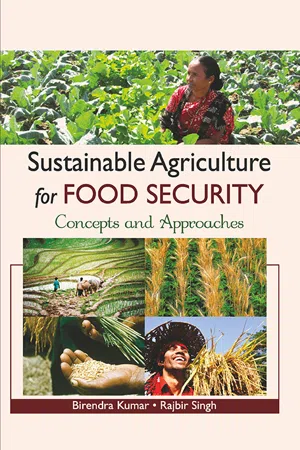
- 255 pages
- English
- PDF
- Available on iOS & Android
eBook - PDF
Information
Subtopic
AgricultureTable of contents
- Preface
- Abbreviations Used in the Text
- 1. Household Food, Nutritional and Livelihood Security through Agricultural Interventions
- 1.1 Household Food, Nutritional and Livelihood Security-Definition and Concept
- 1.2 Knowledge Management (KM) in Agriculture
- 1.3 Food and Agriculture Organization (FAO) Integrated Plant Nutrient Supply System (IPNS) Approach
- 1.4 Opportunities for Organic Farming (OF)
- 1.4.1 Organic Inputs
- 1.5 Role of Biotechnology in Sustainable Crop Production and Food Security
- 1.6 Efficient Use of Renewable and Non-renewable Inputs in Agriculture
- 1.7 Nutrient Management (NM)
- 1.8 Good Quality Seeds/Planting Materials (Genetic Materials)
- 1.9 Use of Precision Farming (PF)
- 1.10 Information Technology and Computer (IT &C) in Agriculture
- 1.11 Soil Resource Management (SRM)
- 1.12 Bio-fortification of Crops
- 1.13 Policy issues
- 1.14 Conclusions
- 1.15 References
- 2. Rural Agriculture Development for Food and Nutritional Security
- 2.1 Assuring Food Security
- 2.1.1 Increase Agricultural Output Worldwide
- 2.1.2 Reduce Poverty
- 2.1.3 Improve Health and Nutrition
- 2.2 Past Progress and Outlook
- 2.3 Encouraging Appropriate Policies and Strategies
- 2.4 Enhancing Food Supplies through Intensification of Production Systems and Through Sound Natural Resources Management
- 2.4.1 Encouraging Rapid Technological Change
- 2.4.2 Increasing the Efficiency of Irrigation
- 2.4.3 Improving Natural Resource Management (NRM)
- 2.4.4 Improving Access to Food
- 2.4.5 Improving Food Utilization
- 2.5 Conclusions
- 2.6 References
- 2.7 Websites
- 3. Agricultural Production Based Food Securities
- 3.1 Various Types of Production Systems
- 3.1.1 Crop Production Systems
- 3.1.2 Medicinal and Aromatic Plants Based Production System
- 3.1.3 Vegetable Based Production System
- 3.1.4 Fruit Based Production System
- 3.1.5 Ornamental Plants Based Production Systems
- 3.2 Forest Based Production System
- 3.3 Livestock and Dairy system
- 3.4 Future Policy Review Point for Production Based Livelihood
- 3.5 Key References
- 4. Urban Wastes Management in Agriculture
- 4.1 The Urban Waste Challenge
- 4.2 Recycling of Urban Organic Waste for Urban Agriculture
- 4.3 Benefits and Constraints
- 4.4 Composting & Vermiculture: The Environmentally and Economically Sustainable Solution from Urban Waste
- 4.5 Ecofriendly Management
- 4.6 Scientific Waste Management
- 4.6.1 Use of Industrial and Urban Wastes in Agriculture
- 4.6.2 Solid Wastes Management
- 4.6.3 Air Pollution
- 4.6.4 Environmental Indicators
- 4.6.5 Crop and Soil Ecology
- 4.6.6 Sustainable Land Use Systems
- 4.6.7 Biofuels
- 4.6.8 Bio-medical Composting
- 4.6.9 Wastewater Use in Urban and Peri-urban Agriculture and its Contribution to Food Security
- 4.7 Restoring Degraded Soils in India using Urban Wastes
- 4.8 Applications
- 4.9 Concentration Not to Exceed
- 4.10 Neutralizing Industrial Waste with Worms
- 4.11 Salient Achievements
- 4.12 References
- 4.13 Other References Consulted
- 5. Climate Change and Mitigating Strategies for Sustainable Crop Production
- 5.1 Factors Responsible for Climate Change
- 5.1.1 Due to Geo-ecological Events
- 5.1.2 Due to Man Kind Intervention
- 5.2 Efforts to Overcome the Impact of Climate Change
- 5.2.1 What Can We Do?
- 5.3 References
- 6. Global Climate Change Impact and Restoring Climate Order for Sustainable Food Security and Soil Health
- 6.1 Global Climate Change Impact
- 6.2 Impact of Climate Change on Agriculture and Systems
- 6.3 Climate Change and Water
- 6.4 Tactics for Restoring Climate Order and Saving Living Planet-The Earth
- 6.5 Carbon Sequestration (CS)
- 6.6 Adoption of Recommended Agricultural Practices (RAPs)
- 6.7 Land Uses Practices
- 6.8 Crop Rotations
- 6.9 Integrated Soil Fertility Management (ISFM)
- 6.10 Biological Management of Soil Fertility
- 6.11 Role of Biodiversity
- 6.12 Resources Conserving Technologies (RCTs)
- 6.13 Future Line of Work
- 6.14 Key References and Resources
- 7. Precision Farming for Natural Resource Management (NRM) and Sustainable Crop Production
- 7.1 Definition of Precision Agriculture
- 7.2 Concept of Precision Farming
- 7.2.1 Assessing Variability
- 7.2.2 Managing Variability
- 7.3 Technology Used for Precision Farming
- 7.3.1 Mapping
- 7.3.2 Manual Mapping during Field Operations
- 7.3.3 Remote Sensing
- 7.3.4 Geographic Information System (GIS)
- 7.3.5 Global Positioning System (GPS)
- 7.3.6 Modeling
- 7.4 Commercialization of PF
- 7.5 Indian Perspective
- 7.6 Site Specific Nutrient Management (SSNM) in Intensive Rice Systems in Asia
- 7.6.1 Major Components
- 7.6.2 Conditions where Precision N Management will be Profitable or Beneficial to the Environment
- 7.6.3 Conditions not Favouring Precision Nitrogen Management
- 7.7 References
- 8. Resource Conservation Technology for Sustainable Food Security
- 8.1 Conservation Agriculture (CA)
- 8.1.1 Goal of Conservation Agriculture
- 8.1.2 Characteristics of Conservation Agriculture
- 8.1.3 What is not Conservation Agriculture
- 8.1.4 Conservation Tillage
- 8.1.5 Direct Planting/Seeding
- 8.1.6 Organic Farming
- 8.1.7 Is CA compatible with IPM
- 8.1.8 What is the role of Animal Husbandry in Conservation Agriculture
- 8.1.9 What are the Downsides of Conservation Agriculture
- 8.1.10 Benefits of Conservation Agriculture
- 8.1.11 Issues in Conservation Agriculture
- 8.1.12 Necessary Technologies are Often Unavailable
- 8.1.13 Is Conservation Agriculture Real
- 8.2 New Machines for Conservation Agriculture
- 8.2.1 Double Disc Coulters
- 8.2.2 Punch Planter/Star Wheel
- 8.2.3 Happy Seeder
- 8.2.4 Rotary Disk Drill (RDD)
- 8.3 RCTs in Reclaimed Alkali Soils
- 8.3.1 Immediate Objectives
- 8.3.2 Long-term Objectives
- 8.4 Resource Conserving Technologies–Potential Tools for Attaining Food, Nutritional and Livelihood Security
- 8.5 RCTs in Rice-Wheat System and Need for Conservation Agriculture
- 8.6 Laser Land Leveling
- 8.7 Resource Conservation Technologies in Wheat
- 8.7.1 Zero Tillage
- 8.7.2 Energy and Economics
- 8.7.3 Reduced/Minimum Tillage
- 8.7.4 Rotary Tillage
- 8.7.5 Bed Planting
- 8.7.6 Surface Seeding
- 8.7.7 Water Use and Savings Under Various Tillage Options
- 8.7.8 Eco-friendly Tillage Options
- 8.8 RCTs in Rice
- 8.8.1 Direct Wet Seeded Rice
- 8.8.2 Weed Management in Direct Seeded Rice
- 8.8.3 Leaf Colour Chart
- 8.9 References
- 9. Advances of Nutrient Management
- 9.1 Brief Reviews
- 9.2 Introduction
- 9.3 Organic Resources
- 9.3.1 Incorporation of Green Manure in Rice Field
- 9.3.2 Brown Manuring in Rice
- 9.3.3 Biofertilizers
- 9.3.4 Crop Residues
- 9.4 Management of Fertilizers
- 9.4.1 Nitrogen Fertilizers
- 9.4.2 Phosphorus Management
- 9.4.3 Potassium Management
- 9.4.4 Secondary and Micronutrients
- 9.5 Role of IPNS
- 9.5.1 Balanced Nutrition
- 9.5.2 Nutrient Removal
- 9.5.3 Fertiliser Application Techniques
- 9.5.4 Calculation of Profile Nitrogen Levels from Soil Test Values
- 9.5.5 N Fertiliser Application
- 9.6 A New Concept of Nutrient Management
- 9.6.1 The Right Practice at the Right Time
- 9.6.2 Site-Specific Nutrient Management
- 9.7 Tools for Farmers
- 9.8 Limitation
- 9.8.1 Small Land Holdings
- 9.8.2 Poor Infrastructure Facilities
- 9.8.3 Lack of Participatory Approach
- 9.8.4 Low Availability of Organic Resources
- 9.8.5 High Labour Demand
- 9.9 Future Strategies
- 9.9.1 Awareness
- 9.9.2 Attention for Major Components
- 9.9.3 Popularizing the Use of Biofertilizers
- 9.9.4 Soil Test Techniques
- 9.9.5 Promoting Various Approaches
- 9.9.6 Maximize Nutrient Use
- 9.10 References
- 10. Principals and Practices of Organic Farming
- 10.1 Concept and Definition of Organic Farming
- 10.2 Why Organic Farming ?
- 10.3 Benefits of Organic Farming
- 10.4 Principles of Organic Farming
- 10.5 Aims of Organic Farming
- 10.6 Organic Farming in India
- 10.7 Major Products of Organic Farming in India
- 10.8 Cultivation Techniques of Organic Farming
- 10.8.1 Nutrient Management
- 10.8.2 Use of Mulches
- 10.8.3 Use of Cover Crops
- 10.8.4 Adaptation of Crop Rotation/Intercropping
- 10.8.5 Irrigation Practices in Organic Forming
- 10.8.6 Weed Management
- 10.8.7 Plant Protection (Insect-pests and Disease Management)
- 10.9 Conclusions
- 10.10 References
- Appendices
- Index
Trusted by 375,005 students
Access to over 1.5 million titles for a fair monthly price.
Study more efficiently using our study tools.
Frequently asked questions
Yes, you can cancel anytime from the Subscription tab in your account settings on the Perlego website. Your subscription will stay active until the end of your current billing period. Learn how to cancel your subscription
No, books cannot be downloaded as external files, such as PDFs, for use outside of Perlego. However, you can download books within the Perlego app for offline reading on mobile or tablet. Learn how to download books offline
Perlego offers two plans: Essential and Complete
- Essential is ideal for learners and professionals who enjoy exploring a wide range of subjects. Access the Essential Library with 800,000+ trusted titles and best-sellers across business, personal growth, and the humanities. Includes unlimited reading time and Standard Read Aloud voice.
- Complete: Perfect for advanced learners and researchers needing full, unrestricted access. Unlock 1.5M+ books across hundreds of subjects, including academic and specialized titles. The Complete Plan also includes advanced features like Premium Read Aloud and Research Assistant.
We are an online textbook subscription service, where you can get access to an entire online library for less than the price of a single book per month. With over 1.5 million books across 990+ topics, we’ve got you covered! Learn about our mission
Look out for the read-aloud symbol on your next book to see if you can listen to it. The read-aloud tool reads text aloud for you, highlighting the text as it is being read. You can pause it, speed it up and slow it down. Learn more about Read Aloud
Yes! You can use the Perlego app on both iOS and Android devices to read anytime, anywhere — even offline. Perfect for commutes or when you’re on the go.
Please note we cannot support devices running on iOS 13 and Android 7 or earlier. Learn more about using the app
Please note we cannot support devices running on iOS 13 and Android 7 or earlier. Learn more about using the app
Yes, you can access Sustainable Agriculture for Food Security: Concepts and Approaches by Kumar, Birendra in PDF and/or ePUB format, as well as other popular books in Technology & Engineering & Agriculture. We have over 1.5 million books available in our catalogue for you to explore.