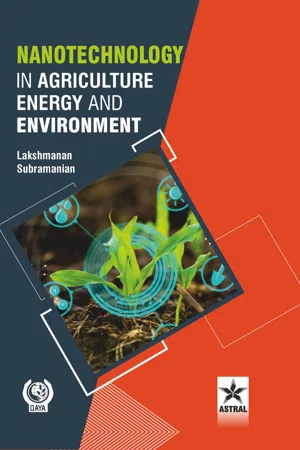
The nanoworld is perhaps the fastest growing world in the twenty-first century and advantages of nanotechnology towards improving the quality of life are enormous. The potentials of nano systems have just started showing encouraging results in agriculture sector and better understanding of nano materials can contribute hugely to ensure food and nutritional security. This book on Nanotechnology in Agriculture, Energy and Environment is a compilation of both basics and applied aspects and the objective of this book is to provide a study material to students and young researchers in nanotechnology pertaining to agriculture, food technology, energy, environment and ecosystem health. The study materials have been compiled in twelve units and thirty three chapters. This book can help teachers, students and researchers to develop a clear vision and better understanding of nano technological interventions in agriculture, besides providing valuable lead for future research. This book helps to create a firm foundation on Nanotechnology in Agriculture, that anyone can build on in any way they wish.
- 717 pages
- English
- PDF
- Available on iOS & Android
eBook - PDF
Nanotechnology in Agriculture Energy and Environment
About this book
Information
Subtopic
AgricultureTable of contents
- Foreword
- Preface
- Contents
- Physical Concepts and StructuralProperties of Nanomaterials
- 2. Magnetic, Electrical and OpticalProperties of Nanostructured Materials
- Mechanical and Thermal Properties ofNanomaterials
- Electronic Structure and SurfaceChemistry of Nanomaterials
- Solid State, Polymer andElectrochemistry of Nanomaterials
- Electron and Probe Microscopyfor Nanometrology
- Characterization of Nanomaterials usingDiffraction and Spectroscopy
- Software to Model Nanostructures
- Synthesis of Nanomaterials usingPhysical Methods
- Chemical Reduction Approaches for theSynthesis of Nanomaterials
- Green Synthesis of NanoparticlaresUsing Biological Reductants
- Nanofertilizers:Concept, Synthesis and Applications
- Nanotechnology for Weed Management
- Nanotechnology for MoreCrop per Drop
- Nanotechnology for EnhancingSeed Quality and Health
- Nanotechnological Approaches inPlant Protection
- Nano-Scale Materials as Probes, Sensorsand Delivery Vehicles
- Nanotechnology inPlant Genome Engineering
- Nanotechnology inChemical and Optical Sensors
- Bio and Nano Sensors: Theory andApplications in Agriculture
- Nano Films and Nanoformulationsfrom Bio Sources for ExtendingShelf Life of Fruits
- Nanotechnology for Enhanced FoodNutrition, Food Safety Assessment andGreen Nanopackaging
- Application of Nanotechnology in Solar,Wind and Hydrogen Energy
- Nanotechnology Interventions inBatteries and Fuel Cells
- Nanotechnology forSustainable Biofuel Production
- Organic and Inorganic Nanoparticlesin Pollution Management andEcosystem Health
- Nanomembranes in Water Treatment
- Harnessing Nanotechnology toManage Greenhouse Gases
- Impact of Nanoparticles onSoil Microbial Communities
- Toxicity of Nanoparticles onNatural Enemies and Pollinators
- Environmental Concerns and Toxicologyof Engineered Nanoparticles
- Biosafety Guidelines forNano Agri Inputs and Nano AgriProducts: Global and Indian Scenario
- Nanotechnology in Agriculture:Emerging Opportunities andFuture Challenges
- Index
Trusted by 375,005 students
Access to over 1.5 million titles for a fair monthly price.
Study more efficiently using our study tools.
Frequently asked questions
Yes, you can cancel anytime from the Subscription tab in your account settings on the Perlego website. Your subscription will stay active until the end of your current billing period. Learn how to cancel your subscription
No, books cannot be downloaded as external files, such as PDFs, for use outside of Perlego. However, you can download books within the Perlego app for offline reading on mobile or tablet. Learn how to download books offline
Perlego offers two plans: Essential and Complete
- Essential is ideal for learners and professionals who enjoy exploring a wide range of subjects. Access the Essential Library with 800,000+ trusted titles and best-sellers across business, personal growth, and the humanities. Includes unlimited reading time and Standard Read Aloud voice.
- Complete: Perfect for advanced learners and researchers needing full, unrestricted access. Unlock 1.5M+ books across hundreds of subjects, including academic and specialized titles. The Complete Plan also includes advanced features like Premium Read Aloud and Research Assistant.
We are an online textbook subscription service, where you can get access to an entire online library for less than the price of a single book per month. With over 1.5 million books across 990+ topics, we’ve got you covered! Learn about our mission
Look out for the read-aloud symbol on your next book to see if you can listen to it. The read-aloud tool reads text aloud for you, highlighting the text as it is being read. You can pause it, speed it up and slow it down. Learn more about Read Aloud
Yes! You can use the Perlego app on both iOS and Android devices to read anytime, anywhere — even offline. Perfect for commutes or when you’re on the go.
Please note we cannot support devices running on iOS 13 and Android 7 or earlier. Learn more about using the app
Please note we cannot support devices running on iOS 13 and Android 7 or earlier. Learn more about using the app
Yes, you can access Nanotechnology in Agriculture Energy and Environment by Lakshmanan, A in PDF and/or ePUB format, as well as other popular books in Technology & Engineering & Agriculture. We have over 1.5 million books available in our catalogue for you to explore.