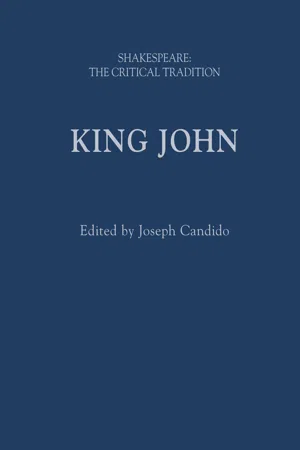
- 472 pages
- English
- ePUB (mobile friendly)
- Available on iOS & Android
eBook - ePub
About this book
This new volume in Shakespeare: The Critical Tradition increases our knowledge of how Shakespeare's plays were received and understood by critics, editors and general readers. Updated with a new introduction providing a survey of critical responses to the plays since the late 1930s to the present day, the volume offers, in separate sections, both critical opinions about the play across the centuries and an evaluation of their positions within and their impact on the reception of the play. The chronological arrangement of the text-excerpts engages the readers in a direct and unbiased dialogue, whereas the introduction offers a critical evaluation from a current stance, including modern theories and methods. Thus the volume makes a major contribution to our understanding of the play and of the traditions of Shakespearean criticism surrounding it as they have developed from century to century.
Information
1
Edmond Malone, commentary on King John
1790
From The Plays and Poems of William Shakespeare, in Ten Volumes; Collated Verbatim with the Most Authentick Copies, and Revised: with the Corrections and Illustrations of Various Commentators; to Which are Added, An Essay on the Chronological Order of His Plays; An Essay Relative to Shakespeare and Jonson; A Dissertation on the Three Parts of King Henry VI.; An Historical Account of the English Stage; and Notes; by Edmond Malone (11 vols, London, 1790).
Edmond Malone (1741–1812), critic and editor, was a friend of Johnson, Boswell, and numerous other luminaries in the literary and political worlds. He played a significant role, both inspirational and editorial, in assisting Boswell with the Life of Johnson (London, 1791), and also edited the work through several reissues. Malone came to London from Ireland in 1777, and in short order produced an influential list of Shakespearian studies, most notably An Attempt to Ascertain the Order in Which the Plays Attributed to Shakespeare Were Written, published with the Johnson-Steevens edition of 1778, and reprinted as part of the introductory apparatus to Malone’s 1790 Plays and Poems. His other important scholarly contributions include a Supplement to the Johnson-Steevens edition (2 vols, London, 1780), a Second Appendix to the Supplement (London, 1783), and A Dissertation on the Three Parts of King Henry VI, Tending to Shew That Those Plays Were Not Written Originally by Shakespeare (London, 1787). The preparation of a new multi-volume edition of Shakespeare occupied Malone’s energies considerably after 1790, but numerous other projects (among them his detailed exposé of William Henry Ireland’s forged Shakespeare papers in 1796 and an edition of Dryden’s prose works in 1800) caused delays, and he died before the enterprise could be completed. The materials for this new project were entrusted to James Boswell the younger, who brought Malone’s plans to fruition in his twenty-one volume edition of 1821.
[From An Attempt to Ascertain the Order in Which the Plays of Shakespeare Were Written1 ]
King John, 1596
This historical play was founded on a former drama, entitled The Troublesome Raigne of John King of England, with the Discoverie of King Richard Cordelion’s base Son, vulgarly named the Bastard Fawconbridge: also the Death of King John at Swinstead Abbey. As it was (sundry times) publickely acted by the Queenes Majesties Players in the honourable Citie of London. This piece, which is in two parts, and was printed at London for Sampson Clarke, 1591, has no author’s name in the title-page. On its republication in 1611, the bookseller for whom it was printed, inserted the letters W. Sh. in the title-page; and in order to conceal his fraud, omitted the words – publikely – in the honourable Citie of London, which he was aware would proclaim this play not to be Shakespeare’s King John; the company to which he belonged, having no publick theatre in London: that in Blackfriars being a private play-house, and the Globe, which was a publick theatre, being situated in Southwark. He also, probably with the same view, omitted the following lines addressed to the Gentlemen Readers, which are prefixed to the first edition of the old play:
You that with friendly grace of smoothed brow
Have entertain’d the Scythian Tamburlaine,
And given applause unto an infidel;
Vouchsafe to welcome, with like curtesie,
A warlike Christian and your countryman.
For Christ’s true faith indur’d he many a storme,
And set himselfe against the man of Rome,
Until base treason by a damned wight Did all his former triumphs put to flight.
Accept of it, sweete gentles, in good sort,
And thinke it was prepar’d for your disport. [IA2, 1ff.]
Shakespeare’s play being then probably often acted, and the other wholly laid aside, the word lately was substituted for the word publickly: ‘ – as they were sundry times lately acted,’ &c.
Thomas Dewe, for whom a third edition of this old play was printed in 1622, was more daring. The two parts were then published, ‘as they were sundry times lately acted;’ and the name of William Shakespeare inserted at length. By the Queenes Majesties players was wisely omitted, as not being very consistent with the word lately, Elizabeth being then dead nineteen years.
King John is the only one of our poet’s uncontested plays that is not entered in the books of the Stationers’ company. It was not printed till 1623, but is mentioned by Meres in 1598, unless he mistook the old play in two parts, printed in 1591, for the composition of Shakespeare.
It is observable that our author’s son, Hamnet, died in August, 1596. That a man of such sensibility, and of so amiable a disposition, should have lost his only son, who had attained the age of twelve years, without being greatly affected by it, will not be easily credited. The pathetick lamentations which he has written for Lady Constance on the death of Arthur, may perhaps add some probability to the supposition that this tragedy was written at or soon after that period.
In the first scene of the second act the following lines are spoken by Chatillion, the French ambassador, on his return from England to King Philip:
And all the unsettled humours of the land –
Rash, inconsiderate, firy voluntaries,
With ladies’ faces and fierce dragons’ spleens, –
Have sold their fortunes at their native homes,
Bearing their birth-rights proudly on their backs,
To make a hazard of new fortunes here.
In brief, a braver choice of dauntless spirits
Than now the English bottoms have waft o’er,
Did never float upon the swelling tide,
To do offence and scathe to Christendom. [2.1.66ff.]
Dr. Johnson has justly observed in a note on this play, that many passages in our poet’s works evidently shew that ‘he often took advantage of the facts then recent and the passions then in motion.’[2] Perhaps the description contained in the last six lines was immediately suggested to Shakespeare by the grand fleet which was sent against Spain in 1596. It consisted of eighteen of the largest of the Queen’s ships, three of the Lord Admiral’s, and above one hundred and twenty merchant ships and victuallers, under the command of the earls of Nottingham and Essex. The regular land-forces on board amounted to ten thousand; and there was also a large body of voluntaries (as they were then called) under the command of Sir Edward Winkfield. Many of the nobility went on this expedition, which was destined against Cadiz. The fleet sailed from Plymouth on the third of June 1596; before the end of that month the great Spanish armada was destroyed, and the town of Cadiz was sacked and burned. Here Lord Essex found 1200 pieces of ordnance, and an immense quantity of treasure, stores, ammunition, &c. valued at twenty million of ducats. The victorious commanders of this successful expedition returned to Plymouth, August 8, 1596, four days before the death of our poet’s son. Many of our old historians speak of the splendor and magnificence displayed by the noble and gallant adventurers who served in this expedition; and Ben Jonson has particularly alluded to it in his Silent Woman, written a few years afterwards.3 To this I suspect two lines already quoted particularly refer:
Have sold their fortunes at their native homes,
Bearing their birth-rights proudly on their backs.
Dr. Johnson conceived that the following lines in this play –
And meritorious shall that hand be call’d,
Canoniz’d, and worshipp’d as a saint,
That takes away by any secret course
Thy hateful life. [3.1.176ff.]
might either refer to the bull published against Queen Elizabeth, or to the canonization of [Henry] Garnet, [Guy] Faux [i.e., Fawkes], and their accomplices, who in a Spanish book which he had seen, are registered as sai...
Table of contents
- Cover
- Half-Title
- Series
- Dedication
- Title
- Contents
- General editor’s preface
- General editors’ preface to the revised editions
- Preface
- Acknowledgements
- Introduction
- Supplementary introduction
- 1 Edmond Malone, commentary on King John, 1790
- 2 Joseph Ritson, response to Malone, 1792
- 3 George Steevens, response to Malone, 1793
- 4 George Chalmers, on the date of King John, 1799
- 5 Elizabeth Inchbald, character and characterization, 1808
- 6 August Wilhelm von Schlegel, personality and politics, 1815
- 7 Nathan Drake, Shakespeare’s art of characterization, 1817
- 8 William Hazlitt, history and character, 1817
- 9 William Oxberry, prefatory remarks on King John, 1819
- 10 Augustine Skottowe, The Troublesome Raigne and King John, 1824
- 11 Samuel Weller Singer, introduction to King John, 1826
- 12 George Daniel, prefatory remarks on King John, 1826
- 13 James Boaden, Sarah Siddons as Constance, 1827
- 14 Anna Brownell Jameson, the character of Constance, 1832
- 15 Thomas Campbell, Sarah Siddons on Constance, 1834
- 16 Thomas Campbell, general remarks on King John, 1838
- 17 Thomas Peregrine Courtenay, King John and history, 1838
- 18 Charles Knight, The Pictorial Edition of King John, 1838
- 19 George Fletcher, the female roles in King John, 1843
- 20 Joseph Hunter, editorial corrections in King John, 1845
- 21 Hermann Ulrici, ‘history’, church, and state in King John, 1846
- 22 Gulian Crommelin Verplanck, critical remarks on King John, 1847
- 23 Hartley Coleridge, critical notes on King John, 1851
- 24 François Pierre Guillaume Guizot, history, art, and character in King John, 1852
- 25 Henry Norman Hudson, introduction to King John, 1852
- 26 Henry Reed, history and character, 1855
- 27 William Watkiss Lloyd, King John and nationalism, 1856
- 28 John Charles Bucknill, the madness of Constance, 1859
- 29 Richard Grant White, background and critical notes to King John, 1859
- 30 Charles Cowden Clarke, characterization, craft, and the philosophy of war, 1863
- 31 Georg Gottfried Gervinus, politics, ethics, and chararacter, 1863
- 32 John Abraham Heraud, the politics of national interest, 1865
- 33 Henry Giles, the transcendent sorrow of Constance, 1868
- 34 Henry Thomas Hall, national interest and personal loyalty, 1871
- 35 Richard Simpson, King John and contemporary politics, 1874
- 36 Edward Dowden, the baseness of John, 1875
- 37 Algernon Charles Swinburne, Shakespeare’s art of characterization, 1875–6
- 38 John Weiss, Constance and the nature of woman, 1876
- 39 Frederick James Furnivall, King John, Richard III, and character, 1877
- 40 Denton Jaques Snider, the theme of nationality, 1877
- 41 George Wilkes, King John and Roman Catholicism, 1877
- 42 Frederick Gard Fleay, literary and historical background to King John, 1878
- 43 Edward Rose, Shakespeare’s adaptation of The Troublesome Raigne, 1878
- 44 George Henry Calvert, high praise for King John, 1879
- 45 Henry John Hardy, on Pandulph and history, 1887
- 46 Henry Morley, on commodity, 1887
- 47 Francis Albert Marshall, a balanced assessment of King John, 1888
- 48 Hiram Corson, on Constance and Arthur, 1889
- 49 Walter Horatio Pater, kingship, personality, and the human condition, 1889
- 50 Oliver Elton, the artistic excellence of King John, 1890
- 51 James Appleton Morgan, The Troublesome Raigne and King John, 1892
- 52 Louis Lewes, on Constance, Elinor, and Blanch, 1894
- 53 Beverley Ellison Warner, historical character and dramatic character, 1894
- 54 Barrett Wendell, the oddities of King John, 1894
- 55 Frederick Samuel Boas, on the principal characters, 1896
- 56 Georg Morris Cohen Brandes, Shakespeare’s uneven artistry, 1898
- 57 Henry Sebastian Bowden, Shakespeare’s Roman Catholicism, 1899
- 58 Charles Harold Herford, Shakespeare’s maturing artistry, 1899
- 59 Hamilton Wright Mabie, King John as a transitional play, 1900
- 60 George Charles Moore Smith, weaknesses and strengths of King John, 1900
- 61 J. Lytelton Etty, the character of John, 1901
- 62 Felix Emanuel Schelling, Shakespeare and Davenport, 1902
- 63 Richard Green Moulton, the pendulum of history in King John, 1903
- 64 Edmund Kerchever Chambers, the formlessness of King John, 1906
- 65 George Pierce Baker, Shakespeare’s dramatic development, 1907
- 66 Henry Charles Beeching, on the religion of Shakespeare, 1907
- 67 Richard Garnett, introduction to King John, 1907
- 68 Ivor Bertram John, King John and Richard II, 1907
- 69 Charlotte Endymion Porter, the belittling of John, 1910
- 70 Frank Harris, Constance and Shakespeare’s shrewish wife, 1911
- 71 John Edward Masefield, on treachery and ‘Englishness’, 1911
- 72 Stopford Augustus Brooke, on John, Faulconbridge, and Constance, 1913
- 73 John James Munro, Shakespeare’s use of The Troublesome Raigne, 1913
- 74 James Brander Matthews, the artistic flaws of King John, 1913
- 75 Horace Howard Furness, Jr., on the Bastard, John, and the play, 1919
- Notes
- A select bibliography
- Index
- Copyright
Trusted by 375,005 students
Access to over 1.5 million titles for a fair monthly price.
Study more efficiently using our study tools.
Frequently asked questions
Yes, you can cancel anytime from the Subscription tab in your account settings on the Perlego website. Your subscription will stay active until the end of your current billing period. Learn how to cancel your subscription
No, books cannot be downloaded as external files, such as PDFs, for use outside of Perlego. However, you can download books within the Perlego app for offline reading on mobile or tablet. Learn how to download books offline
Perlego offers two plans: Essential and Complete
- Essential is ideal for learners and professionals who enjoy exploring a wide range of subjects. Access the Essential Library with 800,000+ trusted titles and best-sellers across business, personal growth, and the humanities. Includes unlimited reading time and Standard Read Aloud voice.
- Complete: Perfect for advanced learners and researchers needing full, unrestricted access. Unlock 1.5M+ books across hundreds of subjects, including academic and specialized titles. The Complete Plan also includes advanced features like Premium Read Aloud and Research Assistant.
We are an online textbook subscription service, where you can get access to an entire online library for less than the price of a single book per month. With over 1.5 million books across 990+ topics, we’ve got you covered! Learn about our mission
Look out for the read-aloud symbol on your next book to see if you can listen to it. The read-aloud tool reads text aloud for you, highlighting the text as it is being read. You can pause it, speed it up and slow it down. Learn more about Read Aloud
Yes! You can use the Perlego app on both iOS and Android devices to read anytime, anywhere — even offline. Perfect for commutes or when you’re on the go.
Please note we cannot support devices running on iOS 13 and Android 7 or earlier. Learn more about using the app
Please note we cannot support devices running on iOS 13 and Android 7 or earlier. Learn more about using the app
Yes, you can access King John by Joseph Candido in PDF and/or ePUB format, as well as other popular books in Literature & Literary Criticism of Shakespeare. We have over 1.5 million books available in our catalogue for you to explore.