A Brief History of Archaeology details early digs and covers the development of archaeology as a multidisciplinary science, the modernization of meticulous excavation methods during the twentieth century, and the important discoveries that led to new ideas about the evolution of human societies.
Spanning more than two thousand years of history, this short account of the discipline of archaeology tells of spectacular discoveries and the colorful lives of the archaeologists who made them, as well as of changing theories and current debates in the field. Early research at Stonehenge in Britain, burial mound excavations, and the exploration of Herculaneum and Pompeii culminate in the nineteenth-century debates over human antiquity and the theory of evolution. The book then moves on to the discovery of the world's pre-industrial civilizations in Egypt, Mesopotamia, and Central America; the excavations at Troy and Mycenae; the Royal Burials at Ur, Iraq; and the dramatic finding of the pharaoh Tutankhamun in 1922. The book concludes by considering recent sensational discoveries and exploring the debates over processual and post-processual theory that have intrigued archaeologists in the early twenty-first century. The third edition updates this respected introduction to one of the science's most fascinating disciplines.
A Brief History of Archaeology is a vivid narrative that will engage readers who are new to the discipline, drawing on the authors' extensive experience in the field and classroom.
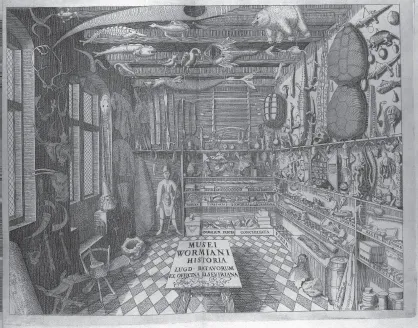
Figure 1.1Ole Worm’s museum, complete with fossils, seashells, human artifacts, and natural history specimens. (Smith Archive/Alamy Stock Photo)
Tomb robbers struck gold in 1987—a magnificent funerary mask, fine ornaments, and beautifully fashioned clay vessels. For weeks, they had been digging surreptitiously into the adobe pyramid on the banks of the Lambayeque River near Sipán on Peru’s North Coast, home of the ancient Moche civilization. Rumors of great wealth swept the community. Fortunately for archaeology, reports of the sensational finds reached the ears of local archaeologist Walter Alva. He rushed to the pyramid, posted armed guards, and saved the richly decorated burials of hitherto unknown Moche lords. For months, Alva and a team of conservators labored over not one but three royal burials, deposited in elaborate brick burial chambers, one above the other. The result was a feat of fine-grained archaeological excavation, and of meticulous conservation of artifacts so fragile that they had to be lifted in blocks, then separated in the laboratory.
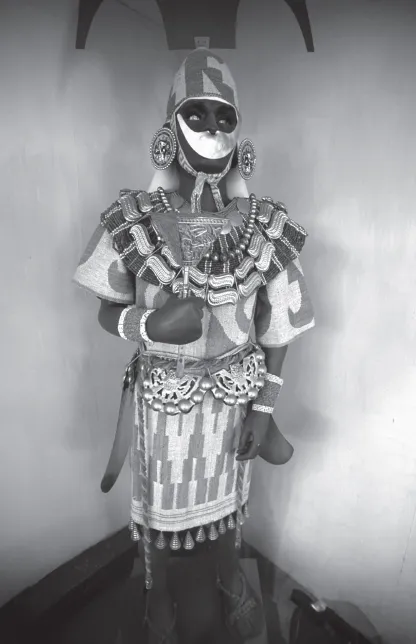
The Lords of Sipán lay in their full ceremonial regalia, glittering with gold and silver, carrying scepters, every part of their elaborate costumes reflecting a Moche world where the realms of the living and the dead flowed seamlessly one into the other. We know from painted scenes on Moche pots that these elaborately costumed lords presided over military campaigns and ceremonies involving the sacrifice of prisoners of war. On rare occasions, the Moche warrior-priests would appear in public dressed in all their glory. They would stand atop a pyramid, glittering brilliantly in the sun, the living personification of gods, showing themselves but rarely to the waiting crowds in the plaza far below (Figure 1.2).
The Lords of Sipán are one of the greatest archaeological discoveries of all time and represent a triumph of science over treasure hunting. They epitomize the romance of archaeology, which has captivated people for centuries.
To many people, archaeology is a world of grinning skeletons and gold-rich pharaohs, of soaring pyramids and lost civilizations. It’s a realm of pith-helmeted archaeologists, frenzied searches for mummies, and the kind of Indiana Jones-like adventures beloved of Hollywood. Nothing could be further from the truth. The early days of archaeology were indeed times when you could find a lost civilization in a week of searching or unearth that rarity of rarities, an undisturbed royal tomb. Today’s archaeologist is not an adventurer but a highly skilled scientist. The development of archaeology as a serious science was one of the greatest scientific successes of the twentieth century. This book tells the remarkable, and often colorful, story of how archaeology changed from a pursuit based on curiosity about the human past into a pastime of high adventure, and then into a science.
Back in the eighteenth century, an anonymous antiquarian (a person who studies remains of the past) lightheartedly described archaeology as “the science of rubbish.” Archaeologists are indeed concerned with ancient garbage heaps—with the discarded remains of human behavior; but it’s perhaps more accurate to describe archaeology as “the backward-looking curiosity.” Whatever the methods used, most archaeology is, and has been, driven by a profound curiosity about the human past. This chapter traces the beginnings of archaeology in the curiosity of an obscure Babylonian monarch.
Figure 1.2A mannequin wearing a replica of a Lord of Sipán’s ceremonial regalia. (Bert de Ruiter/Alamy Stock Photo)
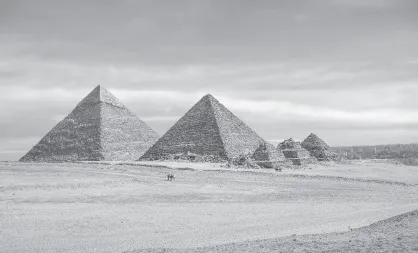
Figure 1.3The Pyramids of Giza, Egypt. (Kateryna Kolesnyk/iStock by Getty Images)
Beginnings
The past is always around us, offering encouragement, warning of danger, laying out precedents for the future. Material remains of ancient times surround us on every side—the Pyramids of Giza in Egypt (Figure 1.3), the stone circles of Stonehenge in southern England, the great city of Teotihuacán in highland Mexico. This is the realm of archaeology—the scientific study of ancient humanity in all its remarkable diversity from our origins in tropical Africa several million years ago to the threshold of modern times.
We’re not talking about the past of mythic origins, chanted about by priests and tribal shamans, which defined a world of legendary creators and established the familiar order of things. We’re concerned here with a linear past, defined and described by archaeological research and Western science.
All societies have their own ways of explaining human existence and the world around them. Many Christians believe in the literal historical truth of Genesis 1, in which God created the world and all living things, including humans, in six days. To many societies, the cosmos is a series of layers, often fashioned by primordial waters. The Quiche Maya Popol Vuh, a book of prophecy and divination, describes the dark stillness at the beginning:
There was not yet one person, one animal… . Only the sky alone is there; the face of the earth is not clear. Only the sea alone is pooled under all the sky; there is nothing whatever gathered together. It is at rest, not a single thing stirs.
(Tedlock 1996:127)
Most societies have been content with their legendary origins. For example, we know that the biblical account of Creation owes much to ancient Mesopotamian tribal lore passed from generation to generation for many centuries before being set down on clay tablets sometime after 3000 B.C.
Babylonian kings of the sixth century B.C. were the first to dig in search of the past. King Nabonidus was an undistinguished ruler, remarkable only for his intense interest in ancient religious beliefs. He dug into, and restored, the great stepped temple-pyramid (or ziggurat) of the Sumerian city of Ur, where he was delighted to unearth the inscriptions of long-forgotten monarchs. His daughter En-nigaldi-Nanna dug for years into another Sumerian shrine at the city of Agade without success. Then a heavy rainstorm cut a deep gully through the crumbling mound and revealed the foundations of the shrine. The discovery “made the king’s heart glad and caused his countenance to brighten” (Oates 1979:162). En-nigaldi-Nanna’s finds were displayed in a special room in the royal palace.
The Babylonians were well aware that history, and perhaps rich treasure, lay beneath their feet; but Nabonidus can hardly be called an archaeologist. Nor could the Greek traveler Herodotus, who visited Egypt in the fifth century B.C. He wrote a detailed and gossipy account of the Pyramids of Giza and the ancient Egyptians. He spent many hours talking to local priests, from whom he learned about mummification and how the embalmers drew the brain of the deceased through the nostrils with an iron hook. Herodotus was well aware of the importance of Egyptian civilization. Like other Greeks, and the Romans after them, he believed that the Nile Valley was the ultimate cradle of all civilization. Herodotus was no scholar and no archaeologist. He was a sucker for even the most outrageous tales, solemnly proclaiming that the pharaoh Khufu sold his daughter into prostitution to pay for the building of the Great Pyramid.
Neither the Greeks nor the Romans practiced archaeology as a way of studying the past. They were well aware of the existence of exotic peoples who lived outside the confines of the Mediterranean world. Many authors, among them Herodotus and Tacitus, wrote astute descriptions of people like the Scythians of the Russian plains and the fierce Celts who lived east of the Rhine River. They referred to them as “barbarians,” describing peoples whom we only know of today through archaeological research.
Both Greek and Roman intellectuals were aware that earlier societies had preceded their own. Homer’s Iliad and Odyssey described ancient Bronze Age societies and the Minoan civilization of Crete. The Greeks and Romans also knew of peoples living in much less sophisticated cultures than their own. In about 700 B.C., the Greek author Hesiod wrote of past ages of humanity, conceiving of them in technological terms. There had once been a Golden Age, he said, when humanity prospered and was content. More recently had come the Age of Iron, when people waged war constantly. No notions of human progress here, for Hesiod wrote in troubled times. But there was a perception of a philosophical past—a less stressful time often thought of as being superior to the present.
Another Greek author, Diodorus Siculus, who wrote a famous geography in the first century B.C., reflected the thinking of many scholars of the day when he proclaimed that all civilization had originally stemmed from Egypt. The ancient Egyptians, it was thought, were the foundation of all wisdom, of the institutions of civilization, and of medicine.
Then, as now, Egypt was a magnet for curious visitors. Roman tourists flocked to Alexandria near the mouth of the Nile, using a galley service that ran like clockwork from southern Italy. After a few days among the fleshpots of this cosmopolitan city, the visitor took a boat up the Nile, pausing to marvel at the Pyramids of Giza, then traveling upstream to admire the temples of the ancient sun god Amun at Karnak and Luxor. On the west bank of the river—the realm of the ancient Egyptian dead—they would wander among the empty royal sepulchers in the Valley of the Kings. Every sunrise, crowds of tourists would gather at the huge seated statues that had once adorned the funerary temple of King Amenhotep III (1386–1349 B.C.). As the sun rose, the stones forming the feet of one of the statues would creak and groan as they expanded in the warming sunlight. Emperor Septimus Severus abruptly terminated the strange noise when he ordered the stones patched in A.D. 202. The tourists’ graffiti scribbled on the statues survive to this day.
Many of these tourists returned home with pendants, scarabs, and other Egyptian antiquities. None other than the Roman emperor Hadrian adorned his garden with Greek and Egyptian statuary.
On the other side of the world, Chinese philosophers also speculated about the remote past—about humanity before the legendary Xia and Shang dynasties founded civilization in northern China. A compilation of writings, Records of the Grand Historian, by Sima Qian in 91 B.C. and other historiographies, set out a Chinese past in which people had imagined primordial ages—first an age of stone, then one of bronze, then one of iron—as a mythical world. This prophetic scheme of three ages of the remote human past was not based on science; it was merely the product of intelligent minds thinking about ancient times, perhaps in the context of now forgotten and lost folklore.
A Past “Five Days Elder Than Ourselves”
The Chinese, Greeks, and Romans merely flirted with the past. Archaeology as we know it today did not exist. With the collapse of the classical world, casual speculations ceased, to be replaced gradually by a history that drew its inspiration from the Old Testament and from the surviving works of classical writers.
Medieval scholars in Europe created an invented past like the one proclaimed by Geoffrey of Monmouth in his A History of the Kings of England, published in 1508. He brought Brutus, the son of the classical hero Aeneas, to England in A.D. 1125 to start British ...
Table of contents
Cover
Half Title Page
Title Page
Copyright Page
Dedication Page
Contents
List of Figures
Preface
Acknowledgments
Authors’ Note
Major Events in the History of Archaeology from A.D. 1600
1 “The Backward-Looking Curiosity”
2 The Antiquity of Humankind
3 Pharaohs and Assyrians
4 Human Progress and the Three Ages
5 Early American Archaeology
6 Scriptures and Civilizations
7 The Birth of Culture History
8 Egypt, Iraq, and Beyond
9 Archaeology Coming of Age, 1920 to 1950
10 Culture History and Beyond
11 Radiocarbon Dating and World Prehistory
12 The “New Archaeology”?
13 After Processualism
14 The Future
Glossary: Archaeological Sites and Cultural Terms
References
Index
Trusted by 375,005 students
Access to over 1.5 million titles for a fair monthly price.
Study more efficiently using our study tools.
Frequently asked questions
Yes, you can cancel anytime from the Subscription tab in your account settings on the Perlego website. Your subscription will stay active until the end of your current billing period. Learn how to cancel your subscription
No, books cannot be downloaded as external files, such as PDFs, for use outside of Perlego. However, you can download books within the Perlego app for offline reading on mobile or tablet. Learn how to download books offline
Perlego offers two plans: Essential and Complete
Essential is ideal for learners and professionals who enjoy exploring a wide range of subjects. Access the Essential Library with 800,000+ trusted titles and best-sellers across business, personal growth, and the humanities. Includes unlimited reading time and Standard Read Aloud voice.
Complete: Perfect for advanced learners and researchers needing full, unrestricted access. Unlock 1.5M+ books across hundreds of subjects, including academic and specialized titles. The Complete Plan also includes advanced features like Premium Read Aloud and Research Assistant.
Both plans are available with monthly, semester, or annual billing cycles.
We are an online textbook subscription service, where you can get access to an entire online library for less than the price of a single book per month. With over 1.5 million books across 990+ topics, we’ve got you covered! Learn about our mission
Look out for the read-aloud symbol on your next book to see if you can listen to it. The read-aloud tool reads text aloud for you, highlighting the text as it is being read. You can pause it, speed it up and slow it down. Learn more about Read Aloud
Yes! You can use the Perlego app on both iOS and Android devices to read anytime, anywhere — even offline. Perfect for commutes or when you’re on the go. Please note we cannot support devices running on iOS 13 and Android 7 or earlier. Learn more about using the app
Yes, you can access A Brief History of Archaeology by Nadia Durrani,Brian M. Fagan in PDF and/or ePUB format, as well as other popular books in Social Sciences & Archaeology. We have over 1.5 million books available in our catalogue for you to explore.