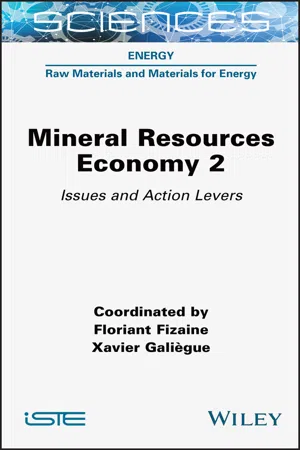
The challenges associated with the environmental impact of renewable energies are formidable and multiple. The exploitation of diffuse forms of energy will require us to reshape our lifestyles and infrastructures. Reducing their environmental impact is imperative and requires the mobilization of all available levers of action.
Beyond the analysis of these challenges, this book presents an overview of the levers of action that should allow us to meet them, by crossing the fields of the human sciences, geosciences and engineering. The levers of action examined are both technical (through the substitution or use of low technology) and economic and social (through the development of recycling or decoupling). The book also addresses the question of their effectiveness and their overall impact.
- English
- ePUB (mobile friendly)
- Available on iOS & Android
eBook - ePub
About this book
Information
PART 1
Stakes
1
Toward a New Geopolitics of Raw Materials in the Energy Transition
Emmanuel HACHE1,2, Gondia SOKHNA SECK1, Charlène BARNET1, Samuel CARCANAGUE2 and Fernanda GUEDES1
1 IFP Énergies nouvelles (IFPEN), Rueil-Malmaison, France
2 Institut de relations internationales et stratégiques (IRIS), Paris, France
1.1. Introduction
The question of access to so-called strategic materials1 (Weil et al. 2009; Helbig et al. 2016) has always been central to economic analysis, in particular because of the random nature of the presence or absence of resources in a given territory.
While authors of the first classics, such as Malthus (1766–1834) in his An Essay on the Principle of Population, published in 1798, raised the question of the relationship between demographic growth and the increase in natural food resources, it was not until the mid-19th century that the notion of dependence on foreign territories was introduced. In his famous essay The Coal Question, William Stanley Jevons thus took an interest in the evaluation of the United Kingdom’s coal reserves to study the country’s probable dependence on imported coal and the possible geopolitical consequences of its decline. In the 20th century, questions about the exhaustion of natural resources were raised by the constitution of the Club of Rome in 1968. The Club’s reflections were to break with the optimism of growth without environmental externalities and expose, for the first time, the risks of systemic collapse on the basis of long-term scenarios. Thus, the report “The Limits to Growth”, published in 1972, the result of simulation work by the Massachusetts Institute of Technology (MIT), was the first to propose trajectories of resource depletion, excess absorption of pollutant emissions and system collapse.
In the field of geopolitics, raw materials have most often been analyzed as a source of international conflicts, as a factor of industrial and military power or from the point of view of scarcity (Haglund 1982). Alex and Matelly (2011) proposed a more geo-economic angle by focusing on raw materials that they consider strategic by nature, due to the functioning and structure of markets and due to the involvement of a multitude of stakeholders with different objectives. These three levels of analysis remain relevant in the context of the energy transition. Indeed, investments in renewable energies (REs) are generally associated with a double dividend, since they reduce CO2 emissions and result in a decrease in fossil fuel imports (Criqui and Mima 2012). This partial emancipation from the economic and geopolitical stakes of traditional energy security, particularly the issues of availability and accessibility, must however be analyzed in a more global logic by taking into account the materials necessary for the construction and implementation of low-carbon technologies (solar, wind, storage, electric vehicles, etc.) in national energy systems. Indeed, the necessary volumes of investment in these technologies could lead to a marked increase in the demand for materials or metals and generate major economic and geopolitical transformations in the various raw materials markets.
However, the latest UNEP-BNEF2 report highlighted that, between 2010 and 2019, the investments already made in renewable3 energy reached 2,600 billion dollars. The capacity of electricity generation based on renewable energy has thus increased from 414 GW to 1,650 GW in 10 years. To limit global warming to below 2°C by 2100, these investments will have to increase significantly in the coming decades.
Due to their higher material content than traditional technologies (power plants and thermal vehicles), the new needs in low-carbon technologies could thus upset the geopolitics of raw material markets. Indeed, the latter will have to integrate an additional layer of complexity related to the new relationships generated by the demand for materials in the energy transition. The geopolitics of strategic raw materials conceals a double dimension, whether one is a producer country with the main issue being the development of its resources or a consumer country for which the question of securing supplies is central. In addition to this double prism, there is also a dimension of management of resources or deposits by states and/or companies. In this context, the mineral markets are affected by issues that generally go beyond the sole prism of the economy to include geo-economics and geopolitics.
The objective of this chapter is thus to study the new economic or geopolitical dependencies that may appear in the dynamics of the global energy transition. In the first section, we present the concept of criticality established to measure the dependence of states on strategic materials and we insist on the difficult consideration of geopolitical aspects. In the second section, we then define, on the basis of our assessments of the demand for raw materials, an indicator of geological criticality, which we discuss in the light of geo-economics and geopolitics. In the third section, we examine the public policies of states to manage this new geopolitical situation.
1.2. Measuring the criticality of raw materials and geopolitical risk
1.2.1. Criticality, strategic materials and risks
The economic literature on the question of criticality is important, but the field of analysis remains extremely poorly defined. Indeed, while the concept of criticality can be conceptualized in a general way as an approach based on an assessment of the risks related to the production, use or end-of-life management of a raw material (Graedel and Nuss 2014), many studies focus on different disciplinary fields (economics, environment, business strategy, lifecycle analysis, etc.), use various indicators to measure criticality (R/P ratio, presence of substitutes, risk, environmental externalities, etc.) and work over multiple time horizons (from the short to medium to very long term), which make any comparison hazardous at first glance.
Behind the term “criticality”, there are many risks related to the question of raw materials in the energy transition: geological risk (lack of availability of materials due to demand pressure), geopolitical risk (concentration of production in the hands of a few producing countries), economic risk (embargoes, policies of trade restrictions, market manipulation, etc.), production risk (under-investment, joint production, etc.) and environmental or social risk (emissions of pollutants related to production, health consequences, etc.).
1.2.2. The absence of a homogeneous theoretical framework
The starting point of any criticality study is to know from which point of view one is trying to position oneself to determine whether or not a raw material may or may not be critical. The first consideration is geographic. The assessment of criticality depends on the scale adopted, whether it is global, regional or national. There is therefore no universality of criticality. The second consideration is that of the nature of the entity consuming the raw material. In the broadest sense, this can be the economy as a whole. In a more restricted way, it will be a question of an industry, a company or even a technology. The third consideration is temporal. Indeed, technical progress, production processes and the introduction of new products on the market generate, over time, variations in the input and output of different materials on the international and national markets.
Once the framework has been defined, the studies seek to distinguish between the risks on the supply of raw materials on the one hand, and the economic and technical importance of the latter on the other hand. A third dimension has more recently been added in criticality studies: the environmental consequences linked to the production of the raw material (Graedel et al. 2012). Each of these three dimensions is quantified using different indices that can be aggregated according to several methods.
1.2.3. Criticality matrices
Criticality analyses are historically linked to the use of risk assessment matrices, which represent the intensity of a risk in two dimensions: the probability of occurrence of the risk and its severity. The first risk assessment matrix was only established in the United States in 2...
Table of contents
- Cover
- Table of Contents
- Title Page
- Copyright
- Introduction
- PART 1 Stakes
- PART 2 Action Levers
- Conclusion
- List of Authors
- Index
- End User License Agreement
Trusted by 375,005 students
Access to over 1.5 million titles for a fair monthly price.
Study more efficiently using our study tools.
Frequently asked questions
Yes, you can cancel anytime from the Subscription tab in your account settings on the Perlego website. Your subscription will stay active until the end of your current billing period. Learn how to cancel your subscription
No, books cannot be downloaded as external files, such as PDFs, for use outside of Perlego. However, you can download books within the Perlego app for offline reading on mobile or tablet. Learn how to download books offline
We are an online textbook subscription service, where you can get access to an entire online library for less than the price of a single book per month. With over 1.5 million books across 990+ topics, we’ve got you covered! Learn about our mission
Look out for the read-aloud symbol on your next book to see if you can listen to it. The read-aloud tool reads text aloud for you, highlighting the text as it is being read. You can pause it, speed it up and slow it down. Learn more about Read Aloud
Yes! You can use the Perlego app on both iOS and Android devices to read anytime, anywhere — even offline. Perfect for commutes or when you’re on the go.
Please note we cannot support devices running on iOS 13 and Android 7 or earlier. Learn more about using the app
Please note we cannot support devices running on iOS 13 and Android 7 or earlier. Learn more about using the app
Yes, you can access Mineral Resource Economy 2 by Floriant Fizaine,Xavier Galiegue in PDF and/or ePUB format, as well as other popular books in Physical Sciences & Environmental Science. We have over 1.5 million books available in our catalogue for you to explore.