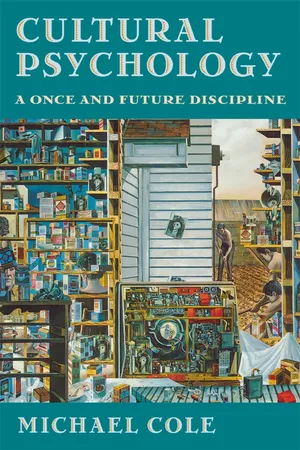
The distinguished psychologist Michael Cole, known for his pioneering work in literacy, cognition, and human development, offers a multifaceted account of what cultural psychology is, what it has been, and what it can be. A rare synthesis of the theory and empirical work shaping the field, this book will become a major foundation for the emerging discipline.
Culture might be precisely that condition that excludes a mentality capable of measuring it. Theodore Adorno
ACCORDING TO the mythology propagated in standard American textbooks, the discipline of psychology began in 1879 when Wilhelm Wundt opened a laboratory in Leipzig.1 What was new about the “new” psychology of the 1880s was experimentation. Students of human psychological processes in laboratory settings used ingenious “brass instruments” to present people with highly controlled physical stimuli (lights of precise luminance, sounds of precise loudness and pitch, and so on) and to record the content, magnitude, and latency of their responses with split-second accuracy. Mind, it was believed, could now be measured and explained according to the canons of experimental science.
Less often noted—the topic received only a single sentence in Boring’s (1957) tome on the history of psychology—was that Wundt conceived of psychology as necessarily constituted of two parts, each based on a distinctive layer of human consciousness and each following its own laws using its own methodology.
In recent years interest has grown in Wundt’s “second psychology,” the one to which he assigned the task of understanding how culture enters into psychological processes (Farr, 1983; Toulmin, 1980). My basic thesis is that the scientific issues Wundt identified were not adequately dealt with by the scientific paradigm that subsequently dominated psychology and the other behavioral-social sciences. As a consequence, attempts by psychologists working within the paradigm of twentieth-century experimental psychology to reintroduce culture as a crucial constituent of human nature face insuperable, unrecognized, difficulties.
Later in this book I will describe how twentieth-century psychology has sought to deal with Wundt’s legacy in attempting to create a more adequate theory of culture in mind. But first I must look into the prehistory of scientific psychology to make clear why culture-inclusive psychology has been such an elusive goal.
In the Beginning
It has long been recognized that culture is very difficult for humans to think about. Like fish in water, we fail to “see” culture because it is the medium within which we exist. Encounters with other cultures make it easier to grasp our own as an object of thought.
Some of the earliest evidence of culture’s becoming a self-conscious phenomenon can be traced back to the Greek historian Herodotus (Myers, 1953). The problem Herodotus set himself was a perfect vehicle for discovering culture. He wanted to know about origins: Who had initiated the hostility between the Greeks and Persians, and why? To answer this historical question, he traveled to more than fifty societies known to the Greeks of his day. In the process of recording their accounts of their origins, he obtained knowledge about the worlds they inhabited, as expressed in their religion, art, beliefs about gods, and everyday practices. What emerged were portraits of distinctive ways of life, which today we would call different cultures.
Herodotus’s inquiry also raised in acute form the question of how cultural differences should be evaluated. When he wrote down the histories and lifeways of other peoples, the generic name he gave to the subjects of his inquiry was barbarian. In early fourth-century Greece, barbarian was a descriptive term for people whose language, religion, ways of life, and customs differed from those of classical Greek culture. In effect, for Herodotus, barbarian meant “people who are different,” and his History is an inquisitive catalog of human variability that is relatively free of strong value judgments.
However, it was not long before difference became deficiency Later Greeks used barbarian to mean “outlandish, rude, brutal.” Both senses of barbaric, as different and as deficient, were retained when the term was appropriated into Latin. Subsequently it came to mean “uncivilized” or “uncultured,” and later “non-Christian.” The increasingly unflattering meanings attached to the word reached their apex when it was taken into English, where it is equated with “savage, rude, savagely cruel, inhuman” (OED).
Greek scholarly opinion was divided concerning the origins of the group differences they observed. Aristotle believed that slaves and barbarians were by nature bereft of the powers of planning and reasoning, while Hippocrates held that group differences arose from differences in climate and social institutions. Similar disagreements can be found in the scholarship of the Roman era and the Middle Ages (see Jahoda, 1992, for a summary and additional sources).
As Margaret Hodgen (1964) points out in her study of the origins of anthropology, the wide-ranging travels of fifteenth- and sixteenth-century explorers enormously increased both scholarly and popular interest in the varieties of humankind and culture. For a thousand or more years following the fall of Rome, European contact with “barbarians” had been very limited. Although descriptions of the life and customs of far-off people were available in reports by traders, soldiers, and missionaries, a vast folklore had grown up about the humans who lived beyond the fringes of the European world.
The difference between first-hand observation and second-hand mythologizing is illustrated by the beliefs that accompanied Christopher Columbus’s voyages. Columbus’s journal portrayed the people he met in the western hemisphere in relatively objective terms. He admired their generosity, moral character and intelligence, while finding their material circumstances lamentable. However, the second-hand accounts that began to proliferate as soon as Columbus returned to Europe built up a fantastic image of the newly discovered lands and their people which drew heavily on the mythical creatures of medieval imagination. The catalog was truly fantastic, including people who squeaked instead of speaking, people who were headless with their eyes and mouths located in their chests, people who went naked, had no marriage rites, lived in total promiscuity, and so on (Hodgen, 1964).
Even following a century of exploration and contact, one could encounter descriptions of the people living along the west coast of Africa as “dog faced, dog toothed people, satyrs, wild men, and cannibals,” and the people of the New World were said to be “liars, thieves, perverts, and obstinate idolaters” who seemed to lack any semblance of “reason peculiar to man.” “By this process of condemnation, New World man or the naked and threatening savage took that place in thought which, during the Middle Ages, had been reserved for human monsters. If human, theirs was a degraded humanity” (ibid., p. 363).
These images entered into the popular European conception of the world’s inhabitants, coming down to us today in such forms as Shakespeare’s Caliban, a creature “not honour’d with a human shape,” who, like the troglodyte cave dweller of antiquity, was incapable of human speech. Some Europeans seriously questioned whether creatures deemed so different were members of the human species at all.2
Hippocrates’ belief that geography and climate are the source of human variations was widely held in later centuries. Whatever its shortcomings, this view assumed all creatures we now recognize as human beings to be of a single species. In the sixteenth and seventeenth centuries geography and climate were thought to explain the darker skins of Africans and Amerindians. This tradition of environmental explanation came in for severe criticism (the sun kept shining on the Greeks and Romans, and yet their characteristic traits changed dramatically over time), and did not survive extensive European contact with third world peoples.3
Europeans assigned so-called savages (that is, non-Europeans) to an intermediate status between humans and animals. Pygmies, Laplanders, and others were claimed as “missing links” in the chain of being between animals and human beings. Carolus Linnaeus, in his System of Nature (1735) took the additional and decisive step of dividing human beings into two species, Homo sapiens and Homo monstrous, as follows:
Homo sapiens, varying by education and situation, was composed of
Wild man: four-footed, mute, hairy.
American: copper-colored, choleric, erect. Paints self. Regulated by custom.
European: fair, sanguine, brawny. Covered with close vestments. Governed by laws.
Asiatic: sooty, melancholy, rigid. Covered with loose garments. Governed by opinions.
African: black, phlegmatic, relaxed. Anoints himself with grease. Governed by caprice.
Homo monstrous, varying by climate and art, included
Mountaineers: small, inactive, timid.
Patagonians: large, indolent.
Hottentots: less fertile.
American: beardless.
Chinese: head conic.
Canadian: head flattened.
Linnaeus’s scheme is clearly a hodgepodge of mixed criteria, including skin color, dress, and political organization. However, it set an influential precedent for the later division of humanity into separate races. Subsequent advances in biological knowledge brought with them increasingly refined attempts to justify a purely biological account of human variability (Gossett, 1965; Harris, 1968), paving the way for racial explanations of what had previously been conceived of as cultural variations.4
Such beliefs, although subsequently discredited, helped to sustain the nineteenth-century intellectual climate in which the idea that national variations among human beings were the result of racial constitution became as widespread as the earlier idea that non-Europeans were at a lower level of the great chain of being. These beliefs helped to justify slavery and colonialism at a time when both practices were under heavy attack (Haller, 1971). Hence in 1849 Benjamin Disraeli could stand before the British House of Commons and declare that “race implies difference, difference implies superiority, and superiority leads to predominance,” confident that he was adopting a purely scientific point of view (quoted in Odom, 1967, p. 9).
Sociocultural Evolutionism
Whether one believed that in some primeval time human beings sprang from a single source (and hence that we were once “all alike”) or that morphologically distinct human groups represented distinct species (and hence that we were different to begin with) it was still necessary to explain the process of change over time. It was clear from the written record that during the sixteenth and seventeenth centuries the inhabitants of Germany, France, and England (for example) would have been firmly counted among the barbarians had the ancient Greeks been around at the time. How had the inhabitants of these countries, in the course of history, come to be transformed from barbarians into the apex of humanity?
Two explanations offered themselves. First, one could reinterpret the relation of environment to development and claim that northern peoples had advanced precisely because of constant challenges from their environment while their southern cousins lounged around indolently eating breadfruit. Or, one could claim that the northerners’ innate intellectual endowment was such that they simply thought their way out of a state of nature more rapidly. Whichever explanatory mechanism one invoked, in the decades preceding the founding of scientific psychology, the mainstream of both scholarly and popular opinion in Europe and the Europeanized areas of North America took it for granted that societies had undergone a process of sociocultural development with profound implications for psychological functioning.
E. B. Tylor, one of the founders of modern anthropology, captures the spirit of such thinking in his hyperbolic personification of Civilization:
We may fancy ourselves looking on Civilization as in personal figure she traverses the world; we see her lingering or resting by the way, and often deviating into paths that bring her toiling back to where she had passed long ago; but direct or devious, her path lies forward, and if now and then she tries a few backward steps, her walk soon falls into a helpless stumbling. It is not according to her nature, her feet were not made to plant uncertain steps behind her, for both in her forward view and her onward gain she is of truly human type. (1871/1958, p. 69)
Although enthusiasm for the equation of evolution and progress has subsided considerably in the century since Tylor wrote, the idea of sociocultural evolution has retained its importance in the social sciences (see Ingold, 1986; Hallpike, 1986; Harris, 1968; Sahlins and Service, 1960; White, 1959).
Tylor conceived of culture as what Melville Herskovitz (1948) later called the “man-made part of the environment,” in which he included knowledge, belief, art, morals, law, custom, and so on. Insofar as these elements are conceived of as adhering in a “complex whole,” claims about cultural variations in level of development could draw on any of them. Tylor reckoned levels of cultural evolution using the level of achievement in a variety of areas, particularly “the extent of scientific knowledge, the definitions of moral principles, the conditions of religious belief and ceremony, the degree of social and political organization (1874, p. 27).”5
In addition, Tylor was typical of other nineteenth-century scholars in assuming a close affinity between the level of sociocultural development and the level of mental development of the people constituting various social groups: “the condition of culture among various societies of mankind,” he wrote, “. . . is a subject apt for the study of laws of human thought and action” (1874, p. 1).
As an example of how natural this packet of assumptions seemed, consider Herbert Spencer’s thought experiment about the link between social and mental progress in which he drew an analogy between cultural development on the one hand and mental development on the other. Spencer assumed that the earliest humans lived such simple lives that they did not have basic materials from which to build complicated mental structures. He invites us to consider the most extreme case as a starting point.
Suppose perpetual repetition of the same experience; then the power of representation is limited to reproduction of this experience in idea. Given two often repeated different experiences, and it thereupon becomes possible to discern in the representations of them what they have in common; to do which, however, implies that the representative faculty can hold the two representations before consciousness; and the ability to do this can arise only after multitudinous recurrences. In like manner it is clear that only after there have been received many experiences which differ in their kinds but present some relation in common, can the first step be taken towards the concept of a truth higher in generality than these different experiences themselves. (Spencer, 1886, p. 521)
Spencer goes on to suggest that as experiences become more varied in their character there are concomitant increases in “the power of representation”:
It follows, therefore, that in the course of human progress general ideas can arise only as fast as social conditions render experiences multitudinous and varied; while at the same time it is to be observed that these social conditions themselves presuppose some general ideas. Each step towards more general ideas is instrumental in bringing about wider social co-operations . . . And then, when correlative experiences have become organized, there arises the possibility of ideas yet higher in generality, and a further social evolution. (1886, p. 522)
Spencer links these ideas to the concept of evolution proposed by Dar...
Table of contents
Cover
Title
Copyright
Dedication
Contents
Foreword
Introduction
1 Enduring Questions and Disputes
2 Cross-Cultural Investigations
3 Cognitive Development, Culture, and Schooling
4 From Cross-Cultural Psychology to the Second Psychology
5 Putting Culture in the Middle
6 Phylogeny and Cultural History
7 A Cultural Approach to Ontogeny
8 The Cognitive Analysis of Behavior in Context
9 Creating Model Activity Systems
10 A Multilevel Methodology for Cultural Psychology
11 The Work in Context
Notes
References
Acknowledgments
Index
Trusted by 375,005 students
Access to over 1.5 million titles for a fair monthly price.
Study more efficiently using our study tools.
Frequently asked questions
Yes, you can cancel anytime from the Subscription tab in your account settings on the Perlego website. Your subscription will stay active until the end of your current billing period. Learn how to cancel your subscription
No, books cannot be downloaded as external files, such as PDFs, for use outside of Perlego. However, you can download books within the Perlego app for offline reading on mobile or tablet. Learn how to download books offline
We are an online textbook subscription service, where you can get access to an entire online library for less than the price of a single book per month. With over 1.5 million books across 990+ topics, we’ve got you covered! Learn about our mission
Look out for the read-aloud symbol on your next book to see if you can listen to it. The read-aloud tool reads text aloud for you, highlighting the text as it is being read. You can pause it, speed it up and slow it down. Learn more about Read Aloud
Yes! You can use the Perlego app on both iOS and Android devices to read anytime, anywhere — even offline. Perfect for commutes or when you’re on the go. Please note we cannot support devices running on iOS 13 and Android 7 or earlier. Learn more about using the app
Yes, you can access Cultural Psychology by Michael Cole in PDF and/or ePUB format, as well as other popular books in Psychologie & Kognitive Psychologie & Kognition. We have over 1.5 million books available in our catalogue for you to explore.