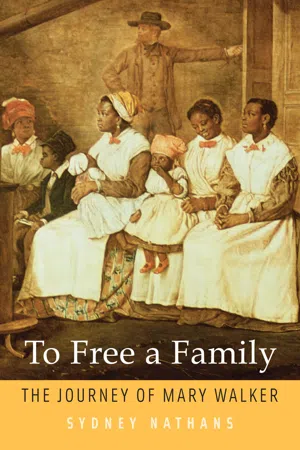
What was it like for a mother to flee slavery, leaving her children behind? To Free a Family tells the remarkable story of Mary Walker, who in August 1848 fled her owner for refuge in the North and spent the next seventeen years trying to recover her family. Her freedom, like that of thousands who escaped from bondage, came at a great price—remorse at parting without a word, fear for her family's fate.
This story is anchored in two extraordinary collections of letters and diaries, that of her former North Carolina slaveholders and that of the northern family—Susan and Peter Lesley—who protected and employed her. Sydney Nathans's sensitive and penetrating narrative reveals Mary Walker's remarkable persistence as well as the sustained collaboration of black and white abolitionists who assisted her. Mary Walker and the Lesleys ventured half a dozen attempts at liberation, from ransom to ruse to rescue, until the end of the Civil War reunited Mary Walker with her son and daughter.
Unlike her more famous counterparts—Harriet Tubman, Harriet Jacobs, and Sojourner Truth—who wrote their own narratives and whose public defiance made them heroines, Mary Walker's efforts were protracted, wrenching, and private. Her odyssey was more representative of women refugees from bondage who labored secretly and behind the scenes to reclaim their families from the South. In recreating Mary Walker's journey, To Free a Family gives voice to their hidden epic of emancipation and to an untold story of the Civil War era.
- 330 pages
- English
- ePUB (mobile friendly)
- Available on iOS & Android
eBook - ePub
About this book
Information
Publisher
Harvard University PressYear
2013Print ISBN
9780674725942
9780674062122
eBook ISBN
9780674266209
1 Reluctant Runaway
She was “a slender light coloured woman with dark straight hair and lightish eyes inclining to blue.” They had their eyes on her from the first. When she arrived at a Philadelphia boardinghouse in June 1846, a block from Independence Hall, a waiter in the neighborhood took notice of her. Thin, her hair long and strikingly straight, she accompanied a seventy-year-old gentleman with white hair and two young women, his daughters, one unable to walk on her own. Mrs. Warden’s place at Sansom and Seventh was known for hosting well-to-do visitors from the South. It was there that the woman was first seen by William Johnson, a twenty-six-year-old free black waiter who lived four blocks away from Mrs. Warden’s, on Currant Alley. While running errands, the waiter repeatedly observed the twenty-eight-year-old woman. She was a “light colored woman, very light colored who could scarcely be distinguished from a white woman.” He struck up her acquaintance. She “called herself Mary Walker.”1
What he learned was that she’d been brought to Philadelphia from North Carolina by her owner to wait on his daughter, “who was sick.” William Johnson and others had difficulty recalling the owner’s name, Duncan Cameron. But they correctly learned that the man they mistakenly called “Judge Campbell” had once been a judge and had kept that title. The judge’s family spent more than six weeks in the city in the summer of 1846. Johnson had “many opportunities of seeing . . . Mary Walker and Judge Campbell [Cameron] and his family” and encountered Mary Walker herself almost every day. From all the waiter saw and heard, the judge treated her as a free woman and “tried to create the impression that she was a free woman.” William Johnson knew otherwise.2
The black waiter alerted others that an enslaved woman had been brought to Philadelphia. He made contact with a long-time black leader of the antislavery movement in the city, James McCrummill, who took Mary Walker under his watch. Born free in Virginia, James McCrummill had arrived in Philadelphia in his youth, had established himself as a barber with a largely white clientele, and had become a dentist as well. His activism coincided with the birth of the great antislavery movement of the 1830s. McCrummill had presided over Philadelphia’s first interracial meetings; he had watched the building of the Antislavery Hall in 1838; he had cofounded the Philadelphia Vigilance Committee to help fugitive slaves find safety in Philadelphia or sanctuary farther north.3
In 1846, McCrummill responded cautiously to the news that an enslaved woman had been brought to town. Eight years before, he had witnessed the burning of the Antislavery Hall by a mob less than a week after its opening. Later the same year, the Pennsylvania legislature had disenfranchised the state’s black voters. In 1842, rioters had attacked the homes of Philadelphia blacks high and low, with no police challenge. McCrummill’s house was spared, but wealthy black comrade Robert Purvis, stunned by the rampage, was “convinced of our utter and complete nothingness in public estimation.” Black unity dissipated, even on the one issue where all had once seemed to agree—namely, helping those in flight from slavery get away. With middle-class blacks fearful that aid to fugitives would invite further white attacks, the Philadelphia Vigilance Committee had become dormant in 1842.4 Slowly, with McCrummill’s assistance, it had started to reconstitute itself in 1844.
So James McCrummill was guarded after hearing about Mary Walker from the young waiter who lived near her. In the summer of 1846, the free black dentist undertook simply to become acquainted with her. When the Camerons and Mary Walker returned to Philadelphia in the summer of 1847, McCrummill was on the waterfront to see them land “on the wharf at Dock street from the Baltimore Boat,” at “which time they boarded in Sansom Street as before.” He resumed his vigil. By then the dentist was aware, as were Mary Walker’s other Philadelphia acquaintances, of a disfigurement that apparently did not disturb her owners—four or five of her upper front teeth were missing. At some point, McCrummill or a friend got close enough to Duncan Cameron to learn that the slave-owner had dropped the ruse of presenting Mary Walker as a free woman. Cameron simply announced, “This is my servant Mary who would not leave me because she is better off in her present situation than those free negroes of the North.”5
There was another reason that McCrummill was deliberate. Usually when enslaved servants were brought to Philadelphia, they gave a sign if they wanted help. Mary Walker gave no outward sign. Still, observers seemed to wonder how long this woman would stay a slave in Philadelphia. “Mary was a very bright colored woman almost white with good straight hair same as a white woman,” recalled black laborer Nicholas Boston, adding his opinion that she had “good features but rather lean.” Free black dressmaker Annie E. Hall agreed: Mary Walker was a slim, delicate woman, a “very light person almost white.”6 Was she in fact utterly devoted to the family that owned her?
For his part, Duncan Cameron voiced complete confidence. The “Judge had brought her on to wait on them because he was not afraid she would run away.”7 He had good reason. Not only was Mary Walker a member of the most favored slave-family in his possession—but four hundred miles to the south, her children remained in bondage.
IN 1848, MARY WALKER WAS the mother of three children residing in Raleigh, North Carolina, the youngest age four and the oldest sixteen.8 She was herself the fourth generation of her family to belong to the same line of slave-owners, going back to the middle of the eighteenth century. Her great-grandmother “Molly” and great-grandfather “Yellow Daniel”—so designated on a slave-inventory that gave only forenames—had been the property of Thomas Amis of the town of Halifax in eastern North Carolina. When Thomas Amis died in 1764, he bequeathed Molly and Daniel and three others to his eight-year-old daughter, Mary Amis. In 1776, at the age of twenty, Mary Amis married Richard Bennehan, a rising thirty-three-year-old merchant from the state’s Piedmont region; she brought the family of Molly and Daniel with her to their new home in Hillsborough, North Carolina. In 1781, Molly gave birth to her third daughter—known as “Aggy”—who was destined to become Mary Walker’s grandmother early in the next century. By the time Aggy was born, Richard Bennehan was rapidly on his way to becoming a planter as well as a merchant. In a short time, he had accumulated twelve hundred acres of land and forty enslaved people.9
The location of their plantation in the North Carolina Piedmont shaped the kind of slave-owners the Bennehans and their children became—and the kind of bondage that Molly, Daniel, and Mary Walker came to experience. Had Bennehan been to the manor born, reared to rule workers growing rice in the coastal region of South Carolina, or to preside over a sugar plantation in the Caribbean, or later to oversee cotton-growing land in the Southern interior, the prospect of windfall profits might have tempted him to push his laborers to the limit. But placed as his farm was in the red clay of the Piedmont, he grew wheat and tobacco, less profitable crops. His interest was to care for his laborers’ health and welfare as if his livelihood depended on it—for indeed it did.10
Mary Walker’s grandmother Aggy was born between the arrival of the slave-owners’ daughter Rebecca Bennehan in 1778 and that of their son Thomas Amis Bennehan in 1782. Living amid a half-dozen black families, the Bennehan siblings grew up on the plantation that their parents called “Stagville,” where they thought of the place and its people in familial terms—“our family, white and black.” They might have come of age simply thinking of the plantation and its laborers as their rightful possessions, to manage as they saw fit. But their views of bondage were influenced by the ethos of postrevolutionary America, a time of debate about the morality of slavery. Thomas Bennehan was in the thick of those heated and heretical discussions in 1796, as an impressionable fourteen-year-old student at the recently founded University of North Carolina. So too was his cousin and classmate, Thomas G. Amis. Thomas Amis continued his soul-searching for another decade, sharing his deepening doubts about “this injured, unfortunate race” with his Bennehan cousin, his “one & only Bosom friend.” The people they owned “are not brutes, they have sentiments.” Like others of his generation, Amis espoused a remedy that fell short of liberation. “Exercise your power with mercy; with-hold the scourge ’till you reflect on their fate, ’till you think on their misfortunes.” “Treat them as human beings, your interest will become theirs, the sweat shall drop unheeded from their brows & their toil shall not be bitter because they love him who shall enjoy its fruits.”11
Thomas Bennehan and his sister Rebecca took to heart their cousin’s exhortations about the treatment of their black family, especially when its members were ill. Rebecca Bennehan always found it “truly distressing to witness the sufferings of so many sick and afflicted fellow mortals.” So too did her brother. Disappointed in love, Thomas Bennehan became a life-long bachelor—and devoted himself to plantation management and medical practice at Stagville. Only when his personal care proved insufficient for his sick workers did he relinquish them to trained physicians.12
BORN IN 1781, MARY WALKER’S grandmother Aggy might have lived an ordinary life as one of the Bennehans’ enslaved workers, tilling the soil and starting her own family with a fellow bondsman. But in 1796, her life took a different turn. At the age of fourteen, she became pregnant. Though the father was never named, there seems a high chance he was a white man. She called the child, born in October 1796, Priscilla. It was a full name—not a diminutive, as “Aggy” was of Agnes. It was a European name—no black ancestor or known member of the slave-community possessed that name. Did the name Priscilla indicate that Aggy imagined a life for her daughter different from her own? All we know is that by 1804, her daughter was no longer called Priscilla but rather “Silla.” In the same year, Aggy was fighting madness—the only member of the enslaved community in the eighteenth or nineteenth century ever to be designated insane.13
Whether sexual violence or dashed hopes or something else caused Aggy’s “derangement,” the result of her illness was that Mistress Rebecca took Aggy’s eight-year-old daughter, Silla, under her wing as a young household servant. Trained as her mistress’s personal helper, Silla was also taught to read, write—and sew. All female household servants were expected to stitch well enough to turn rough fabric bought for slave-clothing into completed shirts, frocks, and pants. Silla, however, became a highly skilled seamstress, who made and mended garments for the white family. When the mistress took sick, Silla looked closely after her; when Silla had a spell, her mistress rushed to the rescue. If seriously ill, as happened in 1816 and thereafter, Silla received sustained attention from the white family’s personal physician.14
The marriage of Rebecca Bennehan to lawyer Duncan Cameron might well have changed the lives of Mary Walker’s forebears for the worse. Duncan Cameron was an ambitious, hard-charging lawyer, the son of an Episcopalian minister in southside Virginia, who had come to the town of Hillsborough in the North Carolina Piedmont in 1799 to make his mark. Quickly his talents won him good cases and good clients; almost as quickly he set his sights on the most eligible young woman in the county. Rebecca Bennehan’s long blonde hair, well-to-do merchant-planter father, and inheritance of twenty-five slaves led one bachelor to dub her the “girl with the golden fleece.” Cameron won her hand and promise of marriage in 1803, besting a local rival. The defeated rival and fellow lawyer made some insinuating remarks—whether connected with the courtship or the courtroom is unclear. To the consternation of his bride and her family, Cameron accepted the challenge of a duel with his rival, went across the state line to Virginia, and there inflicted a wound which maimed and finally killed his nemesis.15 Friend, foe, and family alike took note from that point on: challenge Duncan Cameron and there could be a high price to pay.
In fact, Duncan Cameron’s marriage to Rebecca Bennehan brought the further elevation of the members of Molly and Daniel’s enslaved family. Ruthless when crossed, Duncan Cameron preferred to achieve his will in a businesslike way rather than through coercion, and extended that approach to the enslaved workers who became his when he married Rebecca Bennehan. Reluctant at first to leave Hillsborough and his full-time law practice to oversee a plantation, he finally yielded to the preferences of his wife and father-in-law, who gave him three hundred acres of land to sweeten the shift. Cameron respected the sensibilities of his bride and his brother-in-law, and acknowledged their feelings when their people became unwell. Knowing his brother-in-law’s mind, Cameron could “readily conjecture what his . . . sufferings are, amid so much sickness.”16 He understood that such emotional attachments, if mutual, had economic benefits.
Nonetheless in one dramatic gesture in 1809, Cameron signaled a different emphasis in dealing with his wife’s people. To get the land cleared and prepared for the construction of a new plantation dwelling, he offered all enslaved laborers payments for working overtime. For every cord of wood they cut and delivered (a cord of wood was eight feet long, four feet wide, and four feet deep), they received credit at the country store owned by his father-in-law, Richard Bennehan. Over a period of two years, dozens of Cameron’s workers exchanged cords of wood and hundreds of hours of labor for a bonanza of consumer goods—whiskey, hats, Dutch ovens, calico cloth, fish hooks, and locks. Cameron kept his eye out for the most able and willing workers. The store ledger confirmed that far and away the best man, who drove a horse and wagon and managed crews of fellow slaves, was the twenty-five-year-old Luke—the son of Molly and Daniel, and the uncle of thirteen-year-old Silla. Luke became what historian Michael Tadman has termed a “key slave” on the Cameron plantation: a trusted man for the plantation’s tasks, a groomsman of horses, the man summoned to drive a wagon or a coach, the servant who accompanied Cameron on his still-active legal travels around the state, a courier between plantation quarters or to Raleigh or Hillsborough. Luke in turn was given a handmade “trim suit” for fall and a warm “great-coat” for winter—and his family received the protection of their white owner from harm or sale.17
IT WAS INTO THIS FAVORED family that Silla’s daughter, Mary, was born on August 18, 1818. Later descriptions of her make it almost certain that her father was white. Some thirty years after her birth, a Philadelphian who knew both Mary Walker and Mary Walker’s closest Philadelphia friend asserted that her father was Duncan Cameron himself.18 Casting uncertainty on his claim is the fact that Mary’s mother, Silla, remained the domestic servant and seamstress throughout the lifetime of Rebecca Cameron (who died in 1843) and stayed in the Cameron household until she herself died in 1864. It would have taken considerable tolerance on Rebecca’s part for her to keep the servant and the child of an adulterous union in the household for almost a half-century. A much later source stated that Mary Walker’s father was a man named Taylor. This could have been the physician William Taylor, called upon in 1816 and after to care for Silla during her intermittent illnesses. William Taylor lived in the vicinity of the newly cleared Cameron plantat...
Table of contents
- Cover
- Title
- Copyright
- Contents
- Prologue: A Secret Striving
- 1. Reluctant Runaway
- 2. Sanctuary
- 3. “In the Midst of Friends”
- 4. “Never Reject the Claims of the Fugitive”
- 5. The Rescue Plot
- 6. “A Spirit Like a Dove”
- 7. A Season of Silence
- 8. “A Case of Heart Breaking Distress”
- 9. If They Die for Their Freedom, Amen
- 10. “The Welfare of Her Race”
- 11. “To Part No More”
- Epilogue: “Their Works Do Follow Them”
- Notes
- Acknowledgments
- Index
Trusted by 375,005 students
Access to over 1.5 million titles for a fair monthly price.
Study more efficiently using our study tools.
Frequently asked questions
Yes, you can cancel anytime from the Subscription tab in your account settings on the Perlego website. Your subscription will stay active until the end of your current billing period. Learn how to cancel your subscription
No, books cannot be downloaded as external files, such as PDFs, for use outside of Perlego. However, you can download books within the Perlego app for offline reading on mobile or tablet. Learn how to download books offline
Perlego offers two plans: Essential and Complete
- Essential is ideal for learners and professionals who enjoy exploring a wide range of subjects. Access the Essential Library with 800,000+ trusted titles and best-sellers across business, personal growth, and the humanities. Includes unlimited reading time and Standard Read Aloud voice.
- Complete: Perfect for advanced learners and researchers needing full, unrestricted access. Unlock 1.5M+ books across hundreds of subjects, including academic and specialized titles. The Complete Plan also includes advanced features like Premium Read Aloud and Research Assistant.
We are an online textbook subscription service, where you can get access to an entire online library for less than the price of a single book per month. With over 1.5 million books across 990+ topics, we’ve got you covered! Learn about our mission
Look out for the read-aloud symbol on your next book to see if you can listen to it. The read-aloud tool reads text aloud for you, highlighting the text as it is being read. You can pause it, speed it up and slow it down. Learn more about Read Aloud
Yes! You can use the Perlego app on both iOS and Android devices to read anytime, anywhere — even offline. Perfect for commutes or when you’re on the go.
Please note we cannot support devices running on iOS 13 and Android 7 or earlier. Learn more about using the app
Please note we cannot support devices running on iOS 13 and Android 7 or earlier. Learn more about using the app
Yes, you can access To Free a Family by Sydney Nathans in PDF and/or ePUB format, as well as other popular books in History & Social Science Biographies. We have over 1.5 million books available in our catalogue for you to explore.