The King James Bible has been a sacred and cultural icon of the English-speaking world since it was first published in 1611. The Kàroli Bible has played a similarly iconic role for Hungarians as the King James Bible has for the British. The selection of the papers offered here represents a treasure trove for biblical scholars, theologians, linguists, and students of English literature and cultural studies.
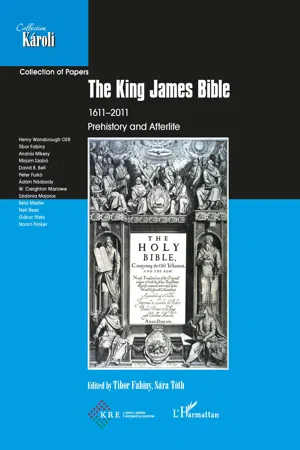
- 262 pages
- English
- ePUB (mobile friendly)
- Available on iOS & Android
eBook - ePub
About this book
Information
Topic
Theology & ReligionSubtopic
ChristianityPART I
THE KING JAMES BIBLE

THE KING JAMES VERSION, A BIBLE OF UNITY
HENRY WANSBROUGH OSB
A HIGH POINT OF ENGLISH LITERATURE
The King James Version of the Bible was one of the greatest achievements of English literature. It was produced at an unrivalled period of English culture and learning. During the years in which this version was being created an astonishing constellation of great writers was at work. Poets like John Donne (1572–1631), dramatists like William Shakespeare (1564–1625), Ben Jonson (1573–1637), essayists like Francis Bacon (1561–1626), homilists like Launcelot Andrewes (1555–1626) were at the height of their powers, writing with vigor, drama and confidence. The contemporary standard of learning may be judged from the remark in the Preface to the KJB, “the Syrian translation of the New Testament (NT) is in most learned men’s libraries […], and the Psalter in Arabic is with many.” (Qtd. in DANIELL 780.)
The process of preparing the translation of the King James Version would put the translators of many Bibles to shame. The KJB was prepared by six panels3 of translators, two at Oxford, two at Cambridge, two at Westminster. In all, at least fifty scholars were involved. All of these were under the close control of the King himself, the first four being presided by Regius Professors, who owed their jobs to him, the last two being located in the royal peculiar of Westminster, near London (now of course engulfed in London). The final revision took place over a period of nine months at the Stationers’ Hall in London. A panel of sixteen scholars sat round, each with a different Bible in one of the principal European languages, while the prepared version was read out. If they wished they could intervene. The notes taken by a scholar named John Bois on the discussion of the final part of the NT have recently been discovered and published, and show the care and detail with which the discussions were conducted.
A BIBLE OF UNITY
It would be possible to expand at length on the brilliance and literary importance of the KJB translation. However, such is not the subject of this paper, and I shall merely allude to three of the qualities of the translation achieved:
• The number of phrases which have become proverbial and unnoticed current coin in the English language is countless: “the powers that be,” “the fat of the land,” “not unto us, O Lord, not unto us,” “sour grapes,” “go from strength to strength,” “the salt of the earth,” “a thorn in the flesh.”
• The number of words newly invented: “passover,” “long-suffering,” “scapegoat” and many others.
• The rhythm and directness achieved by such qualities as use of monosyllables (“She gave me of the fruit and I did eat,” “The Lord is my shepherd, I shall not want”). The former is a perfect iambic pentameter. The version is full of rhythms that please the ear. If the translators took Tyndale’s style as their model, this third quality may be associated with Tyndale’s upbringing: he was born and bred in the sheep-farming country of the Vale of Berkeley, and his family were wool merchants. Much of the pungency and rhythm of his language may come from the speech of the local countrymen.
My principal theme is that the KJB was a Bible of unity. It came at the end of a period of disunity and quarrelling which often issued in bloody persecution, both by Protestants and by Catholics. Born of controversy and protest, the KJB was an important achievement of unity. It was not a compromise in the sense of compromising standards to achieve agreement. It took the best from several opposing worlds, without regard for their place of origin, and knit them together. The preparation of the translation was a determination to unite two strong traditions in British religion, the traditional and the puritan, but it was not ashamed to draw also on the Roman Catholic Rheims version of the NT, which was itself a tool of controversy produced by the tradition rival and bitterly opposed to the royal religion, and whose adherents were currently being cruelly martyred (or executed as traitors) in England.
TRANSLATION OF THE BIBLE INTO ENGLISH
As early as the Lindisfarne Gospels scribed in the Northumbrian tradition (c. 715) English language annotations appear in Bible manuscripts. In about 970 Aldred, Provost of Chester-le-Street, inserted glosses in Old English between the lines of the text. The first real translation of the Bible into English comes, however, from John Wycliffe. Wycliffe’s work unfortunately proved disastrous, in that it blocked all further translation. How was it that this occurred? We need to look more carefully at the person and work of Wycliffe.
John Wycliffe was a famous and respected philosopher in Oxford, who also lectured on the Bible. He has been hailed as a precursor of the Protestant Reformation of the 16th century for four doctrines of his:
• He held that the Scriptures should be available to all in the vernacular, not merely filtered to them by a largely corrupt clergy who could read Latin. The laity should have direct access to the Scriptures and be able to judge for themselves. It is not clear whether he was the literary author of the Wycliffite translation, which may stem from his disciple, Nicholas Herford, but he certainly sponsored and promoted it.
• There was no such thing as a “state of perfection” in the monastic life, and monastic orders should be abolished.
• The philosophical explanation of the presence of Christ in the Eucharist, stemming from Thomas Aquinas, and couched in the Aristotelian terms of substance and accidents, was unsatisfactory. This cry was taken up by Luther who objected to everything Dominican—and Aquinas was a Dominican!
• A corrupt monarch, bishop or Pope has no authority. This was aimed directly at the current Pope, Gregory IX, who was well-known for his corruption.
This last claim was appropriated by the Peasants’ Revolt in 1381. This revolt was primarily sparked by the imposition of a Poll Tax, but the cry that the king had no authority was used as an adjunct and justification for rebellion. The result was that the whole of Wycliffe’s “judge for yourself” attitude was rejected, and possession of any translation of the Bible without Episcopal permission was banned by the Constitutions of Oxford in 1407. During the whole of the century there were frequent investigations of libraries to search out “Lollard” literature, and numerous heresy trials in which such literature was condemned.
ERASMUS AND TYNDALE
A hundred years later, in 1516, the diffusion of books had become a completely different ball game. In that year the greatest scholar of the Renaissance, Desiderius Erasmus, produced the first printed Greek edition of the New Testament. It was produced under great pressure, because Erasmus was determined to score a “first,” and was racing against the Polyglot Bible being prepared at the Spanish university of Alcala (three columns, Hebrew, Latin, and Greek).4 He relied on seven 12th-century MSS, all in one textual tradition, the Byzantine, and did a rushed job. The MSS he used for the Book of Revelation (borrowed from his friend Melanchthon) lacked the last page, which Erasmus himself retroverted into Greek from the Vulgate Latin.5 However, Erasmus was the idol of Christendom; he followed in Wycliffe’s footsteps in his desire to m...
Table of contents
- Cover
- 4th of cover
- Title
- Copyright
- Table of Contents
- “KÁROLI’S (KING) JAMES BIBLE (CONFERENCE)”
- PART I — THE KING JAMES BIBLE
- PART II — ITS AFTERLIFE
- ABBREVIATIONS
- NOTES ON CONTRIBUTORS
- OTHER TITLES IN THE SERIES
Trusted by 375,005 students
Access to over 1.5 million titles for a fair monthly price.
Study more efficiently using our study tools.
Frequently asked questions
Yes, you can cancel anytime from the Subscription tab in your account settings on the Perlego website. Your subscription will stay active until the end of your current billing period. Learn how to cancel your subscription
No, books cannot be downloaded as external files, such as PDFs, for use outside of Perlego. However, you can download books within the Perlego app for offline reading on mobile or tablet. Learn how to download books offline
Perlego offers two plans: Essential and Complete
- Essential is ideal for learners and professionals who enjoy exploring a wide range of subjects. Access the Essential Library with 800,000+ trusted titles and best-sellers across business, personal growth, and the humanities. Includes unlimited reading time and Standard Read Aloud voice.
- Complete: Perfect for advanced learners and researchers needing full, unrestricted access. Unlock 1.5M+ books across hundreds of subjects, including academic and specialized titles. The Complete Plan also includes advanced features like Premium Read Aloud and Research Assistant.
We are an online textbook subscription service, where you can get access to an entire online library for less than the price of a single book per month. With over 1.5 million books across 990+ topics, we’ve got you covered! Learn about our mission
Look out for the read-aloud symbol on your next book to see if you can listen to it. The read-aloud tool reads text aloud for you, highlighting the text as it is being read. You can pause it, speed it up and slow it down. Learn more about Read Aloud
Yes! You can use the Perlego app on both iOS and Android devices to read anytime, anywhere — even offline. Perfect for commutes or when you’re on the go.
Please note we cannot support devices running on iOS 13 and Android 7 or earlier. Learn more about using the app
Please note we cannot support devices running on iOS 13 and Android 7 or earlier. Learn more about using the app
Yes, you can access The King James Bible 1611-2011 by Fabiny Tibor,Sarah Toth in PDF and/or ePUB format, as well as other popular books in Theology & Religion & Christianity. We have over 1.5 million books available in our catalogue for you to explore.