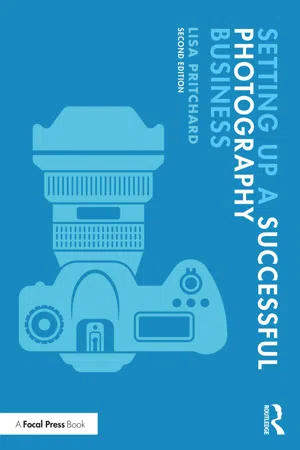
This revised second edition of the best-selling handbook provides practical, actionable insights on how to establish a successful photography business in the current climate.
Written from the perspective of a photographer's agent, this book offers the perfect viewpoint to honestly assess what works, what doesn't, and why some photographers succeed where others fail. Packed with useful templates and advice from leading photographers and commissioners working in all areas of the profession today, industry expert Lisa Pritchard covers all of the essentials: preparing the best portfolio and website; marketing yourself; getting clients; costing and producing shoots; finding representation; financing and running your business; navigating contracts and legal obligations; and more. Updated to take account of shifts in the industry and the increasing importance of digital marketing and social media, this book provides fresh insight and inspiration for the budding and established professional.
This book is essential reading for anyone who wants to be a professional photographer – whether studying to become one, thinking of a change of career, or wanting to know how to improve their existing photography business.
‘The highs are high, the lows are low and there’s rarely any level in between! However, get the balance right and it’s a remarkably privileged and satisfying way to live. I wouldn’t have it any other way.’
Peter Dench
‘There are many things I love about being a professional photographer and the things I love far outweigh the things I don't. Firstly, I enjoy the creativity of photography, the fact there's always something to learn and the satisfaction when you achieve something you are proud of. Even better, when a client enthuses about your work and leaves you a wonderful review. I enjoy the flexibility. I work hard but if I want to I can pretty much take time off whenever I would like to. Not that I do though, I definitely work a lot harder as a freelancer than I ever did as a paid employee. As I work with dogs that's naturally a plus because I love spending time with them. I love being outdoors and all the locations I go to. Sunsets will never get boring! I enjoy making my clients happy. A good pay day for doing something you enjoy is also very nice.
‘Things I don't like are not particularly related to being a photographer, per se, but more about being self-employed: like irregular income, end of year tax return, running all aspects of the business myself can feel overwhelming at times. Oh, and carrying my very heavy bag around gets a bit tiresome! Oh, poor weather also gets in the way, but I'm so used to this now I don't think about it too much.’
Rhian White
‘I firstly love what I do. It’s not a career for me it’s a lifestyle. I am always constantly thinking about the next project, creating the next surface, on the go to find new props or produce and researching on food trends every day. I meet new people every day and it’s exciting to explore their unique talents.
‘Personally the negative side is that you have fluctuating income year on year. It’s always the hardest when starting out. I have found as the years go by you adapt and the busier you get, the less this is a factor. You have to have full dedication to being a full time professional photographer.’
Tim Atkins
‘Having spent ten years working within a marketing company I am very aware of the freedoms and restrictions that come with working for yourself. I love having control over my own work and direction. I still have to pinch myself that I am able to make a good living from being a photographer — it’s such a privilege to live a creative life and to have access to the places and people that my camera enable. I love that I work with real people and that every day is different — I am present on such a happy occasion and I am creating images that will be treasured for generations. I also enjoy the other side of the work – running an independent business and all the challenges that go with that.
‘It’s a wonderful industry to be part of – especially in the last four or five years. There is a strong community and the support network I have with other photographers is unusual within the photography world.
‘The main thing I struggle with is the physical stresses of the job – I need frequent massages and have to be careful to take care of my body and stay strong with exercise – holding heavy cameras and being on the go for ten or more hours a day requires good fitness!’
‘I feel privileged to be able to live off the fruits of my artistic endeavours, however, I also feel that this position comes with a certain responsibility to make work that is politically and socially engaged.’
‘What I imagined life as a professional photographer to be, compared to the reality seven years into this career is incredibly different!
‘My background is a brand and marketing manager so I had some understanding that running the business and administration would be a large part of the job but it is much larger than even I had anticipated. I would say that 80 per cent of my time is spend on running my business with 20 per cent of it shooting.
‘The positive aspects of becoming a photographer are that I can manage my own hours and travel time. When working for a company this is dictated whereas I can develop my own working hours. This is very important for me allowing me the freedom to be a parent and fulfil our dreams as a family to travel together.
‘The challenges that come with running a business are you lose that guaranteed source of income when working for a corporation. I need to plan further ahead and be less reactive to ensure that I reach my yearly income target.’
As the title suggests, this book is about setting up a successful photography business. The crucial thing to accept when you start out as a professional photographer is that you are setting up a business. And, as with most businesses, there are several different ‘departments’ that you will be responsible for – often on a weekly if not daily basis.
Maybe one day you’ll be able to delegate some of these responsibilities and concentrate more of your time on taking the pictures. Most photographers however, especially those just starting out, find their time is generally divided between several diverse tasks.
Department
Responsibilities
Production
Developing and creating the product: building your portfolio of work, planning and preparing for shoots, shooting and editing the images.
Sales and Marketing
Marketing and publicity of the product. Developing a target sales database of potential customers. Acting on leads and enquiries. Pricing the work, negotiating with customers and sealing the bids.
Financial Management
Taking control of how much it costs to run, build and maintain your business.
Customer Services/Reception
Dealing with customer enquiries.
Accounts
Invoicing and credit control.
Administration
Overseeing office supplies, handling filing, administration and compliance systems.
Human Resources
Hiring, training and looking after the welfare and career aspirations of staff.
Technical Support and Development
Maintaining and updating all photographic equipment, computer hardware and software. Keeping up to date with changes in technology.
Legal
Dealing with client contracts and being aware of other laws that might affect your business (e.g. obligations on photoshoots, employment, tax, insurance, copyright and marketing)
Professional photographers don’t just take pictures. In fact, most of them spend a comparatively small amount of time behind the camera and a surprisingly large amount of time dealing with other aspects. Whether you’re a fashion photographer or a war photographer, one day you might be on an intense and challenging shoot, the next you could be updating your website, or doing your tax return.
As photographer Nick David says:
‘Like many photographers my time is divided between shooting, working on post production – putting together pitches for clients – updating websites – portfolios – researching new projects – meetings – conference calls – sending e-cards – invoicing and estimates.’
Have you got what it takes?
I have seen many talented photographers fail where their less-talented competitors have succeeded. Why? Because they lack certain other qualities that are necessary for success.
Likeability
I appreciate this is a slightly odd one, but most people choose to work with others because they like them. Maybe it is a personality or chemistry thing, but generally ‘in a survey’ I reckon the same people would be selected as being ‘likeable’. I’m not sure whether the interpretation of likeability is as subjective as we think.
Good communication skills
Being able to communicate and listen to others is crucial in most areas of photography. Whether presenting your work in the right way to the right audience to gain commissions, responding and listening to a client’s needs or getting the best out of your crew, the ability to interact well and communicate with others will be a distinct advantage.
The constitution to be self-employed
Most professional photographers are freelance, although staff jobs do exist. The demands and unpredictability of being self-employed do not suit everyone. This isn’t going to be a nine-to-five job with a secure salary, annual appraisals, holiday, maternity and paternity leave, sick pay, a sabbatical and a pension plan!
Drive and passion
It’s a very competitive industry because it’s such an attractive one, so you’ll need to be completely driven and passionate about wanting to being a professional photographer on both a creative and a business level. It’s down to you to develop your skills and portfolio, find your own clients and stay motivated.
Patience and a strong work ethic
This isn’t the kind of industry where you can make a fast buck when you first start out. I know plenty of photographers who enjoy a very comfortable lifestyle once they have become established in their careers, but money was rarely their number one motivator. To be successful will require a lot of patience and hard work.
Thick skin
You need to sell yourself and your photography, which means dealing with a few hard knocks on the way and being able to take criticism on the chin. Most feedback is constructive, so do listen to others. Be mindful however of...
Table of contents
Cover
Half Title
Title Page
Copyright Page
Table of Contents
Acknowledgements
Disclaimer
Contributing photographers
Preface
Introduction
Chapter 1 What’s it like being a professional photographer?
Chapter 2 Who buys photography? Where to find your clients
Chapter 3 What sort of photographer are you? The options
Chapter 4 The learning curve: Gaining knowledge and experience
Chapter 5 Making the leap: the transition to becoming a professional photographer
Chapter 6 Business basics
Chapter 7 A start up business plan
Chapter 8 Marketing and promotion. Getting clients
Chapter 9 Pricing photography
Chapter 10 The small print
Chapter 11 Organising a photoshoot
Chapter 12 Industry codes of practice and legal obligations
Chapter 13 Agents, agencies, libraries and galleries
Chapter 14 Building your business
Chapter 15 Tips from the top: professionals’ advice for success
Address Book
Index
Trusted by 375,005 students
Access to over 1.5 million titles for a fair monthly price.
Study more efficiently using our study tools.
Frequently asked questions
Yes, you can cancel anytime from the Subscription tab in your account settings on the Perlego website. Your subscription will stay active until the end of your current billing period. Learn how to cancel your subscription
No, books cannot be downloaded as external files, such as PDFs, for use outside of Perlego. However, you can download books within the Perlego app for offline reading on mobile or tablet. Learn how to download books offline
Perlego offers two plans: Essential and Complete
Essential is ideal for learners and professionals who enjoy exploring a wide range of subjects. Access the Essential Library with 800,000+ trusted titles and best-sellers across business, personal growth, and the humanities. Includes unlimited reading time and Standard Read Aloud voice.
Complete: Perfect for advanced learners and researchers needing full, unrestricted access. Unlock 1.5M+ books across hundreds of subjects, including academic and specialized titles. The Complete Plan also includes advanced features like Premium Read Aloud and Research Assistant.
Both plans are available with monthly, semester, or annual billing cycles.
We are an online textbook subscription service, where you can get access to an entire online library for less than the price of a single book per month. With over 1.5 million books across 990+ topics, we’ve got you covered! Learn about our mission
Look out for the read-aloud symbol on your next book to see if you can listen to it. The read-aloud tool reads text aloud for you, highlighting the text as it is being read. You can pause it, speed it up and slow it down. Learn more about Read Aloud
Yes! You can use the Perlego app on both iOS and Android devices to read anytime, anywhere — even offline. Perfect for commutes or when you’re on the go. Please note we cannot support devices running on iOS 13 and Android 7 or earlier. Learn more about using the app
Yes, you can access Setting Up a Successful Photography Business by Lisa Pritchard in PDF and/or ePUB format, as well as other popular books in Art & Entrepreneurship. We have over 1.5 million books available in our catalogue for you to explore.