Let me start with a metaphor.
My first job was at an ad agency. I was a graduate trainee in what was, at the time, one of the most creative agencies in the world, Collett Dickenson & Pearce. (Puttnam, Powell, and Lowe, the British agency that acquired Sterling Cooper in Mad Men, was loosely based on CDP.)
An important part of your basic training was to work on an account that would teach you the ropes.
In my case, this was the Metropolitan Police’s recruitment advertising account. The gruelling day-to-day job was processing hundreds of small tactical press ads. But the upside was gaining an insight into one of the most high-profile and challenging jobs in the UK, if not the world: policing London.
As part of my induction, I was seconded for 24 hours to a local police station. This turned out to be in Stoke Newington, now colonised by the young middle classes (“Stokeys”), but then, an edgy working-class part of London.
It was early evening. I was milling around the police station when a “shout” went up – police lingo for an emergency call. I was grabbed by the officer who’d been chaperoning me to join him and his colleagues in one of their Incident Response Vehicles (squad cars to you and me).
We swung out onto Stoke Newington High Street. It was now rush hour and the streets were gridlocked, but somehow the driver steered effortlessly through the traffic, overtaking cars and jumping lights at speed.
It turned out that the incident was nothing more than a drunken altercation at a kebab shop. But what really intrigued me was how this police car had travelled at times at nearly 60 miles an hour through the built-up, traffic-laden streets of north London without crashing.
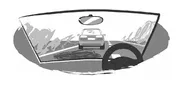
I asked the driver afterwards how he did this. He explained that a critical part of the training was to educate your brain not to focus on the car in front but the car beyond that. In time, your brain quickly processes and allows for the car in front of you. The real processing is about anticipating the actions of the car beyond so that you can leap forward and gain valuable seconds in order to arrive at your destination as quickly as possible.
This image has stayed with me over the years and become a metaphor for life and, within that, one’s career.
Time and time again I meet people whose careers have been defined by following the car in front; leaving university and starting in banking, for example, because of a family contact, and then never leaving that industry; joining a big organisation and being continuously promoted until they find, 20 years down the line, that they are a company lifer.
I became intrigued by people who had, like the police squad car driver, looked beyond the car in front to take advantage of opportunities to accelerate beyond the immediately visible.
*
This book captures 40 years working with, talking to, and assessing executives with many different career journeys. It tries to offer a toolkit to help those who are thinking they need a change. And, crucially, it will help you to avoid getting stuck following the car in front.
To take this beyond the theoretical, I have also had the privilege to interview a number of top executives whose careers have been defined by their decision to look beyond the car in front.
It is not a panacea. It’s a collection of interconnected ideas and techniques that have helped many executives I have worked with to make sense of the journey they’ve been on and, critically, the journey ahead.
Much of it has emerged from my own personal experience too. I was as conservative as they come at the start of my career. I spent 25 years in advertising moving seamlessly from one job and one firm to the next. I became a managing director at the age of 35 and chief executive by the age of 40. I persuaded myself that this was the right strategy.
And then I reached my late 40s, woke up, and saw that I was going to run out of road in the next few years. I had no strategy, no plan, and no idea about what was going to happen next. For the first time, I moved out from behind the car in front. I took a big risk and was lucky enough (because it was luck) to land in the world of executive search which has proved to be a genuinely enjoyable and fulfilling career ever since.
The professional journey we all go on is typically a mixture of hard work, good luck, and brain power. To avoid, like me, having to rely a little too much on the luck part, it helps to have a strategy and to be proactive with your choices and decisions, because taking control of your career can increase your chances of being happier and more fulfilled, both in your work life and elsewhere. I want to give you the tools to be able to do that so that whether you’re in the early stages of your career or well on your way down the road, you can make plans and decisions that work best for you.
This book and its supporting case histories are an acknowledgement that we all need to think ahead and then get ahead of the situations we find ourselves in and take more of an assertive, strategic stance on our career choices.
That way we will no longer be at the mercy of the car in front.
Believe it or not, we can get stuck following the car in front before we’re even allowed a driving license. That’s right; this starts early, because our attitudes towards our own potential begin to be shaped, inevitably, in childhood. And they can come to define us.
It is crucial from the outset then to understand when, where, how, and why we become stuck in traffic, only moving when others do, instead of taking active control of the steering wheel.
THE CURSE OF THE FIXED MINDSET
There has been much discussion in recent years about fixed versus growth mindsets. In her definitive book on the subject, Stanford psychology professor Carol Dweck defines the former as the belief “that your qualities are carved in stone [which] creates an urgency to prove yourself over and over.” Those with growth mindsets, meanwhile, believe “the hand you’re dealt is just the starting point for development [and] your basic qualities are things you can cultivate through your efforts, your strategies, and help from others.”1 She defined the two mindsets after carrying out research which involved setting a group of children progressively harder and harder puzzles to solve. Some reached the point where they felt that the puzzles were impossible, their intelligence was being judged, and they had been found wanting. But others viewed the harder puzzles as a challenge and relished the opportunity to learn. They hadn’t failed; they just hadn’t got it yet.
It is not difficult to see the link between the fixed mindset and following the car in front. If you don’t believe you can learn new skills or successfully strike out into a new sector, there is a tendency to stick with what you know. It is the painful result of cycling too fast as a child and crashing into a bollard; the embarrassment of getting an answer wrong in the school classroom; and the humiliation of peer-group rejection. Like I said, this starts early.
This is not to say that, as you become an adult, you can’t be the very best insurance broker around. But it could mean that you’re not pushing the boundaries to become a mould-breaking disruptor of the insurance category despite the fact that you are super bright and super capable. The fixed mindset means staying in your lane, staying in your comfort zone.
Just about every one of the successful executives I interviewed while researching this book opted to make a change when the easier, more comfortable option would have been to stay put. Gavin Patterson, former BT plc CEO before becoming Chief Revenue Officer and President of Silicon Valley software giant Salesforce, started his career in the hotbed of talent that was Procter & Gamble in the 1990s. He spent nine years there before moving to Telewest in 2000. On this decision, Patterson says: “I had plenty of runway ahead of me at P&G, but I wasn’t sure where it was going to take me.”
Similarly, Clear Channel CEO William Eccleshare opted for a major change in late 1999, when he was CEO of advertising agency Ammirati Puris Lintas. Running APL was comfortable. He was surrounded by great people – many of whom he’d hired – and it was “a lot of fun.” But he knew he was going nowhere. “I remember thinking from my career point of view: I need to get control again or something’s going to happen that I’m not comfortable with.” So he made a change, joining consultancy giants McKinsey in 2000, where he admits to feeling a cultural misfit. “It was no fun at all,” he says. But it was a decision that got him to where he is today.
Tim Davie, Director-General of the BBC, started his career alongside Patterson at P&G in the early 1990s before joining PepsiCo as UK Marketing Manager in 1993. Twelve years later, he made the move to the BBC, but he says he could quite easily have stayed at Pepsi: “Financially I would have been a lot better off. But actually, it was better to jump out and go to a new sector by a mile.”
These are all growth mindset decisions. Having a growth mindset – or “staying open minded” as Informa plc CEO Stephen Carter describes it to me – is key to gaining the tools to break out from behind the car in front. And it is eminently possible to change from a fixed to a growth mindset – tactics we’ll discuss in later sections.
Unfortunately, though, it is not only a fixed mindset that prevents people from making progressive, beneficial career decisions.
MIDLIFE CAUTION (OR HOW TO RESPOND TO RESPONSIBILITY)
As a young professional, career progression will often come naturally, particularly if you have a growth mindset, and are motivated and bright. Risk-taking is a whole lot easier when you have only yourself to look after and your whole life ahead of you. You might not think twice, for example, about taking that posting abroad or joining an exciting if risky startup.
But something I see again and again is the caution that comes from increased responsibility, both professionally and personally.
Some people become the victims of their own success. Rising quickly through the ranks and getting promoted early can become a real disabler if you retrench into risk aversion in order to avoid making any mistakes that lose you the leadership role you worked so hard to achieve. At the same time, people get married, have children, and take on mortgages. And therein lies the other disabler: fear of losing everything you’ve worked for and fear of letting your family down. (This is exactly what happened to me in my mid-30s when I became the managing director of the ad agency Gold Greenlees Trott.)
These are completely legitimate concerns. And if you’re on the right road, why wouldn’t you follow the lead of the car in front? Because you won’t be in control. Paradoxically, the cautious approach can often be the least responsible, as you’re effectively kicking the can down the road. Tim Davie puts it this way: “In order to keep yourself happy in a career and make good career choices, you need to get more comfortable with more risk. More risk is the safer choice.”
In other words, hunkering down is not the only way to respond to additional responsibility. There are other options which will pay greater dividends later on.
INTO THE CUL-DE-SAC
There will be people reading this book thinking, “Oh dear, I have been following the car in front and I am now sitting in a cul-de-sac.” In fact, I suspect the majority of executives have at some moment found themselves heading down a one-way street only to find that a dead end is looming. The truth is that if you hunker down, play it safe, keep following the car in front, then there will come a point when you will hit a dead end, often without seeing it coming. Typically, these are executives in their late-40s, early-50s. They have had a successful career (although perhaps not successful enough to give two fingers to working life). But the road on which they’ve been travelling has come to an end – a new chairman or CEO with new ideas, an economic downturn and a restructuring of expensive management, a merger where there’s two of everything. Or simply getting up in the morning to go to work is simply not exciting. Everything feels like Groundhog Day.
The original intention of this book was ...