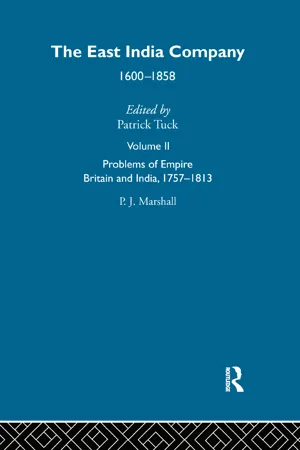
First published in 2004. The purpose of this reference work is to offer a range of materials covering the history of the East India Company during the two and a half centuries of its existence.Volume II, Peter Marshall's Problems ofEmpire. Britain and India, 1757-1813 surveys, partly through the medium of original documents, the Company's complex transformation from a trading concern to an imperial power.
- 240 pages
- English
- ePUB (mobile friendly)
- Available on iOS & Android
eBook - ePub
East India Company V2
INTRODUCTION
DOI: 10.4324/9781003100997-1
INTRODUCTORY
DOI: 10.4324/9781003100997-2
In a little over fifty years the East India Company was transformed from a body of traders controlling a scattered group of commercial settlements round the coasts of India into the rulers of provinces with a population popularly supposed in Britain to contain fifty or sixty million inhabitants. In 1813 the Company’s dominions stretched continuously across northern India from Delhi in the west to Assam in the east. The entire east coast of the Indian peninsula was in the Company’s hands together with strategic points on the west coast between Gujaret and Cape Comorin.
So vast an empire so rapidly acquired confronted Britain with problems unprecedented in their scale and their complexity. Its control and supervision were tasks which would extend the very limited capacities of an eighteenth-century state to the utmost; and political difficulties would be added to the administrative ones. To many contemporaries the delicate constitutional balance of which they were so proud seemed threatened by the wealth and resources of India, unless a means could be devised for keeping them out of politics. Once machinery had been brought into existence for governing India, what principles of government and what standards should it try to apply? Previous imperial experience was of virtually no assistance. Little as most Englishmen knew about India, it was clear that the huge population possessed a polity of their own much more sophisticated than that of African negroes or American Indians. From the outset the British were confronted with the question, which was to dominate discussion of the government of India into the twentieth century, of how far this polity should be left intact or to what extent the British should intervene in the administration of their new provinces and introduce western concepts. India also raised in an acute form questions about the treatment of subject peoples which had already begun to trouble the European conscience over such issues as slavery. In the middle of the eighteenth century the British establishments in India existed solely for commercial ends. Although the conquest of territory did not alter the fact that the primary purpose of Britain’s stake in India was still to enrich the mother country, new methods had to be devised to take advantage of a radically changed situation.
This book will try to show, partly through their own words, how shareholders in the East India Company, ministers of the Crown, Members of Parliament, and such sections of the eighteenth-century public as interested themselves in national affairs slowly became aware of the problems created by the conquest of India, and how solutions to these problems were gradually evolved, so that by 1813 the outlines of the connexion between Britain and India, which was to last until the twentieth century, are clearly visible. The book’s starting point will be 1757, the date of the battle of Plassey, the preliminary to the Company’s conquests. It will end with the passing of the Charter Act of 1813, which gave formal recognition to some of the solutions to Indian problems already worked out in practice. It will concentrate on three main themes: the way in which the British political and administrative systems adapted themselves to meet new responsibilities, the principles and standards which opinion in Britain tried to apply to the government of India, and the creation of new economic links between Britain and India.
This book is concerned with what happened in Britain, not with what happened in India. For instance, those sections which deal with what is commonly called ‘policy’ make no claim to be a history of British administrative policy in India during this period; they will try to describe what men in Britain believed ought to be done in India, which was often a very different thing from what men in India actually did. But without some knowledge of developments in India between 1757 and 1813 any attempt to portray British reactions to them would, of course, be largely unintelligible.
Regular British contact with India began in 1608 when the ships of the East India Company which had been chartered by Queen Elizabeth in 1600 started to call at Indian ports. At first the Company’s operations centered on the spice islands of the Indonesian Archipelago, ships being sent to India only to obtain goods which could be exchanged for spices; but by 1613 the Company had established a permanent post at the west coast port of Surat and a regular direct trade between Britain and India began. Other posts were established at Masulipatam and later at Madras on the Coromandel Coast, the southeast coast of the Indian peninsula, and at Hughli, subsequently moved to a new settlement called Calcutta, on the delta of the Ganges in the province of Bengal. In 1668 the Company obtained the island of Bombay which had been acquired by Charles II from the Portuguese. Throughout the seventeenth century the Company’s Indian imports, chiefly of cotton cloth, indigo and saltpetre, increased, while its trade in pepper with the Archipelago declined. With increased trade some of the Company’s posts became the centres of sizable towns. Privileges were obtained from local rulers making the Company autonomous in its three most important settlements, the ‘Presidency’ towns of Madras, Calcutta, and Bombay, which were placed under the rule of Governors and Councils appointed from the Company’s ‘servants’, fortified, and garrisoned by small forces of Indian and European soldiers.
The Company’s influence remained almost exclusively confined to its coastal settlements until the mid-eighteenth century, when in an astonishingly short space of time large parts of India were to be brought under its control. This wave of expansion was in no sense the fulfilment of plans of conquest drawn up at home. In 1767 the Secretary of the East India Company told the House of Commons that ‘the general tenor of the Company’s orders were not to act offensively.... We don’t want conquest and power; it is commercial interest only we look for’. He lamented that military operations ‘grew insensibly from one trouble to another—we could form no judgement of their progress’.1 This would have been true at any time between 1757 and 1813. The East India Company invariably regarded conquest as incompatible with trade, and the initiative for conquest always came from the Company’s servants in India, although it is usually difficult to see any systematic design for acquiring territory in the policies they pursued. To argue that the Company servants did not plan their conquests is not, however, the same thing as arguing that the British in India were the victims of circumstances, or, as used sometimes to be claimed, that empire was forced upon them. As a general proposition the majority of the Company’s servants agreed that the conquest of Indian provinces was not in the Company’s best interests, but they rarely exercised the restraint in their relations with Indian powers which would have enabled them to avoid war and the acquisition of territory after a successful war.
The intensity of European rivalries and the weakness of political authority in many parts of eighteenth-century India provided the opportunities for the first of the Company’s conquests. The British were not the only European traders to establish settlements in India. Among others, Britain’s traditional enemies the French were also trading from fortified posts. The French and the English companies kept the peace in the Indian Ocean until 1744 when open hostilities broke out on the Coromandel Coast. As the fighting spread, local Indian rulers, who in the past had tried to restrain the Europeans, became auxiliaries in their struggles. In several of the states which had become virtually independent with the collapse of effective Mughal control, conflicts for power took place in which the contenders were prepared to play the very dangerous game of trying to enlist the Europeans on their side. The British and French were willing to accept such offers in order to secure Indian rulers who would aid them against their own rivals. Neither side seems to have been aware of the full implications of this kind of warfare. If an Indian claimant won his throne with European help the price he would have to pay would be a high one: he would become the puppet of the victorious Europeans, bound to submit to an ever increasing degree of interference in his government. On the other hand, while the purposes of the Europeans might at first be limited to securing extra resources for their own wars, by intervening in Indian politics they had often taken the first step which would end in total annexation. The Anglo-French struggle for mastery over south India lasted from 1744 to 1761. It ended in a complete British victory. British candidates were established in control of the main south Indian state, Hyderabad, and of the coastal area called the Carnatic; Hyderabad was to remain a dependent ally, the Carnatic to lose more and more of its until it was annexed in 1801.
Even before they finally won domination in south India, the British had achieved supremacy in Bengal. In 1756 the East India Company’s settlement at Calcutta had incurred the displeasure of the young Nawab of Bengal, Siraj-ud-daula, who captured and sacked it. An expedition was immediately sent from Madras under Colonel Robert Clive, the most successful British commander in south India, who succeeded in recovering Calcutta. Clive then decided to repeat the gambit already attempted in the south, and to substitute for Siraj-ud-daula a Nawab who would be an ally of the British. He was able to achieve this after the battle of Plassey. But events in Bengal were to show that securing the throne of an Indian state for a favoured claimant was only the beginning of an increasing degree of British intervention. Successive Nawabs who resisted the demands which the Company made on its satellites were replaced by others more pliant, until in 1765 Clive, returning to India as Governor of Bengal, for the first time formally accepted British responsibility for the government of an Indian province when he received the diwani, or revenue administration, of Bengal from the hands of the Mughal Emperor.
The collection of territorial ‘revenue’ had been the main function of Mughal administration and was for a long time to come to be the main function of the new British administrations as well. To eighteenth-century Englishmen, Indian territorial revenue seemed to have some of the qualities of rent and some of the qualities of a tax on land. It was collected in the first instance from the cultivators of the land as a proportion of their crop. Through a host of intermediaries, all of whom kept some portion of it for themselves, it reached the diwan, or finance minister of the province, who in his turn was supposed to pay a part of what he received to the Emperor at Delhi. After 1765 the East India Company was the diwan of Bengal. Clive hoped that the system of collecting revenue would continue as before, with the Company merely receiving the revenue paid to them by the existing Indian officials and transmitting to Britain the huge surplus which he anticipated after the costs of governing Bengal had been defrayed. But too much was at stake for so limited a role to be possible. Once the Company had acquired an interest in the revenue of an Indian province they were invariably drawn deeper and deeper into the minutiae of Indian government, however hard they might struggle to avoid new responsibilities. To ensure that the Company got what its servants believed was its due share of the revenue and to control the opportunities for embezzlement and oppression, which the complexities of the system provided so liberally, more and more detailed European supervision was thought necessary. The functions of the diwan included the administration of civil justice, and this again was thought to require direct European supervision. Throughout Bengal, and later throughout British India as a whole, Indian officials were gradually weeded out as unworthy by European standards. Under Clive’s successors, especially in the administrations of Warren Hastings from 1772 to 1785 and that of Lord Cornwallis from 1786 to 1793, the methods by which British officials would endeavour to administer Indian provinces were evolved with much trial and error.
With the acceptance of the diwani Clive hoped that he would be able to set a limit to the Company’s territorial expansion at the boundaries of Bengal, and that acting upon ‘those principles of moderation which are so consistent with the true interest of a trading company’,2 the East India Company would in future live in peace with its Indian neighbours. Although his hopes were shared by all those who succeeded him, at least until the arrival of Lord Mornington, the future Marquess Wellesley, in 1798, war and conquest continued. As a major territorial power, the Company could not afford to cut itself off from the tangled diplomacy of the states which had sprung up in the ruins of the Mughal empire. Warren Hastings felt it necessary to draw Indian rulers into the Company’s orbit, either to maintain a cordon of friendly states round the Company’s own provinces or as an insurance against a French revival. Where his policy was successful and a state, such as Oudh, entered into closer relations with the British, the familiar pattern of a slide towards total British domination repeated itself; where Hastings was rebuffed, as was the case with the states of the Maratha Confederacy, he was prepared to back his diplomacy with military force. Cornwallis was more circumspect than Ha...
Table of contents
- Cover Page
- Half Title Page
- Title Page
- Copyright Page
- Oringinal Title Page
- Oringial Copyright Page
- General Introduction
- Author’s Note
- Table of Content
- General Introduction
- Author’s Note
- Introduction
- Documents
- Suggestions for Further Reading
- Index to Introduction
Trusted by 375,005 students
Access to over 1.5 million titles for a fair monthly price.
Study more efficiently using our study tools.
Frequently asked questions
Yes, you can cancel anytime from the Subscription tab in your account settings on the Perlego website. Your subscription will stay active until the end of your current billing period. Learn how to cancel your subscription
No, books cannot be downloaded as external files, such as PDFs, for use outside of Perlego. However, you can download books within the Perlego app for offline reading on mobile or tablet. Learn how to download books offline
Perlego offers two plans: Essential and Complete
- Essential is ideal for learners and professionals who enjoy exploring a wide range of subjects. Access the Essential Library with 800,000+ trusted titles and best-sellers across business, personal growth, and the humanities. Includes unlimited reading time and Standard Read Aloud voice.
- Complete: Perfect for advanced learners and researchers needing full, unrestricted access. Unlock 1.5M+ books across hundreds of subjects, including academic and specialized titles. The Complete Plan also includes advanced features like Premium Read Aloud and Research Assistant.
We are an online textbook subscription service, where you can get access to an entire online library for less than the price of a single book per month. With over 1.5 million books across 990+ topics, we’ve got you covered! Learn about our mission
Look out for the read-aloud symbol on your next book to see if you can listen to it. The read-aloud tool reads text aloud for you, highlighting the text as it is being read. You can pause it, speed it up and slow it down. Learn more about Read Aloud
Yes! You can use the Perlego app on both iOS and Android devices to read anytime, anywhere — even offline. Perfect for commutes or when you’re on the go.
Please note we cannot support devices running on iOS 13 and Android 7 or earlier. Learn more about using the app
Please note we cannot support devices running on iOS 13 and Android 7 or earlier. Learn more about using the app
Yes, you can access East India Company V2 by Henry Stevens, Patrick Truck in PDF and/or ePUB format, as well as other popular books in History & World History. We have over 1.5 million books available in our catalogue for you to explore.