Countering the dystopic and the apocalyptic, Star Trek's Philosophy of Peace and Justice introduces political philosophical reflections on peace, justice, and non-violence through dramatic plots in the utopian Star Trek Universe.
Using key insights from a global array of philosophers, thinkers, and activists, including Martin Luther King Jr., Cesar Chavez, Angela Davis, Martha Nussbaum, Johan Galtung, and Desmond Tutu, José-Antonio Orosco guides readers through different Star Trek episodes, applying key concepts from peace and justice studies. In the Star Trek Universe, seemingly impossible realities, based on peace and justice exist indefinitely in a post-scarcity society marked by economic cooperation. Orosco continues its bold utopian mission and brings new challenges to the field of peace and justice studies that center anti-racism and intersectional theory to encourage the exploration, over conquest, of our own galaxy.
eBook - ePub
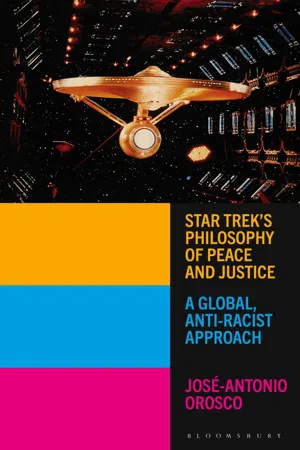
Star Trek's Philosophy of Peace and Justice
A Global, Anti-Racist Approach
- 208 pages
- English
- ePUB (mobile friendly)
- Available on iOS & Android
eBook - ePub
About this book
Information
Chapter 1
Violence and Human Nature
The Enemy Within
Star Trek Episodes
ST: TOS: “The Savage Curtain”; “The Enemy Within”; “Miri”; “City on the Edge of Forever”
ST: TNG: “Tapestry”
ST: DISC: “Die Trying”; “Terra Firma I”; “Terra Firma II”
In March 1964, Gene Roddenberry shopped around a proposal for a science fiction show to television network executives. He sketched out a variety of episode ideas dealing with a starship named the USS Yorktown that would explore the galaxy under the command of Captain Robert April. Among the stories for this new series was one that Roddenberry titled “Mr. Socrates.” It was the tale of the Yorktown finding a planet in which historical figures are recreated and placed into gladiatorial combat with one another. This story line sat dormant for a few years until it was picked up once again by Roddenberry to fill in a script for the third and final season of ST: TOS. In the new story, the ancient Greek philosopher Socrates is reincarnated, along with US president Abraham Lincoln, and both of them are brought to the Enterprise. Captain Kirk, Mr. Spock, Socrates, and Lincoln are then transported to a planet surface by a mysterious alien race and forced to battle treacherous villains, including Adolf Hitler, Atila the Hun, and Mr. Green, a fictional dictator from late 20th-century earth.1 Screenwriter Arthur Heineman worked with Roddenberry to produce a script that eventually became the foundation for the episode “The Savage Curtain.” They removed the character of Socrates, but the final product did, nonetheless, contain at its core a fundamental philosophical question: What is the difference between good and evil?
The struggle between war and peace, good and evil, is depicted in “The Savage Curtain” as a fight between different groups of people. Yet, speculative fiction often treats this tension as something that lies deep in the heart of individuals. Robert Lois Stevenson’s 1886 novel The Strange Case of Dr. Jekyll and Mr. Hyde sets the modern standard with a story of one man who can transform his identity with the use of a magical elixir that releases his most violent inner impulses. The serum does not turn Dr. Jekyll into a monster, it merely liberates the evil monster that lies dormant and repressed within him. The impact of Stevenson’s novel on popular culture is undeniable. We often talk about people with “Jekyll and Hyde” personalities, for instance. And the novel’s influence on the STU is also evident when we consider two other episodes that attempt to represent the nature of the conflict between good and evil within individuals: ST: TOS “The Enemy Within” and ST: TNG “Tapestry.” Together, these episodes suggest that aggression is a dark and inescapable element of human nature. It can be harnessed as a necessary and integral component for good, but untrained, it can be malevolent and disastrous. I call this perspective the Enemy Within Ideal.
In this chapter, I examine how the Enemy Within Ideal is one that is articulated and advanced by several philosophers, such as Thomas Hobbes and William James, as well as in the psychological theories of Sigmund Freud. It has more recent versions that focus on human genetics, concentrating on the markers within our DNA that lead to inborn tendencies toward domination and hostility. Yet, I believe that the Enemy Within Ideal overstates the primacy of aggression in human nature. This emphasis matters because the Enemy Within Ideal is often used to support the claim that war and violence is a feature of human life that is simply inevitable. Peace studies, under this outlook, is a naïve endeavor because it fails to comprehend that we are simply hardwired for conflict and hostility.
I contrast then Enemy Within Ideal with what I call a Situational Ideal that holds that violence among human beings is less an inescapable result of some inherent drive but more a reaction to stressful environments. I find this message pronounced in the ST: TOS episode “Miri,” It is a moral supported by the work of philosophers, such as Peter Kropotkin, and various social psychologists, such as Stanley Milgram and Phillip Zimbardo, who hold that ordinary people can be driven to engage in violent and even immoral behavior if they are placed in highly regimented circumstances—such as prisons—that constrain their choices and emphasize hierarchy and violence as a means of social control. Moreover, the more recent work of archaeologists and anthropologists suggests that warfare, or organized group-on-group violence, is not a universal feature of human cultures nor something that has always been part of our species’ history. Thus, even if aggression is an aspect of human nature, the Situational Ideal gives us hope that war is not an inescapable horizon for our future since it has not always been a feature of our past. Violence can be avoided and should not be conceived as an impulse that merely waits, like the wild urges of Mr. Hyde, in the recesses of our soul to be let loose.
Star Trek Episodes: “The Enemy Within,” “Tapestry,” and “Miri”
In the episode “The Enemy Within,” Captain Kirk is divided, because of a transporter malfunction, into two physically identical halves. One Kirk is paranoid and aggressive, drinking Saurian brandy openly in the hallways and violently attacking crewmembers, including his own yeoman, Janice Rand, whom he sexually assaults. The other Kirk is intelligent and compassionate, but also passive and undecisive. He lacks willpower and the a bility to focus on tasks. Without Evil Kirk’s antagonism, Good Kirk is not able to be an effective leader. The Enterprise crew is able to discover the transporter procedure to reunify the two Kirks at the end of the episode. Reflecting on his experience, the whole Captain Kirk remarks: “I’ve seen a part of myself no man should ever see.”2
An opportunity to tell a similar story about the essential nature of humanity appears in the ST: TNG episode “Tapestry.” Captain Jean-Luc Picard suffers a near-death experience because of an accident that affects his mechanical heart. He is miraculously prevented from dying because of a visit from his old nemesis, the super being Q. Picard is given the chance to travel back in time to his first days as a Starfleet officer when he was a rash and impulsive young man. He is allowed to alter his future by avoiding the bar fight that ended with him being stabbed and needing to have his organic heart replaced by a mechanical one. Picard, thus, restarts his career with the wisdom and forethought of his older self.
Q then flashes forward several years in the time line to show Picard what this less competitive and impulsive version of himself had accomplished. Instead of commanding the Federation flagship USS Enterprise-D, the more measured Picard remained a lowly science officer. After a frank conversation with Commander William Riker and Counselor Deanna Troi in this new time line, Picard learns that his superiors believe he has little chance of moving up the ranks. Q forces Picard to realize that his leadership ability evolved from his youthful aggression, much in the same way that Good Kirk understood he could not make command decisions without Evil Kirk’s ambition. Picard is allowed to go back in time to the bar fight and get stabbed through the heart again, resetting the normal time line. He ends up with his life as a captain, now with the knowledge that he owes his good fortune, in part, to his wild and aggressive youth.
Both these episodes affirm what I term the “Enemy Within Ideal.” According to this perspective, human nature contains two elemental impulses in a dynamic tension with one another. One of these impulses is an aggressive, competitive drive and another is a more rational, caring, and compassionate tendency. Put in the proper balance, these drives offer an individual the opportunity to fashion an exciting, heroic, and creative life. When Dr. McCoy realizes the existence of the two Kirks and their dependence on one another, he tells the Good Kirk:
We all have our darker side, we need it . . . men, women, all of us need both halves . . . it’s half our humanity . . . it’s not really ugly, it’s human. . . . Without the negative half you wouldn’t be the captain. The strength of command is mostly in him. . . . The mental discipline to keep it under control, that he gets from you.3
The implication, however, is that without intelligent authority over the aggressive drive, violence and destruction will ensue.
Another story line from the STU appears, at first, to support this understanding of the Enemy Within Ideal. In the ST: TOS episode “Miri,” the crew of the USS Enterprise encounter a planet that is a mirror image of Earth. Except on this planet, Earth Two, a pandemic wiped out all the adults during the 20th century, leaving only the children. Kirk, Spock, and Dr. McCoy learn that the scientists of Earth Two were experimenting with viruses in an attempt to extend human life spans and accidently unleashed one into the atmosphere. The disease delays aging in children but kills anyone once they begin puberty. The group of children they find on the planet surface are really hundreds of years old. At first, the episode presents these children as an ominous presence. They continually hide in the shadows from the Enterprise crew, but they often taunt them, or pelt them with stones, and then disappear into dark corners. As the crew eventually contracts the virus and gets severely ill, the children steal their communicators. Kirk seeks the children out to negotiate with them for the return of the equipment but they beat him with bats and lead pipes instead. The scene appears to be something straight out of the ending of William Golding’s 1954 novel Lord of the Flies, and the message seems to be the same: children left outside of civilized society, and without adult authority to guide them, will become brutal and irrational, unleashing the Enemy Within in dramatic ways.
The Peace Studies Debate: Is Human Nature Inherently Aggressive and Violent?
The Enemy Within View
This kind of depiction of human nature is most associated with English philosopher Thomas Hobbes (1588–1679). In his book Leviathan, Hobbes begins by imagining the natural condition of human beings before government and codified laws, which he calls the “state of nature.” For Hobbes, such a state of nature would simply be a dystopian hellscape. This is because of the basic facts of human psychology. Our behavior, according to Hobbes, can roughly be described mechanistically as either attraction toward objects (desire) or repulsion from objects (aversion). Our moral vocabularies are simply conventional ways of labeling these impulses. We call something “good” because we are attracted to something and wish to acquire it; we call something “evil” because it repulses us and we wish to get it away from us. Human action, then, is about getting the goods what we want, and neutralizing, or destroying, the evils we fear and hate. If I think something is good, I’m going to want to acquire it, unless the attempt to get it will make me suffer more evil than the good is worth to me. In the state of nature, without an overarching authority to guide behavior through laws and fear of punishment, there will be nothing to stop me from attacking you to acquire your goods and resources. Likewise, there will be very little incentive to trust and cooperate with one another in the state of nature. If I want something, nothing prevents me from lying to you to get it, especially if I think I can get away with the deception. Even if you find out that I broke my promise to you, it will be up to you to overpower me to set things right. Hobbes says that in such a situation, “every man is enemy to every man” since no one can clearly trust anyone or effectively defend themselves from all corners. The natural state of human life, then, is one of self-interested agents acting in ways that inevitably lead to disagreement, conflict, and violence:
In such condition, there is no place for industry; because the fruit thereof is uncertain; and conse quently no culture of the earth; no navigation, nor use of the commodities that may be imported by sea; no commodious building; no instruments of moving, and removing; such things as require much force; no knowledge of the face of the earth; no account of time; no arts, no letters; no society; and which is worst of all, continual fear, and danger of violent death; and the life of man, solitary, poor, nasty, brutish, and short.4
Even if human beings are fundamentally individualistic and self-interested creatures who will tend toward war if left to our own devices, Hobbes does not despair. He believes human beings also possess reason and will realize that living in the state of nature is ultimately not in our best interest. We will seek to establish political authority that can guide our individual desires toward cooperation out of a fear of state repression. The role of the state, then, is to wield coercive force over a group of individuals who have agreed to coexist with one another for mutual benefit and protection. Peace, meaning the absence of war and conflict, is possible as long as government leaders know how to administer just the right amount of fear and punishment to make lying, cheating, stealing, or killing not worthwhile.
A more recent version of Hobbes’s account of human behavior comes from psychologist Sigmund Freud (1856–1939). In 1932, Albert Einstein, working under the auspices of the League of Nations, initiated a letter exchange with Freud by asking him: “Is there any way of delivering mankind from the menace of war?” Einstein believed that modern science had reached such a point that warfare was not just destructive but potentially a threat to the very existence of humanity (and this before the development of the atomic bomb!). He told Freud that he had hope in the idea of a global government that could settle disputes between member nations and curb the violent tendencies of national elites to use war to gain profit for themselves.5
Freud replied that he shared Einstein’s pacifist aspirations and personally found war to be repulsive. However, he did not believe it would be possible to suppress aggressive tendencies that often erupt into warfare. Psychoanalysts, he argued, had categorized human instincts into roughly two types: (1) an “erotic” drive that focuses on conserving, caring, uniting with an attractive object; and (2) a “death instinct” that focuses on destroying, killing, or repulsing an object that elicits disgust.6 These were not the same as moral concepts, such as good and evil, according to Freud, and were not even really opposite impulses. The erotic and the death instincts could be complementary, as in the drive for self-preservation—one’s care for oneself might require learning how to repel or kill threating forces—or in the case of protecting one’s children—the drive to care might require learning how to defend through violence. These impulses were inherent in the nature of humanity, Freud postulated, and while he recognized attempts to stifle aggression through social policy, he thought this was a hopelessly utopian project: “The Russian Communists, too, hope to be able to cause human aggressiveness to disappear by guaranteeing the satisfaction of all material needs and by establishing equality in other respects among all the members of the community. That, in my opinion is an illusion.”7
Like Hobbes, Freud did not despair because of the resilience of aggressive impulses. Instead, he argued that the pacifist strategy might succeed if it could find ways to divert or sublimate the death instinct, rather than try to suppress it. For instance, people could be trained to expand their sense of affiliation and care broadly, to encompass wider circles than just tribe or nation and, therefore, give the death instinct less room to operate. Or people could also be educated to use their intellect to better understand the e...
Table of contents
- Cover
- Half-Title
- Title
- Contents
- List of illustrations
- Acknowledgments
- Introduction: Star Trek and the Philosophy of Peace
- 1 Violence and Human Nature: The Enemy Within
- 2 The Multiple Dimensions of Violence
- 3 The Nature of Peace and Human Flourishing
- 4 Towards an Anti-Racist Future
- 5 Mercy, Forgiveness, and Justice
- 6 Imagining a Better World
- Conclusion
- Notes
- References
- Index
- Copyright
Trusted by 375,005 students
Access to over 1.5 million titles for a fair monthly price.
Study more efficiently using our study tools.
Frequently asked questions
Yes, you can cancel anytime from the Subscription tab in your account settings on the Perlego website. Your subscription will stay active until the end of your current billing period. Learn how to cancel your subscription
No, books cannot be downloaded as external files, such as PDFs, for use outside of Perlego. However, you can download books within the Perlego app for offline reading on mobile or tablet. Learn how to download books offline
We are an online textbook subscription service, where you can get access to an entire online library for less than the price of a single book per month. With over 1.5 million books across 990+ topics, we’ve got you covered! Learn about our mission
Look out for the read-aloud symbol on your next book to see if you can listen to it. The read-aloud tool reads text aloud for you, highlighting the text as it is being read. You can pause it, speed it up and slow it down. Learn more about Read Aloud
Yes! You can use the Perlego app on both iOS and Android devices to read anytime, anywhere — even offline. Perfect for commutes or when you’re on the go.
Please note we cannot support devices running on iOS 13 and Android 7 or earlier. Learn more about using the app
Please note we cannot support devices running on iOS 13 and Android 7 or earlier. Learn more about using the app
Yes, you can access Star Trek's Philosophy of Peace and Justice by José-Antonio Orosco in PDF and/or ePUB format, as well as other popular books in Philosophy & Ethics & Moral Philosophy. We have over 1.5 million books available in our catalogue for you to explore.