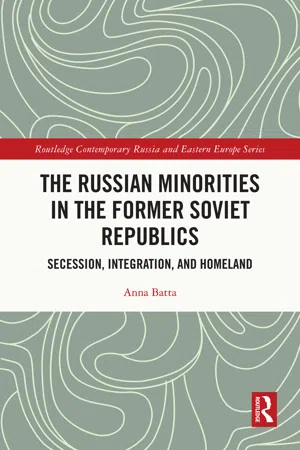
This book explores the differing treatment of Russian minorities in the non-Russian republics which seceded from the Soviet Union in the early 1990s. Providing detailed case studies, it explains why intervention by Russia occurred in the case of Ukraine, despite Ukraine's benevolent and inclusive treatment of the large Russian minority, whereas in other republics with less benevolent approaches to minorities intervention did not occur, for example Kazakhstan, where discrimination against the Russian minority increased over time, and Latvia, where the country on its accession to the European Union was deemed to have good minority rights protection, despite a record of discrimination against the Russian minority. Throughout the book emphasises the importance of the perceptions of the republic government regarding the interaction between the minority's kin-state and the minority, the role that minorities played within the nation-building process and after secession, and the dual threat coming from both the domestic and international spheres.
eBook - ePub
The Russian Minorities in the Former Soviet Republics
Secession, Integration, and Homeland
- 240 pages
- English
- ePUB (mobile friendly)
- Available on iOS & Android
eBook - ePub
The Russian Minorities in the Former Soviet Republics
Secession, Integration, and Homeland
About this book
Information
1Introduction
DOI: 10.4324/9781003205340-1
The puzzle of minority protection
Russia's annexation of Crimea on the basis of minority protection is puzzling in many ways, especially when we compare the case of Ukraine to the case of Kazakhstan. The Russian minority is large in size and highly concentrated in both countries. In Ukraine, the above group has enjoyed relative inclusion by the state, yet kin-state intervention and ultimately irredentism1 occurred in 2014. On the other hand, in Kazakhstan, discrimination against the Russian minority increased over time, but Russia did not intervene on behalf of its ethnic kin. The question is why? In Ukraine, kin-state intervention occurred despite the lack of discrimination of the minority perhaps because democracy, a less corrupt capitalist system, as well as European security guarantees in the form of European Union (EU) and North Atlantic Treaty Organization (NATO) membership were slowly becoming a possibility for the country. None of these developments were knocking on the door of Kazakhstan, in the Central Asian neighborhood of Russia, neither at the time of independence nor later. The process of nation-building did not include the prospects of democratization or a capitalist system with less informal economy in Astana, and Russia did not feel threatened by it, hence the lack of intervention in Kazakhstan by Russia.
The Latvian case complicates the puzzle further, however, and it provides perhaps a middle way between the Ukrainian and Kazakh cases. In Latvia, there was considerable discrimination from the early 1990s toward the Russian minority, and while Russia did not intervene militarily, it has been an active kin-state. When the Latvian government issued quotas in the framework of the 1994 citizenship law, Russia threatened not to withdraw troops from the country. Russia has also used sanctions and military threats, yet Latvia became a member of NATO and the EU in 2004, which required meeting criteria for minority protection. In Latvia, Russia has been an active kin-state, yet did not intervene maybe because kin-state relations were different than in Ukraine and Kazakhstan and the presence of European security guarantees have worked to mitigate threat perception by the government.
The pace of nation-building2 is also critical in the puzzle of minority protection, and there is variation across the spectrum. Neither Ukraine nor Kazakhstan have existed as nation-states in a classical sense prior to the collapse of the Soviet system; however, in the Baltic States, the nation was restored to its previous status. In other words, the Baltic Republics were nation-states in the modern sense because they already enjoyed a period of independence from Russia between 1918 and 1940 during the interwar period when some of the symbols and laws of nationhood had begun to develop. The dynamics were different in Ukraine where early attempts of nationhood were heavily suppressed after the 1917–1921 independence period and later again in 1941 when Stepan Bandera made another attempt (Kalb 2015: 85). Kazakhstan has not initiated independence from the Soviet Union; independence came to the Kazakh people with the dissolution of the Soviet Union and the country was the last one to go.
Central to this puzzle is the minority field itself, and the quadratic nexus framework enables a conceptualization of the minority as a dynamic and contested relational field. While the host and home states as well as international institutions are significant in determining policy, minority groups have agency during this process. Minority groups are unique in their own rights and have various political motivations and goals during the nation-building process. It would be short-sighted to discount them merely as pawns in the political game between external and internal actors. In addition to understanding external fields (Cheskin 2016; Schulze 2018), we also need to highlight that minorities have the ability to make claims and to assert power (Csergő 2007; Jenne 2007; Stroschein 2012). As Csergő states, minorities and domestic actors are more than recipients of international influence who either succeed or fail in complying with the goals of international actors (Csergő 2007: 4).3
Two main questions are evaluated in this book. (1) How do states treat minority remnants of the home country after secession4, and (2) why do we see marked differences in the treatment of these groups across countries? In addition, the broader overarching topic of this book is ethnicity and the purpose it serves in politics. The central prediction of the model is that government threat perception is determined by kin-state minority interaction, which in turn influences minority treatment. Threat perception in this context is made up of minority threat to the government's national political authority, the threat of further secession, and home state support of the minority.
Earlier literature regarding minorities can be categorized as theoretical works on minority rights and the right of self-determination (Kymlicka 1995; Buchanan 1997), minority radicalization in relation to secession and irredentism (Rothschild 1981; Rothchild and Olorunsola 1983; Horowitz 1985; Hannum 1990; Heraclides 1991; Welhengama 2000), works covering the Russian minority in the former Soviet Union (Shlapentokh, Sendich, and Payin 1994; Kolstø 1995; Melvin 1995; Chinn and Kaiser 1996; Ishiyama and Breuning 1998; Laitin 1998; King and Melvin 1999; Kolstø 1999; Smith 1999; Mandelbaum 2000; Zevelev 2001; Barrington, Herron, and Silver 2003; Flynn 2004; Galbreath 2005, Galbreath 2006) as well as Russia's policy toward its diaspora (Rudensky 1994; Teague 1994; Melvin 1998). Discussions on cultural group rights have been strongly dominated by normative considerations (Kymlicka 1995; Bauböck 1996; Joppke and Lukes 1999; Parekh 2002).5
While there have been many volumes written about the Russian minority in the former Soviet states, most recent works have focused on regional comparison of the Baltic States (Agarin and Brosig 2009; Agarin 2010; Agarin and Cordell 2016; Smith et al. 2002; Schulze 2018), and cross-regional comparative studies on the protection of this large and “stranded” diaspora have been relatively sparse (Laitin 1998; Kolstoe 1995; Melvin 1998; Melvin and King 2018; Commercio 2004; Grigas 2016; Toal 2017). Given Russia's recent power resurgence on the world stage, the understanding of this ethnic group and minority politics related to it have become more important. This book provides a cross-regional analysis of the protection of the Russian minority in the former Soviet states.
In addition, there is a growing body of literature on kin-state politics in the post-communist space that focuses on highlighting the importance of both domestic and international considerations in relation to minority policy development (Brubaker 1996; Csergő 2007; Kelley 2004; Galbreath 2005; Jenne 2007; Schulze 2018; Strosschein 2012; Saidemann 2008). These works build on Brubaker's triadic nexus model, which shows the dynamic interaction between national minorities, nationalizing states6, and external national homelands (Brubaker 1996). Smith adds the variable of international organizations, such as the EU, NATO, the Organization for Security and Cooperation in Europe (OSCE), and the Council of Europe, and presents the theory of the quadratic nexus (Smith et al. 2002). All of the above works acknowledge that minority politics are domestically driven but significantly shaped by the external context.
Cetinyan (2002) and Jenne (2007) argue that domestic ethnic mobilization and treatment by government authorities is strongly influenced by transnational kinship ties and relations between states. Ethnic groups with powerful ethnic kin abroad are often treated better than those without such kin because politically dominant kin groups can credibly threaten to intervene, militarily or otherwise, if the rights of the minority are trampled. In addition, some works focus on the discursive aspects of ethnopolitics and rep...
Table of contents
- Cover Page
- Endorsements Page
- Half-Title Page
- Series Page
- Title Page
- Copyright Page
- Dedication Page
- Contents
- List of figures and tables
- 1 Introduction
- 2 A theory of minority protection after secession
- 3 The Russian minority in the frontier states of Ukraine, Georgia, and Moldova
- 4 The Russian minority in the Baltic states
- 5 The Russian minority in Central Asia
- 6 Conclusion
- References
- Index
Trusted by 375,005 students
Access to over 1.5 million titles for a fair monthly price.
Study more efficiently using our study tools.
Frequently asked questions
Yes, you can cancel anytime from the Subscription tab in your account settings on the Perlego website. Your subscription will stay active until the end of your current billing period. Learn how to cancel your subscription
No, books cannot be downloaded as external files, such as PDFs, for use outside of Perlego. However, you can download books within the Perlego app for offline reading on mobile or tablet. Learn how to download books offline
Perlego offers two plans: Essential and Complete
- Essential is ideal for learners and professionals who enjoy exploring a wide range of subjects. Access the Essential Library with 800,000+ trusted titles and best-sellers across business, personal growth, and the humanities. Includes unlimited reading time and Standard Read Aloud voice.
- Complete: Perfect for advanced learners and researchers needing full, unrestricted access. Unlock 1.5M+ books across hundreds of subjects, including academic and specialized titles. The Complete Plan also includes advanced features like Premium Read Aloud and Research Assistant.
We are an online textbook subscription service, where you can get access to an entire online library for less than the price of a single book per month. With over 1.5 million books across 990+ topics, we’ve got you covered! Learn about our mission
Look out for the read-aloud symbol on your next book to see if you can listen to it. The read-aloud tool reads text aloud for you, highlighting the text as it is being read. You can pause it, speed it up and slow it down. Learn more about Read Aloud
Yes! You can use the Perlego app on both iOS and Android devices to read anytime, anywhere — even offline. Perfect for commutes or when you’re on the go.
Please note we cannot support devices running on iOS 13 and Android 7 or earlier. Learn more about using the app
Please note we cannot support devices running on iOS 13 and Android 7 or earlier. Learn more about using the app
Yes, you can access The Russian Minorities in the Former Soviet Republics by Anna Batta in PDF and/or ePUB format, as well as other popular books in Social Sciences & Ethnic Studies. We have over 1.5 million books available in our catalogue for you to explore.