How must our knowledge be systematically organized in order to justify our beliefs? There are two options—the solid securing of the ancient foundationalist pyramid or the risky adventure of the new coherentist raft. For the foundationalist like Descartes each piece of knowledge can be stacked to build a pyramid. Not so, argues Laurence BonJour. What looks like a pyramid is in fact a dead end, a blind alley. Better by far to choose the raft.
Here BonJour sets out the most extensive antifoundationalist argument yet developed. The first part of the book offers a systematic exposition of foundationalist views and formulates a general argument to show that no variety of foundationalism provides an acceptable account of empirical justification. In the second part he explores a coherence theory of empirical knowledge and argues that a defensible theory must incorporate an adequate conception of observation. The book concludes with an account of the correspondence theory of empirical truth and an argument that systems of empirical belief which satisfy the coherentist standard of justification are also likely to be true.
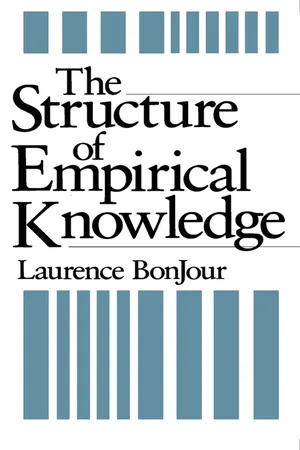
- 258 pages
- English
- ePUB (mobile friendly)
- Available on iOS & Android
eBook - ePub
The Structure of Empirical Knowledge
About this book
Information
Publisher
Harvard University PressYear
1988Print ISBN
9780674843813
9780674843806
eBook ISBN
9780674262157
Topic
PhilosophySubtopic
Philosophy History & TheoryPART ONE
A Critique of Empirical Foundationalism
1 Knowledge and Justification
This book is an investigation of one central problem which arises in the attempt to give a philosophical account of empirical knowledge. That specific problem will be introduced in Chapter 2. But before doing so, it is necessary to delineate and clarify the quite traditional conception of knowledge which will be assumed here and consider in some detail just what a satisfactory philosophical account of knowledge, especially knowledge of the empirical variety, would have to involve.
1.1 The traditional conception of knowledge
As is notorious, the words “know” and “knowledge” have a wide variety of uses which fall under no very neat or obvious taxonomy. My primary concern here, however, like that of most of the philosophical tradition, is propositional knowledge: the knowledge that something is the case, that a certain proposition is true. What is it for someone to know something in this philosophically central sense? What conditions must be satisfied in order for a cognitive state to constitute a genuine instance of propositional knowledge? Despite a great deal of recent challenge and controversy, the following quite venerable answer to these questions is, I believe, at least approximately correct. For a person A to know that P, where P is some propositions, three conditions must be satisfied:
(1) A must believe confidently that P,
(2) P must be true, and
(3) A’s belief that P must be adequately justified.
Though the general intent of this explication of the concept of knowledge is no doubt quite familiar, it may be useful to offer a brief elaboration of the three conditions in relation to a specific example. Suppose then that I am said to know that the tree outside my window is a Douglas fir. What must be the case, according to the explication of knowledge just given, in order for this ascription of knowledge to be correct?
First, I must confidently believe that the tree outside my window is a Douglas fir, must accept the proposition in question without any serious doubts or reservations. Subjective certainty is probably too strong a requirement, but the cognitive attitude in question must be considerably more than a casual opinion; I must be thoroughly convinced that the tree is a Douglas fir.
Second, it must be true, in fact or in reality, that the tree outside my window is a Douglas fir. By putting the matter in this way, I mean to suggest quite deliberately the classical realist account of truth as a relation of correspondence or agreement or accordance between belief and world: the propositional content of my subjective state of mind describes or specifies the world in a certain way; and for this description or specification to be true is for the world as it is in itself, independent of my cognitive or conceptualizing activity (except insofar as that activity is itself part of what I am thinking about), to fit that description or specification. Such a view of truth is largely taken for granted by most of the philosophical tradition and by common sense. Problems can be raised about it, and some of these will be considered later (in section 8.2). But, for reasons which will emerge, I regard the realist conception of truth as indispensable to the very enterprise of critical epistemology and so will simply assume for the time being that such a conception can be adequately explicated and defended.
Third, I must be adequately justified in believing that the tree outside my window is a Douglas fir. Part of what this means is reasonably obvious, at least in broad outline. My belief, if it is to be justified, cannot be a mere guess or hunch or arbitrary conviction. It cannot be merely a product of wishful thinking or something I read on the slip from a fortune cookie. Instead, there must be some sort of reasonably cogent reason or ground or warrant for my belief that the tree is a Douglas fir. But what exactly such a reason must involve will require further consideration later.
There are many important philosophical issues which have been raised about this general conception of knowledge and about the specific ingredients it involves. There are the issues arising out of Gettier’s problem, which has usually been taken to show either that the three standard conditions for knowledge require supplementation by a fourth or else, more radically, that the standard conception is irremediably defective.1 One important further result of the Gettier-initiated discussion has been the realization that attributions of knowledge, and perhaps also of justification, which would be quite beyond reproach if other things were equal may be defeasible if they are not; and the nature and range of possible defeating circumstances has been the subject of vigorous discussion.2 In addition, there are difficult problems concerning the concept of belief, especially pertaining to the idea that it is propositions which are the objects or contents of beliefs.3 And there are also serious difficulties which arise from the assumption made here that the degree of justification required for knowledge falls short of certainty.4 All of these issues will be ignored in the present discussion, however, partly because their exact bearing on the issues which will be discussed is obscure, at least to me, but mainly because there is quite enough to do without them.
There is, however, a further and rather less frequently noticed question regarding the standard conception of knowledge which leads into the very heart of the theory of knowledge and of the issues to be considered here: what sort of justification is required for knowledge? The obvious and merely verbal answer is: epistemic justification, that is, the sort of justification pertaining to and appropriate to knowledge. But what sort of justification is that, and how does it differ from other species of justification?
1.2 The concept of epistemic justification
The concept of epistemic justification is clearly the central concept in the whole theory of knowledge, and this book is largely devoted to exploring in detail certain of its facets and ramifications. But my immediate task is more modest and more basic: to consider how epistemic justification differs from other species of justification and to explore in a very preliminary way some of the problems raised by the concept thus arrived at.
The reason that the first issue requires discussion is that the concept of justification is plainly a generic one—roughly that of a reason or warrant of some kind meeting some appropriate standard. There are many specific varieties of justification actually in use and in principle as many as anyone cares to construct. Thus one may justify an action by appeal to moral standards; a business decision by appeal to business standards; an interpretation of a religious text by appeal to theological standards; and so on. What is involved in each of these examples is plainly some species of justification, but the particular standards of justification which are relevant in each case are obviously very different. Moreover, the choice of standards, in the more interesting cases at least, is not at all arbitrary. Rather there is an underlying rationale involved in each sort of case by reference to which the choice of standards is made and relative to which those standards might themselves be appropriately justified or rationalized. The immediate problem is thus to distinguish epistemic justification, the species of justification appropriate or relevant to knowledge, from other actual and possible species of justification.
Now it might be thought that the solution to this problem is obvious and straightforward: epistemic justification is that species of justification which is appropriate to beliefs or judgments, rather than to actions, decisions, and so on. But this initially plausible suggestion is only partly correct. It seems correct that only beliefs, or cognitive states resembling beliefs, are even candidates for epistemic justification. It may even be the case, though this would be very hard to show, that epistemic justification is the species of justification which is somehow most appropriate to beliefs. But there are other species of justification which also can apply to beliefs, so that mere applicability to beliefs cannot be the sole distinguishing characteristic of epistemic justification.
A pair of examples may help to illustrate this point. First, suppose that I have a dear friend who has stood by me and supported me through many trials and crises, often at considerable cost to himself. Now this friend stands accused of a horrible crime, everyone else believes him to be guilty, and there is substantial evidence for this conclusion. Suppose too that I have no independent evidence concerning the matter and also that my friend knows me well enough that an insincere claim to believe in his innocence will surely be detected. If in these difficult circumstances I can bring myself to believe in his innocence, it is surely plausible to say that there is a sense in which I am justified in so believing; indeed such a belief might well be regarded as obligatory. But the justification in question is plainly not epistemic justification, but rather a kind of moral justification: even if my friend is in fact innocent, I obviously do not know on this basis that he is innocent, no matter how compelling a reason of this sort I may have for my belief.
A different sort of justification for believing, still nonepistemic in character, is illustrated by Pascal’s famous wager and by an analogous example offered by William James. Pascal argues, roughly, that it is rational to believe that God exists because, on the one hand, if God exists, belief will be enormously rewarded and failure to believe horribly punished; and, on the other hand, if God does not exist, the consequences of either believing or not believing will be very minor by comparison. James imagines a situation in which I must leap over a chasm to escape from some danger: it is uncertain whether I can jump that far, but I know that I will make a better effort and thus have a better chance of success if I believe that I can. In such a situation, he argues, I am justified in believing that I can make the leap, even though I have no real evidence that this is so. The point here is that even if these arguments are otherwise acceptable (notoriously there are difficulties at least with Pascal’s), the kind of justification which they provide for the beliefs in question is not the right kind to satisfy the requirement for knowledge—no matter how strong it is in its own way and no matter whether the beliefs in question happen in fact to be true. It is what might be called prudential or pragmatic justification, not epistemic justification.
What then is the differentia which distinguishes epistemic justification, the species of justification appropriate to knowledge, from these other species of justification? The answer is to be found, I submit, by reflecting on the implicit rationale of the concept of knowledge itself. What after all is the point of such a concept, and what role is epistemic justification supposed to play in it? Why should we, as cognitive beings, care whether our beliefs are epistemically justified? Why is such justification something to be sought and valued?
Once the question is posed in this way, the following answer seems obviously correct, at least in first approximation. What makes us cognitive beings at all is our capacity for belief, and the goal of our distinctively cognitive endeavors is truth: we want our beliefs to correctly and accurately depict the world. If truth were somehow immediately and unproblematically accessible (as it is, on some accounts, for God) so that one could in all cases opt simply to believe the truth, then the concept of justification would be of little significance and would play no independent role in cognition. But this epistemically ideal situation is quite obviously not the one in which we find ourselves. We have no such immediate and unproblematic access to truth, and it is for this reason that justification comes into the picture. The basic role of justification is that of a means to truth, a more directly attainable mediating link between our subjective starting point and our objective goal. We cannot, in most cases at least, bring it about directly that our beliefs are true, but we can presumably bring it about directly (though perhaps only in the long run) that they are epistemically justified. And, if our standards of epistemic justification are appropriately chosen, bringing it about that our beliefs are epistemically justified will also tend to bring it about, in the perhaps even longer run and with the usual slippage and uncertainty which our finitude mandates, that they are true. If epistemic justification were not conducive to truth in this way, if finding epistemically justified beliefs did not substantially increase the likelihood of finding true ones, then epistemic justification would be irrelevant to our main cognitive goal and of dubious worth. It is only if we have some reason for thinking that epistemic justification constitutes a path to truth that we as cognitive beings have any motive for preferring epistemically justified beliefs to epistemically unjustified ones. Epistemic justification is therefore in the final analysis only an instrumental value, not an intrinsic one.
The distinguishing characteristic of epistemic justification is thus its essential or internal relation to the cognitive goal of truth. It follows that one’s cognitive endeavors are epistemically justified only if and to the extent that they are aimed at this goal, which means very roughly that one accepts all and only those beliefs which one has good reason to think are true. To accept a belief in the absence of such a reason, however appealing or even mandatory such acceptance might be from some other standpoint, is to neglect the pursuit of truth; such acceptance is, one might say, epistemically irresponsible. My contention here is that the idea of avoiding such irresponsibility, of being epistemically responsible in one’s believings, is the core of the notion of epistemic justification.5
It is this essential relation to truth which distinguishes epistemic justification from other species of justification aimed at different goals. Of course, at times the degree of epistemic justification may fall short of that required for knowledge and thus fail to make it likely to any very high degree that the belief in question is true. But any degree of epistemic justification, however small, must increase to a commensurate degree the chances that the belief in question is true (assuming that these are not already maximal), for otherwise it cannot qualify as epistemic justification at all.
1.3 The epistemological task
The conception of epistemic justification just offered seems obvious and inescapable from the standpoint of the traditional conception of knowledge. No alternative conception of epistemic justification can apparently satisfy the underlying rationale of that conception of knowledge and make intelligible the relation between its three components. But the implications of this conception of justification for the task which must be accomplished by an adequate theory of empirical knowledge are sobering in the extreme and need to be considered most carefully.
Part of the task of such a theory is evident: to provide an appropriately detailed account of the standards or criteria for the epistemic justification of empirical beliefs, of the conditions under which empirical beliefs qualify as epistemically justified. But how are we to know that a given account of this sort is in fact correct? Or, given several rival accounts of the standards of epistemic justification, how is a rational choice between them to be made? Part of the answer to these questions is provided, of course, by such familiar criteria as clarity and consistency, but these are clearly not enough by themselves.
If the account of epistemic justification just set forth is correct, then it seems to follow as an unavoidable corollary that one can finally know that a given set of standards for epistemic justification is correct or reasonable only by knowing that the standards in question are genuinely conducive to the cognitive goal of truth. And this in turn apparently means that it is incumbent on the proponent of such an epistemological theory to provide an argument or rationale of some sort to show that his proposed standards of justification are indeed truth-conducive, that accepting beliefs in accordance with them would indeed be likely in the long run to lead to truth (and more likely than would be the case for any conspiciously available alternative account). Providing such an argument is ultimately the only satisfactory way to defend such a theory against its rivals and against the skeptic; any other sort of defense would be simply irrelevant to the cognitive role that such standards of justification are supposed to play. To disclaim the need for such an argument would be, in effect, to abandon tacitly the claim that the standards in question were indeed standards of epistemic justification rather than of some other kind.
Thus, on the present conception, the main task of a theory of empirical knowledge divides into two parts, both equally essential. The first part is to give an account of the standards of epistemic justification; and the second is to provide what I will call a metajustification for the proposed account by showing the proposed standards to be adequately truth-conducive. Such a metajustification would constitute, in Feigl’s useful sense,6 a vindication of the proposed stand...
Table of contents
- Cover
- Title
- Copyright
- Contents
- Preface
- PART ONE: A Critique of Empirical Foundationalism
- PART TWO: Toward a Coherence Theory of Empirical Knowledge
- APPENDIX A. A Priori Justification
- APPENDIX B. A Survey of Coherence Theories
- Notes
- Bibliography
- Index
Trusted by 375,005 students
Access to over 1.5 million titles for a fair monthly price.
Study more efficiently using our study tools.
Frequently asked questions
Yes, you can cancel anytime from the Subscription tab in your account settings on the Perlego website. Your subscription will stay active until the end of your current billing period. Learn how to cancel your subscription
No, books cannot be downloaded as external files, such as PDFs, for use outside of Perlego. However, you can download books within the Perlego app for offline reading on mobile or tablet. Learn how to download books offline
Perlego offers two plans: Essential and Complete
- Essential is ideal for learners and professionals who enjoy exploring a wide range of subjects. Access the Essential Library with 800,000+ trusted titles and best-sellers across business, personal growth, and the humanities. Includes unlimited reading time and Standard Read Aloud voice.
- Complete: Perfect for advanced learners and researchers needing full, unrestricted access. Unlock 1.5M+ books across hundreds of subjects, including academic and specialized titles. The Complete Plan also includes advanced features like Premium Read Aloud and Research Assistant.
We are an online textbook subscription service, where you can get access to an entire online library for less than the price of a single book per month. With over 1.5 million books across 990+ topics, we’ve got you covered! Learn about our mission
Look out for the read-aloud symbol on your next book to see if you can listen to it. The read-aloud tool reads text aloud for you, highlighting the text as it is being read. You can pause it, speed it up and slow it down. Learn more about Read Aloud
Yes! You can use the Perlego app on both iOS and Android devices to read anytime, anywhere — even offline. Perfect for commutes or when you’re on the go.
Please note we cannot support devices running on iOS 13 and Android 7 or earlier. Learn more about using the app
Please note we cannot support devices running on iOS 13 and Android 7 or earlier. Learn more about using the app
Yes, you can access The Structure of Empirical Knowledge by Laurence BonJour in PDF and/or ePUB format, as well as other popular books in Philosophy & Philosophy History & Theory. We have over 1.5 million books available in our catalogue for you to explore.