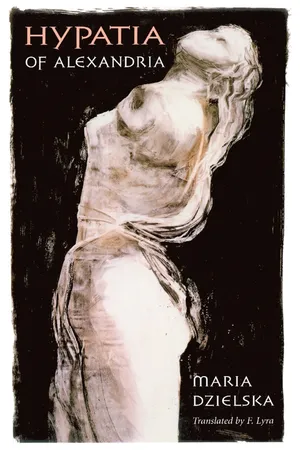
Hypatia—brilliant mathematician, eloquent Neoplatonist, and a woman renowned for her beauty—was brutally murdered by a mob of Christians in Alexandria in 415. She has been a legend ever since. In this engrossing book, Maria Dzielska searches behind the legend to bring us the real story of Hypatia's life and death, and new insight into her colorful world.
Historians and poets, Victorian novelists and contemporary feminists have seen Hypatia as a symbol—of the waning of classical culture and freedom of inquiry, of the rise of fanatical Christianity, or of sexual freedom. Dzielska shows us why versions of Hypatia's legend have served her champions' purposes, and how they have distorted the true story. She takes us back to the Alexandria of Hypatia's day, with its Library and Museion, pagan cults and the pontificate of Saint Cyril, thriving Jewish community and vibrant Greek culture, and circles of philosophers, mathematicians, astronomers, and militant Christians. Drawing on the letters of Hypatia's most prominent pupil, Synesius of Cyrene, Dzielska constructs a compelling picture of the young philosopher's disciples and her teaching. Finally she plumbs her sources for the facts surrounding Hypatia's cruel death, clarifying what the murder tells us about the tensions of this tumultuous era.
- 159 pages
- English
- ePUB (mobile friendly)
- Available on iOS & Android
eBook - ePub
Hypatia of Alexandria
About this book
Information
Publisher
Harvard University PressYear
1996Print ISBN
9780674437760
9780674437753
eBook ISBN
9780674736504
NOTES
I. The Literary Legend of Hypatia
1. Toland, Tetradymus, chap. 3 (London, 1720), p. 103.
2. T. Lewis, The History of Hypatia (London, 1721); I have not seen it. C. P. Goujet represents a similar position in “Dissertation sur Hypatie où l’on justifie Saint Cyrille d’Alexandrie sur la mort de cette savante,” in P. Desmolets, Continuation des Mémoires de littérature et d’histoire, V (Paris, 1749), pp. 138–191.
3. Voltaire, Mélanges, Bibliothèque de la Pléiade, 152 (Paris, 1961), pp. 1104 and 1108. On eighteenth-century philosophy see, among others, P. Gau, The Enlightenment: An Interpretation, I: The Rise of Modem Paganism (New York, 1967).
4. In Oeuvres complètes de Voltaire, VII: Dictionnaire philosophique (Paris, 1835), pp. 700, 701. Voltaire also writes about Hypatia in the treatise De la paix perpétuelle (1769), describing her as “de l’ancienne religion égyptienne” and spinning an improbable tale about her death. See R. Asmus, “Hypatia in Tradition und Dichtung,” Studien zur vergleichenden Literaturgeschichte 7 (1907):26–27.
5. E. Gibbon, The Decline and Fall of the Roman Empire (London, 1898), pp. 109–110.
6. M. R. Lefkowitz expresses a similar view in Women in Greek Myth (Baltimore, 1986), p. 108.
7. In the edition of Gotha (1807), p. 76.
8. Edgard Pich, Leconte de Lisle et sa création poetique: Poèmes antiques et Poèmes barbares (1852–1874) (Lille, 1974), pp. 160ff.; Oeuvres de Leconte de Lisle, Poèmes antiques (Paris, 1897), p. 97.
9. Leconte de Lisle shared this view with other writers and literary theorists of the period, including F. R. Chateaubriand, P. Proudhon, E. Renan, Numa-Denis Fustel de Coulanges (Pich, Leconte de Lisle, p. 186 and nn. 83 and 86).
10. Pich, Leconte de Lisle, p. 160 n. 8.
11. Ibid., p. 165: “Le martyre d’Hypatie a été considéré comme l’une des manifestations les plus claire du fanatisme catolique.”
12. Oeuvres de Leconte de Lisle, pp. 275–289.
13. G. de Nerval, Nouvelles, I: Les Files du feu. Angélique (1854; reprint, Paris, 1931), p. 32: “La bibliothèque d’Alexandrie et le Sera-péon, ou maison de secours, qu’en faisait parti, avaient été brulés et détruits au quatrième siècle par les chrétiens—qui en outre massacrèrent dans les rues la célèbre Hypatie, philosophe pythagoricienne.” C.-P. de Lasteyrie included a life story of Hypatia in Sentences de Sextius (Paris, 1843), pp. 273–304, under the characteristic title Vie d’Hypatie, femme célèbre, professeur de philosophie, dans le deuxième siècle à l’école d’Alexandrie, in which he laid heavy charges against Cyril.
14. M. Barrès, Sous l’oeil des barbares, 2d ed. (Paris, 1904), preface, p. 6.
15. Ibid., p. 13 and passim to p. 58.
16. I use here the third edition (London, 1906).
17. H. von Schubert, “Hypatia von Alexandrien in Wahrheit und Dichtung,” PreussischeJahrbücher 124 (1906):42–60; B. Merker, “Die historischen Quellen zu Kingsleys Roman ‘Hypatia’” (Diss. Würzburg, 1909–10); Asmus in Studien der vergleichenden Literaturgeschichte 7 (1907), pp. 30–35. Asmus also writes about German authors imitating Kingsley (pp. 35–44). Kingsley’s book is also discussed by S. Chitty, The Beast and the Monk: A Life of Charles Kingsley (New York, 1975), pp. 151–156.
18. J. W. Draper, History of the Intellectual Development of Europe (New York, 1869), pp. 238–244. On Draper see Dictionary of Scientific Biography, IV (New York, 1971), pp. 181–183.
19. B. Russell, History of Western Philosophy and Its Connection with Political and Social Circumstances from the Earliest Times to the Present Day (London, 1946), p. 387.
20. The contents of the work and data on it are collected by G. Arrigoni, “Tra le donne dell’ antichità: Considerazioni e ricognizioni,” in Atti del Convegno nazionale di studi su la donna nel mondo antico, Torino, 21–23 aprile 1986 (Turin, 1987), pp. 68–69.
21. Today, too, we find Hypatia presented as a defender of the faith and confused with Saint Catherine. See, for example, R. Richardson, The Star Lovers (New York, 1967), writing of Hypatia on p. 173 that she “died defending the Christians. She is followed by Catharina, an extremely learned young woman of noble family who died in A.D. 307, defending the Christians.” See the discussion later in this chapter.
22. C. Pascal, “Ipazia,” in Figure e caratteri (Lucrezio, L’Ecclesiaste, Seneca, Ipazia, Giosue Carducci, Giuseppe Garibaldi) (Milan, 1908), pp. 143–196.
23. G. Pampaloni, “La poesia religiosa del Mutamento,” introduction to M. Luzi, Libro di Ibazia e II messagero (Milan, 1978), p. 14.
24. I need mention only Lawrence Durrell’s reference to Hypatia in The Alexandria Quartet. He sings his beloved Alexandria thus: “Walking those streets again in my imagination I knew once more that they spanned, not merely human history, but the whole biological scale of the heart’s affections—from the painted ecstasies of Cleopatra (strange that the vine should be discovered here, near Taposiris) to the bigotry of Hypatia (withered vine-leaves, martyr’s kisses)”; Clea (London and Boston, 1968), p. 660.
25. A. Zitelmann, Hypatia (Weinheim and Basel, 1989).
26. Discussed in E. Lamirande, “Hypatie, Synesios et la fin des dieux: L’histoire et la fiction,” Studies in Religion (Sciences religieuses) 18 (1989):467–489.
27. U. Molinaro, “A Christian Martyr in Reverse: Hypatia, 370–415 A.D.,” Hypatia: A Journal of Feminist Philosophy 4 (1989):6–8.
28. See Art in America, April 1980, pp. 115–126; Art International 25.7–8 (Sept.–Oct. 1982):52–53. In our day a well-known star of pornographic films adopted Hypatia as her first name.
29. Socrates, HE VII.15.
30. Suda, s.v. Hypatia (4.645.4–16 Adler) = Dam. frag. 102 (pp. 79.18 and 81.10 Zintzen).
31. Gibbon, Decline and Fall, pp. 109–110.
32. Philostorgius, HE VIII.9.
33. The letter is in Mansi, Conciliorum omnium amplissima collectio, V (Florence, 1751), col. 1007 (Synodicon, chap. 216). On the apocryphal nature of the letter see Hoche, pp. 452–453. The letter seems to have originated at the end of antiquity.
34. L. Canfora, The Vanished Library (New York, 1990), p. 87.
35. See PRLE, I, 657–658. On Palladas also see A. Cameron, “Palladas und Christian Polemic,” Journal of Roman Studies 55 (1965): 17–30.
36. In AP, IX, 400 (Stadtmüller).
37. G. Luck, “Palladas Christian or Pagan?” Harvard Studies in Classical Philology 63 (1958):455–471.
38. Suda, s.v. Panolbios (4.21 Adler); PRLE, II, 829; A. Cameron, “Wandering Poets: A Literary Movement in Byzantine Egypt,” Historia 14 (1965):470–509.
39. PRLE, II, 401–402 and 576 (Hypatia 3).
40. Meyer, p. 52.
41. C. Baronius, Annales Ecclesiatici (12 vols., 1597–1609), VII (Paris, 1816), p. 56 (46–47).
42. G. Arnolds, Kirchen und Ketzer-Historie, I (Frankfurt, 1699), pp. 229–230.
43. S. Le Nain de Tillemont, Mémoires pour servir à Vhistoire écclesiastique des six premiers siècles (Paris, 1701–1730), XIV, 274–276.
44. J. A. Fa...
Table of contents
- Cover
- Title
- Copyright
- Dedication
- Acknowledgments
- Contents
- I The Literary Legend of Hypatia
- II Hypatia and Her Circle
- III The Life and Death of Hypatia
- Conclusion
- Abbreviations
- Sources
- Notes
- Index
Trusted by 375,005 students
Access to over 1.5 million titles for a fair monthly price.
Study more efficiently using our study tools.
Frequently asked questions
Yes, you can cancel anytime from the Subscription tab in your account settings on the Perlego website. Your subscription will stay active until the end of your current billing period. Learn how to cancel your subscription
No, books cannot be downloaded as external files, such as PDFs, for use outside of Perlego. However, you can download books within the Perlego app for offline reading on mobile or tablet. Learn how to download books offline
Perlego offers two plans: Essential and Complete
- Essential is ideal for learners and professionals who enjoy exploring a wide range of subjects. Access the Essential Library with 800,000+ trusted titles and best-sellers across business, personal growth, and the humanities. Includes unlimited reading time and Standard Read Aloud voice.
- Complete: Perfect for advanced learners and researchers needing full, unrestricted access. Unlock 1.5M+ books across hundreds of subjects, including academic and specialized titles. The Complete Plan also includes advanced features like Premium Read Aloud and Research Assistant.
We are an online textbook subscription service, where you can get access to an entire online library for less than the price of a single book per month. With over 1.5 million books across 990+ topics, we’ve got you covered! Learn about our mission
Look out for the read-aloud symbol on your next book to see if you can listen to it. The read-aloud tool reads text aloud for you, highlighting the text as it is being read. You can pause it, speed it up and slow it down. Learn more about Read Aloud
Yes! You can use the Perlego app on both iOS and Android devices to read anytime, anywhere — even offline. Perfect for commutes or when you’re on the go.
Please note we cannot support devices running on iOS 13 and Android 7 or earlier. Learn more about using the app
Please note we cannot support devices running on iOS 13 and Android 7 or earlier. Learn more about using the app
Yes, you can access Hypatia of Alexandria by Maria Dzielska, F. Lyra in PDF and/or ePUB format, as well as other popular books in History & Social Science Biographies. We have over 1.5 million books available in our catalogue for you to explore.