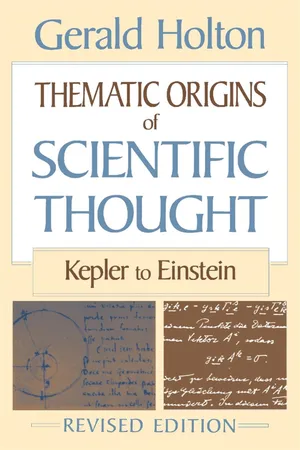
The highly acclaimed first edition of this major work convincingly established Gerald Holton's analysis of the ways scientific ideas evolve. His concept of "themata," induced from case studies with special attention to the work of Einstein, has become one of the chief tools for understanding scientific progress. It is now one of the main approaches in the study of the initiation and acceptance of individual scientific insights.
Three principal consequences of this perspective extend beyond the study of the history of science itself. It provides philosophers of science with the kind of raw material on which some of the best work in their field is based. It helps intellectual historians to redefine the place of modern science in contemporary culture by identifying influences on the scientific imagination. And it prompts educators to reexamine the conventional concepts of education in science.
In this new edition, Holton has masterfully reshaped the contents and widened the coverage. Significant new material has been added, including a penetrating account of the advent of quantum physics in the United States, and a broad consideration of the integrity of science, as exemplified in the work of Niels Bohr. In addition, a revised introduction and a new postscript provide an updated perspective on the role of themata. The result of this thoroughgoing revision is an indispensable volume for scholars and students of scientific thought and intellectual history.
- 499 pages
- English
- ePUB (mobile friendly)
- Available on iOS & Android
eBook - ePub
About this book
Information
Publisher
Harvard University PressYear
1988Print ISBN
9780674877481
9780674877474
eBook ISBN
9780674264557
6 ON THE ORIGINS OF THE SPECIAL THEORY OF RELATIVITY
Continuity or Revolution?

As we shall see, Einstein’s innovation is understood best by superposing the two views, by seeing the discontinuity of his methodological orientation within a historically continuous scientific development.1 His own comments repeatedly stressed the aspect of continuity. Thus he wrote to Carl Seelig on March 11, 1952: “Between the conception of the idea of this special relativity theory and the completion of the corresponding publication, there elapsed five or six weeks. But [he added rather cryptically] it would be hardly correct to consider this as a birth date, because earlier the arguments and building blocks were being prepared over a period of years, although without bringing about the fundamental decision.”2 One of our tasks in this chapter will be to get some idea of what happened during those years and what— or who—helped to bring about the “fundamental decision.” How large or small was the effect of the work of earlier physicists? Is there some strong influence that has so far been overlooked? Indeed, what are the sources for a study of the origins of the special theory of relativity?3 What was the state of science around 1905, what were the contributions which prepared the field for the RT, and what did Einstein know about them? To what extent was this work consciously based on that of Lorentz and Poincaré? What was the early reception of the RT among scientists? What may we say about the style of Einstein’s work? What, if anything, in the origins and content of the RT is typical of other theories that have had great impact on science? And even, what methodological principles for research in the history of science emerge from this case?
Continuity in Einstein’s Work
When one studies Einstein’s early relativity papers and correspondence in the larger contextual setting of his other scientific papers, particularly those on the quantum theory of light and on Brownian motion, which also were written and published in 1905, one is struck by two crucial points. Although the three epochal papers of 1905— sent to the ANNALEN DER PHYSIK at intervals of less than eight weeks— seem to be in entirely different fields, closer study shows that they arose in fact from the same general problem, namely, the fluctuations in the pressure of radiation. In 1905, as Einstein later wrote to von Laue,4 he had already known that Maxwell’s theory leads to the wrong prediction of the motion of a delicately suspended mirror “in a Planckian radiation cavity.” This connects on the one hand with the consideration of Brownian motion as well as with the quantum structure of radiation, and on the other hand with Einstein’s more general reconsideration of “the electromagnetic foundations of physics” itself.5
One also finds that the style of the three papers is essentially the same and reveals what is typical of Einstein’s work at that time. Each begins with a statement of formal asymmetries or other incongruities of a predominantly aesthetic nature (rather than, for example, a puzzle posed by unexplained experimental facts), then proposes a principle—preferably one of the generality of, say, the Second Law of Thermodynamics, to cite Einstein’s repeated analogy—which removes the asymmetries as one of the deduced consequences, and at the end produces one or more experimentally verifiable predictions.
Einstein’s first paper on the quantum theory of light opens in a typical manner: “There exists a radical formal difference between the theoretical representations which physicists have constructed for themselves concerning gases and other ponderable bodies on the one hand, and Maxwell’s theory of electromagnetic processes in so-called empty space on the other hand.”6 The significant starting point is a formalistic difference between theoretical representations in two fields of physics which, to most physicists, were so widely separated that no such comparison would have invited itself and therefore no such discrepancy would be noted. The discrepancy Einstein points out is between the discontinuous or discrete character of particles and of their energy on one hand, and the continuous nature of functions referring to electromagnetic events and of the energy per unit area in an expanding wave front on the other hand. The discussion of the photoelectric effect, for which this paper is mostly remembered, occurs toward the end, in a little over two pages out of the total sixteen. The prescription for obtaining an experimental verification of his point of view is given in a single, typically succinct Einsteinian sentence (straight-line relation with constant slope between frequency of light and stopping potential for all electrode materials).
In his second paper published in 1905,7 Einstein points out in the second paragraph that the range of application of classical thermodynamics may be discontinuous even in volumes large enough to be microscopically observable. He ends with the equation giving Avogadro’s number in terms of observables in the study of particle motion, and with the one-sentence exhortation: “May some investigator soon succeed in deciding the question which has been raised here, and which is important for the theory of heat!” Significantly, Einstein reported the following year8 that only after the publication of this paper was his attention drawn to the experimental identification, as long ago as 1888, of Brownian motion with the effect whose existence he had deduced as a necessity from the kinetic-molecular theory. In his Autobiographical Notes he repeats that he did the work of 1905 “without knowing that observations concerning Brownian motion were already long familiar.”9
The third paper of 190510 is, of course, Einstein’s first paper on the RT. He begins again by drawing attention to a formal asymmetry, that is, in the description of currents generated during relative motion between magnets and conductors. The paper does not invoke by name any of the several well-known experimental difficulties—and the Michelson and Michelson-Morley experiments are not even mentioned when the opportunity arises to show in what manner the RT accounts for them. At the end, Einstein briefly mentions here, too, specific predictions of possible experiments (giving the equation “according to which the electron must move in conformity with the theory presented here”).11
“Revolution” as Return to Classical Purity
The study of the three papers together reveals the extent to which Einstein’s RT represents an attempt to solve problems by the postulation of appropriate fundamental hypotheses and to restrict those hypotheses to the most general kind and the smallest number possible—a goal on which Einstein often insisted.12 In the 1905 paper on the RT, he makes, in addition to the two “conjectures” raised to “postulates” (that is, of relativity and of the constancy of light velocity) only four other assumptions: one of the isotropy and homogeneity of space, the others concerning three logical properties of the definition of synchronization of watches. In contrast, H. A. Lorentz’s great paper13 that appeared a year before Einstein’s publication and typified the best work in physics of its time—a paper which Lorentz declared to be based on “fundamental assumptions” rather than on “special hypotheses”—contained in fact eleven ad hoc hypotheses: restriction to small ratios of velocities v to light velocity c, postulation a priori of the transformation equations (rather than their derivation from other postulates), assumption of a stationary ether, assumption that the stationary electron is round, that its charge is uniformly distributed, that all mass is electromagnetic, that the moving electron changes one of its dimensions precisely in the ratio of (1—v2/c2)1/2 to 1, that forces between uncharged particles and between a charged and uncharged particle have the same transformation properties as electrostatic forces in the electrostatic system, that all charges in atoms are in a certain number of separate “electrons,” that each of these is acted on only by others in the same atom, and that atoms in motion as a whole deform as electrons themselves do. It is for these reasons that Einstein later maintained that the RT grew out of the Maxwell-Lorentz theory of electrodynamics “as an amazingly simple summary and generalization of hypotheses which previously have been independent of one another.”14
If one has studied the development of scientific theories, one notes here a familiar theme: the so-called revolution which Einstein is commonly said to have introduced into the physics in 1905 turns out to be at bottom an effort to return to a classical purity. Not only is this a key to a new evaluation of Einstein’s contribution, it indicates a fairly general characteristic of great scientific “revolutions.” Indeed, although it is usually stressed that Einstein challenged Newtonian physics in fundamental ways, the equally correct but neglected point is the number of methodological correspondences with earlier classics, for example, with the PRINCIPIA.
Here a listing of some main parallels between the two works must suffice: the early postulation of general principles which in themselves do not spring directly from experience; the limitation to a few basic hypotheses;15 the exceptional attention to epistemological rules in the body of a scientific work; the philosophical eclecticism of the author; his ability to dispense with mechanistic models in a science which in each case was dominated at the time by such models;16 the small number of specific experimental predictions; and the fact that the most gripping effect of the work is its exhibition of a new point of view.
The central problem, moreover, is the same in both works: the nature of space and time and what follows from it for physics. Here, the basic attitudes have in both cases more in common than appears at first reading. That Newton’s absolute space and absolute time were not meaningful concepts in the sense of laboratory operations was, of course, not the original discovery of Mach; rather, it was freely acknowledged by Newton himself. But Einstein was also quite explicit that in replacing absolute Newtonian space and time with an infinite ensemble of rigid meter sticks and ideal clocks he was not proposing a laboratory-operational definition. He stated that it could be realized only to some degree, “not even with arbitrary approximation,” and that the fundamental role of the whole conception, both on factual and on logical grounds, “can be attacked with a certain right.”17 Thus the RT merely shifted the locus of space time from the sensorium of Newton’s God to the sensorium of Einstein’s abstract Gedanken-experimenter—as it were, the final secularization of physics. We shall return to this point below.18
Whittaker’s Accounts of the Origins of Einstein’s Work
Not all scholars agree with this view of Einstein’s originality within an old tradition. Some exaggerate its discontinuity and insist on a “revolution.” Some—for ideological and other reasons—go the opposite way. To illustrate this last point concretely, I turn to a question on which a dispute has been active: namely, to what extent Einstein’s work was not only anticipated by but even specifically based on published work by other contemporary physicists. Particularly revealing is an essay published in 1955 by Sir Edmund Whittaker.19 Whittaker’s commitment to the nineteenth-century tradition of physics and to the ether theory was illustrated earlier in his well-known book, A HISTORY OF THE THEORIES OF AETHER AND ELECTRICITY,20and also by his excellent contributions in the field of classical mechanics. Moreover, in the second volume of the HISTORY, completed in 1953, which carr...
Table of contents
- Cover
- Title
- Copyright
- Preface to the Revised Edition
- Contents
- Introduction
- I On the Thematic Analysis of Science
- II On Relativity Theory
- III On the Growth of Physical Science
- Postscript to the Revised Edition
- Sources
- Index
Trusted by 375,005 students
Access to over 1.5 million titles for a fair monthly price.
Study more efficiently using our study tools.
Frequently asked questions
Yes, you can cancel anytime from the Subscription tab in your account settings on the Perlego website. Your subscription will stay active until the end of your current billing period. Learn how to cancel your subscription
No, books cannot be downloaded as external files, such as PDFs, for use outside of Perlego. However, you can download books within the Perlego app for offline reading on mobile or tablet. Learn how to download books offline
Perlego offers two plans: Essential and Complete
- Essential is ideal for learners and professionals who enjoy exploring a wide range of subjects. Access the Essential Library with 800,000+ trusted titles and best-sellers across business, personal growth, and the humanities. Includes unlimited reading time and Standard Read Aloud voice.
- Complete: Perfect for advanced learners and researchers needing full, unrestricted access. Unlock 1.5M+ books across hundreds of subjects, including academic and specialized titles. The Complete Plan also includes advanced features like Premium Read Aloud and Research Assistant.
We are an online textbook subscription service, where you can get access to an entire online library for less than the price of a single book per month. With over 1.5 million books across 990+ topics, we’ve got you covered! Learn about our mission
Look out for the read-aloud symbol on your next book to see if you can listen to it. The read-aloud tool reads text aloud for you, highlighting the text as it is being read. You can pause it, speed it up and slow it down. Learn more about Read Aloud
Yes! You can use the Perlego app on both iOS and Android devices to read anytime, anywhere — even offline. Perfect for commutes or when you’re on the go.
Please note we cannot support devices running on iOS 13 and Android 7 or earlier. Learn more about using the app
Please note we cannot support devices running on iOS 13 and Android 7 or earlier. Learn more about using the app
Yes, you can access Thematic Origins of Scientific Thought by Gerald Holton in PDF and/or ePUB format, as well as other popular books in Biological Sciences & Science History. We have over 1.5 million books available in our catalogue for you to explore.