Is race something we know when we see it? In 1857, Alexina Morrison, a slave in Louisiana, ran away from her master and surrendered herself to the parish jail for protection. Blue-eyed and blond, Morrison successfully convinced white society that she was one of them. When she sued for her freedom, witnesses assured the jury that she was white, and that they would have known if she had a drop of African blood. Morrison's court trial—and many others over the last 150 years—involved high stakes: freedom, property, and civil rights. And they all turned on the question of racial identity.
Over the past two centuries, individuals and groups (among them Mexican Americans, Indians, Asian immigrants, and Melungeons) have fought to establish their whiteness in order to lay claim to full citizenship in local courtrooms, administrative and legislative hearings, and the U.S. Supreme Court. Like Morrison's case, these trials have often turned less on legal definitions of race as percentages of blood or ancestry than on the way people presented themselves to society and demonstrated their moral and civic character.
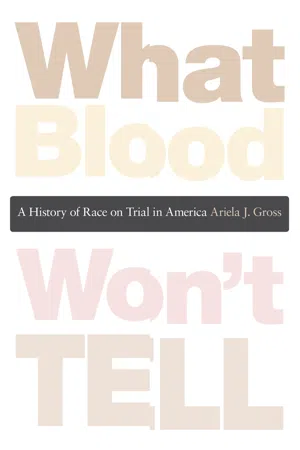
Unearthing the legal history of racial identity, Ariela Gross's book examines the paradoxical and often circular relationship of race and the perceived capacity for citizenship in American society. This book reminds us that the imaginary connection between racial identity and fitness for citizenship remains potent today and continues to impede racial justice and equality.
- 368 pages
- English
- ePUB (mobile friendly)
- Available on iOS & Android
eBook - ePub
About this book
Information
Publisher
Harvard University PressYear
2010Print ISBN
9780674047983
9780674031302
eBook ISBN
9780674264083
Table of contents
- Cover
- Title
- Copyright
- Dedication
- Contents
- A Note on Terminology
- Introduction
- One The Common Sense of Race
- Two Performing Whiteness
- Three Race as Association
- Four Citizenship of the “Little Races”
- Five Black Indian Identity in the Allotment Era
- Six From Nation to Race in Hawai’i
- Seven Racial Science, Immigration, and the “White Races”
- Eight Mexican Americans and the “Caucasian Cloak”
- Conclusion: The Common Sense of Race Today
- Notes
- Acknowledgments
- Index
Trusted by 375,005 students
Access to over 1.5 million titles for a fair monthly price.
Study more efficiently using our study tools.
Frequently asked questions
Yes, you can cancel anytime from the Subscription tab in your account settings on the Perlego website. Your subscription will stay active until the end of your current billing period. Learn how to cancel your subscription
No, books cannot be downloaded as external files, such as PDFs, for use outside of Perlego. However, you can download books within the Perlego app for offline reading on mobile or tablet. Learn how to download books offline
Perlego offers two plans: Essential and Complete
- Essential is ideal for learners and professionals who enjoy exploring a wide range of subjects. Access the Essential Library with 800,000+ trusted titles and best-sellers across business, personal growth, and the humanities. Includes unlimited reading time and Standard Read Aloud voice.
- Complete: Perfect for advanced learners and researchers needing full, unrestricted access. Unlock 1.5M+ books across hundreds of subjects, including academic and specialized titles. The Complete Plan also includes advanced features like Premium Read Aloud and Research Assistant.
We are an online textbook subscription service, where you can get access to an entire online library for less than the price of a single book per month. With over 1.5 million books across 990+ topics, we’ve got you covered! Learn about our mission
Look out for the read-aloud symbol on your next book to see if you can listen to it. The read-aloud tool reads text aloud for you, highlighting the text as it is being read. You can pause it, speed it up and slow it down. Learn more about Read Aloud
Yes! You can use the Perlego app on both iOS and Android devices to read anytime, anywhere — even offline. Perfect for commutes or when you’re on the go.
Please note we cannot support devices running on iOS 13 and Android 7 or earlier. Learn more about using the app
Please note we cannot support devices running on iOS 13 and Android 7 or earlier. Learn more about using the app
Yes, you can access What Blood Won’t Tell by Ariela J. Gross in PDF and/or ePUB format, as well as other popular books in History & North American History. We have over 1.5 million books available in our catalogue for you to explore.