In August 1953, in a covert operation, the CIA and MI6 jointly overthrew the democratically elected Prime Minister of Iran, Mohammed Mossadegh, installing the Shah in his place. Michael Luders illuminates the dark chain of cause and effect that flowed from this conveniently forgotten 'original sin' of postwar Western interference, extending right up to the present day. Along the way he examines other ill-fated interventions, from Iraq to Afghanistan to Libya to Palestine, blowing apart the West's claim to the moral high ground and making a powerful case for a radical rethink.
Already a bestseller in Europe, BLOWBACK is an essential read for anyone who wants to understand a region that remains at the heart of today's violent and disordered world.
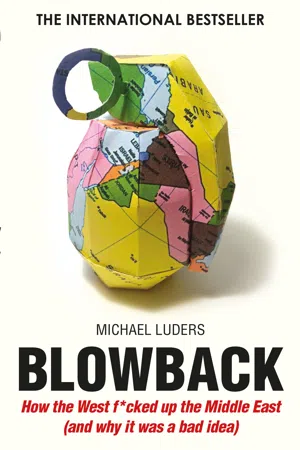
eBook - ePub
Blowback
How the West f*cked up the Middle East (and why it was a bad idea)
- 160 pages
- English
- ePUB (mobile friendly)
- Available on iOS & Android
eBook - ePub
About this book
Information
IN THE HEART OF DARKNESS:
THE SUCCESS OF ‘ISLAMIC STATE’
The ‘War on Terror’ declared by President Bush after 9/11 was continued by Obama, under a different name but in no less deadly a fashion, and largely with drone-strikes. Since 2001, the US has militarily intervened in seven states in the Muslim world: Afghanistan, Iraq, Somalia, Yemen, Pakistan, Libya and Syria. These interventions have varied in intensity and scope, yet they have all had two consequences. They have pushed states towards collapse, and they have strengthened radical, Islamist movements, including the Taliban, al-Qaida and Islamic State. In no small measure, the West has created the terrorist threat it is fighting.
Even so, Washington has continued to differentiate between ‘good’ and ‘bad’ jihadis. ‘Good’ jihadis fight against ‘bad’ jihadis such as al-Qaida, or undesirable (i.e. anti-Western) governments. The following example illustrates how this works in practice. According to the news network Al-Jazeera, in summer 2014 the Americans followed a Saudi suggestion to open a new front against Assad’s regime in the south of Syria. One unit associated with the Free Syrian Army, the Yarmouk Brigade, received weapons and special training via Jordan. The Brigade was allegedly ‘moderate’ and was supposed to oppose both regime troops and al-Qaida-sympathising Islamists in the north and east of Syria. However, to the chagrin of the Americans, video footage soon emerged showing the Yarmouk Brigade fighting alongside the Nusra Front, an al-Qaida offshoot. Worse still, the Brigade had handed the Nusra Front the state-of-the-art weapons systems they had just been given by Jordan, no doubt in exchange for good hard cash. Meanwhile the Baghdad government reiterated its now familiar complaint that IS in Iraq was using weapons originally supplied to ‘good’ Syrian Islamists by the US.
In Iraq, Washington supports the Shiites against Sunni jihadis, while in Syria, jihadis of the same stripe are encouraged by the US to wage war on the regime in Damascus. This schizophrenia has only strengthened Islamic State – first in Iraq, then in Syria, then back in Iraq. The Islamist movement in Iraq has its roots in the country’s US-run prisons; later, in Syria, IS grew to a regional power, undisturbed by outside influences; finally, it launched a major offensive back into Iraq from Syria. At the start of June 2014, IS fighters tore down the border posts and declared the ‘end of Sykes-Picot’, the arbitrary ‘lines in the sand’ drawn to create the border between Iraq and Syria by Britain and France after World War I. Within a few weeks they had taken almost all western Iraq and conquered the second-largest Iraqi city, oil-rich Mosul; their territory extended almost to the borders of Baghdad.
The insurgents in Libya were also ‘good’ Islamists. Every sign of al-Qaida sympathies was played down by Washington. Only when US ambassador Chris Stevens was murdered by jihadis in September 2012 did the cry ‘extremists!’ go up, and with the usual consequences: inflamed rhetoric followed by military strikes. Washington now changed tack, applying the al-Qaida label where it did not fit – as it had during the fight against Sunni insurgents in occupied Iraq, though only a small proportion were actually members of al-Qaida. The truth was not important. What mattered was the equation resistance = al-Qaida, because this is what legitimised the Iraq occupation as an essential component of the war against terror. Of course, it also presented the Western public with a scapegoat for the unfolding disaster.
War Is Worth It
All new threats and challenges to the US-led intervention in the region meet the same, reflexive response: more weapons, more force. As the superpowers enter and exit one conflict zone after another, lessons are sometimes learned, but they concern mainly tactics or strategy. The use of violence per se is seldom questioned.
At the time of writing, for example, the party line is that large-scale ground offensives should be avoided in favour of drones and airstrikes, carried out in collaboration with (questionable) local allies. Is this simply to avoid casualties by risking more ‘boots on the ground’? Or could there be other forces at work on US defence strategy?
Share prices in the largest US weapons company, Lockheed Martin, tripled between mid-2010 and mid-2014; they doubled between mid-2013 and mid-2014 alone. On 6 October 2014 media organisation Bloomberg reported:
Led by Lockheed Martin Group (LTM), the biggest US defence companies are trading at record prices as shareholders reap rewards from escalating military conflicts around the world… investors see rising sales for makers of missiles, drones and other weapons as the US hits Islamic State fighters in Syria and Iraq… The US is also the biggest foreign military supplier to Israel, which waged a 50-day offensive against the Hamas Islamic movement in the Gaza Strip.
Germany’s centre-right newspaper, the Frankfürter Allgemeine Zeitung was similarly bullish:
the campaign against Islamic State is filling the order books of US weapons manufacturers and bringing them rich profits… The development of new weapons projects should also receive a boost. ‘From the point of view of the defence industry, this is a perfect war,’ said industry expert Richard Aboulafia from Market Research company Teal Group.
After the first American airstrikes on IS targets in Iraq in August 2014, former CIA Director Leon Panetta told USA Today that the nation was ‘looking at a Thirty Year War.’ His view, expounded in the book he was promoting at the time, was that this would be a war without territorial limits, extending beyond Islamic State to enfold emerging threats in Nigeria, Somalia, Yemen, Libya and wherever necessary, regardless of consequences for the affected regions and the people living there.
At the other end of the political spectrum, investigative journalist Glenn Greenwald has a similar view:
At this point, it is literally inconceivable to imagine the US not at war. It would be shocking if that [an end to war] happened in our lifetime. US officials are now all but openly saying this. ‘Endless War’ is not dramatic rhetorical license but a precise description of America’s foreign policy. It’s not hard to see why. A state of endless war justifies ever-increasing state power and secrecy and a further erosion of rights. It also entails a massive transfer of public wealth to the ‘homeland security’ and weapons industry (which the US media deceptively calls the ‘defence sector’).
Caliph vs Caliph
In 2009, in a diplomatic telegram made public online by WikiLeaks, Secretary of State Hillary Clinton complained that Saudi Arabian donors were the biggest funding source for Sunni terrorist groups all over the world, including Islamic State. The funds were not supplied by the government, but by wealthy individuals and religious foundations within the country. The demands heard in Western capitals for Riyadh to block these financial transactions are naïve: any such move would meet with powerful resistance within Saudi Arabia. The US, Britain and other Western nations, continue to pay court to the Saudi regime, and persist against all evidence in seeing it as an ally in the fight against Sunni extremists. Meanwhile, Saudi preachers with audiences of millions openly call for the murder of ‘heretic’ Shiites.
Before 9/11, MI6 boss Richard Dearlove had a conversation with Prince Bandar bin Sultan, who was then Saudi ambassador to Washington and head of Saudi intelligence. ‘The time is not far off in the Middle East, Richard,’ said the Saudi diplomat, ‘when it will be literally “God help the Shia”. More than a billion Sunnis have simply had enough of them.’14 Western governments play down the close ties – both ideological and financial – between Wahhabi state Islam and jihadis; like the Saudi government, they seem to believe the circle can be squared. On the one hand, they deploy Sunni jihadis to fight disagreeable governments, once in Afghanistan against the Soviets, now in Syria against Bashar al-Assad. On the other, they try to control the evil spirits they have let out of the bottle. In short, the lessons of 9/11 remain unlearned.
Prince Bandar was fired from his role as head of the Saudi secret service in 2014, because the government blamed him for strengthening Islamic State in Syria – a consequence of his strategy of using jihadis to try to topple Assad. (Prince Bandar is regarded as the instigator of the attack on Damascus in July 2012.) Yet there is very little indeed to choose between the world view of Wahhabism and the ideology of IS. The brutal approach of the new ‘Caliphate’ towards Shiites and other minorities, religious and/or ethnic (Kurds because they are not Arabs; Yezidis because they are neither Arabs nor Muslims), is very much in line with what the Saudi Wahhabis preach from their online pulpits, and what the Saudi state itself enforces within its borders through its feared Mutawa, or religious police.
Despite these ideological similarities, Islamic State is also at war with Saudi Arabia. When Abu Bakr al-Baghdadi proclaimed himself Caliph in Mosul on 29 June 2014, he was implicitly challenging Saudi Arabia’s claim to leadership of the Sunni Islamic world. The nation calls itself ‘the Caliphate of the Faithful’ and the Saudi King bears the title ‘Guardian of the Holy States’ (referring to the pilgrim cities of Mecca and Medina).
Al-Qaida and Islamic State cannot be destroyed without attacking the roots and placing the Saudi regime itself under quarantine. Yet since Saudi Arabia is officially ‘pro-West’ and the world’s largest producer of oil, this will almost certainly never happen. Even if the latest crop of extremists are defeated, the fighters will go underground, carry on under a different name or split up. Wahhabism, IS’s spiritual bedrock, will still exist, as will the collapsed states of Syria and Iraq. All over the region, Sunnis and Shiites will continue to be at loggerheads.
As mentioned above, Islamic State emerged in Iraq, where al-Qaida had had little success in rallying the local population to its cause. In fact, many tribes along the Euphrates actively fought the terror organisation, supported with money and weapons from the US. Few Iraqi Sunnis shared al-Qaida’s dream of a world-wide jihad against the crusaders. Their priority was to regain the power they had lost within Iraq. In any case, so many of al-Qaida’s units were composed of foreign fighters that few Iraqis felt they had common cause with them.
This changed with IS, which at first was a purely Iraqi group, seeking and gaining power strictly within the borders of the nation. It relied on pre-existing structures built by al-Qaida, the Saddam regime or the Sunni tribes. Among its ranks were former officers, generals, secret service agents and soldiers who had served under Saddam. This gave them an edge in combat, intelligence and organisation. Funding from the Gulf States was another factor: it meant better weapons, more military success, more cash to pay the rank and file, and more recruits.
Down with the Romans!
If the war in Syria had not opened new fronts, IS would probably have remained within Iraq. But more and more Iraqi Shiites joined the Lebanese Hezbollah to fight on the side of Assad, fuelling the resentment of Sunnis, both in Iraq and Syria. They began to frame the conflict, not in terms of being pro- or anti-Assad, but of defending Sunni Islam against the heretical Shiites.
Its ranks swollen by outraged Sunnis, IS began to enlarge its sphere of activity, spreading from Iraq into Syria. It changed its name from ‘Islamic State in Iraq’ to ‘Islamic State in Iraq and Sham’. In English, Sham is usually rendered as Syria, Greater Syria or the Levant, but the name (which, confusingly, is also used as a slang term for Damascus) has extra significance for devout Muslims. Historically, Sham encompasses today’s Syria, Lebanon, Israel/Palestine, and Jordan. Jerusalem, with its al-Aqsa Mosque commemorating the Prophet’s ascent to Heaven, is the third holiest city in Islam, after Mecca and Medina. Damascus was the capital of the Umayyad Caliphate (661–750), the first Sunni empire. The city contains the graves of Saladin, the man who drove the crusaders from Jerusalem in 1187, and Ahmad ibn Taymiyya (1263–1328), an ultra-conservative law scholar who inspired the founders of Wahhabism. Many graves sacred to the Shiites also lie within Sham’s territory, including the shrine to the Prophet’s granddaughter, Zeinab, not far from Damascus.
Lastly, both Sunnis and Shiites – at least the most devout among them – believe that Sham will be the site of Armageddon, the Final Battle. According to one hadith (an account of the words and deeds of the Prophet), Muhammad declared: ‘The Last Hour would not come until the Romans would land at al-A’maq or in Dabiq. An army consisting of the best (soldiers) of the people of the earth at that time will come from Medina (to counteract them).’
Al-A’maq and Dabiq are both situated north-east of Aleppo, on the Turkish border; ‘Romans’ denotes the Byzantines. According to the story, the Muslim army will meet a tremendous force of 42 armies, yet will triumph over the enemy. The Shiites, who only make up ten percent of Muslims, believe that after this final battle, the Mahdi, the Redeemer, will appear, and lead the devout into paradise. Radical Sunnis, meanwhile, interpret the hadith as a promise of a final victory over the infidel – including the Shiites.
It is therefore no surprise that Islamic State publishes an online magazine bearing the name of Dabiq. At its ideological heart is this powerful notion of an End-Time, followed by salvation. The evolution of the group’s name, from ‘Islamic State in Iraq’ to ‘Islamic State in Iraq and Sham’, and finally to ‘Islamic State’, reflects the rapid transformation that, within just a few years, turned an internal Iraqi organisation into a jihadi group speaking to the whole Sunni world. People in the West tend to label it as a terrorist organisation, and in so doing vastly underestimate its ambition. It is an Islamic state project that aims to tear...
Table of contents
- Cover
- Title Page
- Epigraph
- Contents
- Introduction
- Coup in Tehran
- Endgame in the Hindu Kush
- ‘Mission Accomplished’
- ‘Good’ and ‘Bad’ Jihadis
- Into the Heart of Darkness
- Unholy Alliances
- Free Pass for Israel?
- A New World Order
- Map
- Copyright
Trusted by 375,005 students
Access to over 1.5 million titles for a fair monthly price.
Study more efficiently using our study tools.
Frequently asked questions
Yes, you can cancel anytime from the Subscription tab in your account settings on the Perlego website. Your subscription will stay active until the end of your current billing period. Learn how to cancel your subscription
No, books cannot be downloaded as external files, such as PDFs, for use outside of Perlego. However, you can download books within the Perlego app for offline reading on mobile or tablet. Learn how to download books offline
Perlego offers two plans: Essential and Complete
- Essential is ideal for learners and professionals who enjoy exploring a wide range of subjects. Access the Essential Library with 800,000+ trusted titles and best-sellers across business, personal growth, and the humanities. Includes unlimited reading time and Standard Read Aloud voice.
- Complete: Perfect for advanced learners and researchers needing full, unrestricted access. Unlock 1.5M+ books across hundreds of subjects, including academic and specialized titles. The Complete Plan also includes advanced features like Premium Read Aloud and Research Assistant.
We are an online textbook subscription service, where you can get access to an entire online library for less than the price of a single book per month. With over 1.5 million books across 990+ topics, we’ve got you covered! Learn about our mission
Look out for the read-aloud symbol on your next book to see if you can listen to it. The read-aloud tool reads text aloud for you, highlighting the text as it is being read. You can pause it, speed it up and slow it down. Learn more about Read Aloud
Yes! You can use the Perlego app on both iOS and Android devices to read anytime, anywhere — even offline. Perfect for commutes or when you’re on the go.
Please note we cannot support devices running on iOS 13 and Android 7 or earlier. Learn more about using the app
Please note we cannot support devices running on iOS 13 and Android 7 or earlier. Learn more about using the app
Yes, you can access Blowback by Michael Luders in PDF and/or ePUB format, as well as other popular books in Politics & International Relations & Middle Eastern Politics. We have over 1.5 million books available in our catalogue for you to explore.