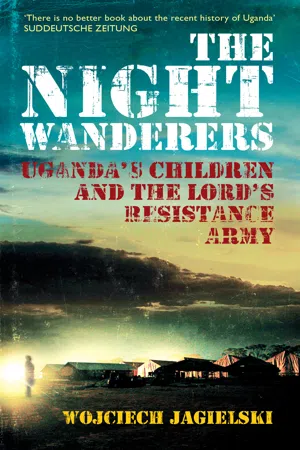
Each night during the civil war in northern Uganda, tens of thousands of children would head for the city centres, hoping to avoid capture by the Lord's Resistance Army - the infamous army led by Joseph Kony, itself composed largely of kidnapped children. The Night Wanderers masterfully evokes the post-war landscape of a country ravaged by decades of violence. It is a country of children who have been abducted from their homes and forced to kill their own family members; children who, even after they have escaped the LRA, carry the weight of their own acts of murder on their young shoulders. Through their stories, the author weaves the wider history of a beautiful but blood-soaked nation, from the end of British overrule through Idi Amin's brutal dictatorship up to today's precarious peace.
- 320 pages
- English
- ePUB (mobile friendly)
- Available on iOS & Android
eBook - ePub
About this book
Trusted by 375,005 students
Access to over 1.5 million titles for a fair monthly price.
Study more efficiently using our study tools.
Information
Topic
Personal DevelopmentSubtopic
African Historyone
IN GULU THE day was ending.
The town was hurriedly preparing for sleep, as usual in the rainy season, trying to get everything done in time before the storm erupted, which had been gathering in the darkening sky in swollen, angry clouds, only waiting for dusk to release all the rage accumulated during the scorching day.
Blazing hot, the town was dropping, starting to cool down and go quiet. Now with no regret the weary storekeepers were putting away the goods they hadn’t managed to sell in the course of the day. Grimy hired hands from the vulcanization workshop were swearing as they struggled to roll some gigantic tires the size of mill wheels back indoors. Set out on the sidewalk, they blocked the way, forcing passersby to slow down and stop for at least a moment, long enough to plant the seed of temptation to buy some new car wheels.
In the downtown area the offices were closing up. With a rattle and a bang, one after another the shutters were coming down on the stalls and workshops, hidden in the deep shade of arcades running the length of the low-rise buildings on the main street. The innkeepers were starting up their electricity generators, and the noise of them could be heard from all directions.
The imminent cloudburst was already palpable. It was as if heavy drops of warm rain were hanging in the air, ready to fall at any moment onto the dusty red earth and change it into slippery mud the color of blood. The sky was thundering louder and louder, bolder and nearer, and short, bright streaks of lightning were cutting across the clouds as they closed in on the town.
The citizens were vacating the downtown area to get home before the storm and the night. During storms the power supply was usually disconnected. Also, the troops stationed in the town preferred people not to hang around after dusk for no reason. It was easy to mistake them for guerrillas, who on dark, cloudy nights in the rainy season sometimes ventured out of their hiding places in the bush and came all the way into Gulu.
Jackson was waiting for me, as usual, at Franklin’s Inn on the main street. There he sat, perfectly still, leaning against a stone column. He was a journalist from the local radio station, King FM. Its office was located opposite the Acholi Inn where I was staying. In the afternoons, when he finished work we would meet at this place. I would order the beer, and Jackson would tell me things—about the wars, about kings past and present, good and bad, and about sorcerers and the spirits that interfered in people’s lives and influenced their fate. On Saturdays and Sundays we used to come to Franklin’s to watch soccer matches from the British league on a large television screen hung from the ceiling in the crowded, smoky bar.
Jackson didn’t move an inch, not even when I came up to his table. He looked tired and was plainly in no mood for talk.
The storm was circling above the town now, waiting for the right time and place to lunge and stun it with thunderclaps, lightning, and lashings of rain. The town was frozen still, as if afraid of being too distracted by the usual hustle and bustle to notice the tempest’s first strike. Crushed by its own weight, the sky was sinking lower and lower, as if trying to touch the ground.
Suddenly the wind, which was tugging at the palm trees just in sight beyond town, blew sand along the main street. Abruptly animated, shreds of old newspaper, bits of colored plastic, and yellowed grass went whirling across the cracked asphalt.
Jackson remained motionless, like a predatory animal holding its breath.
“Did you see that?” he asked.
I shrugged.
“But he flew past just over your head.”
“Who did?”
The first raindrops fell, spattering noisily on the roofs and the ground.

Then the children began to come into town.
They appeared suddenly, almost imperceptibly. They loomed out of the darkness, from under the ground like apparitions. They were heading on foot, by the dozen, from every direction, toward the almost deserted town, now plunged into silence before the storm. They walked confidently, not in a hurry, like someone repeating for the thousandth time an act that’s entirely familiar and no longer holds any mystery.
Some were dressed in school uniforms and had satchels full of textbooks and notepads on their backs. Others, in rags and barefoot, were carrying blankets, bundles and parcels of some kind, as well as sheets of newspaper and pieces of cardboard picked up from roadside ditches or gutters. The older children were leading smaller ones by the hand, and the girls had babies strapped to their backs, like village women on their way to work in the fields.
In the market square the gray river of children, quietly murmuring in the darkness, divided up into several smaller ones. The biggest offshoot turned toward the bus station, while a smaller one ended its journey in the courtyard of the large red-brick church of the Blessed Virgin Mary. Others continued to the yards of local schools and hospitals. The rest of the children ended their march on the main street, in the arcades outside the buildings, where they spread their makeshift beds on the ground.
Most of them were looking for a place to rest, and lay down to sleep at once before dusk fell, plunging the town into darkness. But some of the boys, yielding to the temptations of unlimited freedom, spent a long time running about shrieking, accosting the girls, and playing in the deserted streets, whose masters they became as soon as it was night.
Almost completely obscured by the increasing gloom, the street buzzed with chatter again. The voices wandered, now coming closer, now moving away. Outside the hardware store opposite someone burst into tears. In the empty bar at Franklin’s the television was on low, and through the open kitchen window you could hear the proprietor hustling the dishwashers, who after a long day’s work had no strength left to hurry.
Out of the pitch darkness of the street, some little girls appeared right by our table. Like moths, attracted by the dim streaks of light trickling from the bar, they quietly started laying their makeshift beds on the sidewalk, part of which Franklin’s had taken over. Ignoring the last late clients, they spread their bits of cardboard and blankets on the ground and lay down to sleep.
At the sight of them Jackson looked around vacantly, like someone who has lost his sense of time and stayed up terribly late. He put down his half-drunk bottle of beer and nodded to suggest we leave. Without even waiting for me to settle the check, he rose from the table and vanished into the night. As I followed him out of the circle of light, it took me quite a time to fish his figure out of the dark.
He was walking quickly down the middle of the street, facing ahead without glancing to either side, where the children were bedding down in the arcades. He didn’t look round at me or wait for me. As he passed the first cross street he increased his pace. Only then, as if lured by the sound of footsteps, several small figures loomed out of an arcade. Someone shouted insistently in a high-pitched child’s voice, and someone set off in pursuit, but almost instantly abandoned it. Jackson disappeared at the top of the street, and once again the sidewalk fell silent.
The next morning there wasn’t a trace of the children left.
The earth was going red in the sun again, but there were still some steaming puddles after the nocturnal downpour. Following the storm the air was crisp, bright, and translucent, and the green of the leaves and grass washed clean of dust was bursting with freshness, purity, and life.
Like every day, the main street was full of pedestrians and vendors, in a hurry to get the most important things done by noon, before everything surrendered to the heat again and was plunged into numb immobility—right through to evening.
At the street market by the church the village women, who flocked to Gulu at daybreak, were noisily touting fruits and vegetables set out for sale. From the nearby square, which was occupied by transport firms, buses full of passengers and luggage were setting off.
In the arcades outside Franklin’s Inn, waiters in aprons gone gray with age were putting out the tables and washing down the concrete sidewalk with buckets of water. At the bar, which could be seen from the street and where the television was on as usual, the first clients were already drinking coffee and smoking cigarettes.
I found Jackson at his office, where he was reviewing the morning cables from Kampala and the world outside. When I asked what was new he replied that there had been another bomb attack in Baghdad, and that as far as he could see, it looked as if things were getting worse there. But there was no news from Congo, where they’d just elected a new president and where I was meant to be going from Uganda. Neither bad reports of riots and armed rebellion, nor any encouraging ones either. This lack of news augured well for Congo, in Jackson’s opinion.
When I asked about last night and about the children in town, he didn’t seem to understand what I was talking about.
“Why do you think that’s strange?” he said, shrugging, without taking his eyes off the computer screen. “Are you going to Atiak today?”
That was the village he came from. He had been a teenager when the guerrillas, led by his favorite uncle, Vincent Otti, a former Ugandan army officer, attacked it ten years ago. Jackson remembered how Otti used to come to the village in full dress uniform, sit him on his knees, and let him try on his soldier’s cap with the stiff peak. When the rebels under his command attacked the village and murdered 350 of its inhabitants in the marketplace, Jackson’s parents sent him to relatives in Gulu, and themselves fled to one of the camps set up and protected by government troops. Otti’s brothers had fled from Atiak too, in fear of their neighbors’ revenge.
“Who where those children, the ones we saw last night?” I asked again.
“Children like any others,” he replied. “Do you want me to go with you? Because if I’m going, I must ask the boss if it’s all right with him…”
“I’m not going to Atiak, but to Palenga. You know that. So where did those children come from?”
“They came to town for the night, that’s all. What’s so strange about that?”
“They frightened you.”
“You’re talking crap.”
“It was plain to see. Were you really scared off by those children?”
“You don’t get it. Children are different here.”
“What does that mean?”
“They’re different. That’s all.”
At the Acholi Inn Hotel, past the lawn where dinner tables were put out in the evenings, there was a small swimming pool. Officers from the local garrison spent their Sunday afternoons there. They were small, with such youthful faces that in peaked caps sunk over their eyes, colored shirts, and light linen pants they looked nothing like soldiers. Rocking on wobbly high stools at the bar, they drank beer, smoked cigarettes, and chatted, louder and louder with every hour and every bottle, entirely absorbed in their conversation.
They only looked up and stopped talking when white women from the many charities based in Gulu appeared at the swimming pool. But the unconcealed, lustful curiosity they aroused soon made the women feel awkward; usually, after a short bathe and a few minutes in the sun on an uncomfortable recliner, they retreated to their hotel rooms.
Sitting nearby under a mango tree, I was waiting to be summoned by the adjutant of an important colonel from the garrison command. Whether I could meet with one of the guerrilla leaders who’d been captured and was reportedly being held in Gulu depended on his consent. Promising he’d introduce me, the adjutant had emphatically advised me not to set foot outside Gulu without arranging it in advance with the colonel. Although allegedly the guerrillas had slipped past the army and made their way as far as Sudan, they were conducting armed raids from there, and the district was still regarded as restless. He had told me to come to the swimming pool toward evening.
The important colonel I was supposed to meet was swimming in the pool. The rest of the soldiers were watching their commander swim and responding to the questions, comments, and jokes he offered from the water.
The colonel was a large, well-built man with a shaved head and very dark, almost black skin. His long gray shorts clung to his massive buttocks and thighs. He swam from end to end at a leisurely pace, hardly moving, as if floating on the water. Now and then, snorting and panting noisily, he turned from his belly onto his back, or from one side to the other, only to return to his former position a few minutes later.
Tired of waiting and of the murmur of conversation in a language I couldn’t understand, I started watching some gray bats hanging from a branch. At dusk they star...
Table of contents
- Cover
- Title Page
- Dedication
- Table of Contents
- one
- two
- three
- timeline of events
- About the Author
- Copyright
Frequently asked questions
Yes, you can cancel anytime from the Subscription tab in your account settings on the Perlego website. Your subscription will stay active until the end of your current billing period. Learn how to cancel your subscription
No, books cannot be downloaded as external files, such as PDFs, for use outside of Perlego. However, you can download books within the Perlego app for offline reading on mobile or tablet. Learn how to download books offline
Perlego offers two plans: Essential and Complete
- Essential is ideal for learners and professionals who enjoy exploring a wide range of subjects. Access the Essential Library with 800,000+ trusted titles and best-sellers across business, personal growth, and the humanities. Includes unlimited reading time and Standard Read Aloud voice.
- Complete: Perfect for advanced learners and researchers needing full, unrestricted access. Unlock 1.5M+ books across hundreds of subjects, including academic and specialized titles. The Complete Plan also includes advanced features like Premium Read Aloud and Research Assistant.
We are an online textbook subscription service, where you can get access to an entire online library for less than the price of a single book per month. With over 1.5 million books across 990+ topics, we’ve got you covered! Learn about our mission
Look out for the read-aloud symbol on your next book to see if you can listen to it. The read-aloud tool reads text aloud for you, highlighting the text as it is being read. You can pause it, speed it up and slow it down. Learn more about Read Aloud
Yes! You can use the Perlego app on both iOS and Android devices to read anytime, anywhere — even offline. Perfect for commutes or when you’re on the go.
Please note we cannot support devices running on iOS 13 and Android 7 or earlier. Learn more about using the app
Please note we cannot support devices running on iOS 13 and Android 7 or earlier. Learn more about using the app
Yes, you can access The Night Wanderers by Wojciech Jagielski in PDF and/or ePUB format, as well as other popular books in Personal Development & African History. We have over 1.5 million books available in our catalogue for you to explore.