This is, I believe, a moral tale. It goes far to prove the revolutionary axiom that if you wish to destroy a nation you must corrupt its currency. Thus must sound money be the first bastion of a society's defence.
In 1923, with its currency effectively worthless (the exchange rate in December of that year was one dollar to 4,200,000,000,000 marks), the Weimar Republic was all but reduced to a barter economy. Expensive cigars, artworks and jewels were routinely exchanged for staples such as bread; a cinema ticket could be bought for a lump of coal, and a bottle of paraffin for a silk shirt. In desperation, the Bavarian Prime Minister submitted a Bill to the Reichsrat proposing that gluttony be made a penal offence, his exact definition of a glutton being 'one who habitually devotes himself to the pleasures of the table to such a degree that he might arouse discontent in view of the distressful condition of the population'.
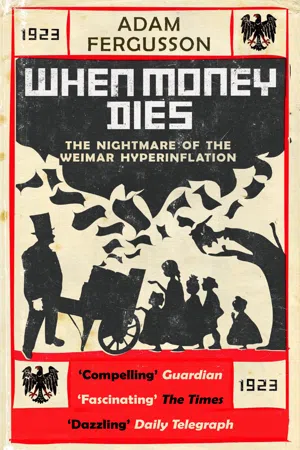
Since its first publication in 1975, When Money Dies has become the classic history of these bizarre and frightening times. Weaving elegant analysis with a wealth of eyewitness accounts by ordinary people struggling to survive, it deals above all with the human side of inflation: why governments resort to it, the dismal, corruptive pestilence it visits on their citizens, the agonies of recovery, and the dark, long-term legacy. And at a time of acute economic strain, it provides an urgent warning against the addictive dangers of printing money -- shorthand for deficit financing -- as a soft option for governments faced with growing unrest and unemployment.
- 283 pages
- English
- ePUB (mobile friendly)
- Available on iOS & Android
eBook - ePub
When Money Dies
About this book
Information
1: Gold for Iron
Just before the First World War in 1913, the German mark, the British shilling, the French franc, and the Italian lira were all worth about the same, and four or five of any were worth about a dollar. At the end of 1923, it would have been possible to exchange a shilling, a franc or a lira for up to 1,000,000,000,000 marks, although in practice by then no one was willing to take marks in return for anything. The mark was dead, one million-millionth of its former self. It had taken almost ten years to die.
The mark’s fall began gradually. In the war years, 1914-1918, its foreign exchange value halved, and by August 1919 it had halved again. In early 1920, however, although the cost of living had risen less than nine times since 1914, the mark had only one-fortieth of its overseas purchasing power left. There followed twelve months of nervous fluctuation, but then the mark sped downwards with gathering momentum, dragging social misery and political disruption in its wake. Not until 1923 did Germany’s currency at last go over the cliff-edge of sanity to which it had, as it were, clung for many months with slipping finger-tips. Pursuing the money of Austria and Hungary into the abyss, it crashed there more heavily than either.
The year 1923 was the one of galloping inflation when a kind of madness gripped Germany’s financial authorities and economic disaster overwhelmed millions of people. It was the year of astronomical figures, of ‘wheelbarrow inflation’, of financial phenomena that had never been observed before. The death of the mark in November 1923 came as a merciful release, for the events of the preceding eight months had ensured that the old mark could never recover. They ensured, too, that Germany would have to undergo appalling rigours of financial reconstruction such as might otherwise have been escaped. The reestablishment of monetary sanity, which bankrupted thousands, robbed millions of their livelihoods, and killed the hopes of millions more, indirectly exacted a more terrible price which the whole world had to pay.
The inflation of 1923 was so preposterous, and its end so sudden, that the story has tended to be passed off more as a historical curiosity, which it also undoubtedly was, than as the culmination of a chain of economic, social and political circumstances of permanent significance. It matters little that the causes of the Weimar inflation are in many ways unrepeatable; that political conditions are different, or that it is almost inconceivable that financial chaos would ever again be allowed to develop so far. The question to be asked – the danger to be recognised – is how inflation, however caused, affects a nation: its government, its people, its officials, and its society. The more materialist that society, possibly, the more cruelly it hurts. If what happened to the defeated Central Powers in the early 1920s is anything to go by, then the process of collapse of the recognised, traditional, trusted medium of exchange, the currency by which all values are measured, by which social status is guaranteed, upon which security depends, and in which the fruits of labour are stored, unleashes such greed, violence, unhappiness, and hatred, largely bred from fear, as no society can survive uncrippled and unchanged.
Certainly, 1922 and 1923 brought catastrophe to the German, Austrian and Hungarian bourgeoisie, as well as hunger, disease, destitution and sometimes death to an even wider public. Yet any people might have ridden out those years had they represented one frightful storm in an otherwise calm passage. What most severely damaged the morale of those nations was that they were merely the climax of unreality to years of unimagined strain of every kind. Financially, for nearly four years, the ultimate cataclysm was always just round the corner. It always arrived, and there was always an even worse one on its way – again, and again, and again. The speeches, the newspaper articles, the official records, the diplomatic telegrams, the letters and diaries of the period, all report month by month, year by year, that things could not go on like that any longer: and yet things always did, from bad to worse, to worse, to worse. It was unimaginable in 1921 that 1922 could hold any more terrors. They came, sure enough, and were in due course eclipsed, and more than eclipsed, with the turn of the following year.
To ascribe the despair which gripped those nations entirely to inflation would of course be misleading. In the winter of 1918-1919 all three underwent political revolutions, following the deprivations of wartime and crushing military defeat: so that conditions were fundamentally unfavourable to any revival of national spirit not rooted in revenge, and would have remained so even had the peace treaties permitted the losers to struggle however gradually to their economic feet. It is not always clear what events – what popular uprising, or Allied ultimatum, or political assassination – contributed to the inflationary panic; or which were themselves directly or indirectly caused by the ceaseless depreciation of the currency and rise in the cost of living.
Undoubtedly, though, inflation aggravated every evil, ruined every chance of national revival or individual success, and eventually produced precisely the conditions in which extremists of Right and Left could raise the mob against the State, set class against class, race against race, family against family, husband against wife, trade against trade, town against country. It undermined national resolution when simple want or need might have bolstered it. Partly because of its unfairly discriminatory nature, it brought out the worst in everybody – industrialist and worker, farmer and peasant, banker and shopkeeper, politician and civil servant, housewife, soldier, merchant, tradesman, miner, moneylender, pensioner, doctor, trade union leader, student, tourist – especially the tourist. It caused fear and insecurity among those who had already known too much of both. It fostered xenophobia. It promoted contempt for government and the subversion of law and order. It corrupted even where corruption had been unknown, and too often where it should have been impossible. It was the worst possible prelude – although detached from it by several years – to the great depression; and thus to what followed.
That is to put the inflation of early 1920s back again in its historical setting. From there, very probably, it is unwise to try too hard to prise it. After all, no one would argue strongly that the German inflation directly caused the world depression, nor even that it alone spawned Nazi Germany. Unquestionably it made the one the more unbearable and, as a contributary cause, made much easier the coming of the other. However, it is the purpose in the pages which follow not to predict by analogy a similar destiny for any industrialised, democratic nation in the grip of severe inflation, but rather, by recounting an extraordinary story, to present some of the evidence of what inflation may do to people, and what in consequence they may do to one another.
The origins of the German inflation are in some ways fundamental, in some ways incidental, to this theme. They were both internal and external. Even during the war, Germany’s financial arrangements were such as to permit the grossest monetary excesses by her national banking system. They were eventually to render post-war inflation uncontrollable, while the nature and presentation of the Entente’s reparation demands – the indemnity for the war – encouraged the activities of the printing presses to the utter exclusion of other, more desirable policies. Nor may it be overlooked that Germany’s industrialists ruthlessly drove their Government down the road to monetary doom.
Nevertheless, it was the natural reaction of most Germans, or Austrians, or Hungarians – indeed, as for any victims of inflation – to assume not so much that their money was falling in value as that the goods which it bought were becoming more expensive in absolute terms; not that their currency was depreciating, but – especially in the beginning – that other currencies were unfairly rising, so pushing up the price of every necessity of life. It reflected the point of view of those who believe the sun, the planets and the stars revolve with the moon around the earth.
In a lengthy interview many years afterwards with Pearl Buck, Erna von Pustau, whose father was a small Hamburg businessman who ran a fishmarket, made the same point: ‘We used to say “The dollar is going up again”, while in reality the dollar remained stable but our mark was falling. But, you see, we could hardly say our mark was falling since in figures it was constantly going up – and so were the prices – and this was much more visible than the realisation that the value of our money was going down … It all seemed just madness, and it made the people mad.’
In other words, the causes of the mark’s depreciation, which certainly escaped Germany’s politicians and bankers as well, had little enough to do with how the people, individually or collectively, reacted to it. Most of them clung to the mark, the currency they knew and believed in, long after the eleventh hour had come round for the umpteenth time. Most had no choice; but all were encouraged or bemused by the Reichsbank’s creed of Mark gleich Mark – paper or gold, a mark is a mark is a mark. If prices went up, people demanded not a stable purchasing power for the marks they had, but more marks to buy what they needed. More marks were printed, and more, and more. Inflation, already in its fourth year when revolution overthrew the old regime, added a new, overwhelming uncertainty to the many uncertainties that attended the birth of the Weimar Republic.
Although the German revolution originated as a military mutiny against the bungling of the Army’s leaders, and was bent upon getting rid of the officer caste who had brought military disaster upon the country, it had distinguishable economic origins as well. Support for the Soldiers’ Councils which were coming into being in every unit as the war drew to an end rested heavily on the personal financial calamities which so many of the soldiers and their families were already experiencing. Their frustrations had been eloquently aggravated by the arrival at the front in the spring of 1918 of a group of seasoned antiwar agitators – the leaders of the factory strikes which had ravaged the country after the Treaty of Brest-Litovsk with Communist Russia. The ruthlessly annexationist terms of that treaty were but another of the crass political mistakes – including the unrestricted submarine warfare that brought the United States into the battle, and the return of Lenin to Petrograd – which were made by the Great German General Staff of whom the Kaiser liked to regard himself the war lord. Through the late summer of 1918 defeatism and disaffection spread; and when defeat itself came the Army was torn in two, essentially between the professional soldiers and the conscripts.
The Supreme Command lost no time in exculpating itself in respect of losing the war. As the Kaiser fled to Holland, at least a week too late to save the monarchy in any form, and Ludendorff made off to Sweden, the odium of signing the Armistice was placed firmly on the head of the civilian authority. A month later, in December 1918, President Ebert at the Brandenburger Tor was welcoming the legions home with the words: ‘I salute you, who return unvanquished from the field of battle.’
The myth of the Dolchstoss, the stab in the back of the Army by the craven politicians and treacherous intellectuals behind the lines, was thereafter to be cultivated to the point when democratic political evolution was poisoned at its heart. This was a heavy burden for the new civilian government to bear, thrown unprepared and with an untried constitution into the deep end of democracy. Finding itself accepting the responsibility for a devastating defeat, and weak in human and material resources, it was miserably equipped to set to rights the financial and fiscal legacy of the purely and arrogantly militarist establishment which had run the war practically to the exclusion of politicians and economists.
Now the new Republic was saddled with the hatred of the Officer Corps as well, permanently generating Right-wing discontent and disruption during a period when Left-wing agitation in the wake of the Russian revolution was already as much as the government could cope with. The German revolution, as that in Austria, was a comparatively tame affair. True, as the Armistice commission completed its task, Berlin was in revolt, loyal troops going over hourly to the revolutionaries. True, too, that all twenty-two of Germany’s lesser royalty had been deposed even before the Kaiser’s formal abdication, Ludwig III of Bavaria hustling from the palace of the Wittelsbachs out into the fog and exile, with four daughters at his side and a box of cigars under his arm – a Soviet republic had already been declared in his patrimony. But the revolution had no other goals beyond the expulsion of the old order. There was neither barricade to man nor gun-fire to march towards.
The immediate turmoil therefore was among the nobility and the Officer Corps itself, acutely aware of its loss of status as a result of its war lord’s departure. The officers, who had once been a race apart, and were still outside the jurisdiction of civil courts, were to remember the revolution primarily as a popular outrage in which the nation’s warriors were repudiated and insulted by those they had protected. They perceived the country close to chaos, the social institutions for which they had fought crumbling away, disorganisation, frustration, hunger and want everywhere. Worse, the Bolsheviks, infiltrating and subverting, seemed to be taking over. There were clashes between Leftist forces and Army units at Aachen, Cologne, Essen and many other places. In Braunschweig a Soldiers’ and Workers’ Council, greeting a squadron of hussars returning from the front, was ridden down for its pains.
The critical point in the Army’s fortunes came a few hours before the Armistice was signed. The Spartakists – the German Bolsheviks who were to become the German Communist Party – were already massing in the streets of Berlin. The civilian power (in the person of President Ebert), already fearing that its democratic hours were numbered, struck a bargain with the German High Command (in the person of General Gröner) to co-operate in the suppression of Bolshevism, to restore order, and to maintain military discipline. It saved the Army: the Republican government, technically the revolutionary regime, instructed the Soldiers’ Councils to support their officers without reserve, and within three months the Weimar Assembly was meeting under military protection.
For a body of society who by its strategic ambitions and failures had brought Germany so low, the speed with which the Army effectually achieved the restitution of its privileged position of power was nothing short of remarkable. Although volunteer Free Corps were used both to protect the Weimar meeting and for the suppression of the Spartakist risings in March, by May 1919 the Army proper had been entirely reorganised, with 400,000 men trained in arms.
However, Germany’s failure had not been only in battle. The nation which had learnt before all others to make a virtue of war, and to exalt her warriors above all other professions, was bound to seek scapegoats when the end came. The myth that the Army was undefeated in the field was believed not only because Germany wanted to believe it but because, other factors being equal, military defeat was not credible. If what Hindenburg was coolly to term ‘the lamentable outcome of the war’ was not the fault of the Supreme Command, then it had logically to be the fault of someone or something else. Yet when the war was over and recriminations began it genuinely did not seem to occur to the Supreme Command, who had kept the civilian government largely in the dark about the true war prospects throughout the summer of 1918, that the breakdown of the military machine – that complex synthesis of munitions, men and morale – stemmed as much from economic mismanagement as anything else.
It may have been true – there is no reason to doubt it – that a short, sharp war and a speedy victory in 1914 had been both hoped for and expected. Together with the prospect of eventual war indemnities extorted from the Entente, this would possibly have justified taking temporary liberties, even outrageous ones, with the known laws of finance. The spoils of conquest might well have outweighed the losses of running an autarky for a short time: it was Germany’s stated intention to take over France’s colonies. Nevertheless, the fact that the same monetary policies were pursued without serious change not only when it was evident that no quick victory was possible (a matter about which the financial authorities may have been broadly ignorant), but when peace came and for years afterwards, would seem to discredit any notion that the German inflation began with a temporary expedient. However, although paper notes had been legal tender since 1910, that was indeed how it did begin: in part the natural result of having a self– willed Army itching for war and a Federal Parliament which, though with limited power over the country’s constituent states, still had to find the money to pay for it.
The first stage of inflation took place under the auspices of one Karl Helfferich, State Secretary for Finance from 1915 to 1917. Before 1914, the credit policy of the Reichsbank had been governed by the Bank Law of 1875, whereby not less than one-third of the note issue had to be covered by gold and the remainder by three-month discounted bills adequately guaranteed. In August 1914 action was taken both to pay for the war and to protect the country’s gold reserves. The latter objective was achieved by the simple device of suspending the redemption of Reichsbank notes in go...
Table of contents
- Cover
- Title Page
- Dedication
- Contents
- Note to the 2010 edition
- Prologue
- 1: Gold for Iron
- 2: Joyless Streets
- 3: The Bill Presented
- 4: Delirium of Milliards
- 5: The Slide to Hyperinflation
- 6: Summer of ’22
- 7: The Hapsburg Inheritance
- 8: Autumn Paper-chase
- 9: Ruhrkampf
- 10: Summer of ’23
- 11: Havenstein
- 12: The Bottom of the Abyss
- 13: Schacht
- 14: Unemployment Breaks Out
- 15: The Wounds are Bared
- Epilogue
- Bibliography
- Index
- Acknowledgements
- About the Author
- Copyright
Trusted by 375,005 students
Access to over 1.5 million titles for a fair monthly price.
Study more efficiently using our study tools.
Frequently asked questions
Yes, you can cancel anytime from the Subscription tab in your account settings on the Perlego website. Your subscription will stay active until the end of your current billing period. Learn how to cancel your subscription
No, books cannot be downloaded as external files, such as PDFs, for use outside of Perlego. However, you can download books within the Perlego app for offline reading on mobile or tablet. Learn how to download books offline
Perlego offers two plans: Essential and Complete
- Essential is ideal for learners and professionals who enjoy exploring a wide range of subjects. Access the Essential Library with 800,000+ trusted titles and best-sellers across business, personal growth, and the humanities. Includes unlimited reading time and Standard Read Aloud voice.
- Complete: Perfect for advanced learners and researchers needing full, unrestricted access. Unlock 1.5M+ books across hundreds of subjects, including academic and specialized titles. The Complete Plan also includes advanced features like Premium Read Aloud and Research Assistant.
We are an online textbook subscription service, where you can get access to an entire online library for less than the price of a single book per month. With over 1.5 million books across 990+ topics, we’ve got you covered! Learn about our mission
Look out for the read-aloud symbol on your next book to see if you can listen to it. The read-aloud tool reads text aloud for you, highlighting the text as it is being read. You can pause it, speed it up and slow it down. Learn more about Read Aloud
Yes! You can use the Perlego app on both iOS and Android devices to read anytime, anywhere — even offline. Perfect for commutes or when you’re on the go.
Please note we cannot support devices running on iOS 13 and Android 7 or earlier. Learn more about using the app
Please note we cannot support devices running on iOS 13 and Android 7 or earlier. Learn more about using the app
Yes, you can access When Money Dies by Adam Fergusson in PDF and/or ePUB format, as well as other popular books in Economics & Economic Theory. We have over 1.5 million books available in our catalogue for you to explore.