- 320 pages
- English
- ePUB (mobile friendly)
- Available on iOS & Android
eBook - ePub
About this book
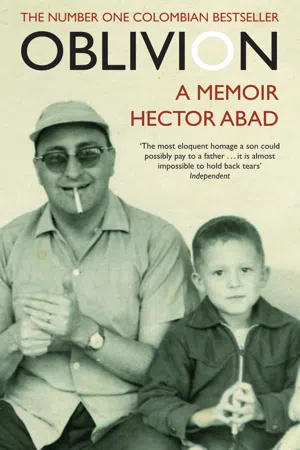
The Number One Colombian Bestseller Oblivion is a memorial to the author's father, Héctor Abad Gómez, whose criticism of the Colombian regime led to his murder by paramilitaries in 1987. A work of deep feeling and consummate skill, it paints an unforgettable picture of a man who followed his conscience and paid for it with his life, during one of the darkest periods in Latin America's recent history. Oblivion has been magnificently translated into English by Anne McLean, two-time winner of the Independent Prize for Foreign Fiction.
Information
And death comes
38
There is a trivial and undoubted truth, which is nevertheless important always to keep in mind: we are all going to die. The end result of all lives is the same. The presence and awareness of death is one of the most striking features of classic Spanish lyric poetry. Some of the best passages of literature speak of it with a beauty at once stark and moving, with that paradoxical solace the evocation of death has when dressed in the perfection of art: St John of the Cross, Cervantes, Quevedo … My father used to recite from memory some of Don Jorge Manrique’s Couplets on the Death of his Father so often on our long walks through the countryside, that I ended up learning them by heart as well, and I think they’ll accompany me, as they accompanied him, all my life, their marvellous rhythm pounding in my skull, with their perfect consoling melody that floats into our ears and thoughts from the deepest folds of a conscience trying to explain the inexplicable:
O let the soul her slumbers break
Let thought be quickened, and awake:
Awake to see
How soon this life is past and gone,
And death comes softly stealing on,
How silently!
Swiftly our pleasures glide away,
Our hearts recall the distant day
With many sighs;
The moments that are speeding fast
We heed not, but the past—the past,
More highly prize.
Onward its course the present keeps,
Onward its course the current sweeps,
Till life is done;
And, did we judge of time aright,
The past and future in their flight
Would be as one.
Let no one fondly dream again,
That Hope in all her shadowy train
Will not decay;
Fleeting as were the dreams of old,
Remembered like a tale that’s told,
They pass away.
Our lives are rivers, gliding free
To that unfathomed, boundless sea,
The silent grave!
Thither all earthly pomp and boast
Roll, to be swallowed up and lost
In one dark wave…
Thither the mighty torrents stray
Thither the brook pursues its way,
And tinkling rill.
There all are equal; side by side
The poor man and the son of pride
Lie calm and still.
We know we’re going to die, simply by virtue of being alive. We know the what (that we’ll die), but not the when, or the how, or the where. And although the ending is certain, inevitable, when what always comes to pass happens to another, we like to find out the very moment, and recount the intricacies of the how, and know the details of the where and conjecture about the why. Of all possible deaths there is one we can accept with resignation: dying of old age, in one’s own bed, after a full, intense and useful life. ‘Maestro Don Rodrigo Manrique, so famous and so valiant’ died like that, and so those couplets by his son, Don Jorge, although they tell of his father’s death, have not just a resigned but, in a certain sense, a happy ending. The father does not only accept his own death, but receives it with pleasure:
As thus the dying warrior prayed,
Without one gathering mist or shade
Upon his mind;
Encircled by his family,
Watched by affection’s gentle eye
So soft and kind;
His soul to Him, who gave it, rose;
God lead it to its long repose,
Its glorious rest!
And, though the warrior’s sun has set,
Its light shall linger round us yet,
Bright, radiant, blest.
Elderly, peacefully aware and surrounded by loved ones. That is the only death we can serenely accept and look back on with consolation. Almost all other deaths are odious, and the most unacceptable and absurd is that of a child or a young person, or the death caused by the murderous violence of another human being. We rebel at these, and the pain and rage, at least in my case, does not ease. I have never resigned myself to my sister’s death, nor have I ever been able calmly to accept my father’s murder. It is true that, in a way, he was satisfied with his life, and ready to die if necessary, but he despised the violent kind of death that was being planned for him. It is this that is most painful and most unacceptable. This book is an attempt to leave a record of that pain, a record at once useless and necessary. Useless because time does not run backwards and events do not change, but necessary at least for me, because my life and work would lack meaning if I did not write what I feel I have to write, and that in almost twenty years of trying have never been able to write, until now.
On Monday 24 August 1987, very early, around six-thirty in the morning, a radio station telephoned my father to tell him that his name was on a list of people who were being threatened in Medellín, people who, it said, would be killed. They read him the relevant paragraph: ‘Héctor Abad Gómez: President of the Antioquia Human Rights Defence Committee. Medic to guerrillas, false democrat, dangerous due to popular sympathy in upcoming Medellín mayoral elections. Useful idiot of the Communist Party.’ They interviewed my father on air and he asked them to read out some of the other names on the list. They did so. Among them were the journalist Jorge Child, the former Minister of Foreign Relations Alfredo Vásquez Carrizosa, the columnist Alberto Aguirre, the political leader Jaime Pardo Leal (assassinated a few months later), the writer Patricia Lara, the lawyer Eduardo Umaña Luna, the singer Carlos Vives, and many others. The only thing my father said was that he felt very honoured to be in the company of such fine and important people, who did so many good things for the country. After the interview, off the air, he asked the journalist to send a photocopy of the list to his office.
Ten days earlier, on 14 August, the left wing senator, Pedro Luis Valencia had been killed. He was also a doctor and a professor at the university, and my father organized and led a march ‘for the right to life’ on the 19th in protest at his murder. This huge march passed through the streets of Medellín in silence, culminating in Berrío Park, where my father gave the only speech. Many people saw it on television, or saw it pass by from the windows of their offices, and later told us what they’d thought: they’ll k ill h im too; they’re going to kill him. H is penultimate article was about that crime, a denunciation of the paramilitaries. He also gave a lecture in the Pontificia Bolivariana University where he accused the Army and government officials of complicity with the criminals.
That same Monday 24 August, at midday, he telephoned Alberto Aguirre at home (having been trying him all morning at his office) and convinced him to request a meeting with the mayor, William Jaramillo, to find out a little about the source of the threats, and maybe to ask for some protection; they arranged to meet on the Wednesday at eleven, in my father’s office. On the afternoon of the same day, the Human Rights Committee of Antioquia met and, given the gravity of the situation, decided to draft a press release denouncing the death squads and paramilitary groups that were operating in the city and killing people linked to the university. Present at this meeting, among others, were Carlos Gaviria, Leonardo Betancur and Carlos Gónima. Leonardo and my father were murdered the next day; Carlos Gónima, a few months later, on 22 February; Carlos Gaviria escaped with his life by fleeing the country.
At the end of this meeting, Carlos Gaviria asked my father how seriously he was taking the personal threat that he’d spoken of on the radio. My father invited him to stay and talk for a while so he could tell him. He opened a small bottle of whisky in the shape of a bell (which Carlos took away empty and still keeps in his study as a memento), read him the list they’d sent him, and, while he acknowledged that the threat was serious, repeated that he felt very proud to be in such fine company: ‘I don’t want to be killed, far from it, but maybe it wouldn’t be the worst of deaths; and if they do kill me, it might serve some purpose.’ Carlos went home feeling distressed.
Several times, during those days, my father spoke of death in an ambiguous tone that seemed somewhere between resignation and fear. He had reflected a lot, and over a long period, on his own death. One of the few short stories he ever wrote dealt with this theme, with death’s mythical figure, an old woman dressed in black with a scythe over her shoulder, who visits him once, but grants him a stay of execution. Among the papers I organized after his death, and published under the title Manual of Tolerance, I found this reflection: ‘Montaigne said that philosophy was useful because it taught us how to die. For me, closer to the last stage than the first in this birth-to-death process we call life, the subject of death is becoming ever simpler, more natural and I’d even say – not as a subject but as a reality – more desirable. And it’s not that I am disillusioned with anything or anybody. Maybe just the opposite. Because I think I have lived fully, intensely, sufficiently.’
He was undoubtedly prepared to die, but this does not mean he wanted to be killed. In an interview he’d given that same week, he was asked about death or, rather, about the possibility that he would be killed, and he answered: ‘I am very satisfied with my life and I don’t fear death, but I still have many joys: being with my grandchildren, tending to my roses and conversing with my wife. Yes, while I do not fear death, I don’t want to be killed either: I want to die surrounded by my children and grandchildren, calmly … A violent death must be terrifying, I wouldn’t like it at all.’
39
That Tuesday 25 August my eldest sister and I got up at dawn to go to La Inés, the farm south east of Medellín by the River Cauca that my father had inherited from Grandpa Antonio. We were having a pool put in and it was due to be finished that day. Since there was no road to the house, we’d asked our neighbour Doña Lucía de la Cuesta for permission to let the workers bring the iron posts and building materials for the pool across the pastures of her farm, Kalamarí. The Suzuki jeep loaded with cement and stones had made so many trips that a little path had formed across the field, and Maryluz and I went along there to meet the work crew. For the first time we saw the pool filled with water, and we felt happy in anticipation of all the enjoyment it would give us. We were back in Medellín before noon. My sister had brought my father two big passion fruits as a gift: they were the first from a vine he’d planted in the garden a few months earlier.
Maryluz wanted to give him a surprise in December, when we planned to spend the holidays at the farm, so she didn’t want to tell him over lunch that day where they’d built the pool – whether it was behind or in front of the house – and she told him a little white lie as well, to add to the surprise: that there hadn’t been enough money to knock down a low wall my father didn’t like that enclosed a narrow porch. Doña Lucía de la Cuesta phoned around noon, to tell my father that since the pool was now completed, she was withdrawing the permission to drive across her land, since if we carried on doing so, it would turn into a right of way. My father asked her if she wouldn’t even let him drive in by himself in December and Lucía said, in a friendly tone, no, he was quite fit and could get there on horseback. ‘And what about when I’m old and can’t get ride any more?’ my father persisted, and Lucía said: ‘That’s a long way off, Héctor. We’ll see when the time comes.’ Doña Lucía herself told me this conversation word for word, years later. Everyone who spoke to him that day has a clear and precise memory of it.
At that time my father was in the running for Liberal Party mayoral candidate; that year would be the first time in Colombia that mayors would be directly elected, and on the Thursday my father had arranged a luncheon meeting at the Rionegro farm with Dr Germán Zea Hernández, who was coming from Bogotá to try to get the Liberal candidates to agree to back a single name. Bernardo Guerra, president of the Liberal Directorate, was opposed to my father’s nomination, though he had the best chance of winning, and had even refused to attend the Thursday lunch at the farm. My mother had been cooking and making preparations for that lunch since Tuesday. Another of my sisters, Vicky, was preparing to host a meal at her house on the Friday; the dissident Liberal leaders would all attend, among them her former boyfriend, Álvaro Uribe Vélez, then a senator. In spite of his personal naïveté in political matters, my father had good intuition about people who might be able to rise to the top. In the last interview he gave, and which was published posthumously in El Espectador in November 1987, he declared the following: ‘At this moment I like Ernesto Samper Pizano and Álvaro Uribe Vélez; they have good proposals.’ Years later both would become president of Colombia.
That same Tuesday, the morning of the 25th, Luis Felipe Vélez, head of the Antioquia teachers’ guild, was murdered on the doorstep of the union headquarters. My father was outraged. Many years later, in a book published in 2001, Carlos Castaño, ringleader of the paramilitaries for more than ten years, would confess how the group he led in Medellín, in consultation with Army intelligence, assassinated, among many other victims, Senator Pedro Luis Valencia, in front of his small children, as well as the leader of the teachers’ union, Luis Felipe Vélez. They accused both of being kidnappers.
At midday on that Tuesday, as they drove home for lunch together, my mother told us later how my father had been trying to get news about the Luis Felipe Vélez crime, but that every station had nothing on but football. For my father the excess of sports news was the new opiate of the masses, what kept them numb, unaware of what was really going on, and he’d written about this on several occasions. In the car with my mother, he had punched the steering wheel and said angrily: ‘The city’s going to ruin, but they won’t talk about anything except football.’ My mother says that he was shaken that day, with a mixture of rage and sadness, almost on the verge of despair.
That same morning, 25 August, my father had spent some time at the Facul...
Table of contents
- Cover
- Title Page
- Dedication
- Epigraph
- Table of Contents
- A boy hand in hand with his father
- A doctor against pain and fanaticism
- Religious wars and an enlightened antidote
- Travels to the East
- Happy Years
- Marta
- Two Funerals
- Years of Struggle
- Car Accidents
- Human and Right
- Opening the drawers
- And death comes
- Friends in Exile
- Oblivion
- About the Author
- Copyright
Trusted by 375,005 students
Access to over 1.5 million titles for a fair monthly price.
Study more efficiently using our study tools.
Frequently asked questions
Yes, you can cancel anytime from the Subscription tab in your account settings on the Perlego website. Your subscription will stay active until the end of your current billing period. Learn how to cancel your subscription
No, books cannot be downloaded as external files, such as PDFs, for use outside of Perlego. However, you can download books within the Perlego app for offline reading on mobile or tablet. Learn how to download books offline
Perlego offers two plans: Essential and Complete
- Essential is ideal for learners and professionals who enjoy exploring a wide range of subjects. Access the Essential Library with 800,000+ trusted titles and best-sellers across business, personal growth, and the humanities. Includes unlimited reading time and Standard Read Aloud voice.
- Complete: Perfect for advanced learners and researchers needing full, unrestricted access. Unlock 1.5M+ books across hundreds of subjects, including academic and specialized titles. The Complete Plan also includes advanced features like Premium Read Aloud and Research Assistant.
We are an online textbook subscription service, where you can get access to an entire online library for less than the price of a single book per month. With over 1.5 million books across 990+ topics, we’ve got you covered! Learn about our mission
Look out for the read-aloud symbol on your next book to see if you can listen to it. The read-aloud tool reads text aloud for you, highlighting the text as it is being read. You can pause it, speed it up and slow it down. Learn more about Read Aloud
Yes! You can use the Perlego app on both iOS and Android devices to read anytime, anywhere — even offline. Perfect for commutes or when you’re on the go.
Please note we cannot support devices running on iOS 13 and Android 7 or earlier. Learn more about using the app
Please note we cannot support devices running on iOS 13 and Android 7 or earlier. Learn more about using the app
Yes, you can access Oblivion by Hector Abad Faciolince in PDF and/or ePUB format, as well as other popular books in Social Sciences & Social Science Biographies. We have over 1.5 million books available in our catalogue for you to explore.