eBook - ePub
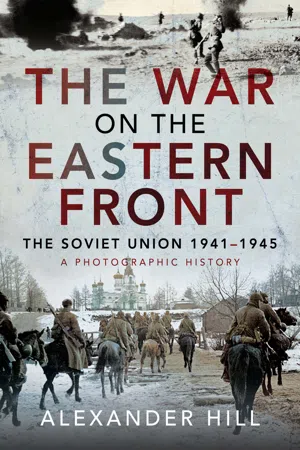
The War on the Eastern Front
The Soviet Union, 1941-1945 - A Photographic History
- 336 pages
- English
- ePUB (mobile friendly)
- Available on iOS & Android
eBook - ePub
About this book
The RIA-Novosti press agency – now known as Sputnik in the West – has one of the best archives of Soviet Second World War photographs and for this remarkable book Alexander Hill has made a superb selection of them. These striking images record vividly, as only photographs can, the brutal conflict on the Eastern Front and the extraordinary experience of the soldiers and civilians who were caught up in it. Every aspect of the struggle is depicted – the fighting on the front lines and behind the lines, aerial combat and naval warfare, the ordeal of living under German occupation, the war industries and Lend-Lease and the massive sacrifices made at every level of Soviet society to defeat the Germans. The photographs and captions take the reader through the entire course of the war, from the Nazi-Soviet Pact and Soviet expansion into Poland, Finland and the Baltic Republics, through Operation Barbarossa and the German advances of 1941 and 1942, to the momentous battles at Stalingrad and Kursk and the sequence of massive offensives mounted by the Red Army that drove the Wehrmacht back to Berlin. The landscapes over which the armies moved, and the shattered towns and cities they left behind, are recorded as are individuals whose faces were captured by the camera during this devastating conflict over seventy years ago.
Information
Subtopic
Military & Maritime HistoryIndex
HistoryChapter 1
The Red Army Prepares for War
The Great Patriotic War of the Soviet Union of 1941–1945 was fought by a Soviet Red Army that in many senses had been preparing for war for more than a decade when the German-led Axis invasion began on 22 June 1941. Although it was the October Revolution and Civil War in Russia of 1917–1921 that brought the Bolsheviks to power, in some ways the real revolution or a second revolution in Russia took place under Stalin. The collectivisation of agriculture and rapid industrialisation of the Soviet Union under Stalin undoubtedly led to a revolutionary transformation in the lives of many Soviet citizens, and particularly the peasantry, for whom many authors suggest that collectivisation of agriculture brought about a second serfdom. This second revolution not only advanced the goals of the October Revolution in leading to a growth in the proletariat or urban working class, but also in strengthening Soviet power. The collectivisation of agriculture in the Soviet Union that began in earnest in 1929 was geared to paying for industrialisation, and industrialisation was to a considerable extent about military power. In February 1931 Stalin gave what has become a famous and seemingly prescient speech to industrial managers, in which he pointed out:
One feature of the history of Old Russia was the continual beating she suffered because of her backwardness. She was beaten by the Mongol Khans. She was beaten by the Turkish beys. She was beaten by the Swedish feudal lords. She was beaten by the Polish and Lithuanian gentry. She was beaten by the British and French capitalists. She was beaten by the Japanese barons. All beat her – because of her backwardness: because of her military backwardness, cultural backwardness, political backwardness, industrial backwardness, agricultural backwardness. They beat her because it was profitable and could be done with impunity …
That is why we must no longer lag behind …
We are fifty to a hundred years behind the advanced countries. We must make good this distance in ten years. Either we do it, or they crush us. [GPW, p. 9]
Although the Soviet Union still lacked concrete threats at this point beyond a vague notion that the capitalist powers would seek to undermine it, the expansion of Soviet military capabilities need not only have had a defensive purpose, but could also have allowed the Soviet Union to spread revolution by force of arms should conducive circumstances arise. Such an eventuality was something considered in the economic planning process – a powerful Red Army would be valuable regardless of the circumstances. Ultimately, according to Marxist-Leninist theory, the Russian Revolution would only be secure if there was revolution elsewhere, and the Soviet Union was committed to helping that along. Japanese expansion in the Far East, starting with Manchuria in 1931, soon gave the Soviet Union a concrete threat to focus on, although the Japanese threat alone was hardly existential. What was to become existential was the threat from fascism in Europe, and in particular the threat from a Nazi Germany that made it plain that eastward expansion was on its agenda, and that the Treaty of Versailles was not going to impede its territorial ambitions.
By 1936 the Red Army was arguably the most powerful army in Europe, although the purges launched against the Red Army and wider Soviet society in 1936–1938 did much to undermine gains that had been made. It is in many ways ironic that purges launched to supposedly make Stalin’s regime more secure in the face of largely imagined foreign-backed internal opposition did so much to weaken the Red Army at the end of the 1930s. Perhaps fortunately for the Soviet Union, war with Nazi Germany was delayed by the signing of the Nazi-Soviet Pact and associated protocols of August–September 1939. Although during the spring of 1941 the Red Army was in the throes of expansion and reorganisation, it was back on a track towards greater military effectiveness. This improvement was thanks to some soul searching about the Red Army’s performance in some of the small wars it was involved in during the late 1930s and 1940, and particularly the war with Finland of 1939–1940. These small wars preceding the Great Patriotic War will be considered in Chapters 2 and 3. This first chapter takes us more broadly through the 1930s and up to 1941 in visually highlighting key elements in the development of the Red Army and Soviet preparations for future war during the period prior to the beginning of the Great Patriotic War.

Sputnik 28932. It is perhaps appropriate that in this first photograph captured First World War-vintage ‘Rikardo’ Type B tanks (British Mark Vs) of the Red Army are shown on parade in Red Square on 7 November 1930 – the date of the 13th anniversary of the Russian Revolution according to the new post-revolutionary calendar. The First World War had been the final factor weakening the Tsarist regime in Russia to such an extent that it collapsed. That at the beginning of the new decade the Red Army was using such tanks in a parade highlights just how far behind the British and French the Soviet Union was at the start of the 1930s in terms of the development of armoured vehicles. At this time Weimar Germany was not allowed tanks under the Treaty of Versailles of 1919, although was secretly involved in developing tanks with the Soviet Union after Germany and the Soviet Union had come to terms under the 1922 Treaty of Rapallo. The Soviet Union’s Tsarist predecessor had fought the First World War without any tanks at all – with the first tanks seeing action on Russian soil during the 1917–1921 Russian Civil War. Nonetheless, at the time this photograph was taken the first of the Soviet Union’s Five-Year Plans was under way, and mass production of the first Soviet tanks was on the horizon. Stalin – now clearly the Soviet Union’s leader – was determined that the Soviet Union would be able not only to defend itself, but perhaps even export its revolution abroad by force of arms. What the Soviet Union would also develop during the early 1930s was a military doctrine in which the new tanks would play a central role as the Red Army moved from relying on cavalry as the principle manoeuvre arm, to the tank.

Sputnik 21824. Here cavalry of the Central Asian Military District are shown on the move somewhere in Kazakhstan in 1932. Despite the development of tanks, the cavalry would continue to rival the armoured forces within the Red Army in terms of prestige until the mid-1930s. Cavalry had proven well-suited to the manoeuvrings of the Russian Civil War when the railway and the horse had proven so essential for all sides. Cavalry also proved valuable in the post-Civil War Red Army for many reasons, including the fact that many of the Red Army’s territorial and regular forces were more familiar with the horse than the combustion engine, where most recruits were poorly educated peasants. Cavalry also proved valuable in the counter-insurgencies conducted by Soviet forces during the interwar period, including against the Basmachi resistance movement that was initially largely neutralised on Soviet soil in the early 1920s but that saw a resurgence in the late 1920s and early 1930s. Basmachi forces were able to briefly operate against the Soviet Union from Afghan territory at the end of the 1920s, during the suppression of which Soviet cavalry operated within northern Afghanistan.

Sputnik 87898. A key proponent of the cavalry arm within the Red Army was Semen Budennii, pictured here as Marshal of the Soviet Union in June 1938 as the so-called ‘Great Purges’ raged within Soviet society and the Red Army. Budennii’s hostility towards Marshal Mikhail Tukhachevskii – who was an early victim of the purges of the Red Army in June 1937 – was not something that Budennii concealed, and seems to have at least in part been as a result of Tukhachevskii’s support for the mechanisation of the Red Army as part of the development of the concepts of ‘Deep Battle’ and ‘Deep Operations’. ‘Deep Battle’ – and its larger-scale compatriot ‘Deep Operations’ – shared much with the later much-vaunted German Blitzkrieg, whereby tanks, supported by artillery, aircraft and even airborne forces, would punch through enemy defences and break into the rear, where they would paralyse the enemy response to the offensive operations. Despite the deaths of Tukhachevskii and many of his colleagues, Budennii was unable to halt the mechanisation of the Red Army even if his position within the chain of command no doubt played a part in the continued importance of the cavalry arm in the Red Army into the Great Patriotic War.

Sputnik 3324617. The Soviet armed forces in 1930 were not only dependent on equipment manufactured before the revolution in terms of tanks and other equipment for the army, but also for naval forces. Here ‘Novik’ Class destroyers are shown with what appears to be a Polikarpov R-1 aircraft on manoeuvres during the summer of 1930. These vessels had been built or laid down by the Tsarist regime, with the Bolsheviks completing a number of such vessels after the revolution. In 1930 Bolshevik naval power was limited to the Baltic and Black Seas, but the 1930s would see the emergence of flotillas that would become fleets in both the north and Far East. Although ambitious Soviet plans for naval development during the 1930s would not come to fruition because increasing attention had to be paid to the readying of ground and air forces for war on the Eurasian landmass, the Soviet Navy would by the start of the Great Patriotic War be equipped with a mixture of ships of both Tsarist and Soviet construction. The Polikarpov aircraft in the photo was one of the first mass-produced aircraft in the Soviet Union, although it was derived from flyable British Airco/ de Havilland D.H.4 aircraft captured during the Russian Civil War. The 1930s would see the mass production of genuinely Soviet aircraft.

Sputnik 60300. By 1936 the Red Army had been, particularly materially, transformed. Tanks such as the T-26s shown here on exercises in the spring of that year in the Krasnoiarsk region in Siberia were available in their thousands. More than a thousand early T-26s had been produced by the end of the First Five-Year Plan in 1932, with 1936 alone seeing the manufacture or completion of just over 1,300 more [RASWW, p. 37]. Whether the tanks and their crews – as part of formations of increasing size – were capable of putting ‘Deep Operations’ or even ‘Deep Battle’ into effect was, however, another matter. Notice the rail-like aerial around the turret on the lead and second tanks in this picture. Most of the remaining tanks lack radio communications, meaning that communication between the command tanks and the remainder of the unit would mean reliance on visual signals. If a command tank was to be knocked out, in all probability a unit would be unable to communicate with its headquarters. Commun...
Table of contents
- Cover
- Title
- Copyright
- Content
- Acknowledgements
- Foreword, by David Stahel
- Introduction
- ‘Wait for me’, by Konstantin Simonov
- 1. The Red Army Prepares for War
- 2. Preludes to the Main Event: the Soviet Union’s Small Wars of the 1930s
- 3. Débâcles in Poland and Finland
- 4. ‘Barbarossa’
- 5. On the Moscow Axis
- 6. Leningrad Besieged
- 7. The Soviet Navy at War
- 8. Counterattack: the Soviet Winter Offensive of 1941–1942
- 9. In the Enemy Rear: the Soviet Partisan Movement
- 10. Soviet Women and the War Effort
- 11. ‘All for the Front!’: the Soviet Rear
- 12. ‘Not a Step Back!’: Stalingrad and the Caucasus
- 13. The Turning Tide: German Defeat in the South
- 14. The Bitter Road back to Smolensk and Beyond
- 15. From Kursk to the Dnepr
- 16. Allied Aid and the Soviet War Effort
- 17. The Axis Undermined: from the Ukraine to Romania and Hungary
- 18. ‘Bagration’: from Minsk to Warsaw
- 19. The Air War: the Soviet Air Forces Ascendant
- 20. The War in the North: from the Barents Sea to the Baltic
- 21. From the Vistula to the Oder
- 22. The Prize: the Battle for Berlin
- 23. Finishing off the Axis: the Soviet Union against Japan
- 24. Counting the Cost, Reconstruction and Commemoration
- Notes
- Further Reading
Trusted by 375,005 students
Access to over 1.5 million titles for a fair monthly price.
Study more efficiently using our study tools.
Frequently asked questions
Yes, you can cancel anytime from the Subscription tab in your account settings on the Perlego website. Your subscription will stay active until the end of your current billing period. Learn how to cancel your subscription
No, books cannot be downloaded as external files, such as PDFs, for use outside of Perlego. However, you can download books within the Perlego app for offline reading on mobile or tablet. Learn how to download books offline
Perlego offers two plans: Essential and Complete
- Essential is ideal for learners and professionals who enjoy exploring a wide range of subjects. Access the Essential Library with 800,000+ trusted titles and best-sellers across business, personal growth, and the humanities. Includes unlimited reading time and Standard Read Aloud voice.
- Complete: Perfect for advanced learners and researchers needing full, unrestricted access. Unlock 1.5M+ books across hundreds of subjects, including academic and specialized titles. The Complete Plan also includes advanced features like Premium Read Aloud and Research Assistant.
We are an online textbook subscription service, where you can get access to an entire online library for less than the price of a single book per month. With over 1.5 million books across 990+ topics, we’ve got you covered! Learn about our mission
Look out for the read-aloud symbol on your next book to see if you can listen to it. The read-aloud tool reads text aloud for you, highlighting the text as it is being read. You can pause it, speed it up and slow it down. Learn more about Read Aloud
Yes! You can use the Perlego app on both iOS and Android devices to read anytime, anywhere — even offline. Perfect for commutes or when you’re on the go.
Please note we cannot support devices running on iOS 13 and Android 7 or earlier. Learn more about using the app
Please note we cannot support devices running on iOS 13 and Android 7 or earlier. Learn more about using the app
Yes, you can access The War on the Eastern Front by Alexander Hill in PDF and/or ePUB format, as well as other popular books in History & Military & Maritime History. We have over 1.5 million books available in our catalogue for you to explore.