The third edition of Archaeological Research introduces the basic methods of archaeological research, including data collection, analysis, and interpretation, as well as considering the state of the field today.
With new sections on curating archaeological collections and public archaeology, the third edition also adds a new chapter on the analysis of metals and glass. This popular, concise textbook examines approaches to the archaeological record, sampling and research design, survey and excavation methods and strategies, recordkeeping, dating and analysis of archaeological materials, and the professional practice of archaeology.
Archaeological Research continues to be an excellent text for undergraduate students in basic archaeology courses, field methods courses, and field schools.
Archaeologists do research all over the world, but regardless of where they work they follow a standard process for conducting research. This process consists of five separate phases: Asking questions, building models, collecting data, analyzing data, and evaluating results. Each takes different amounts of effort and money (asking questions, for example, may only take a moment of free thought, while analyzing data may take years and cost thousands of dollars), but all are vital to reading the archaeological record. In this chapter, I’ll try to introduce you to each phase of the archaeological research process using examples from my own research and training.
1.1 Phase I: Asking Questions
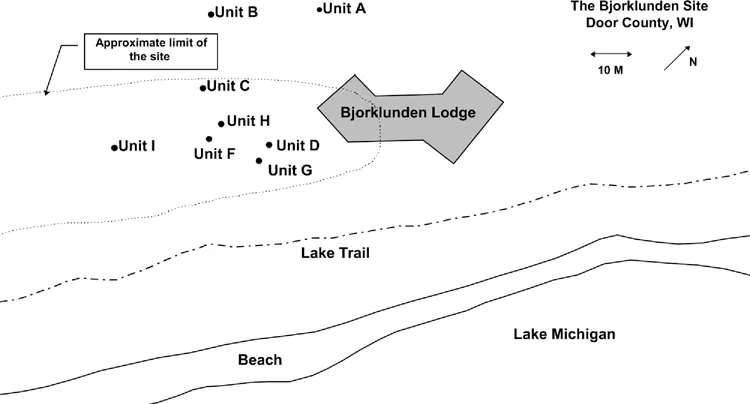
All archaeological research begins with questions. One morning during the summer I started working for Lawrence University I was sitting on my front porch when the phone rang. It was Lawrence’s president. Now, when you are a junior faculty member in a new job and your president calls you at home, it’s usually not a good thing. So, after the pain from the scalding hot coffee I spilled all over myself subsided and I started actually listening, I was pleased to hear that the president was not calling to tell me that they had made a mistake and I wasn’t actually hired, but because he had an archaeological question for me. Lawrence had just broken ground for a new conference facility on property the university owns in Door County, Wisconsin. Some artifacts had been found there, and the president wanted to know if I would take a look at the site. I agreed, and a new archaeological research project was born—the Bjorklunden Archaeological Survey. (Bjorklunden, pronounced “be-york-lun-den”, is the name of the property and supposedly means birch forest in Norwegian.)
This might seem a bit different from how I said archaeological projects begin—asking questions—but it’s actually pretty common. Here, I didn’t ask a question but was asked to look at a site. This happens all the time on construction projects because there are often legal reasons that archaeological work has to be done before construction can begin. We’ll talk about that later. The important point here is that my work, as an archaeologist, began not when the president asked me to visit Bjorklunden, but after I visited the site and saw that it was indeed a likely location for prehistoric habitation. At that point, I asked a fundamental archaeological question: “Is there a preserved and recoverable record of human behavior at this location?” I also asked a number of secondary questions, such as “What types of material might be preserved here?” and “What peoples likely lived here, and what kind of archaeological record would they have left?” These are the kinds of simple questions that start many archaeological projects.
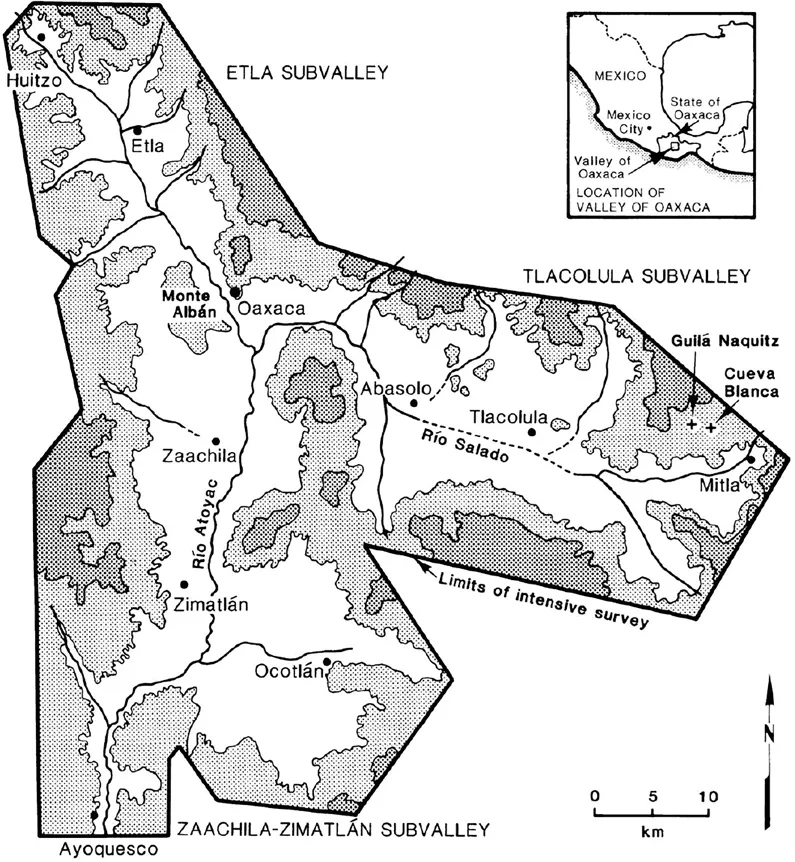
Of course, other projects start with much more sophisticated or specific questions in mind. As a graduate student, I was lucky enough to come in on the tail end of one of the most significant archaeological projects ever undertaken: The Valley of Oaxaca (pronounced “wa-ha-ka”) Settlement Pattern Project. My mentor, Richard Blanton, was the project’s principal investigator, and my dissertation research (and indeed much of what I have done since graduate school) focused on questions stemming from the project and its findings.1 A powerful state evolved in the Valley of Oaxaca, centered at a site called Monte Albán, and the Valley of Oaxaca Settlement Pattern Project was designed to answer the question: “Why did the Monte Albán state evolve?” That question really had three parts, all of which required answers: “Why did the state evolve?” “Why did it evolve at Monte Albán and not elsewhere?” and “Why did it evolve when it did, not earlier or later?”2
These questions are much more specific than the ones I had starting research at Bjorklunden but recognize that they are preceded by a substantial understanding of the existing archaeological record. Indeed, the Valley of Oaxaca was chosen specifically as a research locale because it (1) was a place where a state evolved that (2) had a reasonably well-understood archaeological record that (3) was easily accessible through archaeological survey. Thus, the question of state origins started the whole project. Once the question was framed, a location where answers could be found was sought, and that location turned out to be the Valley of Oaxaca.
Figure1.1 Excavation units at Bjorklunden.
Figure1.2 The Valley of Oaxaca, Mexico, showing survey boundaries.
These two examples illustrate the two major types of questions asked by archaeologists: Descriptive and processual. Descriptive questions ask about the nature of the archaeological record and can be thought of as questions that start with who, what, when, or where. They ask what material is present, what the state of preservation is, when the material was deposited, and, ultimately, who made the material. Answers to descriptive questions often lead to a culture history, which is a history of the cultures that inhabited a particular location or region. Processual questions assume that a location’s culture history is known and move beyond it to ask how and why the culture history takes the form it does. In other words, processual questions ask about the processes of cultural stability and change over time. Most archaeologists find processual questions the most interesting to pursue, but I hope it’s clear that descriptive questions have to be asked—and answered—before processual ones can be addressed.
1.2 Phase II: Building Models
Once a question has been posed, archaeologists begin to devise model answers to the question, or more simply, models. Model answers for descriptive questions are based on two fundamental assumptions: (1) The archaeological record accurately preserves the material remains of human behavior and (2) human behavior can be accurately reconstructed from its material remains. There has been considerable discussion and criticism of these two assumptions, and we will spend part of the next chapter examining them more closely. Suffice it to say that almost all archaeologists accept them, and most archaeological work directed at answering descriptive questions proceeds under a fairly generic model.
Model answers for processual questions are based on some theory of human behavior. In archaeology, two schools of theory predominate: Materialist and eco-functional. Materialist theories posit that the way humans organize labor and technology to get resources out of the material world is the primary force shaping culture. Major forces promoting change are innovations in technology, environmental changes or catastrophes, and internal conflicts over labor organization and access to resources. Eco-functional theories posit that human culture is an adaptation to the environment, and thus, culture functions to maintain humans and the environment in a sustainable balance. The major force promoting change, then, is the environment itself—as the environment changes, so do human cultures. However, a basic assumption in many eco-functional theories is that human population has an overall tendency to grow, and this often puts pressure on resources and the environment as a whole—pressure that leads to change. I hope it is obvious that these two schools of theory are closely related and that both share a common focus on the environment and how humans use it. This should not be all that surprising, given that the best information we can get from the archaeological record is about human interaction with the natural world.
While some model answers for processual questions aim at broad processes like those just mentioned—human use of or interaction with the environment—most are aimed at evaluating very specific theories within those larger schools. The Valley of Oaxaca project was directed toward evaluating an eco-functional theory proposed by the agricultural economist Esther Boserup. Boserup suggested that as population grows in societies that practice agriculture, the society will find ways to intensify agricultural production to support the growth.3 Thus, cultural change is seen as stemming from population growth. As population increases, the society will have to innovate to continue to support itself. Archaeologist William Sanders applied this idea to the rise of the Teotihuacan state in the Valley of Mexico, arguing that the state evolved as a way to centrally control the agricultural economy and intensify production to support a growing population.4 The Valley of Oaxaca project was designed to test this idea in a different location and, in other words, to replicate the findings from the Valley of Mexico.
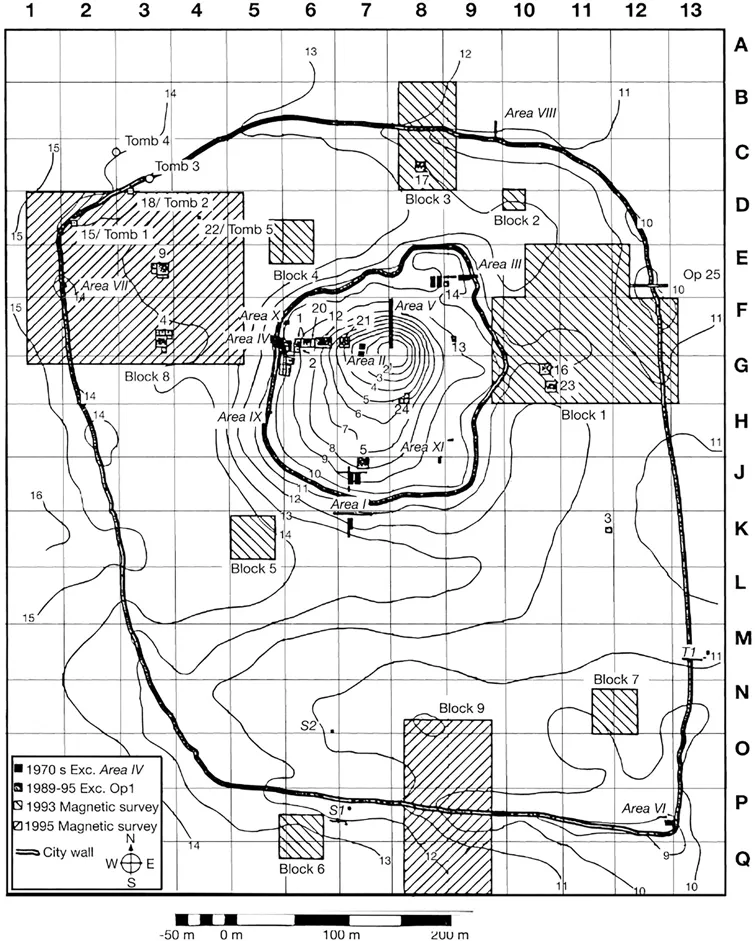
Figure1.3 Excavation units and survey areas at Tell es-Sweyhat.
The basic model used in the Valley of Oaxaca project was a population growth one, based on Boserup’s theory. The model answer to the question “Why did the state evolve?” was that population grew to the point where a state was required to control the agricultural economy. The model answer to “Why did it evolve at Monte Albán and not elsewhere?” was that Monte Albán was located on prime agricultural land where production could easily be centralized and intensified. The model answer to “Why did it evolve when it did, not earlier or later?” was that it evolved when population reached a point where it could no longer be intensified without centralized control. Based on these model answers, the project team developed a series of hypotheses or predictions for how the archaeological record should look. Most fundamentally, they suggested, was that there should be evidence of population growth through time, particularly right before the founding of the Monte Albán state. Once that primary hypothesis was established, a clear set of variables that needed data became obvious, the most obvious being data on changes in population density through time in the Valley. Thus, the question led to a model answer that told the archaeologists precisely what data needed to be collected. This is how most scientific research is done (it’s called the “hypothetico-deductive” approach) and is how the archaeological research process is supposed to work.
Of course, many projects are not so clear-cut in being directed at answering a particular descriptive or processual question or in having such a specific model answer. For example, in the 1990s, I worked on a project with colleagues at the University of Pennsylvania Museum and the Semitic Museum at Harvard University trying to understand settlement in part of a large Early Bronze Age city in northern Mesopotamia called Tell es-Sweyhat (pronounced “sway-hot”).5 The city was divided, as are virtually all northern Mesopotamian cities, into an inner town or acropolis containing a palace and temple complex and elite residences, and an outer town containing workshops and common residences. Little work had been done in the outer towns of northern Mesopotamian cities. We knew, in general, what to expect in the outer town of Tell es-Sweyhat, but many descriptive questions remained. Our primary question, however, was a processual one concerning the political and economic relationship between residents in the inner and outer towns. Clearly, the residents of the inner town were supported by the craftspeople and agricultural workers who lived in the outer town, but what was the nature of their relationship? How did the residents of the inner town “earn” support? Why did residents of the outer town support elites in the inner town?
Our model answers for both the descriptive and processual questions were based on prior research and theory. We knew something about the archaeological record in outer towns from other excavations, and we also knew something about it from Bronze Age documents. We had several bodies of theory on the relationship between elites and commoners in early cities like Tell es-Sweyhat, and the basic model we took from them was that elites provided military and religious services to the commoners who were basically coerced to support them, but who also willingly gave support for the military defense provided by the city and for the supernatural services provided through the temple complex. Our main hypothesis, then, was that clear distinctions would be present in the activities taking place in the inner versus the outer town, with the inner town focused on military and religious activities and the outer town on craft and agricultural production. We needed to gather a variety of data, then, on settlement patterns and residential activities in order to answer both our descriptive and processual questions.
1.3 Phase III: Collecting Data
The outer town of Tell es-Sweyhat covers roughly 40 hectares and the archaeological deposits are more than a meter deep. How do we go about collecting a variety of data on settlement patterns and residential activities over such a large area? We can’t possibly excavate that whole area, and indeed, since all of the information is buried, we can’t even tell where the most informative data are buried—we don’t know where to dig. The Valley of Oaxaca researchers faced an even larger problem: How to gather information on changes in population density over an area of more than 2,000 square kilometers! But, archaeologists are always faced with these problems. Even my fairly simple project at Bjorklunden had archaeological deposits that covered an area at least several football fields in size. So, how do archaeologists know where to start? How do they collect data over such large areas? There are three basic methods used, and which one is employed on a given project depends on the data required to answer a particular question. The three methods are pedestrian survey, test excavation, and remote sensing.
Pedestrian survey is the primary way archaeologists find archaeological deposits. All archaeologists know that pedest...
Table of contents
Cover
Half Title Page
Title Page
Copyright Page
Dedication
Table of Contents
About the Author
List of Figures
List of Tables
Preface
Acknowledgments
1 The Archaeological Research Process
2 The Archaeological Record
3 Measurement and Sampling
4 Survey Methods and Strategies
5 Excavation Methods and Strategies
6 Recordkeeping
7 Dating Archaeological Materials
8 Lithic Analysis
9 Ceramic Analysis
10 Analysis of Metals and Glass
11 Floral and Faunal Analysis
12 Presenting Results and Curating Collections
13 Historic Preservation and the Practice of Archaeology
Glossary
Index
Trusted by 375,005 students
Access to over 1.5 million titles for a fair monthly price.
Study more efficiently using our study tools.
Frequently asked questions
Yes, you can cancel anytime from the Subscription tab in your account settings on the Perlego website. Your subscription will stay active until the end of your current billing period. Learn how to cancel your subscription
No, books cannot be downloaded as external files, such as PDFs, for use outside of Perlego. However, you can download books within the Perlego app for offline reading on mobile or tablet. Learn how to download books offline
Perlego offers two plans: Essential and Complete
Essential is ideal for learners and professionals who enjoy exploring a wide range of subjects. Access the Essential Library with 800,000+ trusted titles and best-sellers across business, personal growth, and the humanities. Includes unlimited reading time and Standard Read Aloud voice.
Complete: Perfect for advanced learners and researchers needing full, unrestricted access. Unlock 1.5M+ books across hundreds of subjects, including academic and specialized titles. The Complete Plan also includes advanced features like Premium Read Aloud and Research Assistant.
Both plans are available with monthly, semester, or annual billing cycles.
We are an online textbook subscription service, where you can get access to an entire online library for less than the price of a single book per month. With over 1.5 million books across 990+ topics, we’ve got you covered! Learn about our mission
Look out for the read-aloud symbol on your next book to see if you can listen to it. The read-aloud tool reads text aloud for you, highlighting the text as it is being read. You can pause it, speed it up and slow it down. Learn more about Read Aloud
Yes! You can use the Perlego app on both iOS and Android devices to read anytime, anywhere — even offline. Perfect for commutes or when you’re on the go. Please note we cannot support devices running on iOS 13 and Android 7 or earlier. Learn more about using the app
Yes, you can access Archaeological Research by Peter Peregrine in PDF and/or ePUB format, as well as other popular books in Social Sciences & Archaeology. We have over 1.5 million books available in our catalogue for you to explore.