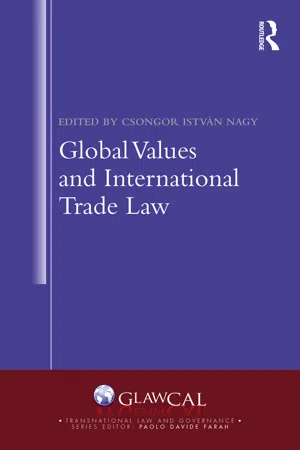
Exploring the relationship and interaction between economic interests and normative non-trade values, this book argues that the emergence and development of non-trade values is based on a complex dialectic interaction between selfish economic interests and normative values, and examines how their structural interdependence has given rise to a remarkable evolution in international trade. Conceiving this relationship as an intricate dialectic one that is neither purely value-driven, nor purely economic-interest-driven, it addresses the emergence, function, and role of non-trade values in international trade with a synthetizing approach and explores the results of their interaction in international economic intercourse. Approaching the non-trade issues of trade in a holistic manner, the book demonstrates that trade can operate smoothly only if it is framed by an architecture of normative value standards and international trade liberalization has reached the level where further development calls for cooperation also in fields that, at first glance, may appear to be non-trade in nature.
- 256 pages
- English
- ePUB (mobile friendly)
- Available on iOS & Android
eBook - ePub
Global Values and International Trade Law
Part I Cross-cutting value standards in international tradeHuman rights, labor standards, and environmental protection
1 Business meets human rightsDo we need an international treaty to close the gap?
DOI: 10.4324/9781003080398-3
Nóra Chronowski
1.1 Introduction
The main objective of Business and Human Rights (BHR) discussion is to expand somehow the (international) human rights obligations to multinational enterprises (MNEs), transnational companies (TNCs), and other business entities. Its antecedent was the concept of Corporate Social Responsibility (CSR),1 though BHR is more than CSR as the former goes beyond self-regulation and tries to create enforceable duties for companies and establish the grounds for their accountability for human rights violations. The objective is to formulate non-trade values (human rights) as respectable legal obligations for the actors of international trade: to make explicit that human rights abuses have their price even in the business sector. It is not an initiative of the 21st century; it has been a recognized challenge since the late 1980s. In the last decades, however, a range of research projects, books, and articles applying a multidisciplinary approach have been devoted to the topic.2 Such discussions were fuelled by the UN instruments adopted in the field.
To understand BHR, this chapter analyzes the actions and instruments of the United Nations, which are to date of a voluntary nature; not even belonging to international soft law, they may be assessed as a kind of conceptualized policy. The 2011 UN Human Rights Council’s Guiding Principles on Business and Human Rights (UNGP), destined to implement the UN “Protect, Respect and Remedy” Framework, was the first to set a global standard for addressing the risk of adverse impact on human rights linked to business activity. Since the UNGP is not a non-binding instrument, in 2014, the UN Human Rights Council set up an intergovernmental working group to work out a binding international instrument – a treaty on BHR – regulating the human rights aspects of the activities of transnational corporations. In the meantime, the national constitutional laws of countries did not change regarding the concept of limited and indirect third party – or horizontal – effect of fundamental human rights and did not remove the limits of extraterritorial jurisdiction in human rights litigation. To demonstrate it, the chapter sums up two landmark cases from US jurisdiction: the US Supreme Court in Kiobel v. Royal Dutch Petroleum (2013) and Jesner v. Arab Bank (2018), which narrowed down the room for litigation under the Alien Tort Statute, hence signaling the shrinking availability of remedies under national law against multinational corporations’ human rights violations. This chapter addresses, in the context of the foregoing background, the points of intersection and the clash between business and human rights, such as, which enterprises should be covered by international rules, how can direct applicability to enterprises be ensured, and how to formulate extraterritorial jurisdiction in business and human rights matters?
1.2 The BHR (hi)story
While economy, trade, and business are globalized to a great extent, the enforcement of human rights law has remained largely local and governed by national constitutional laws.3 According to Tomuschat, the international community has attained the positive international protection of human rights in three theoretical and historical stages. The first step is reaching a consensus with respect to the necessity of protection and the scope of the rights to be protected. The second stage is international codification, putting it into a treaty and into national adoption. The third stage is establishing and operating a mechanism for the enforcement of rights. Even the universalist approach admits that whilst the first two steps have, by and large, been taken successfully, the third – and perhaps most important phase – has not yet been accomplished.4 In addition, the system of international protection must be treated as a dynamic system; it has to be continuously adjusted to the changing state of global reality (handling terrorism, crime, flow of data, environmental disasters, global warming, pandemics, economic and financial crises, ethnic tensions, etc.).
The global developments over the past decades have seen non-state actors such as transnational corporations and other business entities play an increasingly important role both internationally, but also at national and local levels. As the UN Human Rights High Commissioner formulates the phenomenon in respect of business,
The growing reach and impact of business enterprises have given rise to a debate about the roles and responsibilities of such actors with regard to human rights. International human rights standards have traditionally been the responsibility of governments, aimed at regulating relations between the state and individuals.55 http://www.ohchr.org/EN/Issues/Business/Pages/BusinessIndex.aspx.
In Ruggie’s words,
The root cause of the business and human rights predicament today lies in the governance gaps created by globalization – between the scope and impact of economic forces and actors, and the capacity of societies to manage their adverse consequences. These governance gaps provide the permissive environment for wrongful acts by companies of all kinds without adequate sanctioning or reparation. How to narrow and ultimately bridge the gaps in relation to human rights is our fundamental challenge.66 John Ruggie, Protect, Respect and Remedy – A Framework for Business and Human Rights, 3(2) Innovations 189–212, 189 (2008), http://www.mitpressjournals.org/doi/pdf/10.1162/itgg.2008.3.2.189.
Many scholars have pointed out that MNEs can infringe human rights directly or indirectly. The infringement is direct, if the enterprise uses child or forced labor, does not guarantee safety and health precautions, or establishes inhuman working conditions (like in sweatshops), discriminates on the bases of gender, race, sexual identity, belonging to an ethnic or religious minority in the workplace, pollutes the environment, etc. Indirectly, typically during armed conflicts or by supporting autocratic or totalitarian regimes, ...
Table of contents
- Cover
- Half-Title
- Series
- Title
- Copyright
- Contents
- List of contributors
- Foreword: Global values and international trade law
- Introduction: Global values and international trade law
- PART I Cross-cutting value standards in international tradeHuman rights, labor standards, and environmental protection
- PART II The protection of intellectual property
- PART III Investment protection
- Index
Trusted by 375,005 students
Access to over 1.5 million titles for a fair monthly price.
Study more efficiently using our study tools.
Frequently asked questions
Yes, you can cancel anytime from the Subscription tab in your account settings on the Perlego website. Your subscription will stay active until the end of your current billing period. Learn how to cancel your subscription
No, books cannot be downloaded as external files, such as PDFs, for use outside of Perlego. However, you can download books within the Perlego app for offline reading on mobile or tablet. Learn how to download books offline
Perlego offers two plans: Essential and Complete
- Essential is ideal for learners and professionals who enjoy exploring a wide range of subjects. Access the Essential Library with 800,000+ trusted titles and best-sellers across business, personal growth, and the humanities. Includes unlimited reading time and Standard Read Aloud voice.
- Complete: Perfect for advanced learners and researchers needing full, unrestricted access. Unlock 1.5M+ books across hundreds of subjects, including academic and specialized titles. The Complete Plan also includes advanced features like Premium Read Aloud and Research Assistant.
We are an online textbook subscription service, where you can get access to an entire online library for less than the price of a single book per month. With over 1.5 million books across 990+ topics, we’ve got you covered! Learn about our mission
Look out for the read-aloud symbol on your next book to see if you can listen to it. The read-aloud tool reads text aloud for you, highlighting the text as it is being read. You can pause it, speed it up and slow it down. Learn more about Read Aloud
Yes! You can use the Perlego app on both iOS and Android devices to read anytime, anywhere — even offline. Perfect for commutes or when you’re on the go.
Please note we cannot support devices running on iOS 13 and Android 7 or earlier. Learn more about using the app
Please note we cannot support devices running on iOS 13 and Android 7 or earlier. Learn more about using the app
Yes, you can access Global Values and International Trade Law by Csongor István Nagy in PDF and/or ePUB format, as well as other popular books in Law & Law Theory & Practice. We have over 1.5 million books available in our catalogue for you to explore.