This book explores the intersection between artificial intelligence and two intellectual property rights: copyright and patents. The increasing use of artificial intelligence for generating creative and innovative output has an impact on copyright and patent laws around the world. The book aims to map and analyse that impact.
The author considers how artificial intelligence systems may aid, or in some cases substitute for, human creators and inventors in the creative process. It is from this angle that the copyright and patent regimes in four jurisdictions (Europe, the United States, Australia and Japan) are investigated in depth. The author describes how these jurisdictions look at works and inventions generated through a process where artificial intelligence is present or prevalent, and examines how copyright and patent regimes should adapt to the reality of artificially intelligent creators and inventors.
As the use of artificial intelligence to generate creative and innovative products becomes more common, this book will be a valuable resource to researchers, academics and policy makers alike.
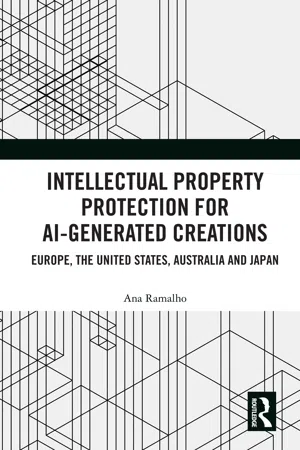
eBook - ePub
Intellectual Property Protection for AI-generated Creations
Europe, United States, Australia and Japan
- 10 pages
- English
- ePUB (mobile friendly)
- Available on iOS & Android
eBook - ePub
Intellectual Property Protection for AI-generated Creations
Europe, United States, Australia and Japan
About this book
1 Introduction
DOI: 10.4324/9780367823290-1
AI has a profound impact on society, including the way people work, create and socialize. Indeed, businesses can significantly improve their services by using it. Yet, behind the hype, there are serious limitations. AI tends to require too many repetitive tasks to be feasible, and it requires too much human labour to become mainstream. In the long run, as business process workers transition to human employees, their number may be reduced due to automation.
I didn’t write that first paragraph, save for the first sentence in bold. Since this is a book about artificial intelligence (AI) systems and their creations, I thought it only polite to give them the first word. The paragraph was written – following the prompt of the sentence in bold – by Talk to Transformer, a neural network that completes text.1 Coincidentally, one of the main goals of this book is to investigate whether AI systems’ creations and inventions require a human being – and if so to what extent they do, and how that impacts copyright and patent laws (or, in Talk to Transformer’s version, whether AI “requires too much human labour to become mainstream”).
Talk to Transformer <https://app.inferkit.com/demo> accessed 3 June 2021.
The term “artificial intelligence” can be used to describe either a scientific field or a technology. This book deals mainly with the latter, although a couple of approaches and techniques from the field of AI as a scientific discipline – such as machine learning techniques – will be mentioned where relevant to explain the workings of the underlying technology. The topic of the book stands at the intersection of AI in the sense just mentioned, and two intellectual property fields: copyright and patents. The starting premise is that the intervention of AI in the process of creation of works or inventions has an impact on, respectively, copyright and patent laws (although that impact might not be the same in the two legal disciplines because copyright and patents function differently in terms of, e.g., requirements for protection). Creation of works by, or with the help of, AI systems raises questions of autonomy (i.e., how autonomous an AI is in creating works and inventions, and the relation that autonomy has to human input), and of how copyright and patent laws treat and should AI-generated content.
To be sure, the general idea of making machines that can mimic human thought and behaviour has been around since antiquity.2 It is the increase in computer power, together with developments in AI technology and access to more training datasets, that has kick-started a new AI era.3 The pervasiveness of AI systems and applications has in turn prompted many policymakers to address the impact of AI on several areas, including copyright and patents. For example, as recently as October 2020, the European Parliament has even classified it a priority in the area of intellectual property law to assess intellectual property rights in light of the “growing autonomisation of certain decision-making processes [that] can give rise to technical or artistic creations,” with the objective of fostering “an environment conducive to creativity and innovation by rewarding creators.”4
Mizuki Hashiguchi, ‘The Global Artificial Intelligence Revolution Challenges Patent Eligibility’ (2017) 13 J Bus & Tech 1, 7: “In Greek mythology, the masterful Hephaestus built a gigantic robot that patrolled the island of Crete, monitoring whether laws were properly implemented. Hephaestus even created intelligent tables that automatically supplied food and drinks. During the Italian Renaissance, Leonardo da Vinci drew mechanical lions that moved autonomously. One of them was designed to present a cluster of beautiful lilies” (footnotes omitted). See also, on how AI has been around for a long time, Ryan Calo, ‘Artificial Intelligence Policy: A Primer and a Roadmap’ (2017) 1–2 <https://papers.ssrn.com/sol3/papers.cfm?abstract_id=3015350> accessed 3 June 2021; Peter Stone and others, ‘Artificial Intelligence and Life in 2030. One Hundred Year Study on Artificial Intelligence: Report of the 2015–2016 Study Panel’ (2016) 50–52 <http://ai100.stanford.edu/2016-report> accessed 3 June 2021. Michael McLaughlin, ‘Computer Generated Inventions’ (2018) 8–9, <https://papers.ssrn.com/sol3/papers.cfm?abstract_id=3097822> accessed 3 June 2021.
See e.g., Explanatory Statement to the European Parliament (Committee on Legal Affairs), ‘Report on Intellectual Property Rights for the Development of Artificial Intelligence Technologies’ (2020/2015(INI)) 12 <www.europarl.europa.eu/doceo/document/A-9-2020-0176_EN.pdf> accessed 29 May 2021.
Ibid. Note that already in 2017 the European Parliament had adopted a Resolution with recommendations to the Commission on Civil Law Rules on Robotics, where it called on the Commission to “support a horizontal and technologically neutral approach to intellectual property applicable to the various sectors in which robotics could be employed.” The explanatory statement accompanying the Resolution clarified in that context that “the elaboration of criteria for “own intellectual creation” for copyrightable works produced by computers or robots is demanded.” See European Parliament Resolution of 16 February 2017 with Recommendations to the Commission on Civil Law Rules on Robotics (2015/2103(INL)). <www.europarl.europa.eu/sides/getDoc.do?type=TA&language=EN&reference=P8-TA-2017-0051> accessed 3 June 2021.
Chapters 2 and 3 will analyse in-depth, respectively, AI and copyright protection, and AI and patent protection. Each chapter starts by exploring the way in which AI can generate products that, if created by humans, would likely qualify as, correspondingly, copyright protected works and patentable inventions. New AI applications emerge every day, so the chapters will offer some illustrative examples that can help paint a picture of AI capabilities in the realm of works and inventions, but they do not purport to be exhaustive.
Next, each chapter examines the justifications for granting copyright or patent protection, as such rationales can provide a sound basis for discussing whether protection should be available. In other words, only by considering the underlying justifications for copyright and patent protection can a grounded conclusion be reached regarding whether AI-generated content should be protected by copyright and patent laws.
The following section of each chapter analyses relevant elements related to copyright and patent protection in four jurisdictions: Europe,5 United States (US), Australia and Japan. The criteria for the choice of these specific jurisdictions were wide geographic area coverage, balance of common law and civil law countries, and advancement of AI developments, both from a technological and legal perspectives. The relevant elements explored were chosen according to their relevance to the question of protection (or lack thereof) of AI-generated content, and vary from one chapter to the other, due to differences between copyright and patent law. For copyright, the elements selected for analysis, which will be examined in relation to which jurisdiction, were protected subject matter (including conditions for protection, such as originality), authorship and other forms of protection, like neighbouring rights regimes, where applicable. For patent, the analysis will focus on patentable subject matter; the patentability requirement of inventive step or non-obviousness; the requirement of enablement or sufficient disclosure of the invention; inventorship; and other forms of protection such as utility model or similar regimes, where applicable.
For copyright, the analysis will focus on European Union (EU) law in the field of copyright. The EU has played a fundamental role in the harmonisation of copyright laws of the member states. For patents, because there is no horizontal harmonisation of patent law at the EU level, the jurisdiction analysed will be Europe, and the basis for analysis will be the European Patent Convention of 5 October 1973 (EPC), which is a multilateral treaty rather than an EU instrument.
Other elements of copyright and patent law regimes, while relevant for the broader topic of AI and intellectual property, are outside the scope of this book. One example is the issue of ownership, which differs from rules of authorship and inventorship. This is because this book seeks to investigate the legal status of AI creations, which include who the creator might be; ownership questions, while relevant, bring little to this discussion. This book will also not examine the protection available for the AI system itself, since the goal is to zoom in on output created by the AI system, but not the AI system itself.
Chapter 4 wraps up with some conclusions and recommendations. Building upon the previous Chapters, it will be highlighted that both copyright and patent laws require a human creator, and that the key question then becomes which type of human contribution to an AI-generated work or invention can give rise to authorship or inventorship claims. Specific recommendations in relation to future policy- and law-making in copyright and patents will also be recalled, and patterns that emerge from those recommendations – namely, the possibility of creating new rights to protect AI-generated content – will be further analysed. These recommendations are, to the extent possible, jurisdiction-agnostic, as the idea is to aim for an alignment of the different jurisdictions. Patent and copyright laws exist against the background of some level of international harmonisation (which is in place due to several treaties and conventions6); building on the work of that harmonisation and continuously monitoring the development of national or regional laws is key, since harmonisation increases legal certainty and trust of users in the patent- and copyright legal systems.7 Chapter 4 will finish by highlighting some points of attention for policymakers, which may also amount to possible topics for other research. These will consist of exceptions that can accommodate machine learning (since AI creation of works and inventions is dependent on a previous stage of machine learning), ownership issues and moral rights.
See e.g., on patents the Paris Convention for the Protection of Industrial Property (1883) and the Patent Cooperation Treaty (1970); on copyright, the Berne Convention for the Protection of Literary and Artistic Works (1886) and WIPO Copyright Treaty (1996); and on both patents and copyright, the Agreement on Trade-Related Aspects of Intellectual Property, or TRIPS Agreement (1994).
This has been highlighted recently, in relation to patents, by the President of the European Patent Office, ‘Update of Legal Aspects of Artificial Intelligence and Patents’ (October 23, 2020) 2<www.epo.org/modules/epoweb/acdocument/epoweb2/468/en/CA-PL_5-20_en.pdf> accessed 3 June 2021): “Continuous monitoring of the technical developments and exchange of policies and practices between the patent offices and beyond contributes to aligning practices and increases legal certainty for the users of the patent system.”).
References
Primary sources
Agreement on Trade-Related Aspects of Intellectual Property (1994)
Berne Convention for the Protection of Literary and Artistic Works (1886)
European Parliament (Committee on Legal Affairs), ‘Report on Intellectual Property Rights for the Development of Artificial Intelligence Technologies’ (2020/2015(INI)) <www.europarl.europa.eu/doceo/document/A-9-2020-0176_EN.pdf> accessed 29 May 2021
European Parliament Resolution of 16 February 2017 with Recommendations to the Commission on Civil Law Rules on Robotics (2015/2103(INL))<www.europarl.europa.eu/sides/getDoc.do?type=TA&language=EN&reference=P8-TA-2017-0051> accessed 3 June 2021
European Patent Convention (1973)
Paris Convention for the Protection of Industrial Property (1883)
Patent Cooperation Treaty (1970)
WIPO Copyright Treaty (1996)
Secondary sources
Calo R, ‘Artificial Intelligence Policy: A Primer and a Roadmap’ (2017) <https://papers.ssrn.com/sol3/papers.cfm?abstract_id=3015350> accessed 3 June 2021
Hashiguchi M, ‘The Global Artificial Intelligence Revolution Challenges Patent Eligibility’ (2017) 13 J Bus & Tech 1
McLaughlin M, ‘Computer Gener...
Table of contents
- Cover
- Half Title Page
- Title Page
- Copyright Page
- Dedication Page
- Contents
- Acknowledgements
- 1 Introduction
- 2 AI and copyright protection
- 3 AI and patent protection
- 4 Conclusion and future outlook
- Index
Trusted by 375,005 students
Access to over 1.5 million titles for a fair monthly price.
Study more efficiently using our study tools.
Frequently asked questions
Yes, you can cancel anytime from the Subscription tab in your account settings on the Perlego website. Your subscription will stay active until the end of your current billing period. Learn how to cancel your subscription
No, books cannot be downloaded as external files, such as PDFs, for use outside of Perlego. However, you can download books within the Perlego app for offline reading on mobile or tablet. Learn how to download books offline
We are an online textbook subscription service, where you can get access to an entire online library for less than the price of a single book per month. With over 1.5 million books across 990+ topics, we’ve got you covered! Learn about our mission
Look out for the read-aloud symbol on your next book to see if you can listen to it. The read-aloud tool reads text aloud for you, highlighting the text as it is being read. You can pause it, speed it up and slow it down. Learn more about Read Aloud
Yes! You can use the Perlego app on both iOS and Android devices to read anytime, anywhere — even offline. Perfect for commutes or when you’re on the go.
Please note we cannot support devices running on iOS 13 and Android 7 or earlier. Learn more about using the app
Please note we cannot support devices running on iOS 13 and Android 7 or earlier. Learn more about using the app
Yes, you can access Intellectual Property Protection for AI-generated Creations by Ana Ramalho in PDF and/or ePUB format, as well as other popular books in Law & Law Theory & Practice. We have over 1.5 million books available in our catalogue for you to explore.