Over the past half a century, the world has experienced rapid changes. Indeed, during this time, the world economy is estimated to have expanded nearly 4.5 times, which can be translated to mean continuous annual average growth of over 3 per cent worldwide.1 But behind this trajectory, ideas about development have been in a state of constant flux, with influential thinkers driving a never-ending evaluation of development discourse – incorporating theories of modernisation, endogenous growth, globalisation and neoliberalism, among others.2
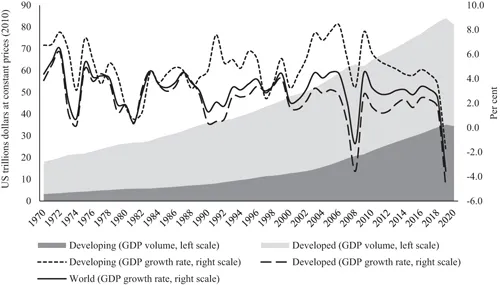
The upward trend in aggregate economic growth has also been associated with diverse experiences depending on the context and level of development (see Figure 1.1).3 For instance, economies of developed countries have expanded over the same period at about three times larger in gross domestic product (GDP). In terms of per capita GDP, this group reached US$39,185 in 2020, which is nearly four times greater than the world average of US$10,891. Their contribution to global economic growth was about 57 per cent in 2020, although this had shrunk by 25 percentage points, from 82 per cent recorded in 1970.
Likewise, many developing countries have also made remarkable progress in sustaining positive growth over the last five decades, while also improving their performance in social indicators such as health and education. Real GDP volume in developing countries increased by 1,067 per cent between 1970 and 2020, which is about 2.5 times the global increase over the same period of 449 per cent. These economies are increasingly referred to as forming the new growth engine of the world as many of them are growing more rapidly than developed countries in the Global North.4 Measured by GDP volume on average, the difference between the two groups decreased from 4.6 to 1.4 times over the period 1970–2020.5 Hence, such catching-up or economic convergence across countries has been observed in the trajectory of global development since the 1970s (Maddison, 2008).
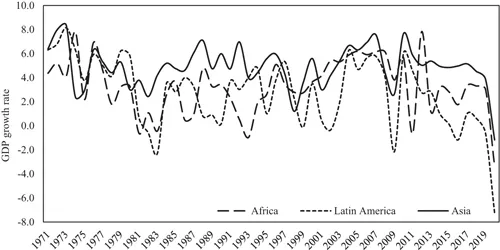
It should however be noted that growth performance within developing countries has been very heterogeneous (see Figure 1.2) and will further be very different from each other mainly due to the COVID-19 crisis and its multi-dimensional repercussions to society (see Box 1.16 ). Among developing countries, Asian countries have sustained the greatest economic growth record with a 4.9 per cent average over the period 1971–2020. This averaged growth rate is far greater than that of Africa and Latin America (3.3 per cent and 2.8 per cent, respectively). Asia’s remarkable performance may have largely been attributed to the development trajectories of the four Asian Tigers (i.e. Hong Kong, Singapore, South Korea, and Taiwan), who realised a radical growth while attaining a manageable level of inequality (Sachs and Warner, 1997; Parente, 2001).
Box 1.1 Meta-discourse on the COVID-19 crisis and beyond
Over the past months and year, the entire world has suffered from a shutdown, self or institutional quarantine, the collapse of medical systems, teleworking challenges, economic downturn and many other developments to which we had previously given little thought, if any. Nonetheless, we have also proved ourselves in terms of having the resilience, determination and solidarity to overcome such hardships observed across many countries in the world. What we have confronted and gone through together has given rise to new perceptions and emerging trends in the fields of politics, economy, industry, education, health and the environment. In other words, it has become clearer that we, the people, should respond proactively rather than fear the upcoming “new normal.” We need to unravel our new way of viewing the future we are facing; explore several potential policy considerations at the national level; and dissect the likely-to-be redefined future narrative of the post-COVID-19 era.
1.1.1 Smart government for a newly redefined national security context
Despite its many uncertainties, the COVID-19 crisis is arguably an ideal opportunity to redefine the role of the state (EBRD, 2020; Greer et al., 2020). We have clearly observed and sometimes experienced that the safety of people is directly affected by the governance and institutional quality of individual governments. In parallel, citizens will have more room to tolerate any form of state intervention if it helps to ensure their lives and safety. During its crisis response, national governments seem to have secured justification to intervene regarding various state-led public health and socioeconomic interventions. Accordingly, a series of strong measures would in turn generate a great opportunity to strengthen its public administration capability if it attaches priority to how smart it is to protect people’s lives and safety, and how smartly it can provide public services and support during these difficult times and beyond.
In the new normal era, the concept of competition between nations that has until now been centred on hard power, such as the economy and the military, will likely be re-centred on soft power, and our COVID-19 experiences may further emphasise that humanity itself becomes the ultimate goal of national security (Szymanski, Smuniewski and Platek, 2020). Effectively managing various newly and potentially redefined national security concepts, including economic security, food security, health security, environmental security, personal security, community security and political security would not be possible without a fully functional smart government systematically underpinned by a broad range of modern technology (Gupta et al., 2021).
With respect to an e-governance system, smart government must be capable of facilitating and supporting better planning and decision-making to provide timely quality public services, with a particular focus on public health and cybersecurity, while the rest of the resources available will have to be invested in enhancing the role of the private sector to bring about innovative technology solutions to improve the smart governance system itself. In doing so, national governments will have to take a leading role in the smart governance solution by taking advantage of its status as a pioneering e-government system.
1.1.2 Control tower for supply chain resilience
The degree of responsiveness to the rapid dynamics of the restructuring of the global supply chain has become a core capability in the COVID-19 era and will be even more so beyond the crisis’ end. As the current pandemic is seriously disrupting global and regional value chains, a sizeable number of multinational corporations are expected to take action by reshoring or U-turning to their home countries (Hoek, 2020).
According to a survey conducted by the Bank of America (2020), nearly 80 per cent of China-based multinational corporations are currently considering reshoring. In effect, many are exposed to serious damage whereby only one supply chain disruption in the global value chain would destroy their business operations due to being closely linked to a globalised division of labour, from production to sales. No wonder, in this regard, that reshoring, or at least a plan to repatriate part of production from one country to another, would be encouraged in terms of supply chain system risk management if the pandemic persists. It should, however, be noted that reshoring or the U-turn option cannot be considered a fundamental solution capable of mitigating such risks. Diversifying the production bases to reduce labour and transportation costs and maintaining an international division of labour that fits the characteristics of each country and relevant businesses would remain essential in achieving global and regional market competitiveness.
Monitoring such likely dynamic trends associated with supply chain disruption is a particularly critical consideration for a country that has maintained its trade performance by relying heavily on a certain group of countries or regions. Because of this, line ministries and relevant agencies must closely monitor and assess the changing trajectory in the global and regional supply chain. An integrated national approach to quickly respond to such changing dynamics will most probably be the key to future prosperity (Baek, 2019). Hence, the establishment of a nationwide supply chain crisis response centre should be carefully considered. This centre should be fully capable of supply chain resilience planning and management through close cooperation with import/export companies, trade unions, food authorities and a cooperative society. Full digitalisation of all these processes and the cooperation and integration of innovative technology solutions such as blockchain and artificial intelligence (AI) will be required in the months to come (Kalla et al., 2020).
1.1.3 Untact culture and industrial restructuring
Reflecting on our radical experiences over the past months and year, there is an increasing desire to enjoy meals and leisure at home as long as social distancing guidelines emphasise that we do so to protect ourselves from COVID-19. We will have to prepare thoroughly for when this so-called untact culture is routinised, something that the COVID-19 crisis will most likely leave behind as part of its legacy (Bae and Chang, 2020). In other words, this pandemic is likely to instil in us a perception that a house where one can control everything is the safest place to be. The spread of such an outlook may influence changes in the structure of service sectors, and hence predicting new demands and responding in advance will be crucial for businesses in preparation for new business opportunities. Meanwhile, there would also be an urgent need for governments to prepare preemptive policy alternatives that effectively respond to anticipated industrial restructuring (de Jong and Ho, 2020).
Such prospective restructuring is likely to lead to a new era of distance education. This may consist of blended learning, which combines online and offline education, or flipped learning, in which teachers and students engage in offline discussions after prior online learning (Kocoglu and Tekdal, 2020; Ince, Kabul and Diler, 2020). Such methods are expected to become widespread during and after this crisis. Now is the time for national governments to ...