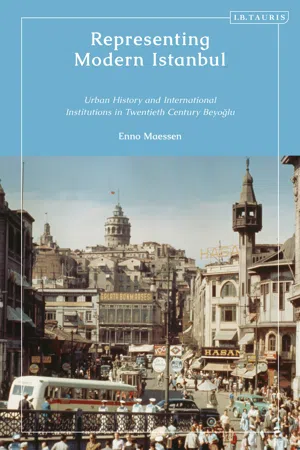
eBook - ePub
Representing Modern Istanbul
Urban History and International Institutions in Twentieth Century Beyoglu
- 208 pages
- English
- ePUB (mobile friendly)
- Available on iOS & Android
eBook - ePub
Representing Modern Istanbul
Urban History and International Institutions in Twentieth Century Beyoglu
About this book
Following the collapse of the Ottoman Empire, Istanbul would lose its position as capital yet remain a crucial urban centre in the new Turkish republic. Since the 1950s it has undergone a metamorphosis from a mid-sized city to a megapolis. Beyoglu, historically represented as its most 'cosmopolitan' district and home to European embassies and cultural institutions, is a microcosm of these changes. This book explores the urban history of Beyoglu via a series of case studies which use previously unexamined archival material to tell the story of its local and international institutions. From the German Teutonia club and a centre point of Turkey's cinema culture to influential francophone, British and German schools which educated many of Turkey's future elite, the book charts the shifting identities of the residents of the district. These case studies reveal the effects of changing political circumstances, from the rise of nationalism to Turkey's place in the Cold War, as well as critically examining Beyoglu's legacy as a multicultural centre. In the process, the book reveals a picture of resilience, cross-cultural contact and provides an important contribution to our understanding of present-day and historical Istanbul and Beyoglu.
Information
Chapter 1
Istanbul and Beyoğlu in historical perspective
Beyoğlu or Galata/Pera has become the iconic site of Istanbul’s imagined ‘cosmopolitanism’. The settlement of the Genovese has been known as Galata since the eighth century, its borders formalized since 1303 with significant expansions of its territory in the fourteenth century. The settlement was lined with defence walls and watch towers, of which the Galata Tower from 1349 is the most prominent and one of the few visible remains.1 Following the transition of Istanbul from Byzantine to Ottoman rulership in 1453, the Genovese held their rights but were forced by the sultan to decrease the height of their fortifications. Following the settlement of the Ottoman rulership in Istanbul, non-Muslims were increasingly attracted to the Galata area. Eldem provides a beautiful description of the impressions of Dominique Fornetty, second dragoman to the French Embassy in Constantinople at the end of the seventeenth century, who he describes to ‘be at a loss when he tried to explain that variety [of people in Galata and among those defined as “Levantines”] to foreigners’.2 He points out that the travellers coming to Istanbul were eager to find ‘the Orient’ and were often underwhelmed by Galata, which reminded them of other port cities along the Mediterranean, yet were at the same time amazed by what appeared to be a Christian enclave and to them was surprisingly diverse for such an oriental place.3 Eldem argues that for them it was not the most spectacular place in the city, since it may have resembled Venice, Genoa or Marseille. Paolo Girardelli nuances this, however, and points out that the district in historiography has been compared by some to a ‘typical, fortified North Italian town’ before 1453 and several centuries afterwards, which he argues is rather exaggerated.4 Eldem suggests that it might be possible to call the Galata district in the seventeenth (and eighteenth) century a city in itself, within Constantinople, as it was walled until the late nineteenth century. The ‘otherness’ of this district, however, is a representation, or, one might suggest, even a representational culture, that has been – and continues to be – actively cultivated. The cultural and religious otherness of Galata, Eldem argues, neglects the gradual integration of the district into the city with a growing community of Muslims moving towards the district, reflected, for instance, in the presence of twelve mosques against six churches following a major city fire in 1696.5 This pushed the non-Muslim communities to expand the district further beyond the walls, towards the Pera hill and Taksim cemeteries.6
The appearance of the Galata/Pera area, its architecture more specifically, poses a highly revealing example of how the area’s cultural hybridity was expressed in physical form. As Girardelli indicates, the newcomers that would populate Istanbul would integrate elements distinct to the architectural traditions of their native regions, which resulted in a fairly homogeneous typology of residential architecture, based on community traditions of constructing in timber. Maurice Cerasi indicates that broadly speaking what became known as the ‘Ottoman house’ was a constant in the Ottoman urban landscape, in Istanbul and beyond during the eighteenth century.7 Timber constructions, despite their vulnerability to the all too common city fires, were common in much of Istanbul without bearing reference to any particular identity in the architectural language.8 This would hold true for both districts on the shores of the Golden Horn, Stamboul and Galata/Pera. Girardelli indicates that apart from the higher density of buildings in Galata and despite the emphasis that is typically put on the alleged difference between the two quarters, they in fact were strikingly similar. Even many of the buildings occupied by the foreign representations appeared in various cases to be decisively more ‘local’ than ‘foreign’ until the first half of the nineteenth century.9
Monumental architecture, on the other hand, reveals a breach with the typological boundaries of the ‘classical period’ in Ottoman architecture and a new phase in the cultural hybridity of Ottoman monumental architecture. Hamadeh points out that the eighteenth century added a broader lexicon to the monumental elements in the urban landscape, with old and new as well as local and foreign elements. She attributes the change to a disintegration of stable power elements and a diffusion of artistic patronage, from the traditional elite to, among others, a growing urban middle class.10 A new social order invoked a response of the imperial elite to press its stamp on Istanbul’s public spaces, claiming its presence. This imperial elite expressed its presence and power through the public spac e, which had previously been the privilege of the sultan and grand vizier, with their own tastes and preferences for self-representation.11 Representation and display of power, moreover, moved from Stamboul to the shores of the Bosporus. Hamadeh argues that eighteenth-century monumental Ottoman architecture is wrongly considered to have suddenly shifted towards Western vocabularies, similar to the construction of ‘Ottoman houses’, which were essentially also architectural testimonies of cultural hybridity. This, she explains, on the one hand, poses a reductionist view of the preceding centuries during which there had been continuous (political, economic, diplomatic and cultural) interaction with European powers, while, on the other hand, the novelties in architectural style were equally appreciative of Western and Eastern traditions of building.12 Rather than ‘Westernization’ it thus seems that ‘novelty’ was the key word in the changing architectural vocabularies of the Ottoman urban context, with attention to a variety of local and foreign styles. This architectural bricolage had been a reality before; it became even more visible in the urban landscape since the imperial elite could lay claim to it as well.13
As strong as the impact of the eighteenth century may have been on Istanbul’s urban landscape, the events that unfolded in the Ottoman Empire during the final years of the eighteenth century and, most significantly, the first half of the nineteenth century would have a decisive effect on the physical integrity and appearance of the imperial capital again. This time, however, the impact would be particularly large in Galata/Pera. The Ottoman rulership had become aware of the limits of the imperial army’s power, particularly in contrast with the modernizing armies of the dominant European powers. The successive failures of the Ottoman army against the revolting Ottoman governor of Egypt, Mehmed Ali Pasha, and the war against the Greek independence movement, which resulted in the reluctant acknowledgement of an independent Greek state by the Ottoman government, made Sultan Mahmud II aware of the need for an extensive reform program. Before him, earlier attempts at reform and modernization had already been initiated. As Erik-Jan Zürcher points out Mahmud II followed in the footsteps of his predecessor Selim III as well as his rival in Egypt Mehmed Ali, by identifying the need for a modern army which was backed by a modern state structure, with an extensive bureaucracy, taxation system, as well as Western-style education and legislation.14 Though it would not be right to pinpoint Mahmud II as the sole initiator of this process, it was ultimately his decision-making that would set the agenda for an extensive wave of reforms in the Ottoman Empire. Zürcher argues that Mahmud II’s push to set up a new army entirely under his control in 1826 would incite a response from the traditional military core in the Ottoman Empire – the Janissaries – which was quite rapidly suppressed and the old corps were disbanded, effectively ending their military and social influence in the Empire.15 Prussian army officers were invited to guide the Ottoman leadership in building a modern army virtually from scratch. Eventually the new army and the infrastructure it required would initiate a period which is often described as the Tanzimat-i Hayriye (Beneficial Reforms), formally starting with the Edict of Gülhane focusing on the introduction of new legislation on equality of Ottoman citizens, taxation and military conscription.16 Even before, however, the term Tanzimat had been used and reforms affecting the Ottoman state structure had obviously already been set in motion by Mahmud II, who died a few months before the realization of the Edict.
As the Tanzimat both explicitly and implicitly aimed to bring the Ottoman Empire up to speed with its European allies and rivals, the influence of the Western powers, intellectually, financially, culturally and politically over the Ottoman Empire grew tremendously.17 Lorans Baruh points out how this also had rather immediate effects on the planning of Istanbul’s urban environment. She refers to a letter by one of the leading figures behind the Gülhane Edict, Ottoman statesman Mustafa Reshid Pasha, who wrote to the sultan in 1836 that the dominance of timber architecture in Istanbul’s urban landscape was criticized in European newspapers as they would pose a recurring problem in the destructive city fires that Istanbul was continuously faced with in its history.18 Mustafa Reshid Pasha, who admired the urban landscapes of Paris, Vienna and London during his diplomatic missions, therefore suggested to the sultan to have buildings constructed in stone or brick rather than wood. The Ottoman government then tried to regularize the urban landscape and in the second quarter of the nineteenth century several regulations were drawn up which stipulated, among other things, that apart from the lower classes, no one was allowed to construct in timber any longer and that timber structures moreover were not allowed to be constructed across from masonry buildings, have significant distance from mason buildings and should be separated from other construction with a masonry wall reaching to the height of the roof.19 Girardelli points out that it would take until the second half of the nineteenth century before a noticeable difference in terms of architectural design became apparent between Muslim and non-Muslim communities. The great city fire of 1831 did, however, have an impact on the properties of the foreign embassies and upper-class families. The embassies chose styles and sizes that would reflect grandeur and a ‘European’ identity, opting in most cases for neoclassical or neo-renaissance designs.20 Meanwhile t he urban government was subjected to a program of reform as well. Zeynep Çelik points how the ‘classical’ Ottoman city had been organized along principles and theories adhering to Islamic modes of government, which did not recognize religious corporations (the individual and communities were recognized) and would leave administration in the urban setting to professional, ethnic and religious communities.21 Islamic judges, the kadıs, should according to Çelik be identified as the principal power bearers in the city as they were entitled to supervise all matters of a juridical nature, in the case of the city also notably that of the city’s real estate. Four juridical boroughs, the kadılıks, divided the city: Eyüp, Galata, Istanbul and Üsküdar, which further separated into smaller neighbourhoods (mahalle) and larger districts (semt).22 Municipal administration took a much more decentralized and, to a certain degree, informal character – based on traditions, jurisprudence and various written and unwritten sources, including imperial orders (ferman).23
This would change during the Tanzimat. In line with the desire of the Ottoman state for full control of the governmental system, the administration of the capital also was brought under the control of a centralized bureaucracy, bringing the power of the kadı and local councils to ministries instead.24 The government aimed to bring Istanbul’s urban landscape’s ‘quality’ to the standard of its European counterparts, regularizing, beautifying, lighting and widening streets, and improving construction methods. To that end the Commission for the Order of the City (İntizam-ı Şehir Komisyonu), set up by the Ottoman government in 1855, proposed to reorder the city in four arrondissements, after the French model, making Galata/Pera and Tophane the Sixth District – arguably with reference to the upscale sixième arrondissement in Paris.25 This Sixth District would become a pilot area for urban modernization, which was expected to be more broadly implemented in other parts of the city at a later stage.26 By then the status of the district had already been growing considerably while the social composition and existing architecture of the area made that the Ottoman government considered it particularly suitable for further modernization. Çelik quotes from the Takvim-i Vekayi (Calendar of Facts, the Ottoman official gazette), which makes this point particularly clear: ‘Since to begin all things in the above-mentioned districts [meaning the thirteen districts except Galata] would be sophistry and unworthy, and since the Sixth District contains much valuable real estate and many fine buildings, and since the majority of those owning property or residing there have seen such things in other countries and understand their value, the reform program will be inaugurated in the Sixth District.’27
As much as the reform program may have implemented significant and highly apparent reforms, Istanbul’s urban landscape would retain the hybridity and mixing of styles beyond the thresholds of community lines. As Girardelli indicates architectural typologies in Istanbul/Constantinople’s urban landscape have been a testimony to the cultural intricacies of Istanbul’s hybrid society since Byzantine times.28 The nineteenth-century Ottoman capital is no exception: a reflection of the complex sociocultural realities faced by Constantinople’s urban dwellers. As pointed out earlier in the context of the eighteenth century, Girardelli stresses in his work that the architectural languages used by the various communities in the city should not be considered as representations of nationality, religion or ‘lineage’ to a different geographic area, political or religious institution. This holds true for the attempts to reform the city’s urban landscape of the nineteenth century as well, which had by no means the effect of the urban planning strategies implemented in Paris and Vienna. Moreover, the urban redevelopment did also not resemble the increasing spatial segregation of ‘local’ and ‘foreign’ communities in semi-colonial urban settings such as Alexandria, Cairo, Tunis or Algiers where sharp divides were cultivated by European communities.29 In Galata, the typologies remained much more mixed, while at the same time an overhaul of building styles towards a ‘Western’ model was not observable. Girardelli argues that instead the model of the Ottoman house was further developed, using less timber and more masonry. Entering the second half of the nineteenth century, however, Galata/Pera’s growing significance as the centre in the city – in part due to the growing economic, cultural and political influence of foreign powers – gradually found spatial expression with a growing conglomeration of monumental buildings.30
Giradelli suggests, however, that the idea of a top-down imposition of urban reform in Galata/Pera underplays earlier attempts at introducing novel modes of construction.31 Considering this also means retracing greater continuity in the changing urban landscape. Much of the radical shifts in Galata/Pera, moreover, were not incited by planning ideals, but by the need to rebuild or reconstruct after city fires such as ...
Table of contents
- Cover
- Half-Title
- Title
- Contents
- List of Illustrations
- Acknowledgements
- Introduction
- Chapter 1 Istanbul and Beyoğlu in historical perspective
- Chapter 2 Galata/Club Teutonia and the Bosporus Germans
- Chapter 3 Yeşilçam street/cinema in Beyoğlu and urban resistance
- Chapter 4 Galatasaray/Galatasaray Lisesi: Turkishness alafranga
- Chapter 5 İstiklal Caddesi/English High School for Girls
- Chapter 6 Tünel/The German High School: Pivot of German cultural diplomacy
- Conclusion
- Notes
- Bibliography
- Index
- Copyright
Trusted by 375,005 students
Access to over 1.5 million titles for a fair monthly price.
Study more efficiently using our study tools.
Frequently asked questions
Yes, you can cancel anytime from the Subscription tab in your account settings on the Perlego website. Your subscription will stay active until the end of your current billing period. Learn how to cancel your subscription
No, books cannot be downloaded as external files, such as PDFs, for use outside of Perlego. However, you can download books within the Perlego app for offline reading on mobile or tablet. Learn how to download books offline
Perlego offers two plans: Essential and Complete
- Essential is ideal for learners and professionals who enjoy exploring a wide range of subjects. Access the Essential Library with 800,000+ trusted titles and best-sellers across business, personal growth, and the humanities. Includes unlimited reading time and Standard Read Aloud voice.
- Complete: Perfect for advanced learners and researchers needing full, unrestricted access. Unlock 1.5M+ books across hundreds of subjects, including academic and specialized titles. The Complete Plan also includes advanced features like Premium Read Aloud and Research Assistant.
We are an online textbook subscription service, where you can get access to an entire online library for less than the price of a single book per month. With over 1.5 million books across 990+ topics, we’ve got you covered! Learn about our mission
Look out for the read-aloud symbol on your next book to see if you can listen to it. The read-aloud tool reads text aloud for you, highlighting the text as it is being read. You can pause it, speed it up and slow it down. Learn more about Read Aloud
Yes! You can use the Perlego app on both iOS and Android devices to read anytime, anywhere — even offline. Perfect for commutes or when you’re on the go.
Please note we cannot support devices running on iOS 13 and Android 7 or earlier. Learn more about using the app
Please note we cannot support devices running on iOS 13 and Android 7 or earlier. Learn more about using the app
Yes, you can access Representing Modern Istanbul by Enno Maessen in PDF and/or ePUB format, as well as other popular books in Sciences sociales & Histoire de l'architecture. We have over 1.5 million books available in our catalogue for you to explore.