This volume approaches the broad topic of wonder in the works of Tacitus, encompassing paradox, the marvellous and the admirable. Recent scholarship on these themes in Roman literature has tended to focus on poetic genres, with comparatively little attention paid to historiography: Tacitus, whose own judgments on what is worthy of note have often differed in interesting ways from the preoccupations of his readers, is a fascinating focal point for this complementary perspective.
Scholarship on Tacitus has to date remained largely marked by a divide between the search for veracity – as validated by modern historiographical standards – and literary approaches, and as a result wonders have either been ignored as unfit for an account of history or have been deprived of their force by being interpreted as valid only within the text. While the modern ideal of historiographical objectivity tends to result in striving for consistent heuristic and methodological frameworks, works as varied as Tacitus' Histories, Annals and opera minora can hardly be prefaced with a statement of methodology broad enough to escape misrepresenting their diversity. In our age of specialization a streamlined methodological framework is a virtue, but it should not be assumed that Tacitus had similar priorities, and indeed the Histories and Annals deserve to be approached with openness towards the variety of perspectives that a tradition as rich as Latin historiographical prose can include within its scope. This collection proposes ways to reconcile the divide between history and historiography by exploring contestable moments in the text that challenge readers to judge and interpret for themselves, with individual chapters drawing on a range of interpretive approaches that mirror the wealth of authorial and reader-specific responses in play.
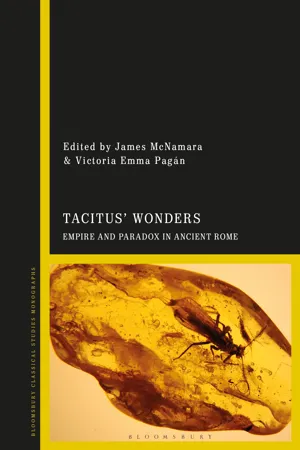
eBook - ePub
Tacitus’ Wonders
Empire and Paradox in Ancient Rome
- 296 pages
- English
- ePUB (mobile friendly)
- Available on iOS & Android
eBook - ePub
Tacitus’ Wonders
Empire and Paradox in Ancient Rome
About this book
Information
Part One
Paradoxography and Wonder
1
Tacitus and Paradoxography
Kelly E. Shannon-Henderson
The ancients had a broader conception of what was appropriate in history than we do. Mythical, paradoxical and supernatural material could sometimes be included, and not everything that might strain the belief of a modern audience was automatically excluded.1 Yet this does not mean that the categories ‘false’ and ‘true’ had no meaning whatsoever for the ancients when they thought about historiography. Perhaps the classic example of such a distinction was Thucydides’ rejection of τὸ μυθῶδες (the fabulous, 1.22.4); although even he does not completely omit every instance of the irrational from his works, he makes a clear programmatic distinction between things capable of independent verification and those that are not.2 Ancient writers even speak about historians who tell lies.3 One such type of ‘falsehood’ is historians’ inclusion of miraculous events in their narratives. Seneca explicitly criticizes this type of material in an attack on the Greek historian Ephorus’ description of a comet dividing into two:
quidam incredibilium relatu commendationem parant et lectorem, aliud acturum si per cotidiana ducetur, miraculo excitant; quidam creduli, quidam neglegentes sunt; quibusdam mendacium obrepit, quibusdam placet; illi non euitant, hi appetunt.
QNat. 7.16.1
Some [historians] garner praise for things incredible to relate, and excite with a miracle the reader who would lose interest4 if he were being led through an everyday narrative. Some of these historians are gullible, others negligent. Lying creeps up on some of them, but others enjoy it: the former do not avoid it, but the latter seek it out.5
Seneca explicitly equates miracula (wondrous things) or incredibilia relatu (things incredible to relate) with mendacium (lying).6 And his criticism has implications broader than the veracity of the particular passage he addresses here, as Williams notes: ‘By inveighing (however unfairly) against Ephorus in particular, he targets a writer reputed in antiquity for his akribeia, thereby damning the historici in general by discrediting one of their most eminent representatives.’7
Contrast this ‘rejection’ (even if not always practised) of marvels and miracles in historiography with a different view of marvellous material on display in a different genre: a category of ancient literature that modern scholars refer to as paradoxography, which emerged in the Hellenistic period.8 These works were collections of θαύματα (marvels/wonders), drawn from both the natural and the supernatural worlds, and probably intended to be read as entertainment.9 One salient example roughly contemporary with Tacitus is the Περὶ θαυμασίων (On Marvels) by Phlegon, a freedman of Hadrian, which includes a variety of fantastic material, such as ghosts, spontaneous changes of sex, giant bones, and even a centaur whose body, he claims, is still preserved in the imperial storerooms.10
Some ancient critics viewed such material as sensationalistic. For example, Aulus Gellius describes buying, at a bookshop in Brundisium, ‘Greek books full of miracles and fictions, things unheard of and incredible … A disgust for such unsuitable writing took hold of me’ (libri Graeci miraculorum fabularumque pleni, res inauditae, incredulae… tenuit nos non idoneae scripturae taedium, NA 9.4.3, 9.4.12). His reading list includes writings by Isigonus, a ‘true’ paradoxographer according to the modern definition; by Aristeas of Proconnesus, a thaumaturge who came back from the dead and allegedly spent time among the Hyperboreans; and by historians like Ctesias who were among the sources from which paradoxographers assembled their lists of wonders.11 Gellius’ testimony, then, suggests paradoxographical writings are sensationalistic and pointless.12 Paradoxography’s reputation has fared little better among modern scholars, who have described it as ‘a parasitic growth on the tree of historical and natural-scientific literature’,13 or as a lowbrow genre meant as entertainment for the uncritical masses,14 effectively the literary equivalent of a Ripley’s ‘Believe It Or Not’ museum. But as I and others have argued, paradoxography is capable of doing powerful intellectual work,15 especially in relation to the question of truth versus falsehood.
The purpose of this chapter is to bring Tacitus and paradoxography into dialogue. What does a serious senatorial writer, often referred to as Rome’s greatest historian, have in common with this ‘parasitic growth’ that is the fantastical and titillating world of paradoxography, and what might be at stake in making this comparison? First of all, the quantity and types of material in Tacitus that could be referred to as ‘paradoxographical’ show that there is actually a large overlap between the marvels Tacitus includes and the material that interests paradoxographers. This overlap all by itself goes some way towards showing that paradoxography is not just an unimportant, intellectually bankrupt genre: if a mainstream author like Tacitus does not shy away from including marvels and miracles in his works of political history, there is clearly nothing about paradoxographical material per se that disqualifies such a work from being considered serious literature. Furthermore, upon a closer look, it is clear that Tacitus did not consider this simply throwaway material: an analysis of the uses he makes of paradoxographical motifs reveals that they are often closely related to key points about historiographical method. Several of these Tacitean miracula become powerful places for thinking about questions of truth and falsehood, bias and believability – all of which are problems central to Roman historiography as a genre.
Defining the marvellous from Callimachus to Tacitus
The study of wonders, miracles, paradox and the marvellous in antiquity is fraught with methodological problems because of the lack of any clearly defined theoretical framework for interpreting such material, or even for identifying parameters to help us define what counts as ‘marvellous’. The task is even further complicated by the blurry boundaries between the marvellous and other similar categories, such as magic,16 religious experience,17 prodigy/omen18 and man-made marvels,19 and also by the often teleological nature of previous scholarship interested in ancient pagan examples of the miraculous mostly in order to provide context for the miracles in early Christian texts.20 A purely philological approach to defining the miraculous is probably insufficient, thanks to the wide variety of terminology used by ancient authors to describe material that could be considered part of this category;21 furthermore, some passages containing material that would seem to fit some definition of the marvellous or paradoxical have no linguistic markers (e.g. the adjective mirus or a form of [ad]miror) at all. The best definitions of ‘the marvellous’ are those ...
Table of contents
- Cover
- Half-Title Page
- Series Page
- Title Page
- Contents
- Notes on Contributors
- Acknowledgements
- List of Abbreviations
- Introduction
- Part One Paradoxography and Wonder
- 1 Tacitus and Paradoxography
- 2 Beyond ira and studium: Tacitus and the Hellenistic Anxiety About Wonder
- 3 Wonderment in Aper’s Second Speech in Tacitus’ Dialogus de oratoribus
- 4 Laus eloquentiae and fama rerum: The Paradox of the Socially Marvellous in Tacitus’ Dialogus and Agricola
- Part Two Interpreting Wonders
- 5 Marvellous Predictions: Wonders as Metahistory in Annals 6
- 6 Prodigiosum dictu: Interpreting Signs and Oracles in Tacitus’ Histories
- 7 Interpreting Wonders in the Agricola and Germania
- Part Three The Principate as Object of Wonder
- 8 qualem diem Tiberius induisset: Tiberius’ Absences on Capri as an Inspiration for Wonder and Uncertainty
- 9 Tacitus’ Tragic Touch: Vespasian’s Healing Miracles at Histories 4.81–83
- 10 Tacitus’ Ordinary Wonders
- Index of Latin Terms
- Index of Greek Terms
- Index of Passages Cited
- Index of Names
- General Index
- Copyright
Trusted by 375,005 students
Access to over 1.5 million titles for a fair monthly price.
Study more efficiently using our study tools.
Frequently asked questions
Yes, you can cancel anytime from the Subscription tab in your account settings on the Perlego website. Your subscription will stay active until the end of your current billing period. Learn how to cancel your subscription
No, books cannot be downloaded as external files, such as PDFs, for use outside of Perlego. However, you can download books within the Perlego app for offline reading on mobile or tablet. Learn how to download books offline
Perlego offers two plans: Essential and Complete
- Essential is ideal for learners and professionals who enjoy exploring a wide range of subjects. Access the Essential Library with 800,000+ trusted titles and best-sellers across business, personal growth, and the humanities. Includes unlimited reading time and Standard Read Aloud voice.
- Complete: Perfect for advanced learners and researchers needing full, unrestricted access. Unlock 1.5M+ books across hundreds of subjects, including academic and specialized titles. The Complete Plan also includes advanced features like Premium Read Aloud and Research Assistant.
We are an online textbook subscription service, where you can get access to an entire online library for less than the price of a single book per month. With over 1.5 million books across 990+ topics, we’ve got you covered! Learn about our mission
Look out for the read-aloud symbol on your next book to see if you can listen to it. The read-aloud tool reads text aloud for you, highlighting the text as it is being read. You can pause it, speed it up and slow it down. Learn more about Read Aloud
Yes! You can use the Perlego app on both iOS and Android devices to read anytime, anywhere — even offline. Perfect for commutes or when you’re on the go.
Please note we cannot support devices running on iOS 13 and Android 7 or earlier. Learn more about using the app
Please note we cannot support devices running on iOS 13 and Android 7 or earlier. Learn more about using the app
Yes, you can access Tacitus’ Wonders by James McNamara, Victoria Emma Pagán, James McNamara,Victoria Emma Pagán in PDF and/or ePUB format, as well as other popular books in Literature & Historiography. We have over 1.5 million books available in our catalogue for you to explore.