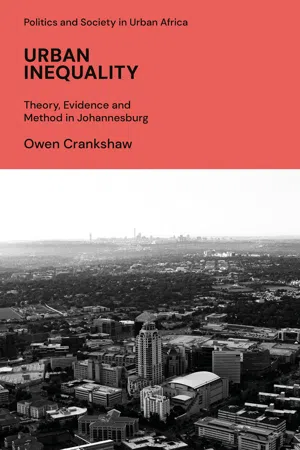
Based on new evidence that challenges existing theories of urban inequality, Crankshaw argues that the changing pattern of earnings and occupational inequality in Johannesburg is better described by the professionalism of employment alongside high-levels of chronic unemployment.
Central to this examination is that the social polarisation hypothesis, which is accepted by many, is simply wrong in the case of Johannesburg. Ultimately, Crankshaw posits that the post-Fordist, post-apartheid period is characterised by a completely new division of labour that has caused new forms of racial inequality. That racial inequality in the post-apartheid period is not the result of the persistence of apartheid-era causes, but is the result of new causes that have interacted with the historical effects of apartheid to produce new patterns of racial inequality.
- 232 pages
- English
- ePUB (mobile friendly)
- Available on iOS & Android
eBook - ePub
About this book
Information
Chapter 1
INTRODUCTION: THEORIES OF URBAN INEQUALITY
Introduction
This book is a study of the changing nature of social inequality in Johannesburg over the last twenty to forty years. In conducting this research, my approach was to produce a case study that was guided by and would contribute to the development of international theories of urban inequality. The theories that attracted my interest were those concerned with understanding inequalities in the labour and housing markets of cities. This urban studies literature has a different approach to mainstream economic theory because of its interest in the occupational class structure of employment and its relationship to the changing geography of inequality. The first of these theoretical debates is the social polarization debate, which is concerned to describe the changing occupational structure and how it has resulted in changing patterns of earnings inequality. The second theoretical debate in the urban studies literature concerns the post-Fordist spatial order of cities. This debate is concerned to describe and measure the changing geography of inequality by examining the relationship between the changing occupational structure and the housing market. Both debates also address how the changing occupational structure of employment and the geography of inequality have influenced changes in racial earnings inequality and racial residential segregation.
Theories of labour market inequality in cities: Social polarization or professionalization?
The debate over the occupational class structure of the post-industrial city has been dominated by two different theories, namely the ‘social polarization’ theory and the ‘professionalization’ or ‘skills mismatch’ theory (Bailey and Waldinger, 1991; Burgers and Musterd, 2002; Hamnett, 1994). The theory of social polarization is probably best known from its application to the study of economic restructuring in global cities (Friedmann and Wolff, 1982; Hamnett, 2003; Sassen, 2001). However, it has also been applied more widely, to the study of deindustrializing non-global cities (Nijman and Wei, 2020; Stanback and Noyelle, 1984) and even entire countries (Goos and Manning, 2007; Harrison and Bluestone, 1988; Wright and Dwyer, 2003).
Proponents of the social polarization theory argue that the distributional structure of employment is becoming more polarized in terms of occupations and the earnings that they attract. Specifically, they argue that there has been more employment growth among highly skilled and highly paid occupations, on the one hand; and among low-skilled, low-paid occupations, on the other. Correspondingly, they argue that there has been slower growth of semi-skilled, middle-income jobs. The theory therefore claims that workers are becoming more concentrated at the extremes of the earnings distribution.
In the urban studies literature, the theory of occupational ‘professionalization’ was advanced, at least partially, as a response to the social polarization theory (Esping-Anderson et al., 1993; Hamnett, 1994; Hamnett, 2020). These scholars argued that de-industrialization did not result in the occupational and income polarization among the employed workforce. Instead, they argued that de-industrialization led to increased employment in high-income managerial and professional occupations, with substantially less growth in all other occupations. These scholars also argue that professionalization of the occupational structure has been accompanied by high levels of unemployment among low-skilled workers. This theory therefore argues that employed workers are increasingly concentrated at the high-income end of the earnings distribution, while the growth of poverty is caused largely by unemployment rather than the growth of low-skilled jobs.
In the United States of America, a separate debate on the fate of low-skilled workers living in the inner cities entailed a similar argument. Wilson (1996) and Kasarda (1989) both argued that chronic unemployment among low-skilled inner-city workers was caused by de-industrialization. The decline of manufacturing employment and the growth of service sector jobs resulted in growing demand for highly educated workers and the decline in demand for poorly educated workers. This change in the demand for labour is therefore argued to be an important cause of unemployment among poorly educated workers. This theory is also known as the ‘mismatch’ theory because it identifies the skills disparity or ‘mismatch’ between the demand for highly skilled workers and the supply of low-skilled workers as the cause of rising levels of unemployment. So, in contrast to the social polarization argument, Wilson and Kasarda argued that the growth of service sector employment led to fewer low-skilled manual jobs and to the growth of highly skilled non-manual jobs. The ‘professionalization’ or ‘mismatch’ theory of urban inequality therefore argues that de-industrialization causes inequality through the growing number of low-skilled unemployed workers, on the one hand, and growing number of highly paid, highly skilled employed workers, on the other.
Unlike the social polarization theory, the professionalization theory provides a coherent explanation for rising unemployment: It is theoretically consistent to argue that the decline in the demand for low- and middle-income jobs can lead to unemployment among less-educated workers. But it is not consistent to argue that unemployment among low-skilled workers is caused by, or is consistent with, social polarization. This is because social polarization entails an increase in the numbers of low-income service sector jobs. Since these are low- and semi-skilled jobs, their growth will result in the increased demand for poorly educated workers, which, all things being equal, is not consistent with growing unemployment among low-skilled workers.
Racial and class inequality in the post-Fordist spatial order
The debate concerning the changing occupational structure of cities has been used by scholars to understand the changing geography of racial and class inequality in post-industrial cities. The proponents of the social polarization and professionalization theories both agree that the post-industrial or post-Fordist spatial order is more residentially segregated by both race and class than the industrial or Fordist order that preceded it. However, they disagree on the specific nature of this increased racial and class segregation.
Both these schools of thought agree that the growth of the high-income managerial, professional and technical class has gone together with residential suburbanization, on the one hand, and inner-city gentrification, on the other. The result is that the occupational structure of suburban residents has become increasingly middle class. This is especially the case in the new ‘edge city’ developments. By contrast, the occupational composition of the residents of inner-city neighbourhoods has become increasingly working class (Castells, 2002: p.299). This is not to say that the residents of inner cities have become homogeneously working class. Since the de-industrialization of inner-city economic activities, inner-city residential neighbourhoods have become more attractive to professionals, managers and technicians. The result has been the expansion of middle-class enclaves of the inner city into erstwhile working-class neighbourhoods in a process known as ‘gentrification’ (Castells, 2002: p.300; Hamnett, 2003: p.171).
These two schools of thought also agree on the racial characteristics of the post-Fordist spatial order. The argument is that white residents have been the main beneficiaries of employment growth in high-income managerial, professional and technical jobs. By contrast, black residents have not been upwardly mobile to the same extent. This increasing class differentiation by race is also argued to have been accompanied by deepening racial residential segregation. In US cities, black residents tend to live in the poorer inner-city neighbourhoods, whereas white residents increasingly live in the wealthier suburbs and edge cities (Beauregard and Haila, 2000: p.29). More recent migrants, largely Latinos, are also argued to be concentrated in the inner city (Castells, 2002: p.299; Sassen, 1990b: pp.85–7; Sassen, 2001: p.325; Soja, et al., 1983: pp.219–20).
At this point, agreement between the polarization and professionalization schools of thought comes to an end. For the social polarization theorists, poverty among inner-city black residents is largely due to their displacement from middle-income manual jobs and their concentration in the growing number of low-skilled and low-paid service jobs (Sassen, 2001: pp.324–5). By contrast, the professionalization theorists argue that post-Fordist poverty among poorly educated inner-city black residents was caused by growing unemployment which was caused, in turn, by the decline in all manual jobs in the inner city (Kasarda, 1989: pp.27–9; Kasarda, 1995: pp.246–52; Wilson, 1996: pp.26–30). This debate is complicated somewhat by the claim among social polarization theorists that inner-city poverty was caused by both the growth of low-wage jobs and rising unemployment (Sassen, 2001: p.325), which are usually understood to be contradictory trends.
This debate over the nature and causes of racial inequality has direct relevance for our understanding of racial inequality in Johannesburg. South Africa and the USA both had a history of racial oppression during the twentieth century. Both countries also went through a period of political struggle in which black citizens achieved equal political rights with white citizens. However, despite this political equality, urban poverty among black residents in the USA increased during the 1970s and 1980s. In South African cities, the post-Apartheid period was also characterized by the persistence of poverty among black residents. In both countries, the main characteristic of this poverty was the increasing rate of unemployment in the racial ghettos of the major cities. Scholars have responded to this phenomenon with a range of competing theories. In the USA, some scholars argued that the growth of black unemployment was due to contemporary racism and the continuing racial oppression of blacks (Wilson, 1987: p.10). Wilson’s criticism of this theory was that it is contradicted by two important social features of US cities after 1970. The first is that the growth of black poverty in cities took place after, rather than before the victories that were achieved by the civil rights movement. The second is that there was the expansion in the size of the high-income black middle class after 1970, which contradicts the argument that racial discrimination persisted in the post-civil rights era (Wilson, 1987: p.11).
Wilson therefore argues that to understand post-1970 racial inequality in US cities, we need to distinguish between the effects of historical racial oppression during the Jim Crow era and the contemporary racism of the post-civil rights struggle era (Wilson, 1987: pp.10–11). He argues that in US cities, historical racism had the effect of restricting many black workers to unskilled and semi-skilled manual jobs and restricted black residents to inner-city racial ghettos. However, he argues that the growth of unemployment among poorly educated black ghetto residents after 1970 was largely caused by the interaction of these effects of historical racism with contemporary changes in the occupational structures and economic geographies of cities (Wilson, 1987: p.39). He argues that if the growth of poverty among blacks in the 1970s and 1980s was due solely to contemporary racism, then how could the growth of the black middle class during this period be explained (Wilson, 1987: p.11)? So his explanation for the rise of urban black poverty entails an understanding of how the effects of historical racial discrimination were reinforced by later changes in the urban economy that disadvantaged poorly educated black residents of the inner cities.
Scholars who support the professionalization theory argue that there were two main features of this urban economic transformation (Kasarda, 1989: p.31; Kasarda, 1995: p.235; Wilson, 1996: pp.27–39; Wilson, 2009: p.40). The first was the decline in the number of manual jobs for workers without a high-school education and the increase in the number of jobs for workers with at least some university education. The second is that this decline of employment for manual workers was specific to the inner cities, where most poorly educated black residents lived. This change in the division of labour was caused not only by deindustrialization and restructuring within economic sectors, but also by the relocation of many inner-city businesses to edge cities. This changing demand for labour therefore resulted in high levels of unemployment among poorly educated black residents of the inner cities.
This urban economic transformation had unequal consequences for black residents. For black residents with university educations, high-paid jobs were available not only in the inner cities, but also in the edge cities. The passage of the Fair Housing Act of 1968 facilitated their exodus from the inner cities to the suburbs (Clark, 2007: p.309; Wilson, 1987: pp.49–55). The result was that the inner-city ghettos lost many of their high-income middle-class residents. The overall consequence was a dilution of the multi-class character of ghettos, which became increasingly dominated by low-skilled manual workers with high rates of unemployment.
This transformation of the inner-city black population, from a multi-class workforce with low unemployment, to a solely working-class workforce with high unemployment has been characterized as the transformation from the racial ghetto to the ‘excluded ghetto’. So whereas the racial ghetto of the Fordist period was characterized by enforced racial segregation of black residents and their racial oppression, the excluded ghetto of the post-Fordist period is characterized by their exclusion from the city’s economy (Marcuse, 1997: pp.3–4; Marcuse and van Kempen, 2000: pp.4 and 19).
This professionalization or skills mismatch account stands in contrast to that of the social polarization theory. Sassen argues that racial inequality in deindustrializing cities was caused by the growing demand for low-skilled workers: a demand that was met by low-skilled black and Latino immigrants (Sassen, 2001: p.321). This theory therefore opposes the argument that the growth of low-skilled jobs in the inner city was caused by the large supply of low-skilled immigrants. To the contrary, Sassen argues that the growth of the post-Fordist economy is such that it has entailed the decline of middle-income, full-time jobs in the manufacturing industry and the expansion of low-income, part-time and casual jobs in the service sector (Sassen, 2001: p.291). It was therefore the growth of the post-Fordist economy that caused the growth of low-wage jobs among low-skilled black inner-city residents. In this account, there is usually some mention of rising unemployment among low-skilled inner-city residents (Sassen, 2001: p.301). However, Sassen makes no attempt to explain how an increasing rate of unemployment among low-skilled workers is compatible with growing numbers of low-skilled jobs.
The social polarization debate, racial inequality and migration
The professionalization and social polarization theories both agree that de-industrialization and the growth of service-sector employment have increased racial earnings inequality. However, the two theories offer quite distinct descriptions of the changing nature of racial inequality and its causes. Sassen argued that social polarization resulted in the growth of low-wage jobs. This growing demand for workers in low-wage jobs was at least partly met by poorly educated foreign migrants (Sassen, 1990b: p.128). In the global cities of New York and Los Angeles, these post-1970s migrants were largely ‘non-white’ [sic] Latino residents who migrated from Mexico and countries in Central America and the Caribbean (Clarke, 2003: pp.31–2; Waldinger and Bozorgmehr, 1996: p.15). So the social polarization theory emphasizes the growth of low-wage jobs and argues that ‘non-white’ [sic] migrants tend to be concentrated in these low-wage jobs rather than in declining middle-income jobs (Baum, 1997: p.1897; Chiu and Lui, 2004: p.1868; Harrison and Bluestone, 1988: p.70; Sassen, 1990b: pp.83–4).
The professionalization or skills mismatch theory has been applied in the United States to explain the growth of black unemployment in cities. This theory argues that black farmworkers who urbanized during the 1950s and 1960s were concentrated in manual, middle-income manufacturing jobs that did not require a tertiary education. Unlike European migrants who arrived much earlier in the century, many poorly educated black migrants were forced into unemployment by deindustrialization (Kasarda, 1989: p.33; Wilson, 1996: p.30). By contrast, the growth of high-income jobs is argued to have largely benefitted the better-educated native population, most of whom are white residents of European descent. Similarly, in studies of Western European cities, authors have argued that the professionalization of the employed workforce has tended to cause higher unemployment among poorly educated workers. To the extent that immigrants from Africa, Asia and the Caribbean were poorly educated and restricted to manual occupations, they were over-represented among the unemployed (Kesteloot, 2000: pp.199–201). So it is the educational achievements of immigrants rather than solely their immigrant status that influences their position in the labour market. This interpretation is supported by Hamnett (2003: pp.117–19) who argued that in London, immigrants from Africa, Asia and the Caribbean were not homogeneously poorly educated and concentrated in low-skilled jobs. He demonstrated that there was considerable diversity of educational achievement and upward occupational mobility among immigrants and their London-born offspring.
Labour market inequality, housing markets and residential segregation
The geographical segregation of residents by occupational class is understood to be a product of the operation of both the housing market and the labour market. The relationship between these two markets is a contingent interaction: although each market is partly created by autonomous social forces, they are also created in relation to each other. So changes in the structure of the labour market will lead to changes in the demand for different kinds of housing in different locations (Hamnett and Randolph, 1986: p.223–4).
In the housing market, the choice of residential neighbourhood is therefore strongly influenced by the ability of homeowners and tenants to pay for housing. The price of housing is determined by a variety of features. The first is the distinction between more expensive housing that is purchased by homeowners at market prices and cheaper houses that are sponsored (or subsidized) by the state (Randolph, 1991: p.27). In the case of the former, such houses may be inhabited by their owners but may equally be inhabited by tenants who pay market rents. The second distinction, which is usually related to the first, concerns the size and amenity of houses. Houses built for sale to homeowners are generally larger with more amenities, whereas state-sponsored houses are by their nature designed to be cheaper and are therefore smaller with less amenity.
Unequal earnings in the labour market can therefore be the main cause of residential segregation, depending on the segmentation of the housing market (Storper and Walker, 1983: p.32). Generally, high-income middle-class residents are homeowners and manual workers and the unemployed live in public housing (Lee and Murie, 1999: p.626; Hamnett and Randolph, 1986: p.237). In many cities of the USA and Europe, inner-city residents were generally poorer than their count...
Table of contents
- Cover
- Halftitle Page
- Title Page
- Contents
- List of Figures
- List of Tables
- Acknowledgements
- Chapter 1 INTRODUCTION: THEORIES OF URBAN INEQUALITY
- Part 1 DE-INDUSTRIALIZATION AND THE LABOUR MARKET
- Part 2 FROM A FORDIST TO A POST-FORDIST SP ATIAL ORDER
- References
- Index
- Imprint
Trusted by 375,005 students
Access to over 1.5 million titles for a fair monthly price.
Study more efficiently using our study tools.
Frequently asked questions
Yes, you can cancel anytime from the Subscription tab in your account settings on the Perlego website. Your subscription will stay active until the end of your current billing period. Learn how to cancel your subscription
No, books cannot be downloaded as external files, such as PDFs, for use outside of Perlego. However, you can download books within the Perlego app for offline reading on mobile or tablet. Learn how to download books offline
Perlego offers two plans: Essential and Complete
- Essential is ideal for learners and professionals who enjoy exploring a wide range of subjects. Access the Essential Library with 800,000+ trusted titles and best-sellers across business, personal growth, and the humanities. Includes unlimited reading time and Standard Read Aloud voice.
- Complete: Perfect for advanced learners and researchers needing full, unrestricted access. Unlock 1.5M+ books across hundreds of subjects, including academic and specialized titles. The Complete Plan also includes advanced features like Premium Read Aloud and Research Assistant.
We are an online textbook subscription service, where you can get access to an entire online library for less than the price of a single book per month. With over 1.5 million books across 990+ topics, we’ve got you covered! Learn about our mission
Look out for the read-aloud symbol on your next book to see if you can listen to it. The read-aloud tool reads text aloud for you, highlighting the text as it is being read. You can pause it, speed it up and slow it down. Learn more about Read Aloud
Yes! You can use the Perlego app on both iOS and Android devices to read anytime, anywhere — even offline. Perfect for commutes or when you’re on the go.
Please note we cannot support devices running on iOS 13 and Android 7 or earlier. Learn more about using the app
Please note we cannot support devices running on iOS 13 and Android 7 or earlier. Learn more about using the app
Yes, you can access Urban Inequality by Owen Crankshaw in PDF and/or ePUB format, as well as other popular books in Social Sciences & African Politics. We have over 1.5 million books available in our catalogue for you to explore.