This book brings together expert opinions from scientists to consider the evidence for climate change and its impacts on ticks and tick-borne infections. It considers what is meant by 'climate change', how effective climate models are in relation to ecosystems, and provides predictions for changes in climate at global, regional and local scales relevant for ticks and tick-borne infections. It examines changes to tick distribution and the evidence that climate change is responsible. The effect of climate on the physiology and behaviour of ticks is stressed, including potentially critical impacts on the tick microbiome. Given that the notoriety of ticks derives from pathogens they transmit, the book considers whether changes in climate affect vector capacity. Ticks transmit a remarkable range of micro- and macro-parasites many of which are pathogens of humans and domesticated animals. The intimacy between a tick-borne agent and a tick vector means that any impacts of climate on a tick vector will impact tick-borne pathogens. Most obviously, such impacts will be apparent as changes in disease incidence and prevalence. The evidence that climate change is affecting diseases caused by tick-borne pathogens is considered, along with the potential to make robust predictions of future events. This book contains: Expert opinions and predictions. Global coverage of trends in ticks and disease. In-depth examination of climate change and tick distribution links.This book is suitable for researchers and students studying zoology, biological sciences, medical entomology, animal health, veterinary medicine, epidemiology, parasitology, and climate change impacts; and for those concerned with public health planning or livestock management where ticks and tick-borne pathogens pose a threat.
- 544 pages
- English
- ePUB (mobile friendly)
- Available on iOS & Android
eBook - ePub
Climate, Ticks and Disease
About this book
Information
eo1 Future Climate of Africa
Rosalind Cornforth* and Heather Plumpton
University of Reading, Reading, UK

*Email: [email protected]
1.1 Expert Opinion
1.1.1 Introduction
Globally, climate change is causing average temperatures to rise and the intensity and frequency of extreme events to increase. However, these changes will not be uniform globally (Sillmann et al., 2013) and will have differential impacts based on population vulnerability. Across Africa, changes to seasonal rainfall and temperature extremes will have significant impacts on society, particularly those strongly dependent on seasonal rains for agriculture. Moreover, these impacts will vary across the region due to a range of local factors. Support for agricultural development programmes, e.g. research into how to meet the challenges of food production in a changing climate (Fig. 1.1), is key in integrating the impacts of climate change into long-term planning. In parallel, support is needed for decision makers to help them work under conditions of uncertainty and help develop ways for local stakeholders to access and assess information as more data and knowledge become available. The contribution of this expert opinion is to provide a synthesis of the current and future climate risks for Africa and the range of impacts in the medium to long term. It also seeks to highlight areas where research and resources might need to be focused, in the future, to limit or avoid negative climate risks to socio-economic development.
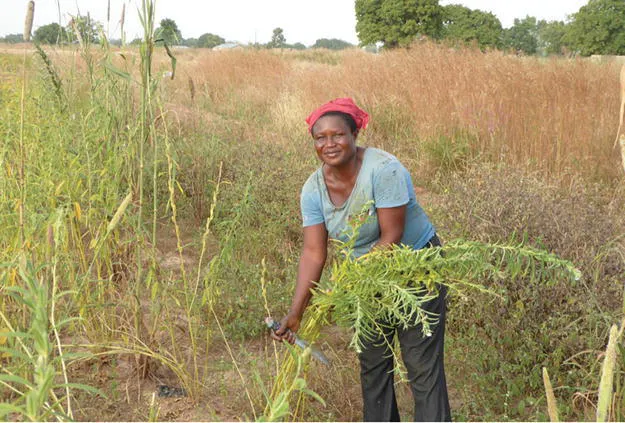
Fig. 1.1. Harvesting sesame seed in West Africa for the family lunch. (Authors’ own photograph.)
1.1.2 What do we understand about the future climate of Africa?
Climate change is projected to continue the current warming trend in Africa, with annual mean temperatures likely to increase beyond 2°C above pre-industrial temperatures by the mid-21st century under a high greenhouse gas emissions scenario (Niang et al., 2014). How the climate will change in different regions over the coming decades, however, remains uncertain.
There is still significant uncertainty in model projections of climate change for Africa, particularly for changes to the rainfall regime. This uncertainty can be a challenge for decision makers designing policies and plans for the future. Some types of uncertainty can never be eliminated fully, and it is important to work with decision makers to support them to work under conditions of uncertainty by considering a range of possible futures (Dessai et al., 2018; Shepherd et al., 2018). However, recent work, particularly through the Future Climate for Africa (FCFA) (https://futureclimateafrica.org, accessed 26 May 2021) programme, has improved our understanding of African climate and narrowed the range of uncertainty in climate model projections for Africa.
Across Africa, annual and seasonal mean temperatures have increased over the last century, with minimum temperatures increasing more rapidly than maximum temperatures (Niang et al., 2014). Model projections across Africa show mean annual temperatures are expected to continue to rise, particularly in more arid regions, with the rate of increase in minimum temperatures continuing to exceed that of maximum temperatures (Niang et al., 2014). However, this temperature increase is not uniform across the region and depends on factors such as proximity to the ocean. For East Africa, which has the largest proportion of Africa’s livestock population, average temperatures have been estimated to increase by 2–3°C by mid-century and 2–5°C by end-of-century (Otieno and Anyah, 2013; Ongoma et al., 2018a). This will be detrimental to the livestock comfort temperature. Under a medium emissions scenario, coastal regions are likely to see the largest increases in the number of warm nights by the end of the century (Ongoma et al., 2018b). Across West and Central Africa, temperature rises are more intense in the driest regions of the Sahel, with maximum temperatures increasing substantially (Diedhiou et al., 2018). The duration of warm spells and the number of heatwaves are also expected to increase, along with the number of warm days, while there is likely to be a reduction in the number of cold extreme events in Africa (Seneviratne et al., 2012).
Projections of future changes in rainfall over Africa are uncertain, with the climate models assessed for the fifth assessment report of the Intergovernmental Panel on Climate Change (IPCC) varying in both whether rainfall will increase or decrease, and by how much (Niang et al., 2014). These projections also suggest there may be increases in heavy rainfall events, but with low confidence (Seneviratne et al., 2012; Niang et al., 2014). More recent work has narrowed the range of uncertainty in model projections and improved our understanding of African climate in three key areas of the precipitation regime: timing of rainy seasons; magnitude of changes to rainfall amount; and changes to the frequency and intensity of extreme rainfall events.
The timing of the rainy seasons in Africa has significant consequences for the large proportion of the population who are dependent on rain-fed agriculture and livestock for their livelihoods (Dunning et al., 2016, 2017). Changes to the timing and intensity of the rainy seasons will impact the length of the growing season and agricultural yields (Vizy and Cook, 2017) and pasture, hence directly affecting the resilience of the population. A continent-scale analysis of changes in wet-season characteristics for Africa under medium and high emission scenarios projects significant regional variation across the continent. In West Africa and the Sahel, the wet season is projected to be delayed by 5–10 days, starting later and finishing later, with no overall change in length of the wet season. In contrast, the later start to the wet season in southern Africa is projected to lead to a shorter wet season with reduced total wet-season rainfall. To the north of the equator, wet-season rainfall is projected to increase with little change in the timing of the rains. In the central equatorial region and the Horn of Africa, where there are two wet seasons a year, the short rainy season is projected to be extended by 8 days on average with higher rainfall amount (Dunning et al., 2018). Factors not considered in these climate models may also impact the seasonal precipitation regime, such as aerosol emissions. Modelling suggests reduced aerosol emissions may delay the timing of the short rainy season in East Africa. However, comparisons across models show significant uncertainties and the need for aerosol emission scenarios to be incorporated into climate models more widely (Scannell et al., 2019). Changes to the timing of the rainy season, which is relied upon heavily for providing water for both crops and livestock (Vetter, 2009; Archer van Garderen, 2011), will also impact on the interaction of vegetation with pests, predators and diseases in the wider ecosystem (Adhikari et al., 2015).
There remain significant uncertainties in whether the total amount of annual and seasonal rainfall will increase or decrease across Africa. However, rainfall intensity is projected to increase across West Africa (see Taylor et al., 2017), southern Africa and Central Africa, with the amount of rainfall per rainy day projected to increase in the wet season. The number of rainy days in the wet season is projected to decrease for West and southern Africa (New et al., 2006), leading to an overall slight decline in total wet-season rainfall. By contrast, Central Africa is projected to experience an increase in total seasonal rainfall due to increasing rain per rainy day and no change in number of rainy days (Dunning et al., 2018).
On top of changes to the seasonal and annual rainfall amounts, the frequency and intensity of wet and dry extremes are critical elements of the precipitation regime with significant impacts on livelihoods and population vulnerability. Model projections of changes to wet and dry extremes have been improved by recent application of convection-permitting models (CPMs) to the African continent, which better simulate the diurnal cycle of tropical convection, vertical cloud structure and coupling between soil and atmosphere in the Sahel (Stratton et al., 2018). The CPM agrees with coarser-resolution models that wet-season rainfall is likely to be less frequent but more intense over much of Africa, even where overall rainfall amount declines. However, the CPM shows larger decreases in rainfall occurrence, and increases in rainfall intensity and extremes, compared with conventional climate models. Flood-inducing events, defined as exceeding 60 mm accumulated rain in 3 h over a 25-km grid scale, are projected to increase from occurring once every 30 years at present to once every 3–4 years in the future. Additionally, dry spells are projected to lengthen significantly during the wet season over the Sahel, Gulf of Guinea and Central Africa. In the Gulf of Guinea, dry spells longer than 10 days are expected to double in frequency in the future (Kendon et al., 2019; Wainwright et al., 2020). These changes in extreme rainfall are larger and more widespread than previously predicted, with implications for disaster risk reduction, food security and infrastructure planning across Africa.
The impact of all these climatic changes across Africa will affect multiple sectors, including food security, vulnerability of the population to disasters, water availability for crops and livestock, public health and infrastructure.
1.1.3 What are the likely impacts on agriculture and people’s livelihoods?
These ongoing changes in the climate will have impacts on a range of sectors in the region. Existing stress on water availability is likely to be amplified by climate change (Niang et al., 2014). Estimating the influence of climate change on water resources is, however, limited by uncertainties in future rainfall changes, as well as the influences of non-climatic drivers such as population growth.
Livestock are likely to be affected by projected decreases in rainfall, which may lead to more droughts, impacting drinking-water (Fig. 1.2) and crop production for fodder. Changing weather patterns could expand the distribution of ticks causing animal disease (Niang et al., 2014). Increases in the variability of rainfall, including longer dry spells and more intense rainfall events, are likely to lead to more frequent and intense flood events. Floods may increase livestock mortality due to damage to livestock housing and the potential for increased transmission of water-borne diseases in floodwaters (FAO, IFAD, UNICEF, WFP and WHO, 2018; InterAcademy Partnership, 2018). Furthermore, increases in temperature will lead to increases in heat stress for livestock, leading to reduced welfare, health and productivity (Escarcha et al., 2018). Climate change is expected to affect the incidence and geographical range of diseases, including tick-borne diseases such as theileriosis, through warming temperatures and changes in rainfall (Niang et al., 2014). Climate change is very likely to negatively affect access to safe water, sanitation, food security, access to healthcare and education, and increase the burden of malnutrition (Niang et al., 2014).
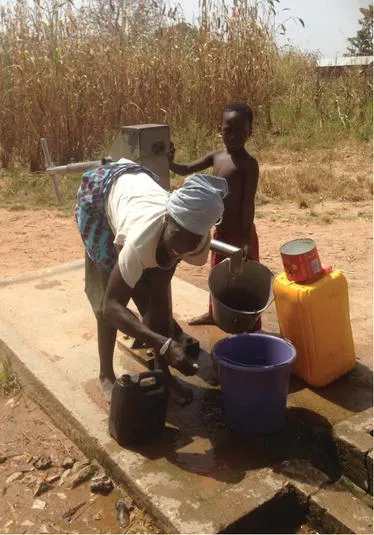
Fig. 1.2. Collecting water from a community borehole in Burkina Faso. (Authors’ own photograph.)
1.1.4 Addressing the science gaps to support agricultural decision making
As outlined above, there remain some specific areas where additional climate science is needed in which the direction of forced change in many impact-relevant variables is uncertain. For example, there is still significant uncer...
Table of contents
- Cover
- Half Title
- Title
- Copyright
- Contents
- Contributors
- Preface
- Section 1: Climate
- Section 2: Ticks
- Section 3: Disease
- Section 4: Final Synopsis and Future Predictions
- Index
- Cabi
- Back
Trusted by 375,005 students
Access to over 1.5 million titles for a fair monthly price.
Study more efficiently using our study tools.
Frequently asked questions
Yes, you can cancel anytime from the Subscription tab in your account settings on the Perlego website. Your subscription will stay active until the end of your current billing period. Learn how to cancel your subscription
No, books cannot be downloaded as external files, such as PDFs, for use outside of Perlego. However, you can download books within the Perlego app for offline reading on mobile or tablet. Learn how to download books offline
We are an online textbook subscription service, where you can get access to an entire online library for less than the price of a single book per month. With over 1.5 million books across 990+ topics, we’ve got you covered! Learn about our mission
Look out for the read-aloud symbol on your next book to see if you can listen to it. The read-aloud tool reads text aloud for you, highlighting the text as it is being read. You can pause it, speed it up and slow it down. Learn more about Read Aloud
Yes! You can use the Perlego app on both iOS and Android devices to read anytime, anywhere — even offline. Perfect for commutes or when you’re on the go.
Please note we cannot support devices running on iOS 13 and Android 7 or earlier. Learn more about using the app
Please note we cannot support devices running on iOS 13 and Android 7 or earlier. Learn more about using the app
Yes, you can access Climate, Ticks and Disease by Pat Nuttall in PDF and/or ePUB format, as well as other popular books in Technology & Engineering & Infectious Diseases. We have over 1.5 million books available in our catalogue for you to explore.