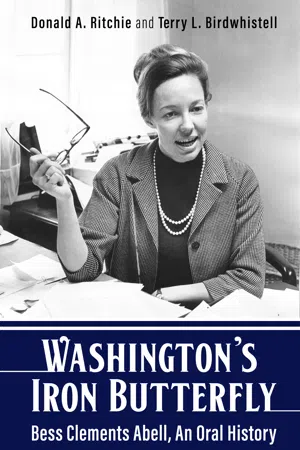
eBook - ePub
Washington's Iron Butterfly
Bess Clements Abell, An Oral History
- 266 pages
- English
- ePUB (mobile friendly)
- Available on iOS & Android
eBook - ePub
Washington's Iron Butterfly
Bess Clements Abell, An Oral History
Trusted by 375,005 students
Access to over 1.5 million titles for a fair monthly price.
Study more efficiently using our study tools.
Information
1
The Governor’s Daughter
Bess Clements Abell’s ancestors made their way to Kentucky from Maryland, Virginia, and North Carolina in the early 1800s, eventually settling in Union County in western Kentucky. The Ohio River separates the county from both Indiana and Illinois along its northern and western border. Agriculture and coal mining became the county’s primary enterprises.
A historical marker stands near Morganfield, the county seat, noting that a thirty-one-year-old Abraham Lincoln gave his only political speech in his native state there in 1840, in support of Whig presidential candidate William Henry Harrison. Two decades later the county would turn decidedly for the Confederacy. With deep Kentucky roots, when Elizabeth “Bess” Hughes Clements, the Clements’ only child, arrived on June 2, 1933, her father, Earle Chester Clements, thought it of utmost importance that his child be born a Kentuckian.
BESS ABELL: I have two birth certificates because at the last minute I was found to be a breech birth and Mother needed a Caesarean. The closest hospital with a surgeon who could do that was across the Ohio River in Indiana, for heaven’s sake. Daddy and Mother took the ferry across the Ohio River and then drove on to Evansville, where I was born and issued an Indiana birth certificate. When Daddy got back to Morganfield, he immediately went down to the county clerk’s office and said, “Well, guess what? Sara had a little girl last night.” So, they just wrote out a Kentucky birth certificate, simple as that. I still have both the Indiana and Kentucky birth certificates.
Years later I decided that I wanted to get a copy of my FBI report through the Freedom of Information Office. Eventually, after three or four years, the FBI report arrived. I was surprised that it was two inches thick and all but a quarter of it had to do with the fact that I have two birth certificates.
I made a mistake. I should have just continued to say that I was born in Morganfield, Kentucky, and there never would have been a problem. But, at some point in my life, it may have been after I was married and was getting a passport, I said that I was born in Indiana because I thought, “This has to be accurate.” If I had not done that, there never would have been this problem.
Later, when our second son, Lyndon, was being born, Tyler filled out all the forms including, “Where was your wife born?” He paused, trying to decide whether to say Indiana or Kentucky. Finally, the clerk said, “The last time she said Indiana.” So that’s the way it was left.1
TYLER ABELL: You wondered, what was the FBI doing, that it had to spend dozens, literally dozens, of special agents’ time finding out why this woman had two birth certificates? As Bess explained, “Nobody ever asked me.”2
Bess’s father, Earle Clements, came from a family of “substantial, well-liked, town-dwelling farmers” in Morganfield, the county seat. Her mother, Sara Blue, was two years older than Earle. She had graduated from Morganfield High School in 1913, sharing highest academic honors with her cousin Lillie Blue. No valedictorian was named that year because the school would name only one valedictorian, and neither student was willing to accept the honor over the other.3
Following a record of academic and athletic achievement in high school, Earle entered the University of Kentucky in the fall of 1915 where he excelled as an “All-Kentucky” center for the Wildcat football team. He left college in December 1916 because his father needed his help on the farm but returned to the university the following spring to take a law course. Earle volunteered for military service in July 1917 at the age of twenty, when the United States entered World War I, and rose to the rank of captain within two years.
Back home in Morganfield after the war, Earle served as deputy sheriff under his father, Aaron Waller (A. W.) Clements, a prominent citizen of Union County who practiced law and had served several terms as both sheriff and county judge. During this time Earle also coached the very successful Morganfield High School football team for several seasons. Following A. W. Clements’s death in 1925 following surgery, Earle completed his father’s term as sheriff.
He learned about politics from his father, and over time Earle would become a legendary political strategist.
EARLE C. CLEMENTS: My father had an influence on my public life. I doubt that he little anticipated that he would have some effect on me for the future because he had no more idea than I did that I’d ever hold public office.
I rode with Father a good many times when he was a candidate for sheriff or county judge. I remember one time I was riding with him and going up to a man’s home out in the county. I thought it was great to hear them talk and see how strong my father was with the Lynn family because Lynn was a good family. I let Father know how pleased I was to know that Mr. Lynn was so strong for him. Father said, “Son, Mr. Lynn is not for me.” I said, “Not for you? Why, I thought he said he was.” “Oh no, son. Mr. Lynn isn’t for me. He gave me great encouragement, but he is not for me. He’s for my opponent, who I believe will be second in this race. I think I will win.”
I said, “But I don’t understand. I just thought that certainly when he said he was for you. . . .” Well, Father said, “There’s a difference between being for me and voting for me.” I couldn’t understand that, but Father explained it to me. He said, “Before I became a candidate, son, Mr. Lynn had promised his vote to my opponent. Now there are thirteen or fourteen members in that family. I’m going to get all of their votes but Mr. Lynn’s. See, he’s for me, but he’s not going to vote for me.”4
Upon his father’s death, Earle served the remainder of his term and subsequently won his own election to a four-year term. From there he went on to serve two terms as county clerk and eight years as county judge, during which time the miles of paved roads in Union County tripled.
Becoming increasingly involved in statewide politics, Earle served two terms in the Kentucky State Senate from 1941 to 1944 before going to the US House of Representatives from 1945 to 1948. Elected governor of Kentucky in 1947, he established a highly regarded progressive record. He won election to the US Senate in 1950. In 1953 Senate Democrats elected him whip, where he served under the leadership of Senator Lyndon B. Johnson until his defeat for reelection in 1956. He remained active in national and Kentucky politics after leaving the Senate, maintaining homes in Kentucky and Washington, DC—although he was always a Kentuckian first.
BESS ABELL: Mother said that she wanted to name me Bess after my grandmother, Bessie Barbour Hughes Blue. But my grandmother did not like her name, and so that is why Mother named me Elizabeth Hughes instead, even though she always called me Bess.
I never knew my grandparents. My father’s mother, Sallie Anna Tuley Clements, was still alive when I was born, but she died the next year. I have a photograph of her holding me in the backyard at Morganfield, but I never knew her. My father’s father, Aaron Waller Clements, passed away after some surgery in 1925.
Mother’s father, James Samuel Blue, had a store in Morganfield, and her mother, Bessie Barbour Hughes Blue, raised plants and seedlings and sold them. Mother was the baby of her father’s second set of children. He had three daughters with his first wife, Lou Willis Hughes Blue, who died young. He then married her sister, Bessie, and had three sons and my mother.
Mother stayed at home with Grandmother Blue during the last years of her life. They eventually moved into the Capital Hotel on the corner of Morgan and Main Streets. I remember meeting Mother’s brothers, George and David. George was a shoe salesman and lived in Georgia and had no children. I only met her brother David once during a driving trip we made out west when Daddy was governor.
I really loved Daddy’s sister, Lucy Clements Scull. She was divorced and lived in Uniontown, Kentucky, but was gay, festive, and fun. I still have a figurine of a little girl that she gave me. Aunt Lucy was a pretty little thing and a good musician who played the piano by ear. I suppose that is the reason that my parents had me take piano lessons for such a long time, hoping that maybe some of her talent had come my way. Alas, it did not. I used to move the hands on the clock around, thinking that it would make my practice time go faster!
Aunt Lucy killed herself [October 23,] 1941, when I was eight years old. One day I was walking home from school, and in the last block before I got home, I tripped and fell. I do not know what happened. All I know is when I jumped up, I said, “Aunt Lucy has died!” I ran home and told Mother, “Aunt Lucy died.” She said, “Who told you?” Well, as far as I knew nobody told me, and that was the only time something like that happened to me. Neither of my parents would talk to me about it, but somebody surely told me. Aunt Lucy must have had a lot of sadness because she just walked into the Ohio River and drowned. But she was the relative that I really liked.
Uncle Tuley Clements farmed in Union County. But Uncle Baldwin J. “Binky” Clements was the most interesting uncle. He married Margaret Kagey [in 1911] and had two children.
In 1917 Baldwin Clements was convicted on forgery charges and for stealing money from Union County while serving as a county magistrate. Sentenced to four years in the state penitentiary, he had to repay the county $1,350. Not long after returning home from prison, he left suddenly.
BESS ABELL: One day he just up and vanished. He disappeared into the ether, and nobody knew where he had gone. Margaret eventually remarried a wonderful man, William Jesse Buchanan, who became head of the state prison at Eddyville, and they had two more children.5
Binky ended up back in Union County after supposedly being on a merchant ship to China. Mother did not really approve of him until World War II came along and Binky became a forager. Binky was very handy and could find extra sugar and shoe stamps.
We had an army camp, Camp Breckinridge, there in Union County. Binky had a little house that was catty-cornered across from the high school, and it was covered with pretend brick or asphalt shingles that resembled yellow brick and looked just awful! Soldiers’ wives and camp followers were coming to town and needed a place to stay. They wanted to spend as much time as they could with their husbands and boyfriends.
Uncle Binky built little tarpaper shacks attached to his house all the way out to the sidewalk and rented them. Mother and Daddy also had three guestrooms in our house, which they rented during the war.
Bess’s Mother and Father
Morganfield during Bess’s youth was a small community of only about 2,500 people. As the Great Depression began, the Morgan Theater in town presented the first “talkie” and the town’s first public library opened. Even during hard times, New Deal programs brought much-needed new school buildings, road improvements, and a remodeled and expanded county courthouse. Also, a Civilian Conservation Corps camp was established just outside Morganfield.
BESS ABELL: Mother graduated from high school and worked for a local lawyer. She decided she wanted to improve herself, so she went to Bowling Green, Kentucky, where she took business courses and learned how to be a better secretary. When she got back home her boss docked her pay by five dollars a week, which she did not understand because she was now better and should be worth a lot more. He said, “No, you inconvenienced me while you were away.”
At that point she left and went to work at the bank. That is when she met Daddy, who was two years younger. After I came along, she...
Table of contents
- Cover
- Praise for Washington’s Iron Butterfly
- Half Title
- Title Page
- Copyright
- Dedication
- Contents
- Foreword
- Introduction
- 1. The Governor’s Daughter
- 2. The Johnson Orbit
- 3. A Part-Time Job
- 4. White House Social Secretary
- 5. White House Impresario
- 6. The Lady Bird Special
- 7. White House Weddings
- 8. In Time of War and Protest
- 9. Part of the Family
- 10. Joan of Art
- 11. Life after the White House
- Epilogue
- The Interviewees
- Acknowledgments
- Notes
- Index
- Kentucky Remembered: An Oral History Series
- About the Authors
Frequently asked questions
Yes, you can cancel anytime from the Subscription tab in your account settings on the Perlego website. Your subscription will stay active until the end of your current billing period. Learn how to cancel your subscription
No, books cannot be downloaded as external files, such as PDFs, for use outside of Perlego. However, you can download books within the Perlego app for offline reading on mobile or tablet. Learn how to download books offline
Perlego offers two plans: Essential and Complete
- Essential is ideal for learners and professionals who enjoy exploring a wide range of subjects. Access the Essential Library with 800,000+ trusted titles and best-sellers across business, personal growth, and the humanities. Includes unlimited reading time and Standard Read Aloud voice.
- Complete: Perfect for advanced learners and researchers needing full, unrestricted access. Unlock 1.5M+ books across hundreds of subjects, including academic and specialized titles. The Complete Plan also includes advanced features like Premium Read Aloud and Research Assistant.
We are an online textbook subscription service, where you can get access to an entire online library for less than the price of a single book per month. With over 1.5 million books across 990+ topics, we’ve got you covered! Learn about our mission
Look out for the read-aloud symbol on your next book to see if you can listen to it. The read-aloud tool reads text aloud for you, highlighting the text as it is being read. You can pause it, speed it up and slow it down. Learn more about Read Aloud
Yes! You can use the Perlego app on both iOS and Android devices to read anytime, anywhere — even offline. Perfect for commutes or when you’re on the go.
Please note we cannot support devices running on iOS 13 and Android 7 or earlier. Learn more about using the app
Please note we cannot support devices running on iOS 13 and Android 7 or earlier. Learn more about using the app
Yes, you can access Washington's Iron Butterfly by Donald A. Ritchie,Terry L. Birdwhistell in PDF and/or ePUB format, as well as other popular books in Social Sciences & Political Biographies. We have over 1.5 million books available in our catalogue for you to explore.