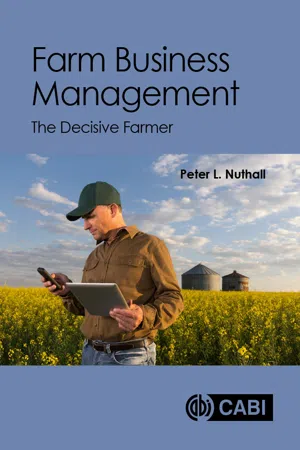
Management research has shown successful farmers have quite distinct personal characteristics which most farmers have seldom thought about. Farmers who are less successful tend to have processes and systems which are likely to be biased. The aim of this book is to help all farmers discover more about these personal attributes that impinge on the success of their management, and to show how their attitudes and personal resources can be improved.This book is not a straightforward textbook. Rather, it tells the story of a group of farmers who take part in an expert-guided experiment designed to test approaches to improving management skill. The group meet at each other's farms to learn about their issues and develop solutions to improving what is called their 'management style' with the aim of removing any identified decision system biases. The book covers issues like optimal decision rule systems and how they can become second nature. Each chapter is devoted to one of the common issues defining management approaches. One chapter, for example, has the farmers sorting out issues around succession planning, another covers the vexed problem of farmer anxiety, and still another has the farmers learning skills on self-critiquing. Overall, there are fifteen chapters covering both general and specific issues.The book is designed for all farmers but is also a valuable resource for students of farm management and agribusiness. A strong learning feature of the book are the references to formal theories and explanations provided in addenda to each chapter. These cover and list the main teaching points highlighted in each farmer meeting giving details of where the detailed methods of solving each situation can be found. Exercises and case studies can also be accessed both on line and in other CABI books.
- 232 pages
- English
- ePUB (mobile friendly)
- Available on iOS & Android
eBook - ePub
About this book
Information
1 Past and future
Ben wandered the rolling hills of his and Jill’s farm in the fresh evening air with the moon just starting to make its presence felt. It had been a hot day, perfect for finishing harvesting a field of wheat using his well-worn but efficient header harvester. Ben had used it for many years and experienced pride in being able to keep it going, using his engineering skill and his extensive and well-equipped workshop. According to Ben, the area put in cash crop each year did not warrant investing in a large state-of-the-art machine. All that mattered was its efficiency in extracting a saleable crop. He had plenty of time for harvesting in what was usually very settled drying weather at this time of year. Jill, Ben’s partner and wife, helped by driving the tractor with the grain collection bins.
After the day of noise, dust, and the concentration required, Ben was in need of some fresh air and quiet time to wind down. Harvest time was critical to the financial success of their medium-sized mixed farm which they had owned for many years now, with occasional land additions as bordering land came on offer.
Time to reflect was increasingly becoming important to Ben, and to Jill, who sometimes accompanied him for an evening walk. Ben liked to regularly check various factors round the farm. This review combined well with his mind games and reflection on many different issues ranging from farm and rural affairs through to higher issues like the origins of the universe. He had recently finished reading one of Stephen Hawking’s popular books in which the Cambridge physics don gave an account of his theories about black holes and the expanding universe. Ben found it all fascinating but for the life of him he couldn’t fully understand all of it and came to his own conclusions after gazing on many occasions up at the Milky Way with is sparkling and impressive array of distant stars.
As the years passed, Ben often mused, he had learnt to approach life with less gusto and over-confidence about what was right. Experience, and keen observation of people and the world, had made him realize the world and its inhabitants were complex. Making decisions on what was the best course of action was similarly complex. Ben agreed there were many ways to skin a cat as the old saying went.
This evening Ben’s mind did not dwell on the progress of his relatively independent children who were making their own way in the world. Annie, an actress based in London, was beating some of the problems that had bedevilled her a couple of years ago. With the support of her close friends and a professional counsellor, Annie had overcome her poorly judged venture into recreational drugs which seemed to be common among certain sections of the artistic fraternity. With breaking off from another actress who had persuaded her to explore a hallucinatory world, the long and difficult road into abstinence was shortly to be a thing of the past, or at least she hoped so. Ben and Jill’s hope was much more fervent.
Annie continued to get good job offers and had held her performances together right through the difficulties. She now felt much stronger, and had resumed regularly communicating with her family, including her brother Graham. Graham was a down-to-earth fellow still working on farms in the Midwest with a particular affinity for Indiana, where his skills were always in demand, particularly during spring and fall for planting and harvesting. Graham had no illusions about getting a green card to stay semi-permanently in the US, knowing his destiny was on the home farm where he would eventually take over from his dad. Perhaps the two of them could work hand in hand for a while when his father eventually slowed down. Bodies don’t last forever.
As he moved from the field just harvested, Ben mused over what he should now do in the paddock. Ben had long ago learnt that making a plan at the beginning of the year and sticking to it was the worst possible management strategy. Why make a decision before it has to be implemented? In the very uncertain world of international markets, random weather events, disease issues, local council environmental decrees and other similar uncertainties, it always paid to constantly review decisions right up to the time when the die had to be cast. And even then he wasn’t averse to later pulling the pin if the situation warranted.
Currently his gut feeling was to put the field into a pure white clover crop to restore the fertility of the soil, given it had come out of wheat following winter barley. The international market for white clover seed was strong and improving in response to the worldwide movement towards environmental friendly approaches, with expanding areas of mixed grass clover pastures using much less nitrogen fertilizer. More and more evidence pointed the finger at artificial nitrogen applications leading to waterway pollution and, in some cases, dangerously high nitrate levels in drinking water. It was even rumoured that there were hints of blue babies, with the nitrates interfering with haemoglobin.
Given his constant review of the internet and the many market and farming journals, Ben was spending increasing amounts of time in the evenings catching up with price movements, new technologies and the many other issues impacting on farming efficiency.
Ben had learnt the importance of keeping up with all the knowledge necessary in making decisions when he took part in university-initiated experiments to assess the importance and development of ‘informed intuition’. Ben chuckled to himself as he realized it was his ‘intuition’ that had come up with the idea of putting white clover in the field. He now needed to muse over whether debate with himself utilizing his logic could reverse the proposal. He doubted it, for increasingly Ben’s ‘informed intuition’ seemed to be getting results.
Ben was impressed with Tom, the university researcher who had organized the five-year programme that had Ben and, initially, nine other farmers attending monthly meetings with a view to improving their decision intuition. And there was also another similar group in the same locality as well as another two groups in a quite different area some 400 miles away – to see whether the results were robust. Tom had realized virtually all farmers made most decisions using their intuition in contrast to formally writing out the alternatives and carefully analysing each one to determine what was best. In many cases such an approach was almost impossible due to the large number of alternatives and the lack of clear information over the inputs and outputs of the alternatives. Farmers worked in a world of risk and uncertainty. And of course the constant flow of daily decisions relied totally on intuition … Should I spray today, or leave it a couple of days? and so on.
The farmers met in turn on each other’s farms to review recent decisions and proposed actions. The idea was that the farmers together could work out how best to analyse each problem and critique each other’s actions and proposals. They also had the help of a couple of professionals who assisted in organizing the meetings and checking out their conclusions and reasoning. Tom’s belief was that this constant reviewing would improve the success of the farmers’ intuition, and so it turned out, for after the five-year programme there was clear evidence that their profitability had improved much more than the farmers in another group who had not been exposed to the same processes … the control group.
The simple and effective idea was that constant review and critique would imprint the correct decision systems on the farmers’ minds and intuition. There was no doubt this had been achieved. But of course constant searching and reading was also required to keep up with technology, rules and regulations, market conditions and similarly important areas.
In a way, what Tom, with the help of the other farmers in the group, proved was what a rather more famous scientist had discovered many decades earlier. Einstein spent many hours on mind experiments using his intuition to suggest possible explanations of physical relationships controlling the world and universe. He succeeded in becoming one of the world’s greatest scientists through his contribution to theoretical physics. But he was nothing if not practical, for he noted: ‘intuition is nothing but the outcome of earlier intellectual experience’. And his intuitively-based theories proved to be correct as shown by later experiments and clever measurement systems.
While Tom and the team had proved that informed intuition led to greater profitability this, Ben mused, was only part of the game. As Tom, and the others, had so often stressed, farmers seldom had profit as their sole objective. The research surveys showed that a return of 4% on capital invested was common. In contrast it was often possible to invest with greater return in urban projects and businesses, making it clear other factors were also important to farmers.
While some years were better, and some worse, there was no way Ben was going to sell up and become an urban dweller: he obtained so much enjoyment from all the many non-monetary aspects of primary production. While Jill was originally from urbanity, she was also now firmly convinced on where her destiny lay. They would grow old together pottering in the wide open spaces.
Ben could still remember the final formal meeting the experimental groups held at the end of the five years. The group of farmers had decided to continue meeting on an informal basis using each other as sounding boards on their decisions. They had all framed up a list of the decision principles they had learnt to follow as part of their informed intuition.
The principles were suggested by the farmers themselves when summarizing what they had learnt with the help of the professionals. Ben frequently glanced at his copy hanging on his office wall. The list was clear and inviolate and had now become second nature, so it was only needed when he felt uncomfortable over what his intuition was telling him.
Keep using additional quantities of an input on a unit of production until the marginal return equals the marginal cost.Be clear on your objectives and act accordingly.Take traditional benchmarking with a grain of salt.Do it just in time … never late, but never early, for conditions might change.Don’t forget opportunity costs when assessing alternatives and allow for the time value of money. If you increase output of one product, something else must decline to release the resources needed. Work out the net change.Don’t make short-term decisions based on costs of production that include both variable and overhead costs. Ignore the fixed overheads in the short term.When doing development budgets be sure to take in enough years to ensure you make the ‘best here and now’ decision. Get the planning horizon right.Don’t follow fads. Work it out logically and rationally.Be sure to actually listen to what others are saying. Use active listening to get their true meaning.Practise active reading skills to ensure you pick up information relevant to you.Practise time management rules. Constantly recalculate estimated return per hour for outstanding jobs and prioritize accordingly.Constantly think ahead to possible outcomes and assess. Read, listen and take note of the future and world markets.Learn to at least mentally simulate possible outcomes from alternative decisions to enable assessment.Practise observation skills so nothing on- or off-farm escapes notice and consideration.Use others and yourself to constantly critique proposed actions. Debate it all!Ensure production is least cost by assessing the marginal impact on costs as substitute inputs are varied.Ensure the mix of products and production processes is such that any marginal change to the mix will decrease profits, thus maintaining the optimal mix such that the ‘marginal value product’ of each product is equal.Develop a range of strategies for uncertain situations, one of which will be used depending on the conditions that eventuate.Constantly review output and input costs and adjust the plan accordingly.Constantly review feed production, feed stores, and mob intake and location. Forecast, dynamically review, and do the sums for both now and the future.Recognize the risk and uncertainty of production and selling, and use risk-reducing techniques to suit your attitude to risk. It is horses for courses.Ensure succession and governance plans are set up early and suit your family and situation. Get professional advice, but remember it is your farm and you must make sure costs don’t exceed the benefits of your governance setup, if any.Remember some resources are flow resources. Use them or lose them (e.g. work hours).Forget the past, that’s history. Work from the ‘here and now’ state of your resources, modifying plans to suit the current situation and outlook.Practise being a good communicator (e.g. in negotiations, with employees – good contracts – and the like).Work on using good employer principles.
Ben was now an avid diary-keeper. He recorded details of most of his more important decisions, giving his reasoning and, eventually, recorded the outcomes from the decisions. He set aside time each week to go back and review whether in hindsight he could have made a better decision. Where ‘mistakes’ were made Ben mused whether it was due to events and outcomes that were unpredictable. While Ben was indeed improving his forecasting ability, he was under no illusions over forecasting perfection.
This review process, suggested by others in the group and supported by Tom, was similar to learning skills like pasture dry matter estimation, and animal live weight assessments. Estimates were made and the result checked with actual measurements. It had been proved many times that with this experience and feedback farmers could become very accurate eye assessors. The need for physical measurement then declined and could be replaced. Informed intuition was similar.
Despite all these new skills Ben worried over decisions where clear mistakes were made. He had a tendency to lose sleep over issues he was not happy with. Jill was understanding but did grumble on occasions about being constantly disturbed at night. She did not handle being tired the next ...
Table of contents
- Cover
- Half Title
- Title
- Dedication
- Copyright
- Contents
- Preface
- Acknowledgement
- The Characters
- 1 Past and future
- 2 Planning games
- 3 Ra ra the team
- 4 Higher issues
- 5 Wrong again
- 6 Not perfect
- 7 You can’t have it
- 8 Mind games
- 9 Culture you reckon?
- 10 I’m the greatest
- 11 Dark days
- 12 Families at war
- 13 Agreement … oh yeah!
- 14 Brain power: seek it if you can
- 15 You owe it to yourself
- Appendices
- Index
- Back
Trusted by 375,005 students
Access to over 1.5 million titles for a fair monthly price.
Study more efficiently using our study tools.
Frequently asked questions
Yes, you can cancel anytime from the Subscription tab in your account settings on the Perlego website. Your subscription will stay active until the end of your current billing period. Learn how to cancel your subscription
No, books cannot be downloaded as external files, such as PDFs, for use outside of Perlego. However, you can download books within the Perlego app for offline reading on mobile or tablet. Learn how to download books offline
Perlego offers two plans: Essential and Complete
- Essential is ideal for learners and professionals who enjoy exploring a wide range of subjects. Access the Essential Library with 800,000+ trusted titles and best-sellers across business, personal growth, and the humanities. Includes unlimited reading time and Standard Read Aloud voice.
- Complete: Perfect for advanced learners and researchers needing full, unrestricted access. Unlock 1.5M+ books across hundreds of subjects, including academic and specialized titles. The Complete Plan also includes advanced features like Premium Read Aloud and Research Assistant.
We are an online textbook subscription service, where you can get access to an entire online library for less than the price of a single book per month. With over 1.5 million books across 990+ topics, we’ve got you covered! Learn about our mission
Look out for the read-aloud symbol on your next book to see if you can listen to it. The read-aloud tool reads text aloud for you, highlighting the text as it is being read. You can pause it, speed it up and slow it down. Learn more about Read Aloud
Yes! You can use the Perlego app on both iOS and Android devices to read anytime, anywhere — even offline. Perfect for commutes or when you’re on the go.
Please note we cannot support devices running on iOS 13 and Android 7 or earlier. Learn more about using the app
Please note we cannot support devices running on iOS 13 and Android 7 or earlier. Learn more about using the app
Yes, you can access Farm Business Management by Peter L Nuthall in PDF and/or ePUB format, as well as other popular books in Technology & Engineering & Agriculture. We have over 1.5 million books available in our catalogue for you to explore.